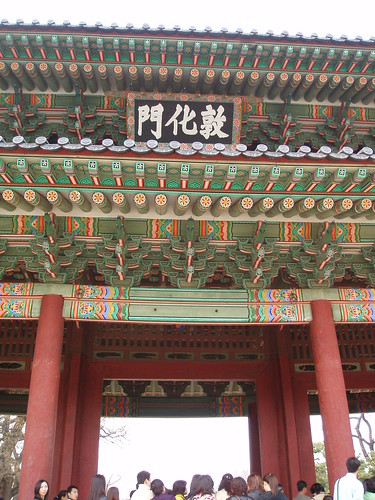
The South Gate of Yasukuni Shrine
As Prime Minister Koizumi keeps officially visiting it at the cost of deteriorating diplomatic relationships with South Korea and, especially, China (see
a BBC article on this),
Yasukuni Shrine is perhaps even known to those outside the Far East.
The whole problem is the fact that war criminals are enshrined here along with other Japanese war deads. I always thought, "Why don't you just separate war criminals from the Shrine?" I hadn't been there but, as a Japanese citizen, I needed to see what the Yasukuni Shrine is like.
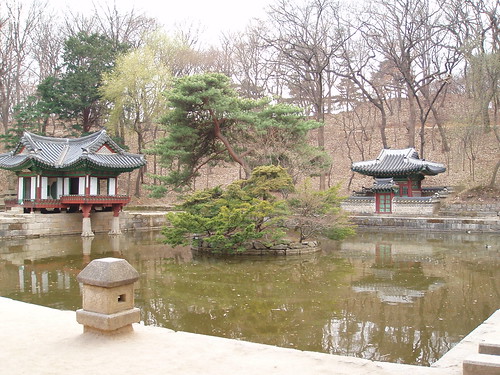
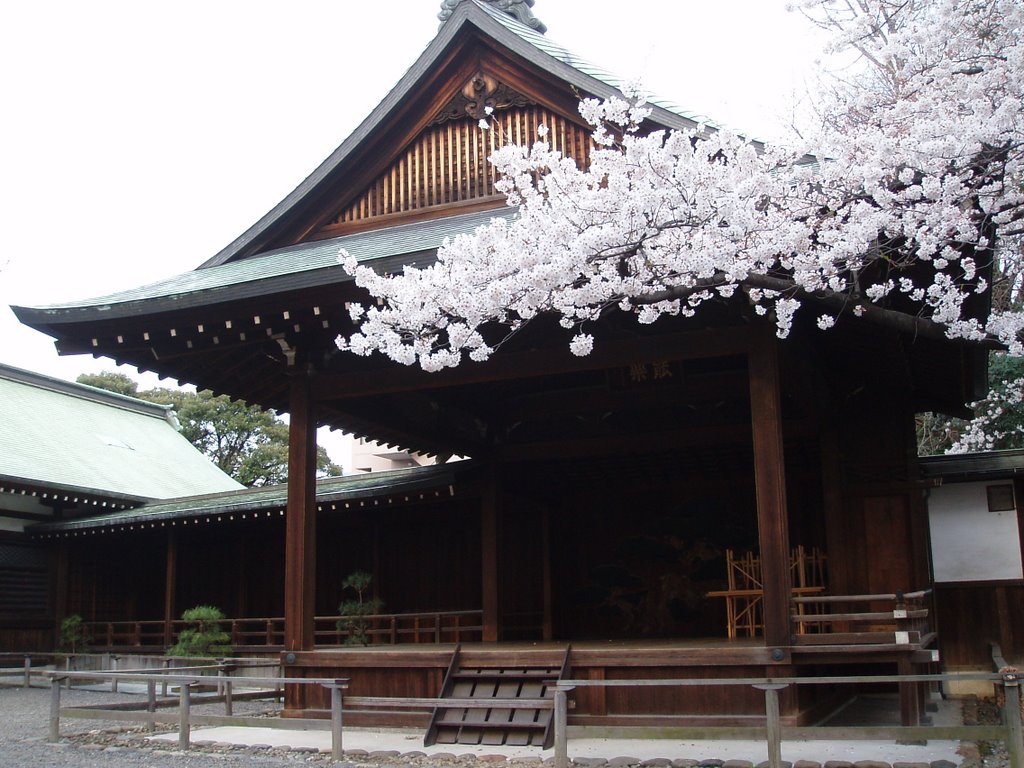
It is a different world from the rest of Tokyo. There are a bunch of cherry blossoms (and some camellia bushes) inside the Shrine. Each tree has a small plastic board indicating that the tree was donated by a certain group of former soldiers who fought the Second World War. There are also a Japanese traditional garden (which claims to be one of the greatest in Japan though it didn't appeal to me at all), an outdoor
nou stage (see the photo below), and the controversial
Yushukan museum.

An outdoor nou stage with a branch of cherry blossom in full bloom in Yasukuni Shrine
The Yushukan museum introduces to its visitors the origin of the Yasukuni Shrine and the war history of Japan in the modern era. In front of the museum stands statues of a horse (for dead horses in wars), a dog (for dead dogs in wars), and Radha Binod Pal, an Indian judge who claimed at Tokyo Tribunal of War Criminals (1946-8) that Japanese war criminals were innocent.
It first emphasizes the fact that worshipping war deads as gods is Japan's long-running tradition of
Shinto (Japan's local religion, different from Buddhism). Those who sacrificed their lives for the sake of the community they belong to were always worshipped as gods protecting the community in ancient Japan.
Then the exhibition goes on to Japan's modern military history. The Civil War (1868-9, known as
Boshin Senso in Japanese), the Sino-Japanese War (1894-5, a war with China over the rule of Korea), the Russo-Japanese War (1904-5, a war with Russia over the rule of Korea and northeastern China), and the "Greater East Asian War" (1941-5, this is how right-wing Japanese people call the Second World War).
The exhibition room for the Russo-Japanese War is enormously exaggerated. There is a panoramic video screen showing a documentary of the war. It excitedly explains how Japan defeated Russia. It also emphasizes that after each winning battle the Japanese army showed "samurai" spirits to Russian soldiers who surrendered, by helping their lives or by allowing them to carry swords to respect their pride, etc.
For the "Greater East Asian War", the exhibition explains why Japan was "forced to" wage a war against the United States. It says, "The United States wanted a war to break out in order to boost its ailing economy. By blocking its trade with Japan, which heavily depended on imports from the U.S., America forced Japan to seek natural resources in East and Southeast Asia..."
I was curious how this exhibition explained the failure of Japan's war efforts. Here's the museum's explanation: Initially, the Japanese forces seized the upper hand over the U.S. After such a success, the army generals advocated for taking a cautious approach to the subsequent war strategy while the navy admirals insisted on further aggressive campaigns. As a compromise, the Battle of Midway (June 1942) was planned in which the Japanese navy tried to lure the U.S. forces into a trap. But the Japanese navy made a sequence of mistakes in this plot and got defeated completely. The tide then turned against Japan, leading to the unconditional surrender in August 1945.
The last exhibition room in the World War II section is devoted to the whole plan of the Mainland Defense Campaign. The Japanese army generals were really serious about fighting back against the invasion of the Allied Forces into Japan's mainland...
The final four exhibition rooms are full of face photos (about 3,000 in total) of "Yasukuni Gods" (ie. war deads enshrined at Yasukuni). "Bridal dolls" which were offered by bereaved families of unmarried young soldiers are also on display.
Overall, the exhibition gives me an impression as a superficial (and flashy) account of the Japanese modern history. It doesn't show any historical documents and the like as evidence for their interpretation of history. It completely lacks the account of how the Japanese military ruled Taiwan, Korea, China, and other parts of Asia-Pacific region. I cannot believe that all the wars undertaken by Japan in the late 19th and the first half of the 20th century were for the sake of Japanese people - they were all initiated by Japan; not a single war was a counter-attack against invading countries. So I didn't feel like worshipping war deads enshrined here because my happiness as a Japanese citizen today doesn't seem owed to their lost lives. I do feel sorry for them losing their lives in wars. But treating them as gods doesn't make sense to me.
To the south of Yasukuni Shrine, located along Chidorigafuchi footpath (famous for its cherry blossom views) is Chidorigafuchi cemetery for War Dead. Buried here are remains of war dead during the Second World War which no one claims. This is where we should pray.
------------------------------------------
Combined with my visit to Seoul (see
this post), I really want to know what happened during the Second World War, what our ancestors did to other Asians. I realized that almost all historians in Japan were trapped in ideology. Left-wing historians believe that Japan was wrong in all aspects, interpreting historical documents only this way. Right-wing people defend the war efforts without learning the history seriously. It's not that we Japanese are lazy to learn the history. We simply have no way of learning the truth due to the laziness of historians. What the fxxk...
As for the Yasukuni Shrine problem, Ichiro Ozawa, a newly elected chairman of the opposition Democratic Party of Japan - I'm writing this on 18th April - argues that enshrining war criminals is wrong because they didn't die in a battle field like other war deads enshrined in the Yasukuni Shrine. He makes sense a lot.


 Omotesando has massively changed during the last couple of years. It is now a "super brand street" where top fashion brands - Dior (see the right photo), Louis Vuitton, Prada, and so forth - all open their fancy-looking stores. Omotesando Hills is the latest addition to the area's drastic metamorphosis.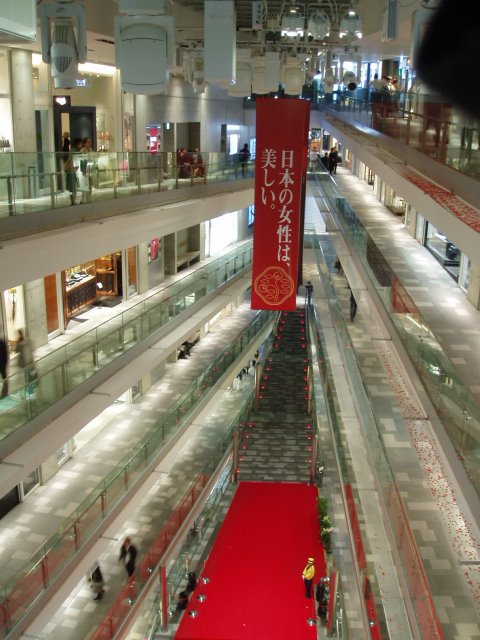




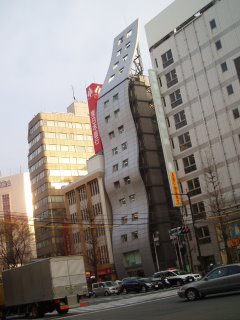 Located diagonally opposite across the crossing is Isetan Men's, a more up-market department store building in which all floors are dedicated to menswear for stylish grown-ups. In addition, opposite to Marui Men across Yasukuni Street towers the Shinjuku Komori Building, a very low-profile but quite unusually shaped building (see left).