Thursday, March 30, 2006

Tokyo 2006 Part VI: Yasukuni Shrine


The South Gate of Yasukuni Shrine

As Prime Minister Koizumi keeps officially visiting it at the cost of deteriorating diplomatic relationships with South Korea and, especially, China (see a BBC article on this), Yasukuni Shrine is perhaps even known to those outside the Far East.

The whole problem is the fact that war criminals are enshrined here along with other Japanese war deads. I always thought, "Why don't you just separate war criminals from the Shrine?" I hadn't been there but, as a Japanese citizen, I needed to see what the Yasukuni Shrine is like.

It is a different world from the rest of Tokyo. There are a bunch of cherry blossoms (and some camellia bushes) inside the Shrine. Each tree has a small plastic board indicating that the tree was donated by a certain group of former soldiers who fought the Second World War. There are also a Japanese traditional garden (which claims to be one of the greatest in Japan though it didn't appeal to me at all), an outdoor nou stage (see the photo below), and the controversial Yushukan museum.
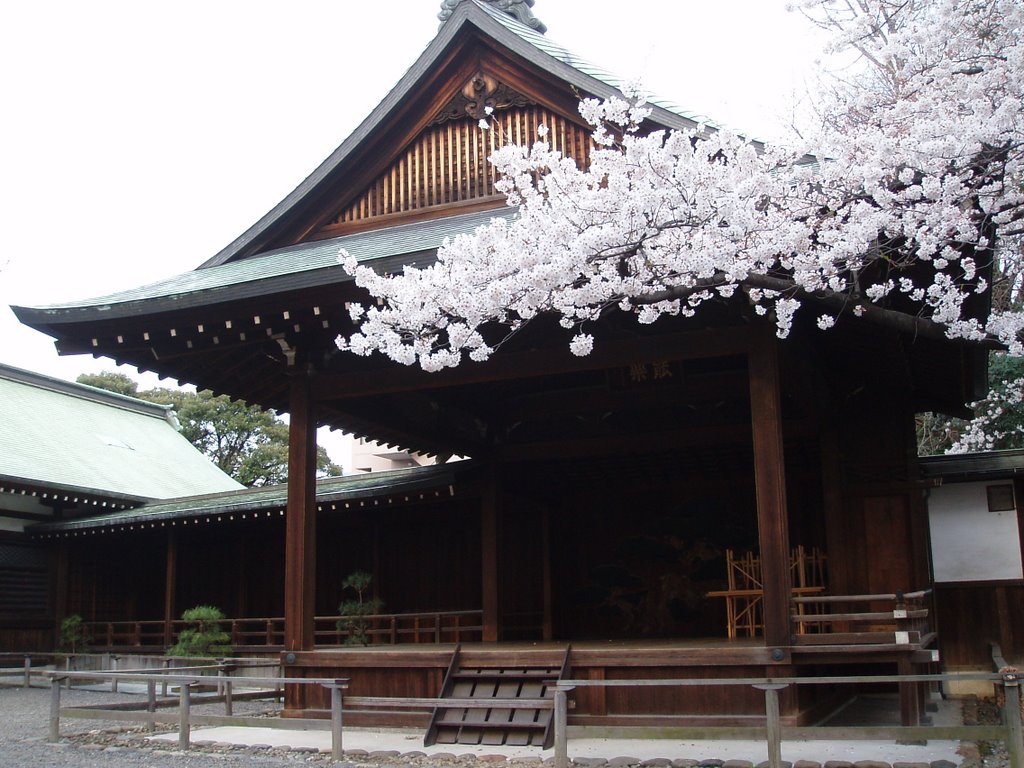

An outdoor nou stage with a branch of cherry blossom in full bloom in Yasukuni Shrine


The Yushukan museum introduces to its visitors the origin of the Yasukuni Shrine and the war history of Japan in the modern era. In front of the museum stands statues of a horse (for dead horses in wars), a dog (for dead dogs in wars), and Radha Binod Pal, an Indian judge who claimed at Tokyo Tribunal of War Criminals (1946-8) that Japanese war criminals were innocent.

It first emphasizes the fact that worshipping war deads as gods is Japan's long-running tradition of Shinto (Japan's local religion, different from Buddhism). Those who sacrificed their lives for the sake of the community they belong to were always worshipped as gods protecting the community in ancient Japan.

Then the exhibition goes on to Japan's modern military history. The Civil War (1868-9, known as Boshin Senso in Japanese), the Sino-Japanese War (1894-5, a war with China over the rule of Korea), the Russo-Japanese War (1904-5, a war with Russia over the rule of Korea and northeastern China), and the "Greater East Asian War" (1941-5, this is how right-wing Japanese people call the Second World War).

The exhibition room for the Russo-Japanese War is enormously exaggerated. There is a panoramic video screen showing a documentary of the war. It excitedly explains how Japan defeated Russia. It also emphasizes that after each winning battle the Japanese army showed "samurai" spirits to Russian soldiers who surrendered, by helping their lives or by allowing them to carry swords to respect their pride, etc.

For the "Greater East Asian War", the exhibition explains why Japan was "forced to" wage a war against the United States. It says, "The United States wanted a war to break out in order to boost its ailing economy. By blocking its trade with Japan, which heavily depended on imports from the U.S., America forced Japan to seek natural resources in East and Southeast Asia..."

I was curious how this exhibition explained the failure of Japan's war efforts. Here's the museum's explanation: Initially, the Japanese forces seized the upper hand over the U.S. After such a success, the army generals advocated for taking a cautious approach to the subsequent war strategy while the navy admirals insisted on further aggressive campaigns. As a compromise, the Battle of Midway (June 1942) was planned in which the Japanese navy tried to lure the U.S. forces into a trap. But the Japanese navy made a sequence of mistakes in this plot and got defeated completely. The tide then turned against Japan, leading to the unconditional surrender in August 1945.

The last exhibition room in the World War II section is devoted to the whole plan of the Mainland Defense Campaign. The Japanese army generals were really serious about fighting back against the invasion of the Allied Forces into Japan's mainland...

The final four exhibition rooms are full of face photos (about 3,000 in total) of "Yasukuni Gods" (ie. war deads enshrined at Yasukuni). "Bridal dolls" which were offered by bereaved families of unmarried young soldiers are also on display.

Overall, the exhibition gives me an impression as a superficial (and flashy) account of the Japanese modern history. It doesn't show any historical documents and the like as evidence for their interpretation of history. It completely lacks the account of how the Japanese military ruled Taiwan, Korea, China, and other parts of Asia-Pacific region. I cannot believe that all the wars undertaken by Japan in the late 19th and the first half of the 20th century were for the sake of Japanese people - they were all initiated by Japan; not a single war was a counter-attack against invading countries. So I didn't feel like worshipping war deads enshrined here because my happiness as a Japanese citizen today doesn't seem owed to their lost lives. I do feel sorry for them losing their lives in wars. But treating them as gods doesn't make sense to me.

To the south of Yasukuni Shrine, located along Chidorigafuchi footpath (famous for its cherry blossom views) is Chidorigafuchi cemetery for War Dead. Buried here are remains of war dead during the Second World War which no one claims. This is where we should pray.

------------------------------------------

Combined with my visit to Seoul (see this post), I really want to know what happened during the Second World War, what our ancestors did to other Asians. I realized that almost all historians in Japan were trapped in ideology. Left-wing historians believe that Japan was wrong in all aspects, interpreting historical documents only this way. Right-wing people defend the war efforts without learning the history seriously. It's not that we Japanese are lazy to learn the history. We simply have no way of learning the truth due to the laziness of historians. What the fxxk...

As for the Yasukuni Shrine problem, Ichiro Ozawa, a newly elected chairman of the opposition Democratic Party of Japan - I'm writing this on 18th April - argues that enshrining war criminals is wrong because they didn't die in a battle field like other war deads enshrined in the Yasukuni Shrine. He makes sense a lot.

Wednesday, March 29, 2006

Tokyo 2006 Part V: Nihonbashi

Nihonbashi - the name of a bridge and its surrounding area - used to be the center of Japan. When the Tokugawa Shogunate began its more than 250-year rule in 1603, it built the five main roads connecting Tokyo (then called Edo) and different regions of Japan from Nihonbashi. In other words, all the roads in Japan headed towards Nihonbashi. During the early 20th century, Nihonbashi was the major business and financial district - there are still the headquarters of Mitsukoshi department store and the Bank of Japan (Japan's central bank). Even today, the official distance from Tokyo to anywhere in Japan is measured from Nihonbashi.

Despite its historical significance, Nihonbashi keeps a low profile today because of this:


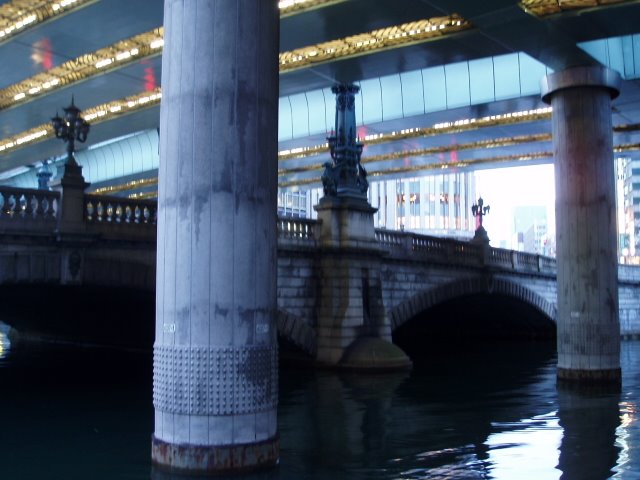
Overshadowing the Nihonbashi bridge is a motorway (Tokyo Metropolitan Expressway) built in 1964, when Tokyo hosted the Olympics. It's probably the ugliest cityscape in the world. Last year Prime Minister Koizumi encouraged the plan to remove the motorway in order to improve the landscape (a news article). Debates are going on about how it is done (and my dad is involved in this debate).

But I realize that the view of the bridge after dark is not that bad:


Of course, it's not beautiful. But this view is probably unique to Nihonbashi. Nowhere around the world you will see this.

Walking to the north from the Nihonbashi Bridge, you will see another spectacle: Mitsui Main Building (the former headquarters of Mitsui business group):


Isn't this marvelous in the sense that a Neoclassical architecture has got a golden kanji (Chinese character) sign that reads from top to bottom (the Japanese and Chinese way of writing a sentence)? It reads Chuou Mitsui Shintaku Ginko (Chuou Mitsui Trust Bank). The building was built by Americans from 1926 to 1929, after the Great Kanto Earthquake destroyed the whole city of Tokyo in 1923. Traditionally Japanese buildings were built of wood. Everytime there was an earthquake followed by fire disaster, all the buildings were gone. That's why you see few old buildings in Tokyo. In the late 19th century and the early 20th century, when Japan began its modernization, many Neoclassical architectures were built of stone. You still see some of them in Nihonbashi and Ginza areas (and in Seoul as well). The Nihonbashi bridge wasn't an exception - it used to be built of wood (and burned down 18 times) and then in 1911 the current form of the stone bridge was constructed.

In this sense, it's understandable that Japanese people at that time thought Western architecture was advanced and a model to follow. Exploring Nihonbashi makes you think of that era in Japan, which was unthinkable to me when my parents often took me as a primary school kid to Nihonbashi in order to shop at the Mitsukoshi department store (and I liked its toy store section).

Tokyo 2006 Part IV: Kamuro eyeglass workshop

Bought a pair of glasses at Kamuro Megane Kobou (Kamuro Eyeglass Workshop) in Ginza. This shop, recommended by my hairstylist Yumiko-san, has got a wide range of stylish eyeglass frames. Each shop attendant is an eyeglass craftsman, so you can also order a tailor-made frame here.

This is the first time to wear a pair of glasses. I had absolutely no idea what kind of eyeglass frame would fit me. A shop attendant suggested several frames. When I tried on one by one, he took a digital photo shot so I could compare at most four faces of mine with different pairs of glasses on a computer screen. This helped me a lot, and about half an hour later I found a pair of glasses I liked. I gave him a prescription obtained from an eye doctor yesterday, and he cut lenses in the workshop next to the shop within the next 15 minutes. How efficient the whole process was. I was impressed.

Tuesday, March 28, 2006

Tokyo 2006 Part III: Shinjuku 5 - Men's shopping area


Shinjuku 5-chome crossing, a block north from Shinjuku 3-chome Station (Tokyo Metro Marunouchi Line and Toei Chikatetsu Shinjuku Line), is a must-visit for fashion-conscious men, which no travel guidebook would mention. At the north-east corner stands Marui Men (or spelled OIMEN as O can read "maru" - a Japanese term for a circle), a very rare building in which all floors are devoted to stylish young menswear (recommended brands are Rupert (2nd flr), PPFM (3rd flr), Tornade Mart (3rd flr), A.S.M. (4th flr), and Scoopman (5th flr). (It's unfortunate that only Rupert has its official website. If any of these brands sets up a website and sells their clothes online in English, I believe they will earn a lot of money.) If you think I often wear stylish clothes, it owes this department store a lot.

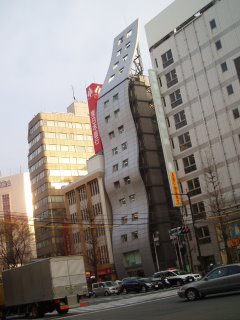
Located diagonally opposite across the crossing is Isetan Men's, a more up-market department store building in which all floors are dedicated to menswear for stylish grown-ups. In addition, opposite to Marui Men across Yasukuni Street towers the Shinjuku Komori Building, a very low-profile but quite unusually shaped building (see left).
Actually, around this area you will see quite a few stylish young men sporting interesting pieces of clothes. On the other hand, those men in a suit are all dull-looking. It may be because those at the workplace cannot wear stylish clothes because it gives a signal to their boss or clients that they are not serious at work... Or simply because Japanese men don't look good in a suit anyway.

Tokyo 2006 Part II: Japanese banks unfriendly to foreign tourists

After living in London for more than three years, visiting Tokyo is almost like a foreign trip. I begin to understand how foreigners will find Tokyo. Although many things are convenient here, the coverage of that convenience seems limited to Japanese people living in Japan.

You can't use your credit card issued by foreign banks to make a cash advance at ATM machines of Mizuho Bank, one of the world's largest banks. It wasn't because the ATM machines were located in the suburbs of Tokyo. It was in Shibuya, one of the busiest areas in Tokyo. Can you believe this? A bank staff recommended me to use Citibank, which unsurprisingly allowed me to make a cash advance with my Mastercard issued by Natwest Bank in UK.

The situation seems the same for other major Japanese banks. According to japan-guide.com, an exception is post office ATMs, which are linked to Citibank. If you visit Tokyo, it may be a good idea to learn where Citibank branches and post offices are in Tokyo.

Tokyo 2006 part I: Pay-as-you-go mobile phones in Japan

The first thing I did in Tokyo was to get a mobile phone. I can use my Vodafone UK handset, but both making and receiving calls will cost more than 1 to 2 pounds per minute. For a two-week stay, it's better to buy a pay-as-you-go mobile here. (And I forgot bringing a battery charger.)

So I did a bit of research on Japanese mobile phone markets. Here's the report.

Pay-as-you-go (called "pre-paid" here) mobile phones are very unpopular in Japan. NTT Docomo, the largest carrier in Japan, stopped accepting new pay-as-you-go contracts on 31st March 2005. It says that the number of pay-as-you-go users has declined since its peak in March 2001 from 21 million to 8 million. AU, the second largest operator, still provides the service though, judging from their uninspiring list of mobile handsets for pay-as-you-go services, it's not really keen on attracting new customers.

Vodafone, which has decided to withdraw from the Japanese market, turns out to be the best in pay-as-you-go services (and maybe that reflects why Vodafone failed in the Japanese market). The call rate is 60 yen per minute (approximately 30 pence or 50 cents) while AU's rate is 100 yen (50 pence or 80 cents) per minute. They just released a new, relatively stylish handset which costs 7140 yen (35 pounds or 51 dollars).

You can top up your mobile phone airtime by purchasing a "prepaid card" (3,000 yen or 5,000 yen) at convenience stores or Vodafone shops or by credit card online. The topped up fee will expire in 60 days. To keep your phone number, you need to top up at least 3,000 yen before 240 days passes. Otherwise, you will lose your number. Once you lose your number, you need to pay about 3,000 yen to reactivate your handset and your number will be different.

You will be required to submit a piece of identification documentation such as a driving license and a passport to purchase a pay-as-you-go mobile phone, which is nothing surprising to UK customers. But this requirement has just been introduced in Japan since scam using pay-as-you-go phones became a social problem last year).

Monday, March 27, 2006

Seoul 2006 - Part IV: Attractions in Seoul

(Continued from Seoul 2006 - Part III: Japan and Korea in the past.)

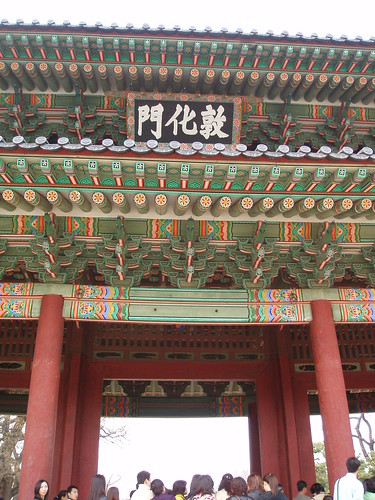
Donhwamun, the main gate of Changdeokgung Palace


The biggest attraction in Seoul is no doubt Korean cuisine - Korean barbecue restaurants are everywhere. But there are other things to do in Seoul as well.

First, Korean palaces. I visited two of them: Changdeokgung Palace (a UNESCO World Heritage site) and Toksugung Palace. It was unfortunate that Biwon or the Secret Garden, the back garden of the Changdeokgung palace, was closed to the public until May.


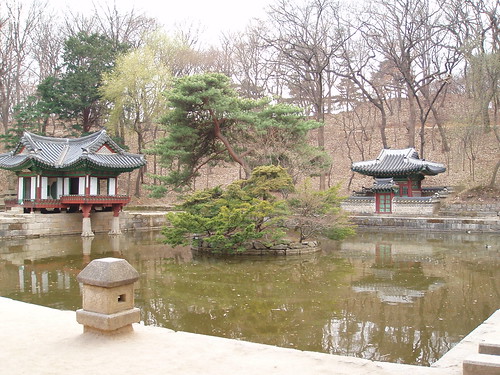
Buyongji pond, Changdeokgung Palace
Buyongji pond, Changdeokgung Palace - the only part of Biwon garden open to the public when I visited the palace. The view that pine trees grow in the middle of a square pond is (perhaps) rather unusual in Far East.


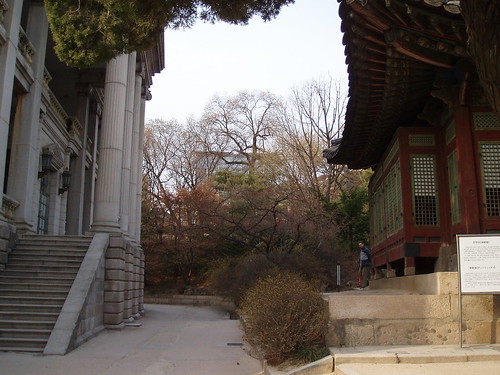
Toksugung Palace, on the other hand, is quite intriguing in the sense that one building (Jeonggwanheon Hall) is half-Korean and half-Western and that another (Sokchon-jeon) is totally Western (of Greek-Roman style).

Jeonggwanheon Hall, Deoksugung Palace
Jeonggwanheon Hall


Korea meets the West
Sokchon-jeon (on the left) stands right next to a building of Korean tradition in Deoksugung Palace.

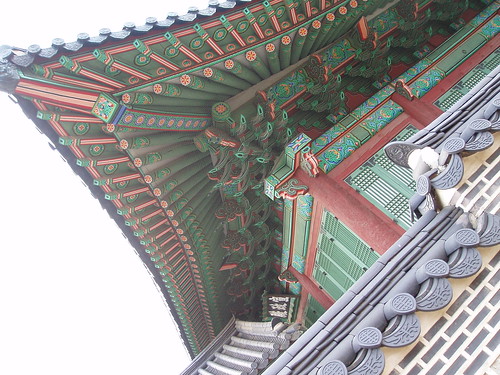
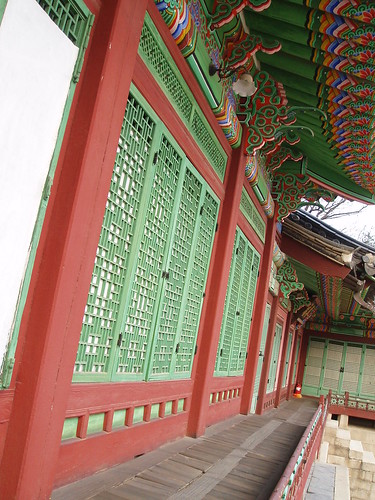
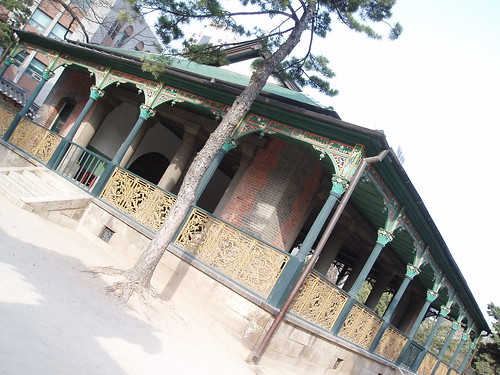
Overall, Korean kings used a lot of green colour to paint palace buildings, which I think is distinctive in the Far East region.

A roof edge of Injeongjeon, Changdeokgung Palace
A roof edge of (probably) Injeongjeon, Changdeokgung Palace


A veranda of Daejojeon, Changdeokgung Palace


I found it interesting for Seoul to have both Tokyo-like aspects (skyscrapers, billions of showy signboards, etc.) and Kyoto-ish characteristics (preserved old buildings due to the fact that it has been the capital of Korea since long time ago).

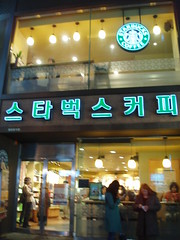
Another attraction in Seoul is Insa-dong Street. It has got a distinctive atmosphere created by a black cobblestone street lined with both traditional buildings as well as contemporary low-rise ones such as the Ssamjikil shopping mall (No, don't imagine an American-style shopping mall. It's much, much more stylish than that. A shame I forgot taking photos...). Some shops sell traditional Korean artcrafts while there are small contemporary art galleries as well. Even Starbucks is forced to match the landscape by having the one-and-only Hanguel-lettered "Starbucks" sign.

Starbucks on Insa-dong StreetStarbucks Insa-dong.

Another interesting part of Seoul is Hondae, an area around Hongik University - South Korea's best art university. So hip places - bars, clubs, and interesting shops at one of which I bought a cute alarm clock - abound here. I only managed to visit this part of Seoul after dark for just a couple of hours by myself... I should have come here with someone else.

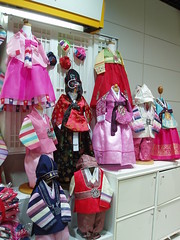
"Fashion buildings" in the Dongdaemun area are something unique to Seoul. These high-rise department stores - Migliore, Doota, and Hello apM are the three big names with Doota the most stylish - house 1500 to 2000 shop tenants most of which are casualwear boutiques. What's interesting is that among all the other busy floors devoted to young fashion is one quiet floor for Korean traditional dresses for girls. Sooyoung told me that on New Year's Day she wears such a traditional dress and bows to her parents for showing appreciation - Korea is a Confucian country.

Korean traditional dresses on sale in Doota fashion buildingKorean traditional dresses for baby girls(?).

What's also unbelievable is that they are open until 5 AM. Even boutiques or any department stores in Tokyo close before midnight. I visited these buildings after midnight. A large volume of Korean pop music with good sound quality was pumped out at the entrance. Inside the buildings were quite a few young Korean people (some looked teens). I wonder how they go home after the metro and bus services are over around midnight - no night buses in Seoul. But taxi fares are cheap in Seoul - it begins with 1900 won (less than 1 pound or 1.5 dollars) for the fist 2 kilometers.

Finally, Cheong Gye Cheon, a small stream cutting across Central Seoul. It used to be covered by the highway. But the current mayor of Seoul decided to scrap the highway and to restore the stream. The restoration work just completed last year. I saw quite a few Koreans, especially families with children, enjoying themselves by walking along the stream. This is suggestive to Tokyo, where there is a similar plan of getting rid of highways overshadowing Nihonbashi, a historical bridge.

As I stayed at Morishita-san's place on the second night in Seoul, I managed to get a glimpse of what life in Seoul is like. I followed him and his wife when they went to a supermarket. Supermarkets in Seoul are again different from those in Tokyo. There are not many large supermarkets in this city. Lotte Mart and E-Mart - the only (?) two large supermarkets in Central Seoul - are pretty much of Anglo-Saxon type with an exception of quite a few "campaign girls" sent by product companies. They wear short skirts and white boots that remind me of "super loose socks" (fashionable only briefly among Japanese high school girls about a decade ago). It sounds like Japanese-style, but we don't have such girls in supermarkets. (They inhabit streets in Tokyo.) People in Seoul come here once a week to buy everything they need for the coming week, which is different from the Japanese style of household shopping - Japanese housewives like to go to supermarkets almost everyday to buy ingredients for tonight's dinner etc. Finally, products on sale often come with a completely irrelevant extra - cereals coupled with towels, for example. It doesn't seem to be part of sales promotion. It's probably just that supermarkets attach unsold stuff randomly to newly stocked products, or so guessed Morishita-san.

Surprisingly, information on Seoul in English is very limited on the web. True that English speakers find it difficult to explore this city as everything is written in Hanguel letters (and sometimes in Chinese characters, which helps me a lot). But I got a sense that exploring this Far Eastern city further will be intriguing. Two days and a half isn't enough! I want to visit Seoul again.

Many, many thanks go to Sooyoung and Morishita-san.

Seoul 2006 - Part III: Japan and Korea in the past

(Continued from Seoul 2006 - Part II: Korean cuisine.)


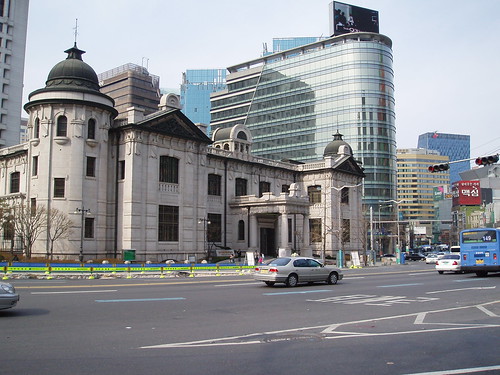
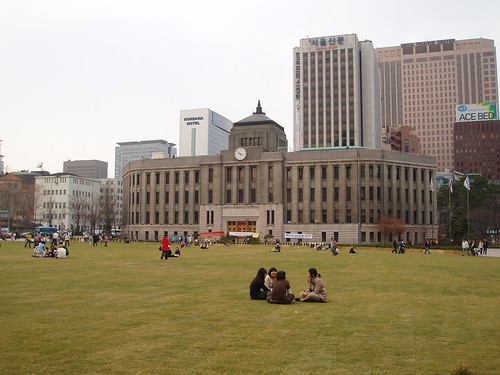
(From above, Seoul Railway Station (now disused), the Bank of Korea Museum, and Seoul City Hall)

The third thing that I learned during this trip was what Japan did to Korea in the past. As you might know, history education in Japan is terrible in the sense that we do not learn properly about what our ancestors did to Korea, China, and Southeast Asia. It was a weird experience to see some old modern buildings in Seoul were built by the Japanese during colonial time (see photos above).

There are a few former palaces in Seoul, but most buildings inside these palaces date back to, at most, the 17th century because the Japanese army burned them all down in the late 16th century... We do learn Japan invaded Korea at that time but I didn't know the Japanese samurai soldiers reached as far as Seoul... Koreans all know these things. I think I need to learn this kind of stuff properly, but I'm not sure if Japanese historians have properly studied it. (Unlike the EU, where historians across countries cooperate and produce the common history textbook, there has been no communication between Japanese and Korean/Chinese scholars in history, if I understand correctly.)

(Continued to Seoul 2006 - Part IV: Attractions in Seoul)

Seoul 2006 - Part II: Korean cuisine

(Continued from Seoul 2006 - Part I: Cityscape of Seoul)

Secondly, Korean cuisine. Its ingredients are more or less similar to those of Japanese cuisine, but they cook them quite differently. On the first evening in Seoul, Sooyoung, my Korean friend in Seoul, took me to a restaurant in the Gangnam area. It was full of surprises. Doenjang-jjigae, soybean paste stew, looks like Japanese miso soup, but smells of natto, fermented soybeans unique to Japanese cuisine. This confused me a lot. These two - miso soup and natto - are different things to me, but they are part of the same dish for Koreans. Sooyoung was surprised to know that I didn't know this national stew for Koreans. How little I knew about Korea. I also had mackerel-kimchi stew. Again an impossible combination in Japanese cuisine (Kimchi, Korean spicy pickled salad, is popular in Japan as well, but Japanese people eat it only with barbecued meat, never with fish.

The list still goes on. Koreans love beef and pork grilled on an indoor barbecue. Japanese love it as well though we usually broil raw beef (not so often pork) while Koreans more often than not barbecue marinated beef and pork. But the crucial difference is that Koreans dip grilled beef or pork into kinako powder (ground soybean). Kinako in Japan is used for eating mochi - sticky rice cake - especially on New Year's holidays or for sweets. Its combination with grilled meat is again an impossible one in Japanese cuisine. On the other hand, it's an impossible mix for Koreans to eat boiled rice with barbecued meat, which Japanese love to do. Koreans wait for rice (or naengmyeon - cold noodles in soup) until they finish eating meat. They also use pears extensively for cooking - to make marinating sauce for barbecue or to add slices to naengmyeon and yukhoe (raw beef strips). Japanese only eat them as dessert.

The similarity-cum-difference is not limited to ingredients. Koreans use a large pair of scissors to cut grilled meat on a barbecue, which initially made me feel uncomfortable - the pair of scissors they use looks like the one we Japanese use for cutting cloth or gardening. When we do an indoor barbecue, beef is already sliced to a mouthful size. Koreans put a large chunk of meat on a barbecue and then cut it into pieces after grilled.

Korean cuisine is quite diverse, by the way. I only knew the tip of iceberg. My favorite turned out to be dwaeji kalbi (marinated pork ribs on a barbecue) and jumullok (marinated loin beef that is unstiffened by hands). Plus, lo and behold, it's value for money. Dwaeji kalbi costs around 8000 Korean wons (4 pounds or 6.5 dollars) while jumullok at Seogyangchip, a rather expensive (by Korean standards) restaurant in the Mapo district, costs 30000 Korean wons (15 pounds or 25 dollars). These prices include a wide range of side dishes - different kinds of kimchis, garlic cloves for grilling, lettuce leaves for rolling barbecued meat, and, in the case of Seogyangchip, naengmyeon noodle soup. This is a Korean way of serving dishes. If you order one main dish (or two), you'll get a wide range of side dishes as well - what side dishes come along differ restaurant by restaurant. (Continued to Seoul 2006 - Part III: Japan and Korea in the past.)

Seoul 2006 - Part I: Cityscape of Seoul


I visited Seoul, the capital city of South Korea, for the first time from the evening of 24th through the morning of 28th March 2006. It was in many senses educational. Which means how little I knew about this neighbouring country to Japan.

The first thing that struck me was how similar the cityscape of Seoul is to that of Tokyo. But people there, of course, speak Korean, not Japanese, and use Hangeul - Korean alphabets, which are totally different from Japanese alphabets (hiragana and katakana) - for all signboards. So all I saw looked what I'd seen before in Tokyo, which was not the case. This dazzled me a lot. To be fair, it's probably partly because I came directly from London, not from Tokyo. My images of Tokyo were not quite accurate as it was one year and three months ago when I last visited Japan's capital city. Still, the fact that this was my first time experience of visiting a rich country that doesn't use European or Japanese language probably enhanced my confusion. (Continued to Seoul 2006 Part II: Korean cuisine.)

Thursday, March 16, 2006

Economics of Terrorism

On 22nd, 23rd, and 24th February, Alan Krueger, known to economists as a leading labour economist coming up with innovative (and sometimes controversial) empirical research strategies or known to the general public as a New York Times columnist (the list of his columns), came to LSE and gave this year's Lionel Robbins Memorial Lectures. The topic was - lo and behold - terrorism.

Professor Krueger began his lecture by explaining why economics can investigate terrorism. His answer: it's an application of occupational choice theory. :)

The recurring theme of the three-day lecture series was that poverty DOES NOT matter to terrorism. After the 9/11, the world's political figures all say that one of the important strategies to combat international terrorism is to tackle poverty. But there is NO evidence for supporting such a claim.

The first lecture focuses on micro evidence for causes of terrorism. First, public opinion polls conducted in Islamic countries suggest that poor people are just as likely to justify terrorism as rich people are. If anything, MORE educated people tend to support terrorist acts. Surveys of actual terrorists reveal that they are richer and more educated than the general public, except for the IRA in which terrorists were poor and uneducated. Prof. Krueger provides possible explanations for this anomaly: for Northern Ireland, rich people could leave for the United States easily. Also the Northern Ireland case is more like a civil war, for which recent economic analysis shows that poverty matters.

A possible theoretical explanation for why richer and more educated people become terrorists is as follows. From the supply side, well-off people are drawn to extreme views because information acquisition cost is low. Poor people are unable to learn anything. From the demand side, a terrorist group wants to recruit smart people because it requires high-skilled labour to conduct terrorism and the cost of failure is substantial (if members are arrested, the group as a whole will not survive).

It's not that lack of education matters. It is the content of education that matters.

The second lecture focuses on macro evidence for causes of terrorism. Using the US government data (the reliability of which, though, is severely limited as pointed out in this New York Times column in 2004), the countries of origin of international terrorism are by no means poor while the countries of target tend to be rich. What's correlated with countries of origin is the lack of civil liberty. Investigating nationalities of foreign insurgents in Iraq captured during April to October 2005 yields similar results. They are not coming from poor countries but from countries without civil rights.

The last lecture then focuses on consequences of terrorism. There are two views on economic consequences of terrorism: terrorism having a large effect versus terrorism having a small effect. Evidence seems to suggest that terrorism has a significant impact on the economy if it is repeated for a long period while it has a negligible effect if it is temporary. Abadie and Gardeazabal (2003) convincingly show that terrorism in the Basque region of Spain reduced the region's GDP by 10 percent. Another study (I forgot the author's name - if you know this study, let me know), on the other hand, shows that terrorist attacks against listed companies in the U.S. during 1975 to 2002 (excluding the 9/11 as an attack against airline companies) reduced the stock values of targeted companies just by 0.064 percent of the US GDP per year.

I couldn't follow the lecture part on psychological consequence of terrorism...

If you're interested, here's the list of papers on which the lectures were based upon (on Prof. Krueger's website).

Wednesday, March 15, 2006

Life Expectancy

Lent term is about to end. I learned several things during this term. But I'm sure I'm going to forget them in a month or so. So let me write them down here. The first instalment is about life expectancy. If you spot any inaccurate descriptions below, let me know by leaving a comment.

1. Life expectancy is visualized as follows. Take age on the x-axis and take the proportion of survivors to a certain age on the y-axis. From the data on death rates for each age cohort, you can plot the proportion of survivors for each age. The area surrounded by the x and y axes and the plot curve is life expectancy at birth. (Added on 16th March: Of course, one cannot estimate life expectancy for each cohort because then you need to track this cohort until the last person dies. For practicality, demographers assume that each cohort will face the same survival probability as the one currently faced by older cohorts. Special thanks to Bessho-san (his Japanese blog), who emailed me on this point.)

2. In the demography literature, various ways to decompose change in life expectancy between two points in time have been developed during the past 25 years. But the most useful is still one of the first proposals: Arriaga, E.E. (1984). "Measuring and explaining the change in life expectancies", Demography, 21, pp.83-96.

3. Crude death rates are sensitive to age composition of the population. Even if the death rates for every age group doesn't change, the crude death rate of the population goes up if the proportion of old people to the population goes up. A solution to this is standardized death rates, in which the population death rate is calculated with the age structure fixed. But then the arbitrariness of the choice of a "standard" age composition is a problem.

4. A good reference of these issues is Demography: Measuring and Modeling Population Processes, by Samuel H. Preston, Patrick Heuveline, and Michel Guillot (Blackwell Publishing, 2001).

Tuesday, March 14, 2006

Drum & bass meets live drums

This week BBC 1Xtra, a digital radio station specializing in urban music, features XTRABASS06 - everyday at midnight it broadcasts drum & bass club nights live for two hours. The first 1 hour of last night's show was awesome. L Double, a drum & bass DJ who has a regular show on 1Xtra, plays his dj set with Jungle Drummer, probably the world's only drummer playing drum & bass. Drum & bass is a digital music - all sound is created by computers. But when it meets live drum sound, voila, the vibe is totally different. Check this out! (Skip the first few minutes and ignore the last 50 minutes or so where Scratch Perverts play their lost-in-focus mediocre DJ set)

By the way, I went to Paris last week for just two days. Below you can see photos and so forth.

Wednesday, March 08, 2006

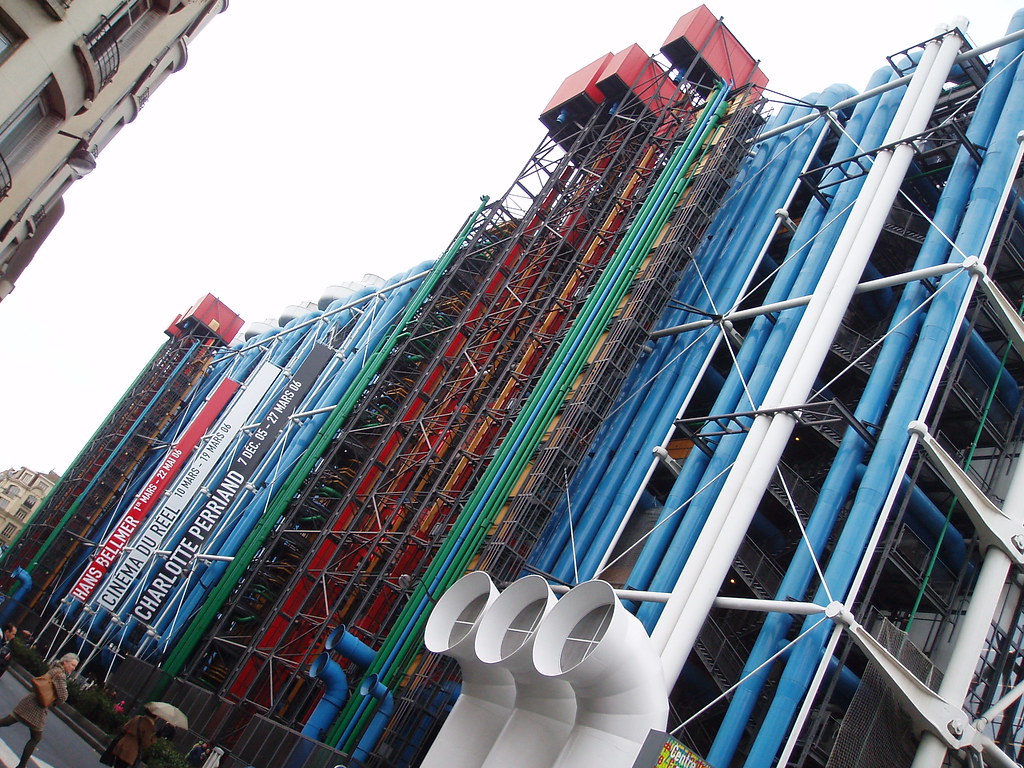
Centre Pompidou, the back facade

Centre Pompidou, the back facade
Designed by Renzo Piano and Richard Rogers in 1977. Paris's counterpart of Tate Modern. But it doesn't just house a contemporary art museum but also a library, performance spaces, and a cinema - a revolutionary concept for an modern art museum. To ensure a vast space inside, air-conditiong, pipes, lifts, and escalators are all attached outside the building. As is often the case with contemporary art museums, the building itself is more fascinating than what it houses inside. Its top-floor cafe/restaurant Georges is superb in terms of its decor and foods except for the fact that the waiter sneaked a bottle of Vittel into my bill, which raised the total amount by 6 euro.

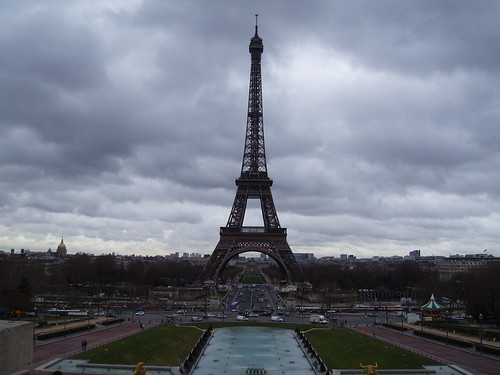
Tour Eiffel

Tour Eiffel
Again this is what every tourist takes a photo of. But I had to. Viewed from the hill of Palais de Chaillot (just a few second walk from Trocadero metro station), the Eiffel Tower, combined with greenery of Parc du Champ de Mars at the back and Palais de Chaillot in the front, taught me the pleasure of watching a geometrically symmetric construction. Some youngsters were playing skateboards and inline skates on the vast square of Palais de Chaillot with a fantastic view of the Eiffel Tower, probably the world's most luxurious place for skateboarding and inline-skating.

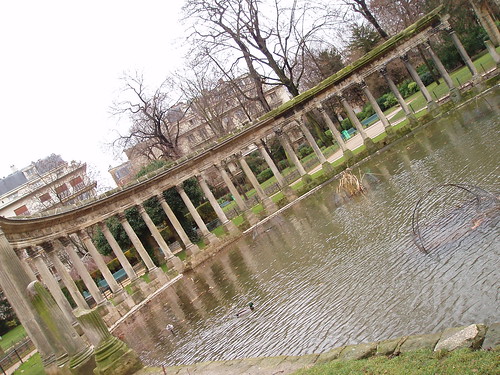
Parc Monceau

Parc Monceau
Normal tourists wouldn't visit this park in the 8th arrondissement. But when I browsed through Chikyu-no-Arukikata Paris (the Japanese counterpart of Lonely Planet with far more photos and far less sentences), a photo of Parc Monceau caught my eyes: a pond surrounded by a Corinthian colonnade. It is a tranquil, but strange park: weird follies are scattered around the park.

Tuesday, March 07, 2006

Colette

In addition to being caught up in a metro train carriage just like in London, I was also caught up in rain just like in London. Even worse, rain in Paris never stops, unlike London. I forgot bringing an umbrella. I tried to run away into the Louvre, only to find that Tuesday is a holiday for this massive museum. I looked into Time Out Guide Paris and found Paris has got what they call "concept stores", represented by Colette. Thankfully, the Colette store is close to the Louvre.

It's an interesting store. They sell anything as long as it's cool - from iPod accessories to fashionable digital cameras, from cool music CDs to art books on the ground floor. Upstairs they have trendy clothes on sale - I found a very fancy jacket for a man (but with the price tag of 800 euro) - as well as some art exhibition featuring UK (The Evening Standard's news headline posters at newsstands fill up the entire wall... What can be art changes a lot across the Channel).

Here I found an interesting art magazine: ArtIt. This is a Japanese art magazine written both in Japanese and in English. This is what I've been looking for. Japanese words and expressions used to talk about art are often very difficult to translate into English. This magazine tries to overcome this. Even though this is nothing to do with Paris, I had to buy this magazine.

While strolling around Paris, I found quite a few small shops selling and displaying Japanese stuff. Japanese restaurants also abound. I saw an ad poster of a manga school. I felt the fact that Japan is cool is already obvious in Paris. Parisians seem to now try to take it to a next level by treating Japan as one of many cool things they can exploit. In this sense, Paris goes ahead of London.

Paris Metro

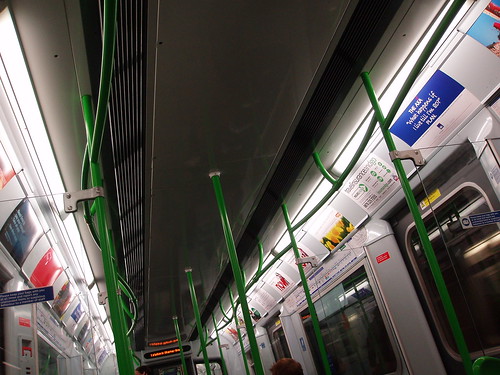
Compared to London Underground, Paris metro is much, much more pleasant to use. Although I was stuck in a Ligna 1 train carriage not moving for 15 mintues - I think I was very unfortunate; why on earth did I need to go through this typical London experience even in Paris? - the design of train carriages and stations looked better. Paris metro trains do not decorate too much. Inside the carriage everything is basically silver. Outside the carriage they use pale colors to decorate. London Underground trains are painted in vivid colors like red and blue outside and for grab bars inside, which sometimes causes me a headache. Station platforms are clean and well-designed - some of which I even took a photo of. The space inside carriages is wider, the noise kept to a minimum. It's much closer to Tokyo's subway, but even better because Paris metro keeps advertisement to a minimum while Tokyo's is extensively decorated with ad posters.

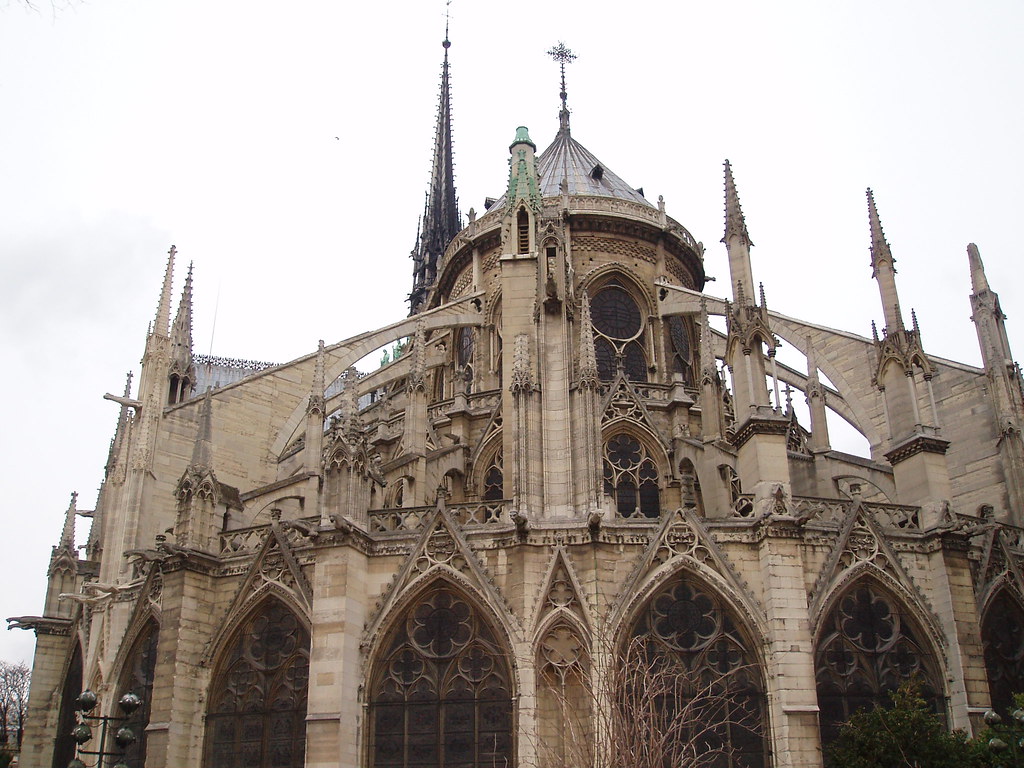
Cathedrale Notre-Dame de Paris, the east side

Cathedrale Notre-Dame de Paris, the east side
I personally like the east side most. I didn't plan to visit the Notre-Dame Cathedral. But when I saw this east side from a distance when I walked on the bridge over the Seine (Pont de la Tournelle, the bridge between the Ile St-Louis and Latin Quarter), I immediately changed my mind.

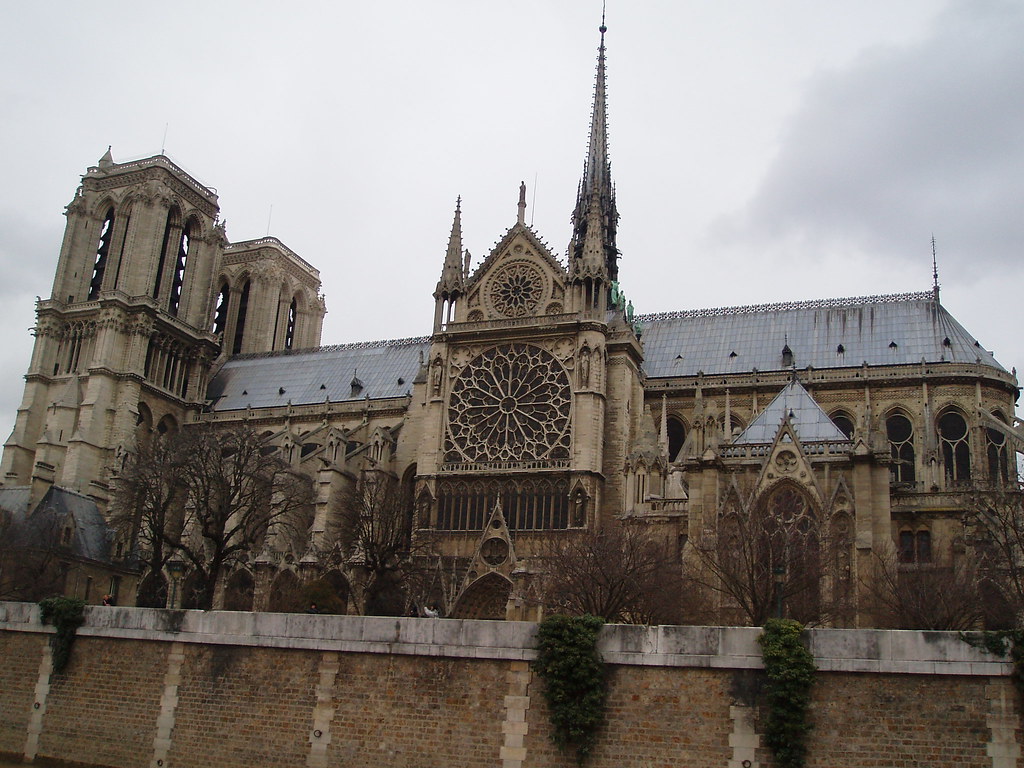
Cathedrale Notre-Dame de Paris, the north side

Cathedrale Notre-Dame de Paris, the north side

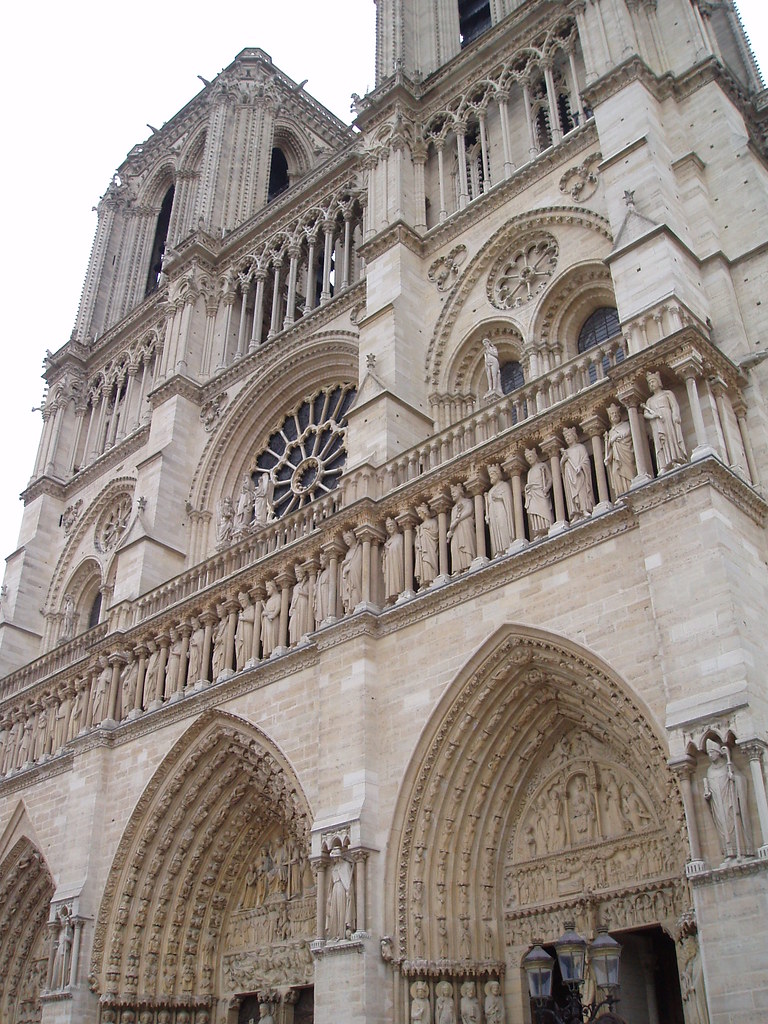
Cathedrale Notre-Dame de Paris, the west front

Cathedrale Notre-Dame de Paris, the west front
I admit I did a bad job here. I tried to take a bit different photograph because the west front of the Notre-Dame Cathedral is what every tourist takes photo of. But what's beautiful about this side of the Cathedral is its symmetric facade. Taking its photo at an angle is a terrible idea...

Cathedrale Notre-Dame de Paris, the south side

Cathedrale Notre-Dame de Paris, the south side

Le Petit Marche

9 rue de Bearn - 75003 (Tel. 01 42 72 06 67)

A restaurant just two blocks north of Place des Vosges in Le Marais. With less than 20 euro, you'll have a fantastic lunch set - proper French with a hint of Southeast Asian flavour. Presentation is also artistic. If only I could speak French... (No waiter/waitress speaks English here and no English menu.)

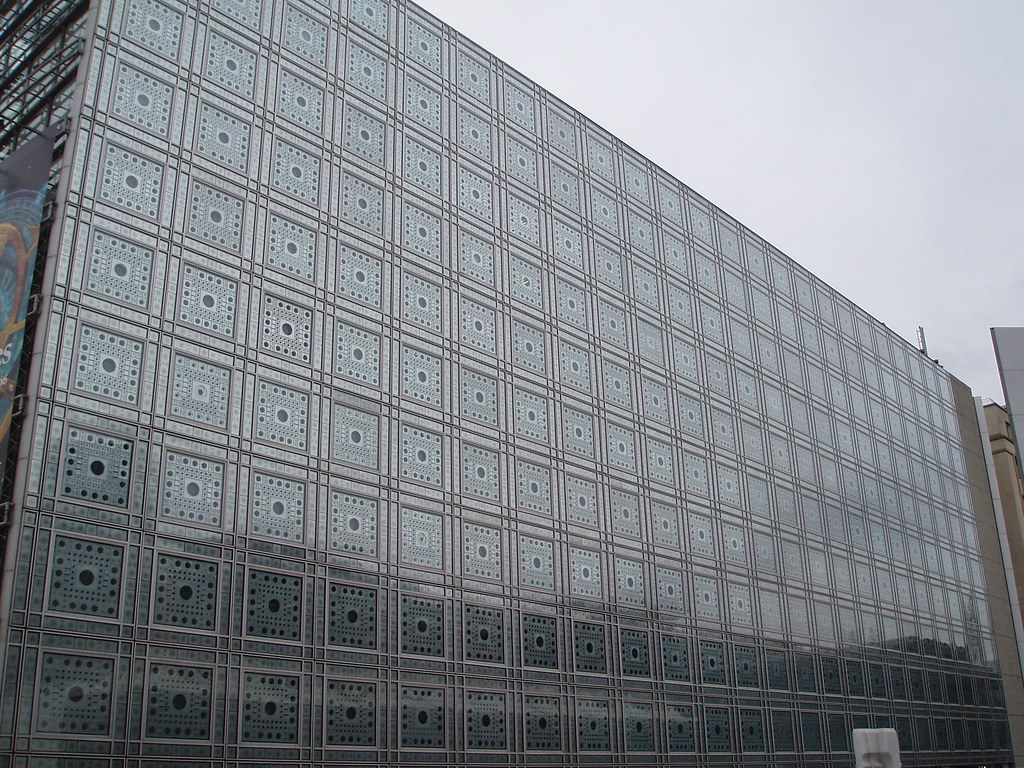
Institut du Monde Arabe

Institut du Monde Arabe
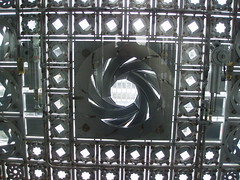
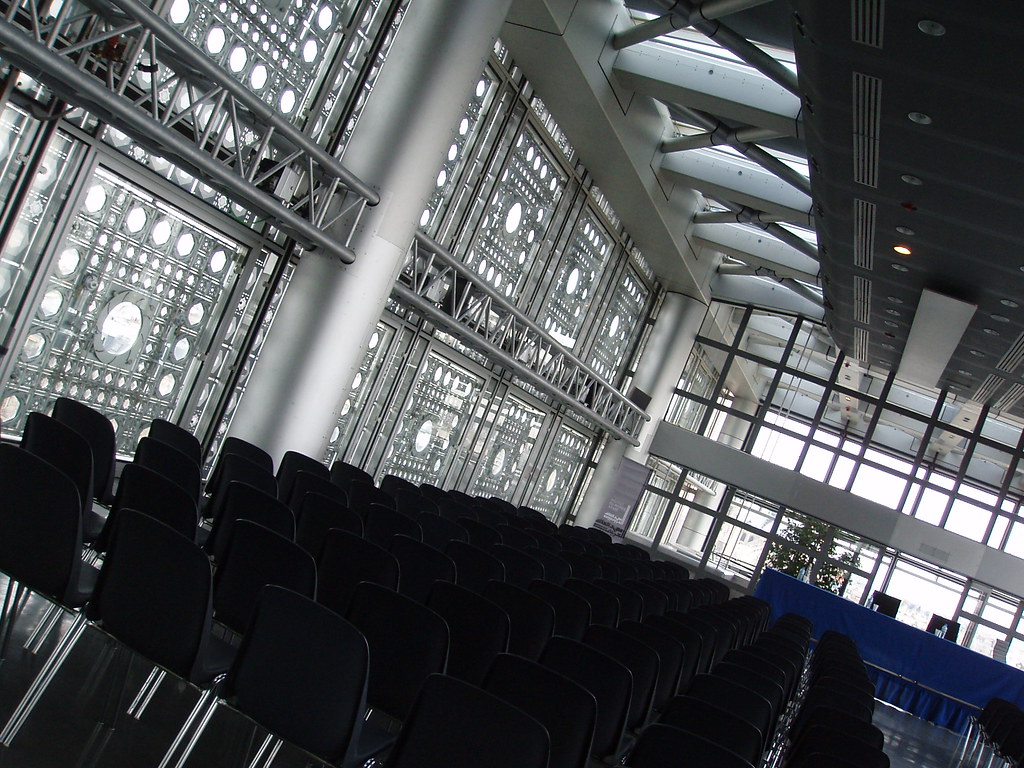
Designed by Jean Nouvel in the 1980s. Windows are decorated with camera apertures, looking like an Islamic art pattern. If you go up to the top floor, you can see these windows from inside:
A window viewed from inside Institut de Monde Arabe
The top floor has a conference room with these windows on one side. I want to organize a conference here: it's cool.
A conference room in Institut de Monde Arabe

La Grande Arche de La Defense

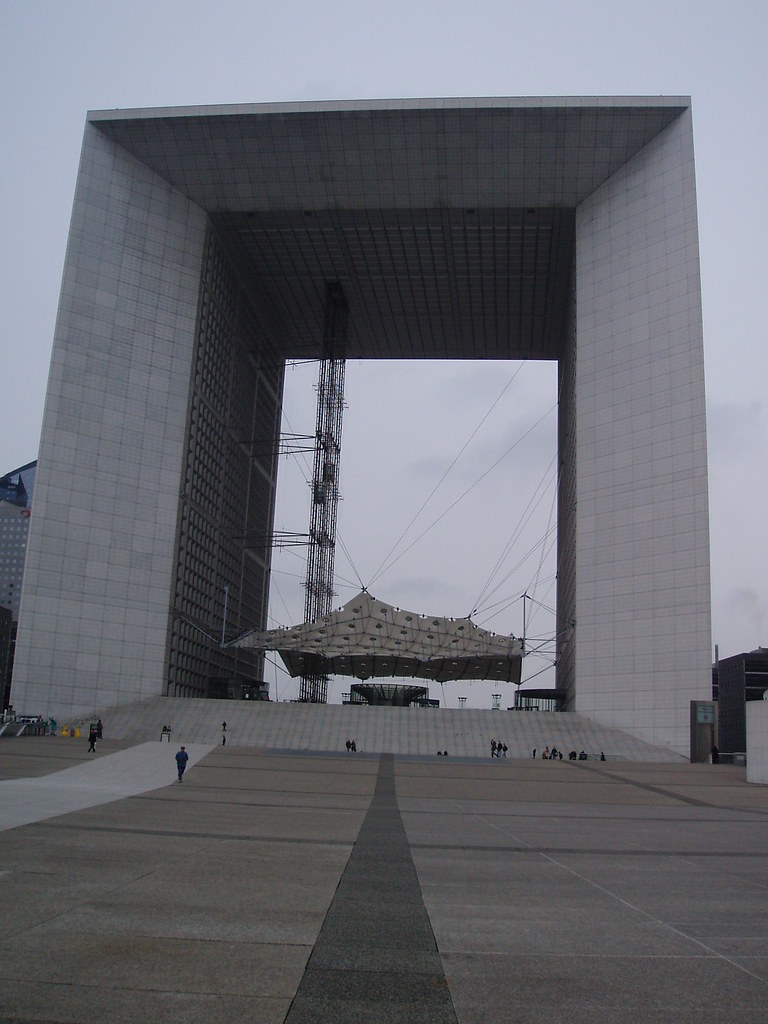
La Grande Arche de La Defense
Designed by Johan Otto von Spreckelsen in 1989. Every bit of the gigantic Grande Arche shows no sign of compromise. What's particularly twisted is the fact that although the Grande Arche is located on the same straight line stretching from the Louvre Museum through Champs Elysees Avenue and the Arc de Triomphe, the Arche itself is facing slightly askew. In the picture above, the line of darker tiles goes straight to the Arc de Triomphe. Notice that the Arche is slightly looking left.

Friday, March 03, 2006

Who's an "engineer" in the economic policy sphere?

Today's EOPP Happy Hour was really enlightening. (For those who do not know what EOPP is, EOPP is a research group consisting of professors and PhD students of economics at LSE interested (mainly) in development economics and political economy.)

The topic was "What defines economics?" But the discussion flew into the issue of the relationship of economics with policy-makers.

We had Professor Paul Gertler from UC Berkeley as a guest. And he made a couple of revealing remarks.

In addition to academic works, he's been doing policy advice works in developing countries like Mexico, Argentina, Uganda, Kenya, etc. When he talked to politicians in these countries about what development policy should be undertaken, their first response was

"Does it get me into trouble?"

When he said no, then the next response was

"Does it make me look smart?"

When he said yes, then the third response was

"Does it make the public better off?"

He also told us that the reason for why conditional cash transfer schemes (CCTs) like Oportunidades (formerly known as PROGRESA) in Mexico and Bolsa Familia in Brazil, where poor households receive cash from the goverment conditional upon sending kids to school etc., is more acceptable for policy-makers than, say, simply providing education to all kids for free. The empirical evidence shows that CCTs are by no means more cost-efficient. But politicians love it because parents will vote for them if they implement CCTs (parents get cash!). Providing free education, on the other hand, does not directly benefit those with voting rights.

Then the following discussion led us to the idea that there needs to be "engineers" in the economic policy sphere, a metaphor suggested by Tan. Engineers are those who know natural science and apply it to real situations. Likewise, we need someone who knows economics and knows how to implement it to reality.

The following is the point made by Professor Mark Schankerman. Economists are good at finding WHAT the efficient outcome is. A good example is free trade. But economists are bad at finding HOW the efficient outcome can be achieved. That's why politicians often don't like the free trade policy, for example. In the process of implementing free trade, there will be those who lose from free trade. Politicans cannot ignore such people. Finding what the efficient policy is is like what scientists do in natural science. But finding how it is achieved in reality is a different job. In the case of natural science, engineers undertake such a job. What about social science?

Who can be an "engineer" in the economic policy sphere? Time was over at this point. I wonder if this is a journalist who understands economics well. Or maybe this is what political economists or political scientists (the distinction is very blurred these days) are all about.

This is how Japan does diplomacy.

Captain Tsubasa is one of the most well-known Japanese anime/manga in the world. I still remember a Chinese guy I met in London loves this cartoon. I still remember a French girl working at a travel agency in London who wants to travel to Japan because she wants to see the Japanese landscape illustrated in Captain Tsubasa. (I later learned that Captain Tsubasa was a big hit in France a few years ago, which triggers Europeans' interest in Japanese manga and animation.) I still remember a soccer shop in Allepo, the second largest city in Syria, decorates its entrance with posters of Captain Tsubasa (known as Captain Majid in the Middle East).

Now it's going to be used as a tool of developing friendship between Japan and Iraq (see United Press International; Middle East Online). But I wonder if the fact that Captain Majid will be aired in "The U.S. government-funded Iraqi Media Network" stifles everything...

Saturday, February 18, 2006

Robotic floor cleaners

Everybody believes that Japan is always at the cutting edge, especially when it comes to consumer electronics products.

Not really true. I'm surprised to find iRobot Roomba. This fancy robot, developed by iRobot three years ago, automatically clean floors, something Japanese household appliance makers couldn't think of.

According to a discussion board on robotic floor cleaners for Japanese people, Roomba is on sale in Japan for 80,000 Japanese yen (near 800 US dollars or 400 British pounds) while you can buy one in the U.S. for 250 US dollars.

Part of the reason is likely to be the fact that Japanese people live in small houses, not enough space for a robotic cleaner to running around the floor. Toshiba produced something similar, but it's now discontinued...

This year iRobot even produces Scooba, which washes, scrubs, and dries the kitchen floor automatically! (See BBC News report.) I want to buy this... (It's not yet to be sold in UK.)

Anyway, that's a distant dream. All I need to do now is to find the best hoover in UK. Do you have any suggestions? Is Henry, the British original hoover, really good? (I found a Japanese website devoted to Henry and his family, which is far more informative than any English webpages on Henry... (Look at the official website of Numatic, the British company making Henry. The company doesn't seem to realize Henry's potential appeal to a wide range of consumers.)

Wednesday, February 15, 2006

The Virtue of Economics

Here's why I love economics.

During the last month, I was trying to explain the difference in agricultural policies between East Asian and Sub-Sahara African dictators: East Asians have promoted agricultural growth while Africans have screwed it up. We have seen this difference despite their similarities in terms of per capita income in the early 1960s, the political trajectory until the early 1990s (both regions were ruled by more or less non-democratic governments), and the motivation to promote industrial development on the part of the government.

My intuitive reasoning was this: a non-democratic government faces a trade-off between maximizing tax revenues and preventing citizens from undertaking insurgencies. Taxing both agricultural and non-agricultural sectors in a similar fashion allows the government to collect as large tax revenues as possible. On the other hand, this leads to citizens in the agricultural sector identifying themselves with those in the non-agricultural sector, and vice versa, in their relationship with the government. Therefore, citizens as a whole have a high incentive to threaten the government with insurgencies in order to demand less taxes.

Taxing two sectors in a different way, on the other hand, certainly reduces the amount of tax revenues but reduces the insurgency incentives for citizens as well. This is because citizens in the less heavily taxed sector do not identify themselves with those in the more heavily taxed sector, and therefore do not cooperate with them if heavily taxed citizens decide to take up arms against the government. This makes an insurgency more costly for the heavily taxed citizens. If the government follows this strategy, it wants to tax agriculture more heavily because taxable incomes are larger in the agricultural sector, at least, in the early stage of economic development (as was the case in the early 1960s for both East Asia and Sub-Sahara Africa).

The differential taxation is more desirable for the government if the loss of tax revenues due to this tax strategy is small. This is the case if there is a huge difference in taxable incomes between the two sectors. In many African countries, agriculture provides far more taxable incomes than non-agriculture as soil and climate conditions allow them to produce export cash crops such as cocoa and coffee. This leads to African dictators severely taxing agriculture while favouring industries. In East Asia, however, agriculture does not yield particularly high incomes relative to the other sector in the economy. This makes East Asian dictators to treat both agriculture and non-agriculture in a similar way (ie. promoting productivity growth by not destroying production incentives due to heavy taxation).

That was my speculation. Based on this idea, I worked on building a model showing this logic in a mathematically rigorous way. It turned out, however, that the above reasoning had a flaw in it. A mathematical model allowed me to realize that if agriculture is far more profitable than non-agriculture, then citizens in the non-agricultural sector are never willing to oust the government even if they are taxed as heavily as those in agriculture. This is because their gain from toppling the government (the amount of incomes taxed away) is small (their taxable income is small by assumption) while the cost of insurgency is independent of the size of taxable incomes. In this situation, therefore, only citizens in the agricultural sector have an incentive for insurgencies. Removing the tax burdens on non-agricultural citizens does not weaken insurgency incentives for agricultural citizens (they need to oust the government on their own anyway), only to reduce the amount of tax revenues. Therefore, the government never chooses the differential taxation as its optimal policy.

I couldn't have noticed this logical flaw if I hadn't tried to build a mathematical model. Your intuition can tell a lie while mathematics never does. This is why I love the way economists engage in theoretical analysis.

This love affair does not mean that I make progress in my research, though.

Monday, February 13, 2006

Baron 'At The Drive In' (Breakbeat Kaos)

Listen to this week's drum & bass chart no.1 tune!

If you like trippy house/trance music, you're gonna like it. What a beautiful track.

The producer of this track, Baron, emerged in the drum & bass scene last year. No one in the mainstream music scene notices this, but drum & bass has been constantly pumping out new amazing talents during the past few years. You may remember the names like Roni Size, LTJ Bukem, Goldie, Adam F, DJ Hype, DJ Zinc. But they are not in the centre of the scene anymore. Instead of pumping out uncreative tracks only taking advantage of their celebrity status, these old names are now busy discovering new talents. Drum & bass music scene is very healthy in this sense right now, unlike some pop music scenes.

Sunday, February 12, 2006

Japan's succession "crisis"

If you are a Japan watcher, you know this issue in Japan: whether the Imperial Household Law (the law on the Japanese royal family) needs to be reformed so that a woman can ascend throne. (See this BBC article last month and this month.)

But BBC doesn't seem to understand the fundamental issue here (nor the Japanese media, though). The issue is not whether or not a woman can succeed to the throne but whether or not a child of a woman in the royal family can become the Emperor of Japan.

In its history of more than 1500 years, the Japanese royal family did have female emperors (there are eight of them, two of whom became the empress twice). The current law prohibiting a woman to succeed is a product of Meiji Japan (in the late 19th century). But no children of these female tennou (the Japanese term for the Emperor of Japan) ascended throne. Which means that the current emperor has blood inherited only through men during the past 1500 years.

Those Japanese putting heavy weight on tradition, therefore, oppose the idea that a woman becomes the Emperor of Japan. Don't misunderstand them as anachronistic sexists.

But does tradition matter that much? They even propose that "former members of the old aristocracy who left the Imperial Family after Japan's defeat in World War II could possibly be brought back." (quoted from BBC article.) This is nonsense.

What's wrong with imperial blood transcended through women? Yes, it never occurred in the last 1500 years. But think about 1500 years later from now. The Japanese Emperor in the year of 3506 will have blood inherited from more than 3000 years ago, through both men and women. What's wrong with this?

Princess Masako, the wife of Crown Prince Naruhito, suffered from depression because she was implicitly accused of having no male children by those tradition fundamentalists in the Imperial Court. If women can pass the Imperial blood, this kind of absurd thing will never happen.

By the way, BBC seems really curious on this issue. Its website allows visitors to post their opinions. I burst into laughter quite hard when I read this:

I think this old-fashioned monarchy should be abolished, as it has no longer any connection with the realities of life in Japan.
Anna, Iran

Which also makes me feel like hearing what people around the world would say to this issue. Can you post your view coupled with your national background? That will be interesting.

Thursday, February 09, 2006

Swerve

Went to the Swerve party at The End nightclub last night. This is a drum & bass party organized by Fabio, one of the leading drum & bass DJs since day one who also has a BBC Radio 1 programme. The theme of the party is smooth drum & bass, in other words, liquid funk.

It's always interesting to see how the guest DJ responds to this concept of the party. Even DJs known for their hard, dancefloor-smashing style play a bit different set than usual. This kind of tension - creative people faced by some constraints in what they can do - sometimes creates a marvelous thing. (If you think DJs are not creative, you're absolutely wrong.)

Tonight's guest DJ was Bailey. He began with a series of liquid funk tunes, which is not his usual style. But he still tore the floor down. As the previous warm-up DJ was terrible at mixining tunes, his skill was in stark contrast. It kept me, and all clubbers in the floor, dancing.

Then he moved on to noisy-but-cosy style (I make up this phrase) - fast beats with slow melody and bass line. I love this style of music. Now I was just standing listening deep into music. It washed my mind away.

It was already fantastic, but Bailey didn't stop there. In the last 20 minutes or so, he revealed his own style, almost leaving the audience behind. The style got harder and the rhythm got totaly unexpectable. Different, irregular rhythms cross over each other, creating a totaly wicked vibe. Yeah, that should have been what drum & bass was all about. Complicated, unexpected, but still danceable. The current drum & bass scene tends to forget this. I couldn't resist dancing madly. There were a few people who understood this, dancing hard to this style of music. That was an amazing moment.

Bailey was too good to appreciate Fabio taking over tonight. Usually, I feel somehow relieved when Fabio takes over at this party, because his set is what attracts me to this party. But tonight, Bailey was too wicked, making Fabio less impressive. So I left the venue before 3am, when the party would be over.

I love drum & bass. It's one of the few, very few things that completely please and satisfy me. It's an increasingly scary thought that I will leave London in a couple of year's time. It's very hard to find a decent drum & bass party outside London...

P.S. I deleted the previous post. Thanks a lot for your comments and encouragements, Mir and Ikem. I appreciate this. I feel pretty much fine now thanks to this drum & bass party. :)

Tuesday, February 07, 2006

Freedom of expression?

Buck-Tick is one of my favorite Japanese rock bands. In 1995, they released an album including a track called Rakuen (a Japanese term meaning Eden). This track features, as an interlude, the reversed version of a melody you hear in an Islamic country - the sound of reading the Koran.

Soon after the release of the album, an Islamic organization in Japan criticised it as a profane treatment of Allah and, in response, the record company recalled the original album CDs and re-released the album with an edited version of the track.

As Buck-Tick was not hugely popular at that time, this news was only reported in a very small column in newspapers. I wonder what would have happened if it had been an album released by a massively popular pop singer.

New District Line train carriage


District Line train carriages are the oldest and ugliest among all London Underground lines. Since last year, however, new train carriages have been introduced step by step. They have got fancy grab bars. I love this design.

Saturday, February 04, 2006

Italian guys

I always envy Italian guys. When they see a good-looking girl, they shamelessly approach her and start talking to her until they understand she's not much into talking to them. I can't do this. The extent that I can't do this is increasing with the degree to which this girl is good-looking.

This good-looking-ness thing always bugs me. It's an undeniable truth that talking to a good-looking girl itself is enjoyable for men (and probably even for women) because she entertains you by her appearance, if not by the content of conversations. This often obscures an obvious fact that you want to talk to someone with whom you can strike an interesting chat; even if you don't really enjoy what you are talking to a good-looking girl, you still want to talk to her because she's good-looking.

This annoys me.

Friday, February 03, 2006

Bow Arts Lane


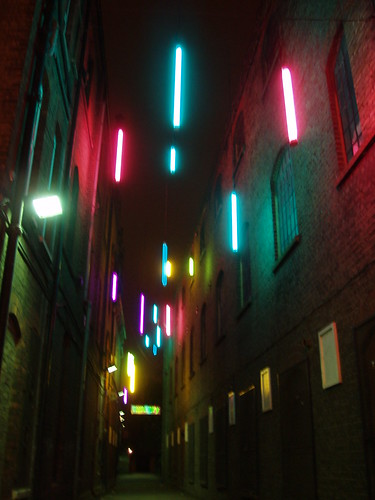
An alleyway next to Bow Arts Trust (183 Bow Road, E3, London)

A visit to Whitechapel Art Gallery

I needed a break in my mind that has almost always been preoccupied with economics recently. So I paid a visit to Whitechapel Art Gallery this evening as it is open late on Thursday. The Gallery, located in East London, is more or less on the way from the School to my home. So it's also convenient to visit on the way home.


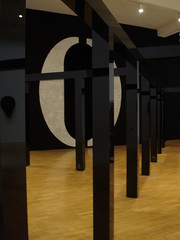
The ground floor exhibition pretty much sucks. Even if a piece of modern art sucks, however, you can still enjoy it with a digital camera in hand. A photograph can be very powerful. You can throw away any unnecessary images out of the picture frame. What you see on the right is such a result. The title of this installation is "zero built a nest in my navel", by the way.

Upstairs, on the other hand, is quite intriguing, personally. It is an exhibition to introduce the works of British architect David Adjaye. I didn't know of him, but it turned out that I did know one of his buildings: Idea Store in Chrisp Market Street, which I believed was the world's coolest local library.

What's more, several more works undertaken by this architect are located in places more or less familiar to me: T-B A21 Olafur Eliasson Pavilion (follow this link and scroll down to see photos) was built in Venice (the link will take you to my photos), which I visited last year (but I missed the Pavilion); a residential building under construction on Fairfield Road, which is within a walking distance from my place in East London; Rivington Place in Shoreditch (again in East London), where I frequently walked around; and Idea Store Whitechapel (yet again in East London), built near a vast Sainsbury's supermarket store I visited a couple of times.

The exhibition explains how he designs such buildings by taking into account the area surrounding the building site and by being inspired by African craft designs, which was quite intriguing.

On the way home, I paid a visit to one of his buildings - Idea Store Whitechapel:

Thursday, February 02, 2006

FT's book review on Acemoglu and Robinson (2005)

I just found FT magazine's book review on Acemoglu and Robinson (2005). (See 18th January 2005 for discussions on this book.) I was always wondering what the general public's response to their innovative theory of democratization would be. Tim Harford - the reviewer - gives a thumbs-up overall. I hope this theory will soon be taught by high-school world history teachers.

Sunday, January 29, 2006

Lent Term 2006 Week 3

Monday (23rd):
1430-1600 Job market seminar by Alvaro Bustos from Princeton
The rest of afternoon - Fatigue from last week's work prevented me from thinking properly...

Tuesday (24th) through Thursday (26th):
Wrote a research memo in which I describe a theoretical model that I have in mind and its solutions and implications. As this process involves mathematics, you can't skip any single step in logic. This requires you to think real hard. So it took longer to finish and I got exhausted more than expected.

But this is why I love economics. This process often takes you somewhere you didn't expect. Which means you find a new thing. I mean, the conclusion derived from this process is often different from what you expected. If you just rely on verbal arguments, this won't happen. Which means you don't really make progress in expanding our knowledge on society. That's why economists hate most arguments without explicit mathematical modelling made by social scientists outside economics.

Friday (27th):
1300-1400 EOPP Work-in-progress Seminar
Afternoon - Wrote email to Professor Caselli, the speaker at today's seminar, on his presentation as what he's trying to do is quite similar to my research - I should talk to him soon. Then figured out how to use Excel2Latex for Ameet. The end result is written down here (look for "EXCEL2LATEX").
1800-1900 EOPP Happy Hour

Saturday (28th):
Complied the dataset for my research. Although it's theoretical, to motivate my research, it's good to present the data showing what I'm trying to explain is in fact a reality. (I followed Tim's advice last week.)

Sunday (29th):
Started reading Esteban and Ray (2006) to hone my skill of writing a theoretical paper. Debraj Ray's papers are good for this purpose - they are theoretically rigorous but still carry a huge relevance to reality so I don't get bored. What struck me during this week (and during the Christmas holidays, when I worked on the same research idea) is the fact that I haven't been exposed enough to theory papers. (This is partly because both development economics and political economy these days tend to be empirical (for development economics, to the extent that Dilip Mookherjee - one of the leading theoretical development economists of the present days - expresses his concern that there is too little theory in the field) and because due to my research topic I've been forced to read tons of descriptive (ie. non-mathematical) papers in political science, which was more often than not agony.) That is why I took almost a week to write up even a sketch of a simple model, or so I thought.
Also started proof-reading the proofs of Tim's forthcoming book as part of research assistance work for Tim.

Friday, January 27, 2006

Royal National Theatre after dark

Illuminated in red is Royal National Theatre, viewed from near Temple tube station.

Monday, January 23, 2006

Swiss Cottage tube station

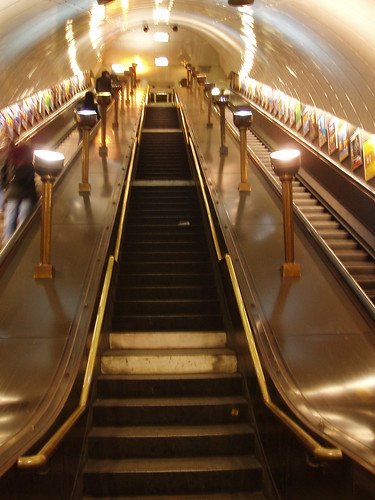
The stairs and escalators in Swiss Cottage tube station.

Sunday, January 22, 2006

Lent Term 2006 Week 2

Here's an example of my daily life as an economics PhD student at LSE interested in development economics.

Monday (16th):
1300-1400 Development & Growth PhD Seminar
1430-1600 Job Market Seminar by Tavneet Suri from Yale
1700-1830 LSE/UCL Development & Growth Seminar by Eric Verhoogen from Columbia
The rest of the day - Read Esteban and Ray (2001) to figure out how larger groups can be more effective in conflict.

Tuesday (17th):
Late morning - Have a brief chat wih Tim on my own research and on our Health & Democracy project.
The rest of the day - Following Tim's advice, try to find data on agricultural tax rates in Africa and East Asia for my own research and get to know Anne Krueger et al. eds. The Political Economy of Agricultural Pricing Policy (John Hopkins University Press, 1991).

Wednesday (18th):
Morning - Following what Tim told me yesterday, run a few regressions for the health & democracy project (in vain).
1600-1730 LSE/UCL Development & Growth Seminar by Alwyn Young from Chicago
The rest of the day - Read Suri (2005) for the health & democracy project.

Thursday (19th):
Morning - An idea occurs to me and run a few regressions for the health & democracy project (in vain).
Lunchtime - Have power lunch with Sonia (by power lunch I mean a lunch over which conversations are all about each other's research)
Afternoon - Read Montalvo and Reynal-Querol (2005) for my own research. Try to find a way to get around an ad hoc assumption made in the theoretical model that I'm working on - and learn that the marginal cost of insurgency must be convex.

Friday (20th):
Morning - Try to find data on cross-country infrastructure data for my own research and remember Canning (1998).
Early afternoon - Have a chat with Maitreesh (my supervisor) on my research and receive a couple of modelling tips, told to write a short memo of the model and its analysis based on which we can talk further.
The rest of the afternoon - Work on the theoretical model for my own research and come up with an idea to implement Maitreesh's advice.
1800-1900 EOPP Happy Hour
The rest of the evening - Talk to Tianxi on where the accountability of the Chinese government comes from and then to Madhav on our potential new research project inspired by today's EOPP Happy Hour. After coming home, read Lemieux (1998) from which Suri (2005) seems to get inspiration.

Saturday (21st):
Continue reading Lemieux (1998). Then start writing a short memo of the model, following what Maitreesh told me yesterday.

Sunday (22nd):
Continue writing a short memo of the model.

Monday, January 16, 2006

Sunday, January 15, 2006

Mackerel stewed with miso (saba no miso-ni)

It's time for lesser-known Japanese cuisine again!

Another whole mackerel was in the fridge today (I bought two yesterday). As one day has passed, eating it raw isn't a choice anymore. So I tried to cook it in a very Japanese way. It's called "saba no miso-ni" (mackerel stewed with miso). Here's a recipe:

1. Mix 400cc of water, 200cc of Japanese sake, one spoonful of sugar, one spoonful of soy sauce, and sliced ginger in a pan, and then bring it to a boil.

2. Place 130g of miso paste in a jar, add about 100cc of the "soup" made in Step 1 to it, and mix it with miso paste until the paste is dissolved into the soup. Keep this aside.

3. Add mackerel fillets to the soup made in Step 1. Place a lid onto the pan and heat gently for 5 minutes.

4. Open the lid and add half of the miso paste soup made in Step 2 to the pan. Then place the lid again and keep heating gently for another 5 minutes.

5. Open the lid and add the remaining miso paste soup and a hint of rice vinegar.

That's it! Miso paste is easy to get burned. That's why you shouldn't add miso from the beginning. A hint of rice vinegar in Step 5 makes the taste milder.

I've kept saying this since yesterday. But it was brilliant! I'm happy to be born as a Japanese. :)

Stewing fish in soup like the one made in Step 1 above is a very Japanese way of cooking fish. (The soup is not for drinking. It is just for stewing fish though we can serve stewed fish dipped in the soup.) We don't just eat raw fish as sushi.

Interestingly, I didn't like stewed fish when I was in Japan. More generally, I didn't like cooked seafood meals when I was in Japan. Since I started a life in London, I've begun missing fish. Then here I am, eager to explain a Japanese recipe for cooking fish!

Tom Thumb's Arch

Tom Thumb's Arch, a recently-renovated railway arch in Bow, East London. I walk through it everyday on the way to/from Bow Road station (see below).

Bow Road tube station

Bow Road tube station, recently renovated. This is the nearest tube station to my place.

Tate Modern and Millenium Bridge at night


Tate Modern and Millenium Bridge, viewed from Paul's Walk at night.

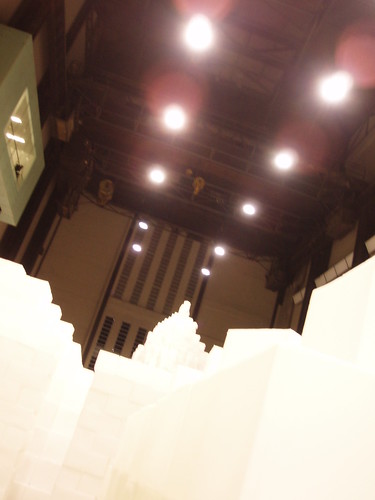
The Unilever Series 2005/6 at Tate Modern

Embankment by Rachel Whiteread, an installation for The Unilever Series 2005/6 at Tate Modern

Honestly speaking, this installation is just a bunch of white boxes piled up if you see it alone. But this art must be coupled with Tate Modern's Turbine Hall and viewed as a whole. This leads me to the above photograph, different from any other photos of this installation.

Saturday, January 14, 2006

Neginuta

This blog sometimes becomes a Japanese cuisine guide. It's such time again.

After coming home from the Billingsgate fish market, where I bought two whole mackerel for 3.50 pounds, I pickled one of them as described on 21st August 2005. For lunch, I ate a half by dipping in soy sauce. It was gorgeous as always.

For dinner, I tried a new thing: neginuta. I didn't know this way of eating pickled mackerel. But it is brilliant. Here's the recipe:

1. Slice pickled mackerel and chop spring onions.
2. In a bowl, put three spoonfuls of miso paste, one and a half spoonful of rice vinegar, and a spoonful of sugar (you can change the amount to your taste as long as you keep the ratio, just like making cocktails).
3. Add sliced mackerel and chopped spring onions into the bowl, and marinate them all.

That's it! The sweet taste of miso and the sour taste of pickled mackerel along with the crunchy texture of raw spring onions melt together in your mouth, producing a pleasant sensation.

By googling Japanese websites, I found that neginuta refers to marinating spring onions (or, more precisely, negi (Japanese leeks) - but I prefer using spring onions as I doubt Western leeks fit this cuisine) in the miso/vinegar/sugar mixture. Some seafoods like boiled octopus or squid are sometimes added. Adding pickled mackerel is probably not a standard thing to do. Anyway, I'm probably the first person who introduces neginuta to English speakers as googling it in English doesn't yield any result. :)

Friday, January 06, 2006

Making Presentation Slides including Maths

I can sometimes become a computer geek. Here's proof.

Economics uses mathematics. Writing an academic paper in economics requires a word processor capable of inputing and outputing mathematical expressions. Microsoft Word is horrible for this purpose. So most economists use a word processor software called Scientific Workplace.

Still, Scientific Workplace is horrible. Its help files are hieroglyphics. I've already wasted tons of time to figure out how to do one thing or another with this software. But as long as writing a paper is concerned, it is not too bad.

When it comes to making slides for presentation, however, Scientific Workplace is even more horrible. Basically it's useless for making decent slides. Microsoft PowerPoint coupled with TexPoint doesn't work quite properly, either.

I figure out the ideal software environment for making slides for presentation in the economics profession (or any academic discipline using mathematics): MiKTex + TeXinicCenter + Prosper. (For Prosper, this page at University of Colorado is more useful than the official one.) They are all free to download and install.

In case you're interested, here's the recipe:
1. Download and install MiKTex.
2. Download and install TeXinicCenter.
3. Download and install Ghostscript (this is required to use Prosper).
4. Join TeXnicCenter-Users Yahoo! Group (this is necessary to download a batch file in the next step).
5. After your Yahoo! Group membership is accepted, download prospermake.zip by following the link provided in this message.
6. Unzip prospermake.zip and follow the instructions given in readme.txt to create a new output profile for TeXnicCenter.

One warning: do not install any software (MiKTeX, TeXnicCenter, or Ghostscript) under the directory of "C:\Program Files". The reason is this directory name includes a space, which prevents the new output profile from working properly (yes, this is Microsoft's fault). The simplest way to do this is install them all right under "C:" directory.

Now you're ready to use Prosper. You don't need to download and install Prosper itself; MiKTeX automatically does it when you compile a TeX file meant to use the Propser package. (You need an Internet connection, though.)

A couple of technical notes: Steps 3-6 are needed as TeXnicCenter is not compatible with Prosper by default. The main reason is that PDFLaTeX accompanied with TeXnicCenter doesn't work with Prosper. You need PS2PDF to create a PDF file. Ghostscript has this, and a batch file included in prospermake.zip allows you to use it properly.

Sunday, January 01, 2006

Toshikoshi soba

I just had a New Year's Day soba noodles, a Japanese tradition.

Sorry I just lied. What's traditional in Japan is a New Year's Eve soba noodles (toshikoshi soba). I simply forgot eating soba noodles last night.

I bought chasoba noodles (noodles made of soba powder and green tea leaf powder) the other day in Oriental Delight supermarket, a newly opened East Asian food market in Chinatown. I boiled it for three minutes. British-managed or American-managed Japanese restaurants, notably Wagamama, don't seem to understand how long you should boil Japanese noodles to serve, by the way. They always boil it too long, serving jellyish noodles to disappoint Japanese customers. Italians know this. Their phrase "al dente" says it all.

While waiting, I sliced spring onions very thinly. In a very small bowl, I poured soba dipping sauce (made of soy sauce, mirin, and dashi soup (soup containing umami) and added the sliced spring onions.

Serve soba noodles boiled al dente, after washed with cold water, onto a large plate with a small amount of wasabi paste put on the edge. Pick up a few noodles with chopsticks and dip them into the dipping sauce. Add a hint of wasabi on top of it. Then quickly put them all into your mouth before wasabi melts into the dipping sauce. The al dente texture of soba noodles, the bitterness of raw spring onions, the umami taste of the dipping sauce, and the distinctively spicy taste of wasabi melt together in your mouth.

Lovely.

The moment I feel happy to be born as Japanese. After eating them all, have a cup of hot Japanese green tea. It clears the umami taste left in your mouth. This is how we Japanese do our thing.

Year 2005

The following is what I wrote before year 2006 arrived...

I hate this atmosphere of New Year's Eve. It forces everyone to look back at what happened this year and feel more or less sentimental about the year that's almost gone. I always try to defy this temptation. After having a Sainsbury's Indian curry and a vitamin tablet for supper (I don't feel like cooking tonight) and sitting at desk in my bedroom alone (my housemate is back at home in Scotland) on this quiet, cold evening in London, I give up.

The year of 2005 was certainly not the greatest in my life, but much, much better than the previous years in London. Speaking English is no longer a headache. In the past couple of months, even speaking academic things in English stops being a source of frustration.

A large part of the improvement in my life in London comes from two of my best friends - Alberto and Cheyok. Alberto (see his blog in English) is probably the one who understands me the most. Although he left London earlier this year, I visited his house in Italy last September. He's the guy I talked to for the longest time this year. Talking to him definitely made my life with English easier. Cheyok has always been incredibly nice to me. Without her permission, I think of her as my beautiful elder sister. :) From time to time we exchange email, talking about my private stuff, and meet up on several occasions. She's the one who always cheers me up.

The biggest event this year is nothing but a trip to Syria. (I will never be able to finish the Syria 2005 blog...) Thanks to Arabic-speaking Misao (see her essays on Syria in Japanese), I spent an enormously great time there - good food, nice people, total safety, and lots of historical sites. Honestly speaking, I partly sympathize the idea of Islam on women's outfits. During my stay there, I was relieved from being aroused by seeing scantily-clad girls. On the other hand, I realize Mohammed's aim (I believe he was too ashamed of his potential as a womanizer) is not perfectly achieved: a slender woman wearing a black burka still looks sexy. :) This trip certainly broadens my perspective on the world, something you never acquire if you just follow what America says.

Research-wise, this year has been extremely difficult. At the end of the three years as a PhD student, I couldn't finish writing up a single paper. But Tim has always been helpful. I started working for him as a research assistant last summer. One end result is his forthcoming book. (Chapter 2 "The Anatomy of Government Failure" is a must-read for everybody. Trust me.) I proof-read the whole manuscript and pointed out mistakes and made some suggestions. Beyond my expectation, he quite liked my work performance and, at the beginning of this month, offered co-authorship of a paper prepared for the American Economic Association Conference next month. This experience gave me kind of self-respect as a researcher, something that had kept deteriorating during the best part of this year. Now I came up with a new idea on my own research, working hard on it to make it to the presentation on 9th January.

Last but not least, I'm very lucky to meet Kotono, Alberto's girlfriend's friend. She's incredibly sweet and at the same time very assertive, a very rare combination for a girl. I like her a lot. Since I met her, my life has become much easier.

At the end of the day, it's people surrounding you who make you feel better. I couldn't learn this until I left Tokyo for London.

My best tune of 2005
Hiphop/R&B: Amerie - '1 Thing'
Dancehall raggae: Damian Marley - 'Welcome to Jam Rock'
Drum & bass: Shy FX and T-Power - 'Feelings' (see 19th September 2005)

The best DJ set:
Artificial Intelligence at Fabric on 25th June

The best CD album:
Influx UK 2 Million and Rising

Saturday, December 31, 2005

A hilarious paper

Debraj Ray's website (click "Miscellany" on the left column) took me to a hilarious (but quite serious) paper. If your surname is something like Zaitsu (a Japanese surname), you won't succeed as an economist as much as the person with the same background and the same ability and a surname like Akamatsu (another Japanese surname).

Tuesday, December 20, 2005

Diary 2006

This post is just to play a role of my 2006 diary, which I haven't found time for buying.

January
9(mon) 1pm: My presentation at EC501 Development & Growth PhD Seminar.

February
21(tue)-23(thu) 6pm: Alan Krueger's LSE public lecture

Sunday, December 18, 2005

G Child's Refix

I supposedly have no time for updating this blog. But I've got to tell you this. I found a brilliant urban music DJ here in UK. His name is G Child.

Every Saturday night (from 10pm to midnight) his radio show on BBC 1Xtra, a DAB digital radio station in UK, features two sets of his 15-minute DJ mix called "the refix". This is not an ordinary DJ mix. G Child mixes vocals and beats from completely different sources. For example, last night, he mixed the vocals of Mary J. Blige - the queen of R&B - with various hiphop and dancehall reggae beats. In his second session last night, UK garage beats were mixed with US hiphop raps and vocals. This was absolutely HEAVY. It made sense a lot. UK garage artists often produce very innovative beats but they tend to be poor singers/rappers. US hiphop artists are much better skilled rappers/singers but the beats they make these days are so predictable and uninteresting. And G Child is very good at making a perfect combination from two different genres of music. I urge you to listen to last night's show online. The Mary J. Blige set begins after around 35 minutes while the UK garage vs US hiphop set starts at around 1 hour 40 minutes.

He needs to be known more widely. More generally, DJs tend to be underrated in public, often accused of their lack in creativity. That's absolute nonsense. True, there are many crappy DJs out there. But some are really making new music by mixing the existing tracks. Ever since I found this in London, probably the capital city of DJ culture, I've stopped buying CDs and begun recording DJ sets broadcast in radio shows instead. Artists can rarely make CD albums full of excellent tunes. CD singles are always coupled with rubbish tracks. Online music stores like iTunes and Napster only sell boring mainstream music while those selling tracks from independent labels online only sell tunes widely unknown because of its rubbish quality. Your music life will become much more interesting if you find good DJs mixing good tunes only in an unexpected way as G Child does.

(It's funny that mix CDs (CDs recording DJ sets) are almost always of poor quality. Maybe DJs lose their concentration when they are aware that their play is being recorded to preserve it in the CD forever.)

Saturday, December 10, 2005

Zambia and the WTO for poor countries

I think this FT magazine article by Alan Beattie today is a well-written one on the reality of an African country's bureaucracy and economy, and of the World Trade Organization for poor countries.

Some interesting excerpts:

"God," Patel [- trade minister from the impoverished southern African state of Zambia -] says... "The FT has more capacity to do trade policy than we do."


Being a minister in a desperately poor country throws up unimaginable challenges. One of Patel's first jobs under Chiluba [the former Zambian president] was as minister of sport. On his second day in office, the entire Zambian national football team died in a plane crash in Gabon, an event that stunned the footballing world. "I had never even been to a bloody football match," he says. But he pushed and cajoled and eventually got the Danish government to agree to train Zambia's new team at the national football centre outside Copenhagen. "Then the next year we got to the finals of the African Cup."


In late June this year trade ministers from the LDCs [short for least developed countries] meet in Livingstone, Zambia ... There is a short debate about including commas around the expression "inter alia". Because of the francophone African countries present, the communique is translated into French and there is a discussion about whether the correct interpretation of "market access" is "acces sur le marche" or "acces au marche". ... The first day of the conference ends early because the interpreters are only paid to work until late afternoon. Finally, towards the end of the second day, Patel takes the conference chair himself and charges through the rest of the agenda in about half an hour, cajoling and demanding, flattering the delegates by calling them "brothers and sisters", and then bulldozing the communique into coherence. A Cambodian delegate, evidently impressed by this unusual display of executive decisiveness, suggests leaving all the negotiations to Patel. He reads out Patel's personal e-mail address to the conference and implores all present to send their ideas to him and let him decide. ... Later that night in the bar his frustration is evident. "We have no analysis, no data. That is why we spend our time changing commas and arguing about translations."


[Zambia's trade minister Patel] picks me up from the hotel five minutes early, waiting impatiently in the car while I get ready. "I caught you early, huh?" He drives himself to the office, railing against the lack of a Lusaka bypass when he is held up in traffic for two minutes.


The ministry has just moved to an impressive new tower block. The building was funded by an aid package from the Chinese government, which, Patel says, offered countries in southern Africa either a new party headquarters or a football stadium. "Most countries chose the stadium."


[A] more pressing matter this morning is the need to boot out the human resources people who have taken up residence in offices down the corridor, offices [Patel's] staff are supposed to move into.


[Patel] cites a computer simulation showing that EU demands for cuts in Zambian tariffs will lose the government $15m in precious tax revenue. But Zambia's ability to do such research is limited. It has access to an online computer model developed by the World Bank, which allows it to do simulations. "But I don't have the bandwidth, so I often get cut off," Patel says.


Often, he relies on briefing notes prepared by NGOs based in rich countries, such as Oxfam. "We get criticised for allowing NGOs to dictate our policy. But if we don't have the capacity to do our own research, what can we do?"


In October, in a drab, strip-lit room in the WTO's unglamorous Geneva headquarters, 21 officials from a variety of countries - Yemen, Afghanistan, Uganda, the tiny Pacific nation of Kiribati - sit in rows taking instruction on the agreements that underlie the organisation. Twice a year - once in English, once in French - the WTO offers three- week training courses to officials from LDCs. The class is taken by Claude Trolliet, an earnest shirt-sleeved WTO employee who has been with the organisation for 10 years. ... To me, Trolliet says: "Providing assistance to developing countries was not one of the functions of the WTO when it was set up. We have had to change ourselves."


This summer British Airways cancelled its weekly freight flight from Lusaka [- the capital city of Zambia -], citing the rising cost of airline fuel as global oil prices soared. Zambia's growers, left with tonnes of rotting produce, had to scrabble around to find space on other flights or truck their goods out through South Africa.


One afternoon Ronnie Parbhoo, an old schoolfriend of Patel's, shows me round his milk-packaging plant in Livingstone. Parbhoo is one of the few remaining members of Livingstone's formerly thriving business community - as in much of southern and east Africa, this is largely ethnic Indian. ... He once owned one of Livingstone's 40 factories in a flourishing textile industry. But output collapsed under east Asian competition, aided by president Chiluba's decision, egged on by the International Monetary Fund and World Bank, to slash protective tariffs rapidly in the early 1990s. So quick was the resulting implosion that most of the factory owners, disillusioned, left the country altogether. Of the 2,000 or so Indians formerly in Livingstone, about 150 are left. "The rest went to the US or Canada," Parbhoo says. "Or they are running corner shops in London." ... The industrial zone of Livingstone - now largely abandoned and overgrown, an African version of a midwestern American steel town - used to employ 10,000 workers. It now employs about 300, a third of whom work for Parbhoo.


Parbhoo sells his milk mainly to Zambians, limiting the size of his market. In theory, he could export his milk to Zimbabwe, but they don't have the hard currency to pay for it. Exporting it to Zambia's other southern African neighbours often runs foul of their hygiene rules - frequently used as a form of protectionism - and the country no longer has the government-backed testing facilities to make its own checks. It is, moreover, a long way across terrible roads to neighbouring countries, and the railway through Livingstone that crosses Zambia has been abandoned.