Sunday, August 21, 2005

How do you eat mackerel?

The cooking page of The Sunday Times' Style magazine today has a point.

Don't cook mackerel if you want to extract maximum flavour.
I completely agree. And all Japanese people know this. We pickle mackerel fillets (called shime saba, where shime means pickled, and saba mackerel).

The last time I went to the Billingsgate Market, I bought a mackerel for 99p. I filleted it at home, spread a generous amount of salt on a large flat metal plate, placed the mackerel fillet on it, add more salt on top of it, and left it for an hour and a half. Then I washed the fillet with water, dried it with paper towels, soaked it into rice vinegar on a metal plate, placed paper towels over it as a lid, and left it for 20 minutes. That was it. Eating sliced pickled mackerel fillets with soy sauce (just like when you eat sashimi) was full of pleasure.

Everytime I talked about this, people here in London was like "You eat raw mackerel?" They don't understand. Heston Blumenthal, the guy quoted above, understands this. But he is still an amateur when he says, "When the fish is ready, wash it thoroughly to remove all the salt, then remove the skin from the fillets." Come on! The skin of a mackerel is an important part of appreciating the taste of a mackerel.

This is why Japanese people sometimes find it hard to live abroad: nobody but Japanese people seems to understand how to eat fish "properly". I'm always amazed by looking at how small the area for selling fish is in Britain's supermarkets and how unfresh and pricey the fish fillets they sell are. That's why I have to go to the Billingsgate Market from time to time. Japan's per capita fish consumption tops the world ranking, which sometimes troubles the rest of the world, including the whale conservation debate and the environmentally-unfriendly fish farming in Southeast Asia to export fish to Japan.

Saturday, August 20, 2005

Saturday afternoon at Hoxton Square

I had lunch at Macondo, a little cafe-restaurant facing Hoxton Square, East London. I had came here previously a couple of times (see, for example, 1st May 2005). Everytime I come here, my impression of this place improves. What's good about this place is three little nice dishes of my own choice from the menu of the day for "only" (by London standards) 6.95 quid. The basic thrust of the menu at this place is Spanish (including Latin Americans). The choices include tortillas (Spanish omelettes), nicely cooked vegetables, and other specialties of the day. Today I chose a broccoli tortilla (which is tasty unexpectedly as I'd never had broccolis inside an omelette), baked asparagus with cheese, and Bolivian prawn ceviche.

This thing called ceviche is a revelation. Prawn, chopped tomatoes and onions in lemon juice, olive oil, and coriander. Now I want to try proper Bolivian cuisine.

Macondo also boasts its fresh juice. Unfortunately, mixed berry juice (which was fantastic the last time I came here) ran out today. So I ordered banana smoothie (which was fantastic as well the last time I came here). But unfortunaly again ice cubes ran out. So mine was warm... (A few minutes later a guy carrying two large bags of ice cubes came to the cafe.)

But ceviche makes up for all this.

---

Then I visited Whitecube, a contemporary art gallery facing Hoxton Square. This month's featured artist is Anselm Kiefer, who, of course, I didn't know anything about.

You can learn what is in display by reading the Whitecube's description (Look for the paragraph beginning with "Part II opens on 2 August with ...").

The installations clearly indicate something couldn't be achieved: derelict concrete staircase stuck on the wall leading to nowhere, scattered pieces of shattered glass, a lead boat looking like running aground against rumps of concrete...

All the same, I simply felt they looked beautiful, very beautifully "organised".

I saw a few people having a five-second look and quickly leaving the place as if they didn't understand anything. I guess these people didn't go through severe setbacks in the past or everything for them currently is going well.

Saturday, August 13, 2005

Lesser-known "Good" Dictators - Part III

This post is a sequel to 17th June.

Marien Ngouabi (Republic of Congo, 1968-1977)

Under his 9-year rule, real GDP per capita in purchasing power parity terms increased by 50%. As he was said to have established the first Marxist-Leninist state in Africa (according to Wikipedia), it was probably the case that he managed the Soviet-style economic growth (ie. growth solely due to capital accumulation). Actually, the investment rate during his rule was staggering 30 percent on average.

Sunday, August 07, 2005

A jumbo power point


At the east end of Ganton Street (southside), Soho, W1 (off Carnaby Street)

Sunday, July 31, 2005

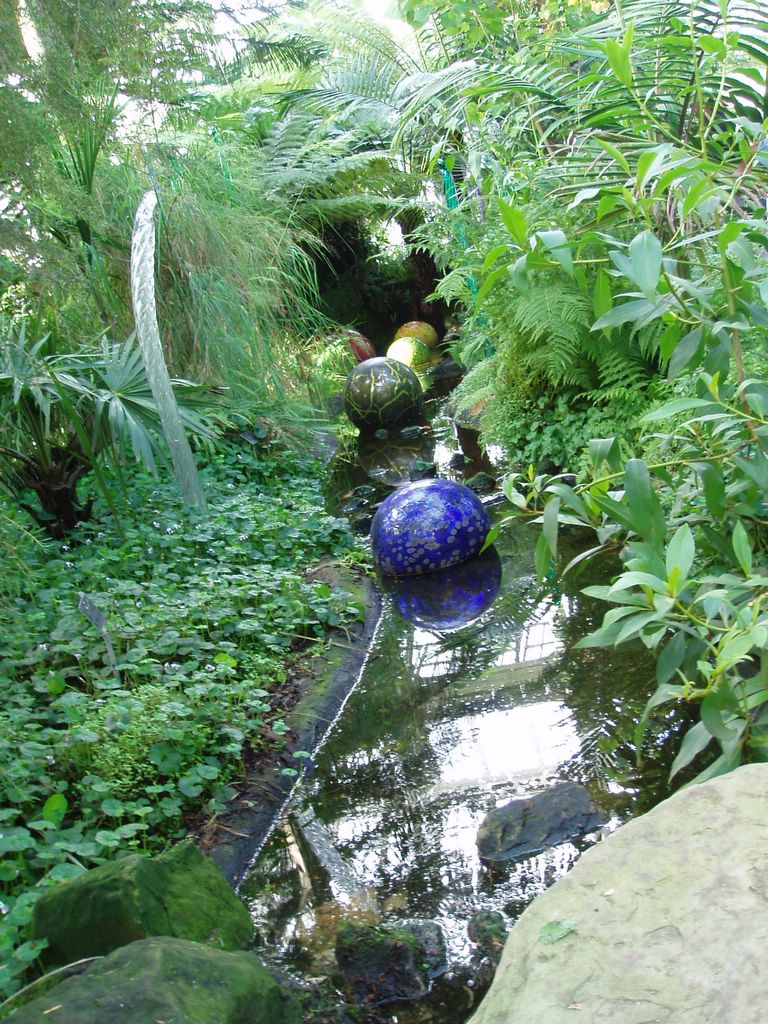
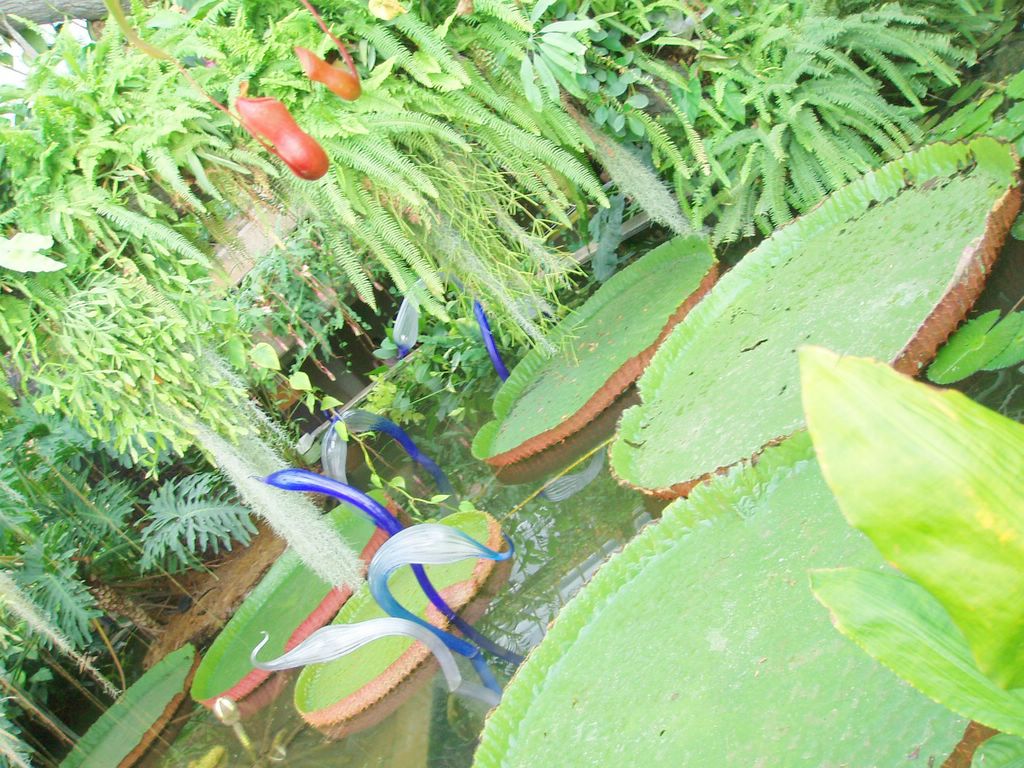
Kew Gardens featuring Dale Chihuly

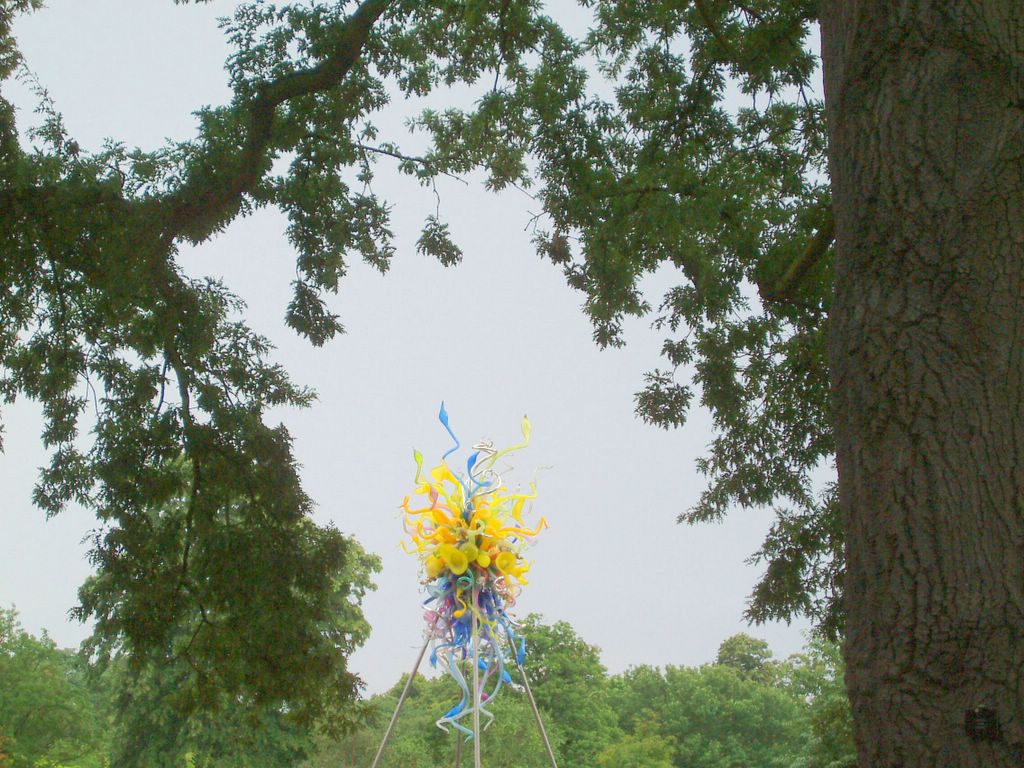
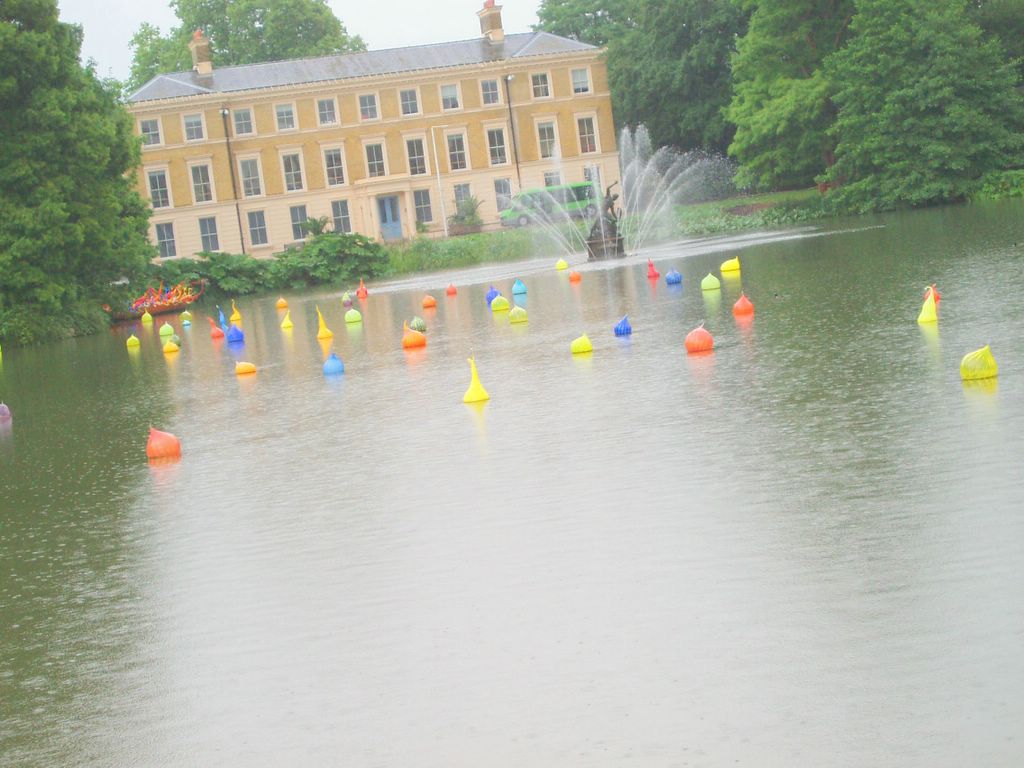
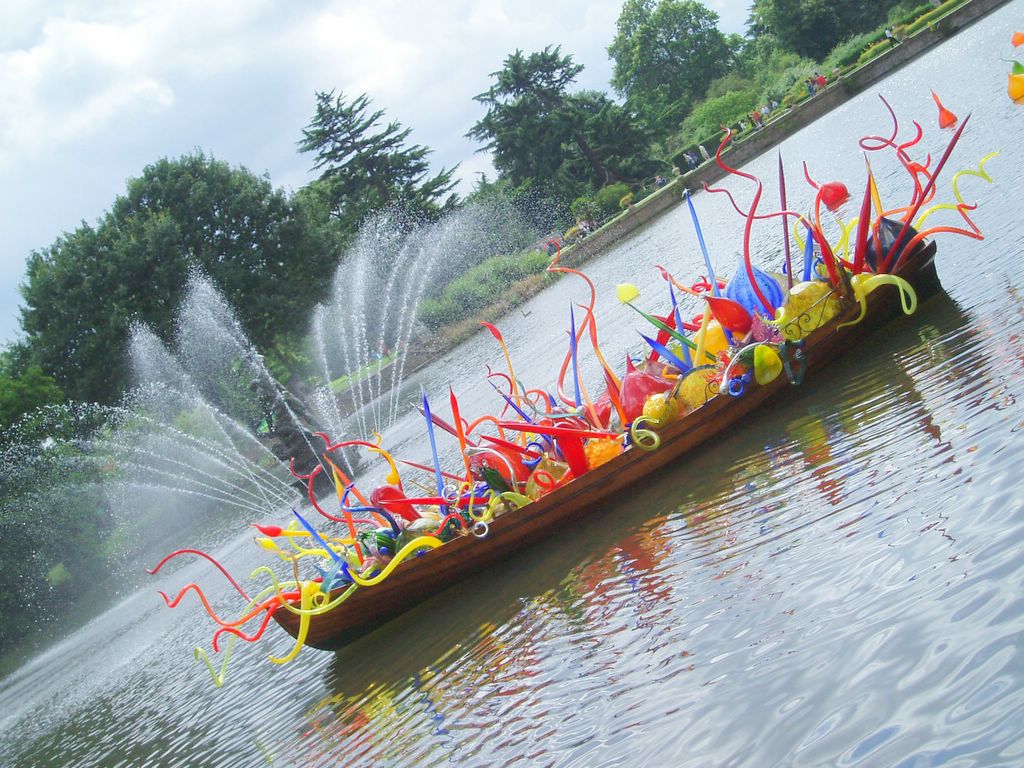
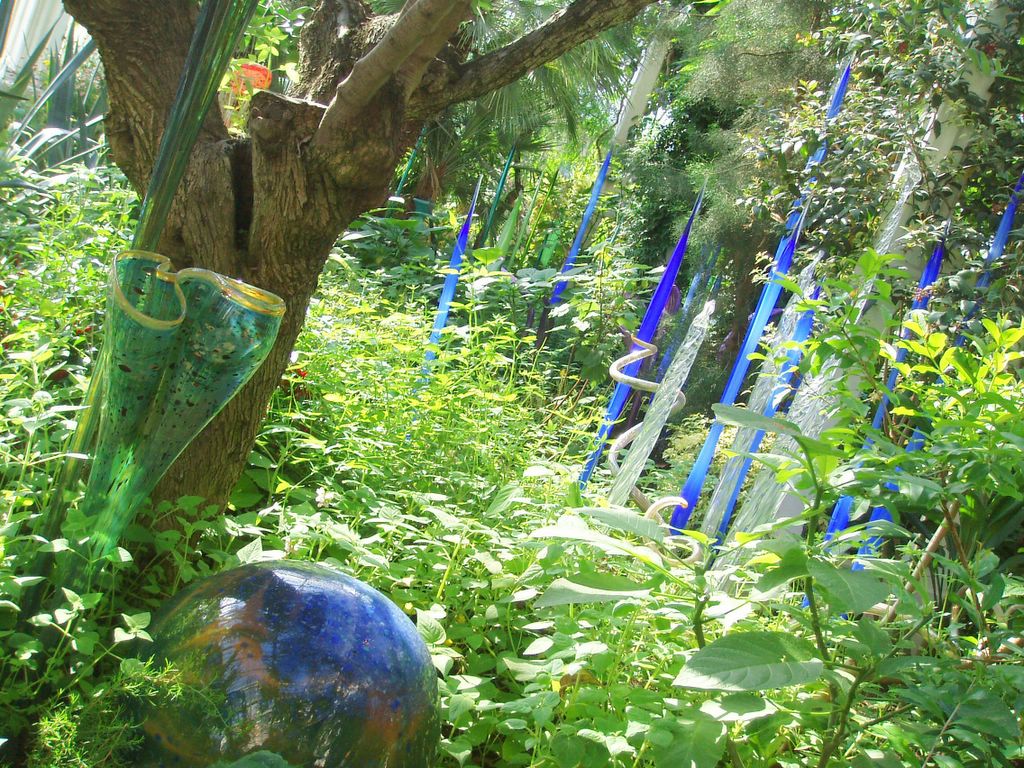
Until 15th January 2006, visiting the Kew Gardens gives you a surreal experience. The Gardens, especially inside the greenhouses, are dotted with Dale Chihuly's glass works. You don't expect colourful, beautifully-shaped pieces of glass standing or sitting amid trees, bushes, plants, or flowers, do you? This is a wonderful exhibition. You must go there. If you're coming to London on holidays, don't miss this out.

Unconvinced? Then look at pictures below.


On the way from the Victoria Gate to the Palm House


Walla Wallas, on the Palm House Pond


Thames Skiff, on the Palm House Pond


Red Palm House Tower, in front of the Palm House


Inside the Palm House


Inside the Temperate House


Inside the Temperate House


Persian Chandelier, at the atrium space in the Temperate House


Inside the Temperate House


Inside the Temperate House

Saturday, July 30, 2005


Inside the Temperate House


Inside the Temperate House


A stream inside the Temperate House


Inside the Temperate House


A pond in the Temperate House


Inside the Temperate House


A pond inside the Temperate House


Green Grass, inside the Temperate House


Macchia, at the west entrance of the Temperate House


Inside the Temperate House


Ikebana, in the Temperate House


Inside the Temperate House


Inside the Princess of Wales Conservatory


A pond inside the Princess of Wales Conservatory


Inside the Princess of Wales Conservatory


Reeds, at the Princess of Wales Conservatory


Basket Sets at The Princess of Wales Conservatory


The Sun, at the north end of The Princess of Wales Conservatory. Although this is supposed to be the leading installation of this surreal exhibition, it is not as impressive to me as others...

An extra


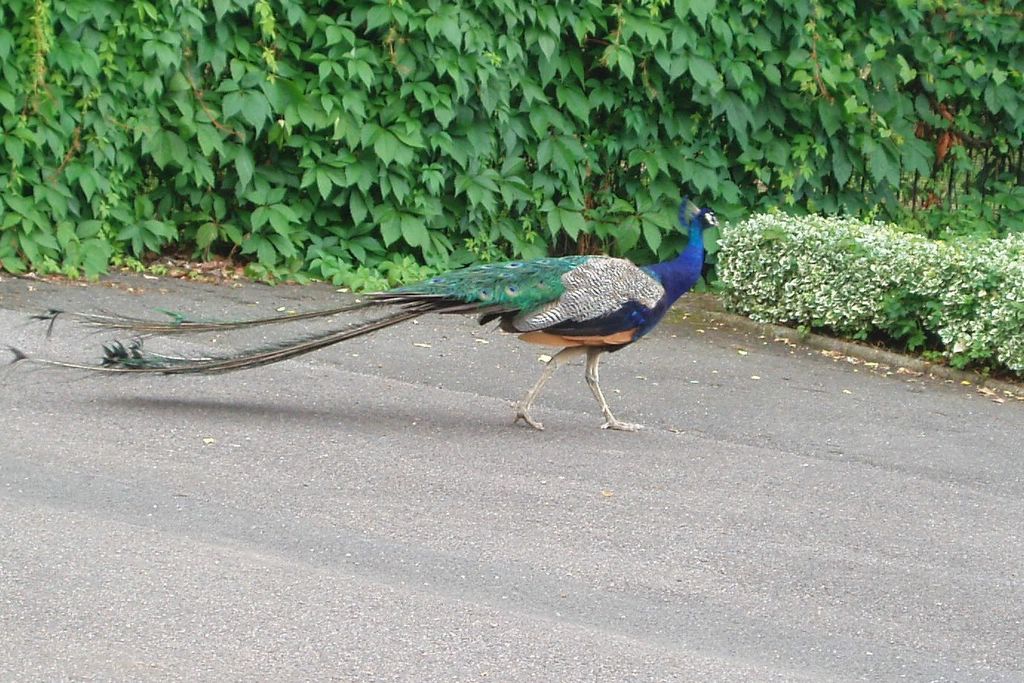
A peacock wandering (just like pigeons!) in the Pavilion Restaurant of the Kew Gardens

Sunday, July 24, 2005

Bedroom Curtain


This week was all about changing my bedroom curtain.

On Tuesday, I went to Ikea in Brent Park with Yumiko-san. (Hence the photo on 19th July). For those uninitiated, Ikea is a Swedish furniture store chain very popular in Europe. They sell pieces of furniture with minimalist design and for very reasonable prices. Some say every household in Britain has at least one piece of Ikea furniture.

Incidentally, Ikea will at last land in Japan next year. But I'm not sure if they will be successful in Japan. Minimalist design is nothing new to Japanese people. (Just remember Muji from Japan.) Plus, the popularity of Ikea in Europe seems to rely on its cheap prices at the cost of convenience and good services. (You need to assemble the pieces of Ikea furniture for yourself by reading very unhelpful instruction booklets.) Japanese consumers take good prices and good services for granted. I suspect Ikea will find it hard to penetrate into the Japanese market.

Anyway, I took this opportunity of visiting Ikea to change my bedroom curtain. Ever since I moved into my current house two years ago, my bedroom curtain, which was already there before I moved in, has been the same: a worn-out blue one. It has certainly been letting me down everytime I saw it.

I looked for one of contemporary design at Ikea store. Then I got the one shown in the above picture. Cool, isn't it?

The problem was I needed to fix a new curtain rod into the wall. The Ikea curtain was not compatible with the curtain rail in my bedroom. Which meant I needed to drill a couple of holes. But I didn't have a drill...

After coming home, I contacted a couple of my friends, none of whom had got one. So on Wednesday I went to Woolworths in the neighbourhood, finding one on sale for half a price (10 quid). So I bought it on Thursday.

Back in my bedroom, I realised that my window was wider (more than 2m) than I expected (my old curtain always hid the left edge of the window). The curtain rod that I bought at Ikea was too short!

On Friday, I went to Ikea again, all the way from East London to Northwest London (about one and a half hour trip). There is one Ikea branch in East London, but that one is in the middle of nowhere unless you have a car.

Today I began drilling my bedroom wall around midday. I realised the wall was so old that when I turned a screw into the hole I drilled, the screw simply scraped the hole further and never stopped turning...

Fortunately, a wooden bar was attached to the wall above the window. By drilling this bar, I finally managed to fix the new curtain rod into my bedroom wall by 6 pm.

Now I'm happy with my bedroom. :)

Wednesday, July 20, 2005


A kitchen showroom at Ikea Brent Park Store

Sunday, July 17, 2005

Economics in the view of Japanese bureaucrats

People outside Japan seem to believe that, as Japan now has the world's second biggest economy, the Japanese government relies on the wisdom of economists to manage its economy.

This is absolutely wrong.

A good example came out on an article of Yomiuri Shinbun, Japan's most-read (and a bit right-wing) newspaper today. (Special thanks to Hayashi-san for calling attention to this article.)

Three professors of economics/statistics in Japan - Takamitsu Sawa at Kyoto University, Naosumi Atoda at Keio University, and Toshihiko Igawa at Meikai University - have shown that statistically there is no correlation between the bidding prices for public works projects and the quality of such projects, counterarguing the view held by the Ministry of Construction and Transport that open bidding for public works projects is not appropriate as it deteriorates the quality of such projects.

What's "fascinating" is the comment by the Ministry official on this research result:

"The ministry holds that there certainly is a relation between bidding price ratios and evaluation scores. Quality is low when bids are low. We have no plan to further examine the data (used for the analyses)."
It's not a counter-argument at all. It's like the Ministry doesn't believe such an econometric/statistical analysis to evaluate government policies.

See? Economic policies in Japan are made by those bureaucrats who know nothing about economics.

Well, the research done by the Japanese econometricians and statisticians is itself not a good reason to believe that open bidding does not sacrifice the quality of projects: the data used in the analysis is about what happened under the system of "bidding among designated companies", not under open bidding. Presumably, the relationship between bidding prices and the quality of projects undertaken will change if open bidding is introduced. It may still be the case that what the Ministry argues is correct. Alas, there is no one in the Ministry who is exposed to econometric analysis enough to counter-argue in such a way.

Tate Modern

Went to Tate Modern to meet Cheyok, Eugene, and their friends. We watched the exhibition of Frida Cahlo, a Mexican surrealist painter. Her paintings are impressive, very unique, versatile, and beyond your imagination; but not pleasant to see.

The Turbine Hall houses an exhibition by Herzog and De Meuron, whose architectural works include Tate Modern itself. They display mock-ups of building designs that were discarded before reaching the final idea. In other words, a bunch of waste products. The curator insists that this way the exhibition shows the thought process that architects go through. But as so many mock-ups are scattered on many desks in the Hall and as little explanation is provided on which model came before which, it just confuses me. Well, confusion itself is probably the process of creativity. But it is not pleasant.

I always feel what's most fascinating about Tate Modern is not exhibitions themselves but the former power station that has turned into the contemporary art museum. Look at this (click to enlarge):


Also, the view of the Millennium Bridge and St Paul's Cathedral from here is magnificent. Everybody takes a picture here. I tried to take a bit different one. What do you think?

Thursday, July 07, 2005

The Mayor of London's statement

"... Finally, I wish to speak directly to those who came to London today to take life.

"I know that you personally do not fear giving up your own life in order to take others - that is why you are so dangerous. But I know you fear that you may fail in your long-term objective to destroy our free society and I can show you why you will fail.

"In the days that follow look at our airports, look at our sea ports and look at our railway stations and, even after your cowardly attack, you will see that people from the rest of Britain, people from around the world will arrive in London to become Londoners and to fulfil their dreams and achieve their potential.

"They choose to come to London, as so many have come before because they come to be free, they come to live the life they choose, they come to be able to be themselves.

"They flee you because you tell them how they should live. They don't want that and nothing you do, however many of us you kill, will stop that flight to our city where freedom is strong and where people can live in harmony with one another. Whatever you do, however many you kill, you will fail."

(Ken Livingston, upon arrival in London from Singapore, where the 2012 Olympics decision was made the day before. See the whole transcript.)

London under attack

On the day after it got the 2012 Olympics, and on the day when everyone's attention is directed at the G8 summit in Scotland, London seems to have been attacked by terrorists. A number of explosions in the public transport system were heard. (One bus blast near Russell Square, and 20 fatal casualties, is now confirmed by the Scotland Yard.)

All the tube lines are being suspended. Mobile networks are down now, for preserving phone communication for emergency services. All the buses in central London are just suspended.

I was at home, as usual, when things happened around 8:45 am. I'm physically fine, but feel depressed by this.

And, annoying Indian sales pitch calls are in operation normally. (I just got one.)

Tuesday, July 05, 2005

Kiyo's lunchtime concert


St. Bride's Church, (Fleet Street, London, EC4)

My concert pianist friend Kiyo, with a soprano performer Natalie, held a lunchtime concert at St. Bride's Church. As seen in the above picture, the interior of the church is beautiful. Among the pieces they performed, I liked Schubert's 'Libesbotschaft' and 'Fruhlingstraum'.

After the performance, we, along with Kiyo's friends, had lunch at a pub next door. I hate having lunch at English pubs because, you know... But Club Mangia at The Punch Tavern (99 Fleet Street) is a revelation. Their lunchtime buffet (7.5 pounds, and you can eat as much as you like) is extremely excellent. See its Time Out review.

Sunday, July 03, 2005

Somali cuisine

My Singaporean friend Linus loves trying obscure ethnic restaurants in London. I like to join his exploration. In the past he discovered the Ethiopian restaurant Menelik on Caledonian Road (see 14th November 2004) and the Turkish Bursa Inegol Koftecisi in Hackney (see 2nd April 2005).

Today, it's a Somali restaurant in Mile End Road: Tayo Restaurant. Everyone but us in the restaurant is Somali people, a good sign for authenticity.

When I arrived at the restaurant, Linus already had a spaghetti. Oh, yes, Italians colonised Somalia in the early 20th century. But, acoording to Linus, the taste is more of Indian. Yeah, East African coasts have a sizable population of South Asians because Muslim traders came to East Africa during the times of Islamic empires.

I don't know the name of what I ordered, something like meat and vegetable stew. It tasted like a Jamaican meal. Well, both countries have black people...

Accompanied with the stew was Somali bread, looking like Ethiopia's ingera (sour crepe). But it tasted different and good!

We noticed all Somali customers were easting bananas with the stew or other meals. Next time we should order bananas as well to have a proper Somali lunch.

The problem with such obscure ethnic restaurants is it is difficult to take girls there. Linus does take his girlfriends and enjoy seeing how they react. He's so mean. :)

Next door to the restaurant is a Somali clothes shop, where Linus got the incense and the decorated stand on which you burn incense with charcoal for the Ethiopian coffee ceremony. (Google "Ethiopian coffee ceremony, and you'll find its popularity!)


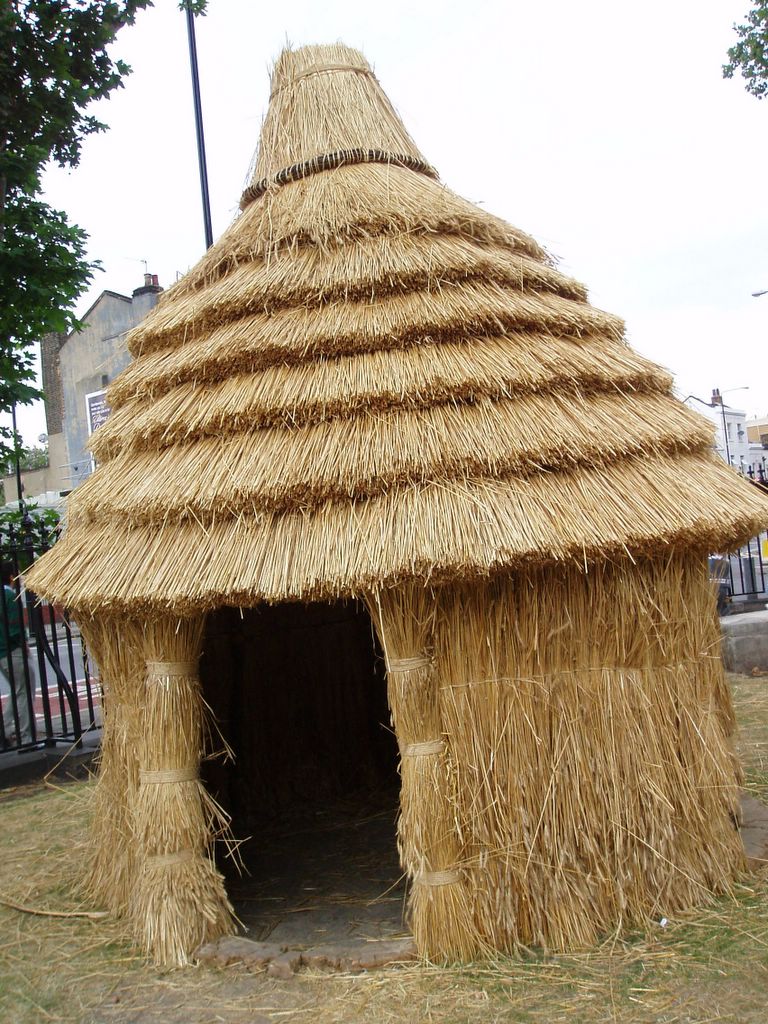
A replica Darfur hut, built by refugees from Darfur, western Sudan, in the front garden of the Museum of Childhood. Building this hut, say the Sudanese refugees, reminded them of their happy moments in Darfur.

Saturday, July 02, 2005

Spanish names

By tracking the names of dictators in Latin America, I'm confused with their names a lot. Take the Somoza dynasty in Nicaragua. The founder's name is Anastasio Somoza Garcia, who ruled the country since 1937. When he was assassinated in 1956, his son Luis Anastasio Somoza Debayle succeeded. In 1967, Anastasio Somoza Debayle, Luis's brother, succeeded.

How complicated! Especially, the last guy's name has no original part!

Then I found this website explaining how Spanish-speakers name their children. Finally it makes sense. Take the second-to-last name as the family name!

Sunday, June 26, 2005


Sienna Cafe, on the lower ground of Selfridges department store in London (400 Oxford St., W1)

Saturday, June 25, 2005

A Night of True Playaz at Fabric

So I went to Fabric last night. Going to Fabric seems to give people an impression of hard-core nightclubbing. They don't understand. Going to Fabric means getting exposed to the world's best sound system.

I finally discovered the best place to enjoy this high-quality sound in Fabric: the upstair balcony of Room 1. Fabric has three dancefloors. Soundwise, the best one is Room 1 (the worst is Room 2, where high-pitched sound is squeaking; Room 3's soundsystem seems to have been renovated - its bass sound is better than before). But the downstair dancefloor of Room 1 has some drawbacks: it's so ram-packed you can hardly move your body at will; bottles of beer are scattered around on the floor; some parts of the floor are wet and slippery (due to beer spilt out of the bottles), making it hard to dance; those who seem to be on drugs keep dancing as if they were alone, shoving people around them; and finally the MC's microphone sometimes causes feedback. These things had kept me away from Fabric for a year.

But in the upstair balcony, all these problems are solved. Surprisingly fewer people - and they are much nicer than those downstairs - dance here, and the acoustics is much, much better. I was listening to - and dancing to - DJ Hype's wicked 2 hour set (his impromptu mix of Pendulum's 'Masochist' is just incredible - he's been doing this since a few months ago, but now it's reached perfection) and A.I.'s liquid funk set (their new approach to drum & bass production - the combination of rather simple rhythm patterns and very fat low bass line - permeates their djing style as well) from 1 to 4am. I felt enormously happy. One of the happiest moments in my life. Although I was tired (see yesterday's post), I kept dancing without interruption. Although I felt hungry around 3am, I couldn't leave the place.

I went to Fabric with Daiten-san, a Japanese guy who got into drum & bass after starting living here in London three months ago. We met for the first time - Yumiko-san introduced him to me by giving us each other's email address. He's a nice guy. If you're a Japanese speaker, check out his blog. It's ridiculously funny, like a story of mushrooms budding in his bathroom. :)

Friday, June 24, 2005

I need toughness.

Today quite a few people told me that I looked tired. Yes, they were right. I was (and am) very tired.

The only thing I want now is toughness. I'm easy to get tired from hard working, which certainly hampers my productivity in research. Some say toughness, rather than intelligence, is the most important thing to be a good researcher. I agree.

Now I start babbling. If I had a girlfriend, I would certainly get tougher. No doubt. The problem is that when I'm tired, I stop bothering to talk, and get very unfriendly and very unthoughtful. Obviously girls don't like such guys. I'm trapped.

Thursday, June 23, 2005

econphd.net

For those who frequent Princeton Review Discussion Board to gather information on PhD programs in economics, econphd.net requires no introduction.

Probably lesser known is the fact that its ranking of economics departments is now linked from a couple of official websites of economics departments (UBC and UTI, as far as I know). Presumably, those departments which are ranked higher than usually perceived love this ranking.

What I like about this ranking is that those non-academic institutions are also ranked. By comparing the score, we see that the World Bank's research productivity is ranked as 14th in the world, falling in between those nearly top 10 (UCLA, LSE, Columbia) and those whose research productivity is almost half of top 10. I didn't know that the World Bank did that well.

What's also interesting is its new "network" ranking. This ranking counts publications not only by faculty members belonging to the university of concern but also by their co-authors outside the university. Compared to the original ranking, noticeable is the LSE's breaking in to top 10 (12th in the original; 7th in the network ranking). I suppose that this is reflected in the gorgeous list of visiting professors and seminar speakers invited to the LSE. If you keep reading my blog for the past three years, you may notice quite a few big names coming to LSE from time to time. I belive that there is a correlation between the number of professors in a university who co-author papers with a lot of people (which implies they also know quite a few researchers outside the university) and the variety of visitors to the university.

I think this is one factor - an obscure one, though - that you need to take into account when you decide which university to go. I'm not sure if this applies to pure theorists. But if you aim to be an applied economist, your research productivity depends on how widely you know the literature in economics. Take Montalvo and Reynal-Querol's paper forthcoming in American Economic Review, one of the best academic journals in economics (see 16th May). Their breakthrough comes from their familiarity with the literature on civil war and ethnicity and with a highly technical paper Esteban and Ray (1994). If Drs Montalvo and Reynal-Querol - the latter got her PhD at LSE! (I didn't know this) - just read papers directly related to civil war and ethnicity, they would never be able to write this paper.

Obviously, just talking to your supervisor and attending lectures by professors at your own university, the scope of your knowledge is limited. If, in addition, a variety of scholars visit your university and give talks on their pieces of research, your horizon expands.

Friday, June 17, 2005

Lesser-known "Good" Dictators - Part II

This post is a sequel to the post on 8th April.

Mohammad Zia ul-Haq (Pakistan, 1977-1988)

General Zia ul-Haq staged a coup after parliamentary elections earlier in 1977 resulted in the opposition party's accusation of the government, led by Zulfiqar Ali Bhutto, of vote-rigging.

During his rule, real GDP per capita (in PPP term) steadily grew, though not impressively, from 1040 US dollars in 1977 to 1580 dollars in 1987. Zia finally agreed to hold parliamentary elections in autumn 1988 though he was killed in an air crash on 17 August of the same year.

Googling "Zia ul-Haq" reveals that he was a pro-business dictator.

After 1977 the government of Mohammad Zia ul-Haq (1977-88) began a policy of greater reliance on private enterprise to achieve economic goals, and successive governments continued this policy throughout the late 1980s and early 1990s. Soon after Zia came to power, the government instituted constitutional measures to assure private investors that nationalization would occur only under limited and exceptional circumstances and with fair compensation. A demarcation of exclusive public ownership was made that excluded the private sector from only a few activities. Yet government continued to play a large economic role in the 1980s. Public-sector enterprises accounted for a significant portion of large-scale manufacturing. (Source: Country Studies - Pakistan)

Saturday, June 11, 2005

Congo

This week's The Economist magazine features a special report on Congo (no subscription required). The following story in the article is quite intriguing.

Veronique, an office worker, was separated from her daughter by the war. When peace broke out, she booked an aeroplane ticket for her (penniless) girl to rejoin her. But before the daughter could board the plane, she was detained. Her yellow fever vaccination card had been stamped by rebel health authorities, and so was invalid, the officials tut-tutted. Alas, she had no money for a bribe.

But Veronique was able to send her the equivalent of cash by mobile telephone. She bought $20 worth of telephone cards. These give you a code number which you key into your phone and thereby "recharge" it with pre-paid airtime. Veronique called the obstructive officials and gave them her code numbers to recharge their own mobile phones. It took only minutes to send her bribe across the country?faster than a bank transfer, which would in any case have been impossible, since there is no proper banking system.

Thursday, June 02, 2005

Back from Syria

I've been in Syria for the past 12 days, visiting a friend of mine living there. I'll start another blog called Syria 2005 to "propagandise" this amazing country as an ideal travel destination, with photographs taken there. Check it out.

Wednesday, May 18, 2005

DESTIN-STICERD joint seminar part II

The second DESTIN-STICERD joint seminar. (See here for the first one held last November.)

This time, the main theme is "Aid and the End of Poverty". As it suggests, the background is Jeffery Sach's recent book The End of Poverty (see 9th April for Sach's basic argument) and a recent political initiative undertaken by the British government to end poverty in Africa (see Commission for Africa website).

The first speaker is Francesco Caselli, representing development economists. His main point is that the effectiveness of aid depends on which world the poor live in, the nonconvex one or the convex one.

In the nonconvex world (or the world endowed with increasing return technology), the poor cannot get richer because of (1) minimum consumption to survive (therefore they can't save at all), (2) lack of education, (3) lack of healthiness, and (4) lack of infrastructure. But if your wealth exceeds a certain level, then these problems are suddenly solved, hence you start getting richer and richer. This is the world Jeffery Sachs envisions, and the rationale for more aid as aid money brings the poor immediately above the threshold level of wealth.

In the convex world (or the world endowed with decreasing return technology), on the other hand, the poorer you are, the higher the investment return. In this case, aid is wasteful because at the end of the day everyone reaches the equilibrium level of wealth (remember the Solow growth model). What matters is the curvature of production function, which is affected by, say, governance.

Therefore, the question is which world the poor live in. Based on evidence available, the convex world seems more likely as empirical studies have shown that return to education is higher in poorer countries and that return to physical capital is also higher in poorer countries (see Professor Caselli's own working paper).

He also raises two questions. Are the middle class people (whose wealth level is above the threshold in the non-convex world) becoming richer fast? If so, the world is non-convex. Is there any evidence that aid triggered the take-off of the economy? If so, the world is non-convex.

The second speaker is Dr. Teddy Brett from DESTIN. He points out quite a few countries where aid worked because the government was good (Uganda after the 1980s, India, Botswana, Ghana, Mozambique, Morocco, and, to a lesser degree, Egypt). So we shouldn't be so pessimistic. His main point is that aid is effective with good governance, which consists of bureaucratic capacity and the government's commitment.

Now it's PhD students' turn. The third speaker is Masa Kudamatsu from STICERD.

Yes, I was the speaker. :) I talked about under what conditions self-interested political leaders are willing to use aid money to tackle poverty. I introduced two theories in the literature of policy-making in autocracy.

The first one is Mancur Olson's stationary bandit theory (see McGuire and Olson 1996). According to this theory, political leaders tackle poverty by using aid money if both of the following two conditions are met: (1) The government is capable of collecting taxes (Self-interested politicians are assumed to consume tax revenue for their own benefit, and therefore we need to have a positive correlation between poverty reduction and tax revenue); (2) Political leaders won't be ousted in the near future (otherwise leaders cannot reap the benefit from poverty reduction even if the first condition is met).

The second one is the agency model approach (or what is sometimes called the political accountability model), first proposed by Barro (1973) "The Control of Politicians: An Economic Model", Public Choice, 14, pp.19-42, and Ferejohn (1986) "Incumbent Performance and Electoral Control", Public Choice, 50, pp.5-25. Although these two authors had in mind democratic politics, the basic idea can be applied to autocracy as well (see Gallego and Pitchik 2004, for example). This theory tells us again that we need both of the two conditions to be satisfied so that self-interested political leaders are willing to tackle poverty out of aid money: (1) the poor can play a role in leadership selection (otherwise political leaders will stay in office without tackling poverty); (2) the poor can trust a potential new leader who will assume office after the current leader is ousted (otherwise, the poor are happy with the incumbent who takes poverty serious only marginally because the alternative to the current leader is even worse). (The second point was brought to attention by Bueno de Mesquita et al. 2002, and Padro-i-Miquel 2004 applied it to African ethnic politics.

I couldn't effectively connect these ideas to the points raised by the two faculty members earlier in the seminar. That was my regret. But I guess the presentation went well overall as Robert Wade, a professor from DESTIN, told me it was interesting and crisp. (I didn't know the meaning of "crisp". Later I looked it up in the Collins Cobuild English Dictionary; it says, "If you describe someone's writing or speech as crisp, you mean they write or speak very clearly, without mentioning unnecessary details.") Special thanks goes to Paolo, who gave me comments on my slides, saying, "Difficult to understand." :)

The last speaker is Elliot Green from DESTIN. He is a specialist of Uganda. He points out that the headcount ratio (the percentage of the poor over the total population) in Uganda had been in decline during the 1990s but went up around 2000. He attributes this dynamics to the coffee price in the world market. If you look at the headcount ratios by region, the number of poor people is falling mainly in the central region, where coffee beans are produced. Plus, the world coffee price was on the rise durng the 1990s and began falling until 2002. He also mentions that democratic elections for regional governments in Uganda actually caused a fall in tax revenue because the governments cut taxes in order to win votes. This is detrimental to good governance in his view (and, it seems, in the view of most development studies researchers) because the link between the government and citizens is broken without tax collection. (This argument is shared by The Economist magazine as well. See this article.)

So there seemed to be a consensus between me and Elliot (and some DESTIN students) that tax collection is key to poverty reduction.

During the floor discussion that followed, a couple of interesting interactions between economics and development studies emerged. In relation to Professor Caselli's question - is the middle class people getting richer quick? - Bettina, a DESTIN student, pointed out the fact that middle class people in poor countries simply invest their money overseas or emigrate to rich countries. Prof. Caselli's response was that it indicates the return to investment for middle class people is low, supporting the idea of the convex world.

Also in response to Professor Caselli's comment that good governance comes with a good leader, which is more or less a matter of luck, Dr Brett raised an interesting point. President Yoweri Museveni of Uganda and former President Charles Taylor of Liberia were both rebel leaders who succeeded in defeating the government forces. But under Museveni's rule Uganda has seen improvements in the economy (with caveats pointed out by Elliot, though) while Charles Taylor just brought another civil war to Liberia (see this BBC article). The difference between these two cases is, in Dr Brett's view, higher education. Uganda received a lot of aid money to improve its higher education system in the 60s and 70s, which President Museveni enjoyed before turning to be a rebel leader. This didn't happen in Liberia. So Dr Brett welcomes one suggestion made by the Commission for Africa that aid should target higher education in order to bring about good governance. This point is revealing to me as development economists all ignore the role of higher education in development.

The seminar ended with this argument on the quality of leadership. This is somehow encouraging to me because that's what I'm now trying to figure out: how the quality of leadership is determined in nondemocratic countries.

Overall, I benefited a lot from this seminar though other STICERD people didn't seem to (plus, none of STICERD professors attended the seminar)...

Monday, May 16, 2005

Polarization and Conflict

Debraj Ray's LSE public lecture titled "Polarization and Conflict". One of the best lectures I've ever attended, in the sense that it synthesizes theoretical and empirical works done by economists (including the lecturer himself, of course) to answer a practical question.

The lecture begins with the following question: Does ethnic division matters for civil war? Although there are quite a few reasons you can think of in favour, statistical analysis done by economists and political scientists has failed to identify the effect of ethnic division on the occurrence of civil war (see Fearon and Laitin (2003) "Ethnicity, Insurgency, and Civil War", American Political Science Review, 97, pp.75-90). This does not exclude the possibility that ethnic division indirectly affects civil war through, say, poverty. But the consensus emerging from the empirical literature is that ethnic fragmentation does not have a direct impact on civil war.

Professor Ray now asks this: Is the measure of ethnic division appropriate? The measure those empirical researchers have used is called "ethnolinguistic fractionalization index", which measures the probability that two people randomly picked up from a country belong to different ethnic groups (a good reference is probably Easterly and Levine 1997). Horowitz (1985), a book that takes a historical - rather than statistical - approach to this issue, suggests that broad cleavages, not fractionalization, matter. Civil war is more likely to happen when we see, in a given country, two large distinct groups rather than a large number of different groups. But how can we conceptualize this notion of "broad cleavages"?

Professor Ray, along with Joan Esteban, already made this happen in 1994 (see Esteban and Ray 1994). He created a measure of polarization. This measure captures two ideas: identity and alienation. Identity refers to how many people you are identified with - what can be called "local equality". Alienation refers to how far other people are from you - something called "global inequality". As civil war is not something you can do individually, you need to capture something social. That's what "fractionalization index" fails to do. But Esteban-Ray's polarization measure does.

Now a forthcoming paper in American Economic Review - "Ethnic polarization, potential conflict and civil wars" by Jose G. Montalvo and Marta Reynal-Querol - utilises this concept of polarization and does the same empirical analysis as Fearon and Laitin (2003) (see above). Guatemala, Sierra Leone, Nigeria, and Bosnia, countries well-known for civil war, turn out to be countries with high polarization index but low fractionalization index. Even after controlling for a bunch of other variables - income per capita, population, geography, etc. - it is shown that the index of polarization does have a direct impact on the probability of civil war.

The lecture closes with a remaining issue: Do economic differences across groups matter for conflict? Empirically, this question is hard to answer due to lack of data. But it's beginning to be collected. Theoretically, there are two types of civil war: vertical war (poor vs. rich ethnic groups as in Rwanda and Burundi) and horizontal war (economically similar groups fighting each other as in Nigeria). Research is now going on to figure out how economic differences across groups affect the occurrence of civil war.

Tuesday, May 03, 2005

Robert Townsend's lecture at UCL

Robert Townsend came over to University College of London and gave a two-day lecture titled "Evaluation of Financial Systems in Developing economies".

Professor Townsend is one of the leading development economists though his research strategy is quite different from the others in the sense that he tries to understand macroeconomy by looking at microeconomic datasets. I think this is cool. Usually, economists are either looking at macroeconomic datasets to talk about macroeconomy or looking at microeconomic datasets to talk about microeconomy.

What's also cool about him is, though this is a bit gossipy, he has been doing research on how the economy has grown in a country where his partner comes from (see the overview of Townsend Thai Project). I think this is beautiful.

Anyway, his main argument in the lecture is that Thailand's economic growth in the past few decades has been mainly driven by financial deepening; more and more people become able to borrow money, thanks to a variety of financial policy measures undertaken by the government, and set up their own small businesses.

On the first day, he mainly talked about hard facts on the Thai economy. Based on not only national account data (GDP etc.) but also household survey datasets collected by the Thai government as well as by Townsend's research team, he gave us the following revealing facts:

1. In Thailand, households, usually seen as labor suppliers and goods consumers in macroeconomics (look at the circular flow diagram in your macroeconomics textbook), play a huge role in production. The share of income earned by small household businesses is larger than that of big corporate businesses in Thailand.

2. Looking at tambon-level data ("tambon" is a Thai word for dictricts, smaller than provinces but larger than villages), income distribution is more equal in high-income tambons than in low-income ones, contradicting the usual argument that economic growth brings about inequality at the initial stage of development (Kuznet's inverse U-curve theory).

3. Around 20% of change in per capita income is explained by population movements from low-income occupations to high-income ones.

4. 97% of fimrs in Thailand is small-sized, with many being rice-mills run by one person.

5. The more assets you initially have, the more likely you start a business later and keep your children at school.

6. The BAAC (Thailand's government bank for farmers) serves as an insurance provider for farmers, by rescheduling loan repayments conditional upon verified unexpected shocks such as rainfall failure, with delayed repayments compensated by government subsidies. Looking at who each household borrows money from, the BAAC serves for poor people while other sources of credit (commercial banks, moneylenders, etc.) are mainly for rich people.

On the second day, his lecture began to be more formal. First, he explained his recent article published in Journal of Development Economics, where a simple occupational choice model (see Ghatak and Jiang 2002 for the simplest exposition on what the occupational choice model is like) with the non-intermediate sector where people cannot borrow and the intermediate one where people can borrow is constructed, parameters in the model are estimated based on the Thai household survey data (the amount of wealth they own and whether or not they are self-employed), and macroeconomic variables (growth rates, gini coefficients, etc.) are calibrated. He stressed that this model explains the huge surge in Thailand's economic growth rate in the early 1990s.

An interesting point is that this analysis treats the relative size of the intermediate sector (ie. the fraction of people with access to credit) as exogenous. If they build a model where the fraction of people with access to credit is endogenous and calibrate macroeconomic variables (see Townsend and Ueda 2003), the model fails to explain the upturn in Thailand's growth rate in the early 1990s! That's why Professor Townsend believes that the expansion of finaical markets in Thailand is largely exogenous, induced by the financial liberalization undertaken by the government.

This style of argument is very different from what I'm used to at LSE, or in other words, the way the majority of leading development economists adopt. They say, "At the end of the day, most economic variables are endogenous. So let's find an instrument. If that's very difficult, let's do randomly assigned policy interventions by persuading NGOs (e.g. Kremer and Miguel 2003), the World Bank (Olken 2004), or even the national governments (Shultz 2004)."

I believe it's not about which approach is superior to the other, though Townsend's approach may not be a good strategy for those who want to get more and more papers published in top academic journals...

The above model is, of course, not perfect. Some model predictions are not compatible with reality. But, Professor Townsend said, the model insufficiency tells you what kind of modification in theory is needed and what kind of data is needed. "That's how research makes progress," he said.

He went on to introduce other pieces of research done by him and his students. Interesting results are as follows:

1. Even for those with access to credit, the wealth matters for starting a business. The world is not neoclassical even for them. (A very intriguing statement for an economist at University of Chicago.)

2. Thai firms in a business group share risk; individual firm characteristics do not matter for cash flow within each group.

3. Rubber producers in south Thailand do not smooth consumption in response to rubber price in the world market, a result in contrast with Paxson (1992) on Thai rice farmers.

4. The impact evaluation of the Million Baht Village Fund program - the Thai government gives one million bahts (about US$25,000) to each village, irrespective of the number of households in a village - suggests that the less the number of households in a village (which means more access to credit), the more villagers borrow from other sources of credit, the higher their consumption, and the higher their agricultural investment. (Kaboski and Townsend 2005)

5. The source of credit market imperfection is moral hazard, not limited libability. (See Paulson and Townsend 2003.)

Let me conclude by mentiong this: Professor Townsend said he is increasingly interested in political economy. By doing the whole macro and micro economic research as described above, he came to a conclusion that different financial sectors in Thailand are regulated quite differently. Financial markets are segmented with the BAAC targetting the poor and commercial banks targeting the rich. He seems to want to know why this is the case, a question that requires political economy research.

See? It's political economy that matters in the end when you do research on economic development!

Sunday, May 01, 2005

Macondo on Hoxton Square

Had brunch with Sean at Macondo (Unit B2, 8 & 9 Hoxton Square, N1, phone: 020 7729 1119).

Along with dishes, we engaged in a little FAKE cultural exchange: I ordered a soft drink called Agua de Jamaica; Sean from Jamaica ordered a cocktail called Kamikaze. Neighther originates from each country. :)

The second time to come to this nice little cafe/bar/restaurant on trendy (and dodgy at night) Hoxton Square. Although the service is a bit too relaxed, food is good and value for money (three dishes of your choice for 6.50 pounds). The decor is quite relaxing with comfortable sofas and chairs. I like this relaxed atmospher.

Saturday, April 30, 2005

My home-made Chinese dumplings

Invited to Cheyok and Joel's home party. (I guess "home party" is a Japanese English. Google "home party". You'll see two of the first ten websites written in Japanese...)

Brought home-made gyoza, or Chinese dumplings. Incredibly popular among guests. :) The third time I cooked them for someone else. (My blog posts in archives for the first time and for the second time.) They're always popular.

Friday, April 29, 2005

Daron Acemoglu

Daron Acemoglu won the John Bates Clark Medal, the prize given each other year to the greatest economist under the age of 40, which is a good indicator of who will win the Nobel Prize in Economics in the future.

I knew this news by visiting LSE's Economics Department website (see the NEWS section). LSE seems to be proud of him as he's the first former LSE PhD student winning this prize.

The award is given by the American Economic Association, whose website describes Professor Acemoglu's contributions.

What's weird to me is that this description only very briefly mentions yet another big contribution Acemoglu does to the field of political economy. He, along with James Robinson, came up with an economic theory of democratization, which is succinctly summarised in Chapter 2 of their forthcoming book. (See 18th January 2005 in my blog archives for the discussion on their theory.)

I believe this work also deserves a lot of attention.

Saturday, April 09, 2005

Jeffrey Sachs

Attended Jeffrey Sachs's public lecture at Queen Mary, University of London. He's delivering the same public lecture at LSE next week, too, but I've just got bored with LSE's lecture theatre. :)

A sixth of the world's population (1.1bn) live in absolute poverty, with their (imputed) income less than 1 dollar a day. People in Washington, D.C., say it is all about corrupt politicians and government officials. Professor Sachs says it's not only about that.

Poor people, especially in Sub-Saharan Africa, are too poor to be part of global economic development. Compare them with the poor in China and Indian; they have been becoming part of it and starting to enjoy the benefits. What causes this difference?

African people are vulnerable in three ways. First, they are vulnerable to crop failure. Compare them to Asians. Asia has become self-sufficient in food thanks to the Green Revolution, which requires the use of irrigation and fertilizer. Africa has failed to do so because of lack in both. Africa does not have the Himalayas, which ensure high water tables across Asia along with the monsoon. In Africa, rainfall evaporates very quickly; just a short spell of no rain causes serious damage in crop yielding. They need irrigation, but they simply cannot afford it. In addition, with the population rapidly increasing, they no longer fallow land, preventing nitrogen in the air from being fixed to the ground. If they could afford fertilizer, crop yield will triple. But they simply can't afford it. It is possible to make it happen, though, if donors give money to them.

Second, they are vulnerable to disease. Malaria is transmitted far more quickly in Africa than anywhere else because Africa provides the most favourable environment for malaria virus. But it is 100% curable. They can't afford drugs or can only afford the previous generation of drugs that are no longer effective. They can't afford preventive measures, either. They don't have cash to buy insecticide or bed nets. If donors give them such things, poor Africans will no longer be vulnerable to disease.

Finally, they are vulnerable to isolation. Many Sub-Saharan African countries (along with Afghanistan, Bolivia, and Nepal in other continents) are landlocked. It is difficult for them to trade with countries overseas. On top of that, however, these countries often lack in transportation and communication infrastrucre inside the borders as well. If there is no paved road, transporting crops to the nearby market is very costly. If there is no phone, you have to walk to a faraway town, only to find there is nothing to buy today. But they simply cannot afford such infrastructure. Again, giving them aid money solves the problem.

So what we need is simply more money. At the end of his lecture, he stresses the recent movement by EU countries (UK, France, and Germany among others) to set a timetable for reaching the 0.7% target in foreign aid. (In 1970, rich countries agreed to aim for providing foreign aid equal to 0.7% of their GDP. Except some countries -Norway, Sweden, Denmark, the Netherlands, and Luxemburg - they have failed to achieve it.)

He has very few words on how to ensure that aid money will be properly spent. But his succinct summary of causes of poverty (vulnerability to crop failure, disease, and isolation) is revealing to me. Also what strikes me is his idea that there is a jump between absolute poverty and the process of economic development due to capital accumulation (physical and human). Absolute poverty prevents people from saving. In this situation, the market force does not work. It's not about too many regulations imposed by the governments.

Professor Sachs has been an advisor to the governments of many countries and visiting many poor countries around the world. His talk seemed to come from these expeeriences, not from academic works. It made me realise that my view on development has been a bit confined by mainstream development economics. (Professor Sachs is no longer part of it.) This way, the lecture was worth attending for me. (Plus, it may give me an idea useful to my research...)

The lecutre, by the way, is part of his book launch tour (see his new book website and a book review by The Economist magazine - subscription required). He also held signing after the lecture. He's like a novelist.

Friday, April 08, 2005

Lesser-known "Good" Dictators - Part I

I started investigating what actually happens behind the dataset by reading area studies journal papers available at Jstor. During the course of this investigation, I realised there are lesser-known "good" dictators, good in the sense that investment, the most robust determinant of economic growth, is somehow encouraged under their rule.

So I decided to take notes of them in this blog. Today you'll know three "good" dictators from Bangalesh, Burkina Faso, and Burundi. All the economic figures come from the Penn World Table version 6.1.

Ziaur Rahman aka Zia (Bangladesh, 1975-81)

Under his rule, the share of investment in GDP went up from 6.82% in 1975 to 13.08% in 1981. Although the economic growth rate was volatile, real GDP per capita also went up from 963.43 US dollars to 1059.29 dollars (both in 1996 value). His economic policies are discussed in

Syed Serajul Islam (1986) "Relative State Autonomy and Development Strategy in Bangladesh, 1975-1981," Pacific Affairs, 59(4), pp.563-576.
4o percent of the industries nationalised by the previous government were handed over to private entrepreneurs. The constitution was amended so that acquisition, nationalization or requisition of property could now take place "with compensation only."

This move, however, was applied only for industries losing money; he retains control of profitable sugar industry, for example. Behind this profit-maximization objective, argues the author, lies his reliance on the military's support; the defense budget shot up after he seized power in 1975.

Thomas Sankara (Burkina Faso, 1983-87)

Under his rule, investment as a ratio of real GDP picked up from 7.37% in 1983 to 12.91% in 1985 (then declined to 10.25% in 1987). Although his political ideology was rather left-wing, "private investment in manufacturing industries, in construction and in agricultural input supply sectors was encouraged... [T]he economic policies ... under Sankara resembled the approach advocated by the World Bank in terms of regulating the public sector" including cuts in pay and number employed in public administration (Mike Speirs (1991) "Agrarian Change and the Revolution in Burkina Faso," African Affairs, 90(358), pp.89-110).

Jean-Baptiste Bagaza (Burundi, 1976-87)

Under his rule, the share of investment in GDP steadily went up from 3.48 percent in 1976 to 12.86 percent in 1984. Although the economic growth rate during this period were more volatile (so real GDP per capita in 1987 was almost the same as in 1976), he must have done something to create a good investment climate in Burundi. Unfortunately, information on his rule is very scarce. The only piece of information I found is on page 35 of
Rose M. Kadende-Kaiser and Paul J. Kaiser (1997) "Modern Folklore, Identity, and Political Change in Burundi", African Studies Review, Vol.40, No.3, pp.29-54:
"Closely allied with the army, Bagaza carefully controlled ethnic relations, not permitting Hutu and Tutsi to emphasize their ethnic identities through fear and repression. During this period, the army and government became increasingly under the control of Bagaza's political confidants, many of whom were Tutsi from the south. ... There was relative calm in the country during the Second Republic..." (Note: the Second Republic refers to the period of Bagaza's rule)
I'm unable to find any more than this. If you know about Bagaza's economic policies, let me know.

Monday, April 04, 2005

Cancellation

I cancelled the conference presentation at SMYE2005. The monetary cost of doing this: 40 euro for conference registration fee already paid and 13 pounds for The Rough Guide Switzerland (I didn't buy one online).

My supervisor's advice was two-fold.

Number one: Never present what you're not convinced about.
Otherwise it hurts your reputation as a researcher. Cancellation of conference presentation is less hurting than presenting something dubious.
Number two: Successful PhD students are those who worry little and write a lot.
I was told I always worry too much. Before worrying, just write up a draft! That's what he said.

It's true that I'm a guy who worries too much not only about research but also about everything about my life (as pretty much obvious for long-time readers of this blog). I know this just wastes my precious time. But that's my personality, difficult to change. As long as research is concerned, however, I MUST change this.

Sunday, April 03, 2005

No Sunday for me.

Went to the School, preparing a bit for tomorrow's meeting with my supervisor. See 31st March.

Saturday, April 02, 2005

Saturday lunch at Hackney

Had a Turkish lunch with Linus at Bursa Inegol Koftecisi (6 Morning Lane, Hackney E9). Brilliant pide bread and juicy chicken shish with friendly staff and Turkish customers.

Hackney is a distinct place in London, different from any other districts in London. Even McDonald's has got a different atmosphere with a special burger called Curry Chicken Burger.

London Bus drivers

London Bus drivers are sometimes mental.

I was waiting for a bus to come at a bus stop near Bethnal Green tube station today. As happens very often with London Buses, two buses came at the same time.

(Digression: You might think this was due to jammed traffic. You are wrong. The bus stop near my home in London is the second bus stop from the one end of a bus route. So buses coming from that end of the route shouldn't be affected by traffic congestion. Still, I sometimes see two buses coming in a row. It's not traffic. It's drivers. What happens in bus garages is likely to be that a bus driver is having a chat with his colleagues, forgetting his departure time. Then the driver of the next bus comes to him and says, "Why are you still here? It's time for me to leave the garage!" So they come together.)

Anyway, I chose to get on the second bus as there were a lot of people queuing to ride on the first bus. (Another reason is that the second bus often overtakes the first one before I end the 10 minute bus journey to my home.) The driver of the second bus didn't open the entrance door. I knocked the door. He ignored me. When the first bus left the bus stop, this second bus also left.

What's the point of this? Why are passengers not allowed to get on the second bus in a row? My jaw dropped into the underground...

Friday, April 01, 2005

Emergency

The following is the email message I sent to my supervisor:

I found that my argument that the way to select chief executives in the government matters for the economy was totally wrong. The direction of causality is very likely to be opposite, which is nothing new or surprising. My paper was accepted to present at a conference in three week?s time (at Summer Meeting of Young Economist 2005 in Geneva), and I wonder whether or not I should cancel it. The detailed conference program hasn?t been announced yet, so the cancellation will probably be accepted if I say so as soon as possible. And, for a longer-term concern, I wonder how I will continue on this topic...
His response:
These sort of ups and downs are part of research so don't worry too much.
We're going to talk about this next Monday...

Thursday, March 31, 2005

Shoe laces

I didn't know that shoe repair shops are the place to buy shoe laces...

I needed to replace shoe laces for one pair of my shoes. Initially, I thought I could get one by visiting shoe shops. So I went to Neal Street, Covent Garden, where lots of shoe shops are clustered (see this page for more). Among ten shops or so, only two shops had shoe laces. And the choice was quite limited. I wanted to have thin shoe laces, usually used for boots or leather shoes, because I was sure thin laces would fit my shoes perfectly though the original one was not so thin. But none of these shops had thin laces.

On another day, I went to Church's, a posh shoe shop on Regent Street. They didn't have any. Then I went down to Harvey Nichols, a stylish department store near the famous Harrods. Their shoe shop didn't have laces either. A shop attendant there told me I should go to a shoe repair shop.

I had no idea where shoe repair shops are located. I grabbed my Time Out Shopping Guide and spotted a shoe repair shop called Krantz and Son (180 Drury Lane).

Today I went there and found the most wide-ranging (in terms of length, colour, and design) stock of shoe laces. I bought a pair of 120cm thin shoe laces for 2.45 quid. Going home and replacing the old laces with this new ones, and voila! My shoes now look better than before!

Tuesday, March 29, 2005

Two Japanese ladies in London

Thanks to Kiyo and Alberto, I found a nice cafe-restaurant in Angel: Art to Zen cafe-gallery. The atmosphere is arty with contemporary abstract paintings hanging on the walls. But for some reason it's not pretentious at all.

And the food is excellent. I ordered salmon and mussel tagliatelle. This tasted amazingly brilliant. And it cost just 5.50 quid. There are also some Japanese meals available.

It seems like the owner of this cafe is a Japanese called Akemi. I'm not sure if she's the chef. But she's done a great job here in London.

---

With Alberto, I visited the Serpentine Gallery. Until 10th April, the gallery features a Japanese contemporary artist Tomoko Takahashi, who was shortlisted for the Turner Prize in 2000. Her installation was crazy. Just crazy. At face value, it seems to be a total chaos; lots of rubbish are just scattered around. But look more closely and you'll feel a subtle sense of order in it. I felt the artist's enormous sensitivity. You may at first think you can construct this installation too. Think more and you'll realize you would go crazy if you have to finish it on your own.

Alberto, who usually is quite sceptical about contemporary art, was reminded of his childhood by looking at Takahashi's work. He seemed to like this rubbish art in the end.

On the final day of the exhibition, visitors will be allowed to take away any materials used for this installation. This kind of playful ideas can be seen in the installation as well, which probably contributes to the rather soft and tender atmosphere for a contemporary art exhibition.

Turntables

I've been wanting to buy a turntable as most drum and bass tracks are only available in vinyl. At last, I did a bit of research by Googling a lot this morning. After two hours of research, I found it costs no less than nearly 300 quid for my purpose.

There are basically two types of turntables out there: home-use and DJ-use. Main differences between these two are (1) belt drive or direct drive; (2) with or without built-in phono-preamplifier; (3) without or with pitch control.

The first difference is about whether or not you are unable to scratch records. For my purpose, I don't necessarily need to scratch, but if possible, I want to practice scratching just for fun. So the DJ turntable wins here.

The second difference is about whether or not you want to connect your turntable to the Hi-Fi system without a phono input. If you just plug a turntable into your stereo, the sound level will be very low. You need to amplify the vinyl sound. But my stereo does not have a phono-preamplifier. Connecting a DJ turntable to line-in inputs won't work. The home-use turntable wins here.

The final difference is about whether or not you are happy with the speed of music just as fast as recorded. I want to listen to drum and bass with vinyl. But DJs always play records a bit quicker than the recorded speed. I'm used to that speed by going clubbing or listening to the radio. So I want to control the pitch of music. The winner in the final round is the DJ turntable.

So I need a turntable with built-in phono-amplifier AND pitch control. The only option for this type of turntable seems to be Vestax BDT-2500, which costs nearly 300 quid. This one is a belt-drive type. So I can't scratch. There seems to be no direct-drive turntable with an amplifier built-in.

Or I can buy Numark TT200 for less than 200 quid (reputable DJ turntables like those made by Technics and Vestax cost more than 300 quid) and some phono-amplifier like TerraTec Phono PreAmp Studio USB for 100 quid.

But I don't have 300 quid. My budget is 200 quid...

Sunday, March 13, 2005

No more frequent blog-updating

I don't think I will be able to update this blog as frequently as before.

All my energy is directed towards research. I don't have any energy left for anything else, including blogging and even (sadly) loving someone.

I think I'm happy if I can only do research and enjoy listening to drum & bass and dancehall reggae on the radio. (I realise I now prefer dancehall to hip hop. Hip hop is about to die. No new stuff comes out in that genre anymore. In a response to Chris's post on 50 Cent, the whole story can be found at BBC 1Xtra's website. He always picks a beef (a hiphop slang term for fight). Last year against Ja Rule. This year against Fat Joe and Jadakiss. I don't care what rappers do non-musically. But I can't appreciate his rapping skill. He doesn't move my mind in any way. I don't get why he's so popular.)

An update to 28th February: I got an email message from SMYE2005 Conference Committee last Wednesday, saying that my paper is now selected "because of a cancellation of an accepted paper." As I remember correctly, there were 200 papers accepted. So my paper was ranked as 201st out of 800 papers submitted. Not too bad.

But since I applied, my research has been going through a radical revision. I wasn't sure if I could present something substantial when I got the acceptance message. I have to make my mind by 15th. So I gave up this weekend and worked at the School. And I've decided to attend the conference.

I have chronically stiff shoulders and my spine feels funny as I'm touching a PC keyboard almost all day (to run a lot of regressions with Stata). That's another reason I might as well refrain from blogging by sitting in front of a PC for extra hours.

Oh, I got another good news last Wendesday. A friend of mine in Tokyo got accepted at Havard University's PhD programme in Political Science. Congrats!

Oh my. Once I start blogging, I can't stop! Bad for my shoulders. I'm outta here.

Wednesday, March 09, 2005

Journal Publication in Economics

I'd had a cold since the day after the night of losing my bag (see 26th February). Now that I'm fine, I'll resume blogging.

A day of Stata programming. For the first time in my life, I make my own Stata command. Yey. (Note for non-economist readers: Stata is a software essential for those researchers who want to test theoretical predictions or to establish stylised facts by using data.)

I found an interesting essay:

Pranab Bardhan (2003) "Journal Publication in Economics: A View from the Periphery," Economic Journal, vol.113, pp.F332-F337.
Here's the abstract:
In this paper we point to special problems faced by economists in `peripheral' fields (like development economics), particularly those at early stages of their career, in publishing their research results in mainline journals, and how this creates a kind of vicious circle that may be damaging to our profession.
In the economics profession, your reputation as a researcher is determined by how many papers you publish in mainline journals. This essay kind of reveals insider information in the process of publishing papers in such journals. If you're a PhD student, or aspiring to be so, you'll find it interesting.

Thursday, March 03, 2005

UK broadband

I'm grumpy about my ISP, Nildram.

My current contract with them is 512kbps broadband service for 22.99 pounds per month. (If you live in Japan, South Korea, the United States, or maybe other rich countries, you'll be surprised by hearing this. But this is true. In UK, this is the standard price for as slow as 512kbps Internet connection in the 21st century...)

Before I knew, Nildram began a new broadband package with 2Mbps and 15.99 pounds per month (though customers will be charged more to download more than 1GB per month, which is I'm totally not sure enough for my heavy usage of the Internet). They never told me about this new service.

What's more, if I transfer to this new service, I have to pay one-off fee of 39.99 pounds! What the hell is this price system? (And this is the explanation they offer, which totally doesn't make sense.)

FAQ on Applying to PhD in Economics at NYU

I'm not sure if this page is already popular among those prospective econ PhD students, but I found NYU offers detailed FAQ on applying to PhD program in Economics. Check it out and spread the word. Special thanks goes to Kimura-kun (his blog in Japanese) for letting me know this webpage.

Monday, February 28, 2005

Rejected

I got rejected by SMYE2005. Also I was too late to submit my abstract to present at the Konstanz meeting of Polarization and Conflict research project (see 14th February). So I missed two opportunities to present my work. What a shame...

Saturday, February 26, 2005

A Friday night story

Last night I met up with Alberto and his friend Yukari, who was visiting London from Paris for this weekend. We'd been supposed to go to the V&A Friday late opening, but the museum was shut down early for security reason. According to the museum, a lot more people than expected showed interest in this month's Friday late event. With a limited capacity of the museum, they decided to cancel the event in order to avoid any madness like the one we saw in the opening of IKEA's Edmonton branch a few weeks ago.

So we had dinner at Cafe Creperie (2 Exhibition Road), the only restaurant that seemed decent to me in this area. I was correct. Their galette lived up to the Parisian's taste buds, though picky Alberto may disagree. :-)

Then we took the tube and headed for West End for drink. I don't like West End bars, but under this freezing weather (London has seen snowfalls almost everyday this week), walking to a decent bar in Notting Hill or Hoxton for ten mintus from a tube station is not a good idea. (Good things in London tend to be located far away from tube stations...)

After finding a queue in front of the Market Place (one of the few good bars in West End) and visiting a few crappy bars, we ended up in a bar called the Porters Bar. Yukari was surprised to see how noisy London bars were. Almost all bars in London play crappy music in a very loud volume, just like a nightclub, making it difficult for punters to have a chat, though most Londoners do not seem to care. The Porters Bar didn't follow such a trend, but for some reason the bar was full of noise made by visitors. I guess there's something wrong with the accoustics of this bar.

Around 11 pm, we were forced to leave the bar as it was closing. Another surprise for Parisien Yukari. Many London bars and pubs shut down at 11 pm though scrapping the regulation has been proposed by the Blair government.

We searched for another bar, finding a bunch of noisy and smelly ones...

It was at that time when I realised I wasn't holding the handle of my bag.

Where did I leave it? I really had no idea. It was not that I was drunk. I only had one shot of tequila at the Porters Bar. I was probably too knackered from madness at LSE for the past few weeks to take care of my belongings...

Inside my bag were, among others, a digital camera, a mini-disk player, and an electronic English-Japanese dictionary. Chances were I lost everything, as London's norm says, "If you find something in the street, you're lucky."

We walked back to the Porters Bar first, finding no bag. Then we took the tube to visit Cafe Creperie. No bag there either.

It was already half past midnight. The last tube train was gone. Maybe I left my bag in the tube train. So I asked the tube guy. He told me to call 0845 330 9882 tomorrow. (Actually, this telephone line is open only on weekdays. People don't know anything exactly in this city.)

Alberto and Yukari saw me off when I got on the night bus home. I have to apologise to them for destroying a good Friday night out...

The next morning, I got a call from someone unknown. A guy called John told me he found my bag in the toilet of Moon & Six Pence, the pub where he's working. He called me by finding my mobile number on the diary in the bag. He asked me what was in it. A digital camera, a mini-disk player, ... "Sorry, they are gone, though you still have a dictionary."

I went to the pub and finally got the bag back. John told me, "Someone, after finding or stealing your bag, must have walked into the toilet so he/she could search for valuables without being noticed by anyone."

As I didn't visit this pub last night, a possible explanation is that I left the bag in the Porters Bar, someone found it, took it to the Moon & Six Pence pub, browsed inside it in the toilet, took the camera and the MD player (and a red and black ball-point pen and an eye drop), and left the bag behind.

As the digital camera is gone, I won't be able to decorate this blog with some pictures... As the mini-disk player is gone, I won't be able to listen to music away from home. But the hugest loss is the mini-disk inside the player. It recorded the broadcasting on BBC Radio 1 of Fabio & Grooverider's fantastic DJ set at Fabric last November. I hope the guy or girl stealing it is a drum & bass fan who can appreciate the value of that disk...

But I was rather lucky to have the bag back. This bag is very unusual. It's silver-coloured and rectangular-shaped. The one that a business tycoon might carry. Attached inside are plastic files in which I can keep A4 size papers, which is very convenient as academic papers printed out or photocopied are all I need to read as an economics PhD student. I'm 200% sure I won't be able to find something similar in London (even in Tokyo that would be difficult).

Also inside the bag was a copy of my draft paper with plans of revision written on it. That would have been a huge loss in terms of my research.

So thanks a lot, John.

Friday, February 25, 2005

Lobbying and AIDS

A job market seminar at lunchtime. The paper is an extension of Grossman-Helpman (1994)'s lobbying model. But several comments raised by LSE faculty members were related to the lobbying model itself, rather than the speaker's extension, suggesting that it may not be a good idea to analyze lobbying behaviour based on Grossman-Helpman's framework... (The speaker ran out of time to explain her own contribution as she spent a lot of time to convince the audience on Grossman-Helpman's model.)

Late in the afternoon, Shanta Devarajan from the World Bank gave a talk for DESTIN Friday Visiting Speaker Series. The talk was probably based on this paper.

While I was listening to the lecture, I remembered what Yamada-kun wrote to me in email. He's been doing the literature survey on the macroeconomic impact of AIDS. His current conclusion is that the effect of AIDS can be in either direction depending on the assumption you make regarding the effect of AIDS on fertility rates.

Devarajan's model seemed to assume that AIDS does not have any impact on fertility rates. During the question time, I asked him on this. (I needed to pluck up the courage to do this... But I gotta do this as the challenge I'm facing right now is speak out at seminars.)

Devarajan's answer was that there is no hard evidence on the effect of AIDS on fertility. So he took a neutral stance.

If you do empirical research on this in an econometrically convincing way, I'm sure your paper will be cited by every paper dealing with macroeconomic impacts of AIDS...

Monday, February 21, 2005

Three things about empirical research in economics

DISCLAIMER: Today's post is solely about economics; if you are not an economist, you don't understand what I'm going to talk about at all. I apologise.

Number One: I wonder under which circumstances the use of a cross-sectional dataset, rather than a panel dataset, is justifiable in the 21st century economics. An exceptional case that I can think of is Shleifer and his co.'s legal origin studies (See 25th to 27th January here), though he seemed to be annoyed by criticism based on omitted variable bias concerns. (The best paper that tells you the importance of panel data may be Islam 1995 in QJE.)

Number Two: This is what my supervisor told me when I bumped into him at the STICERD communal area today.

Unlike theoretical research, trust and reputation matters a lot in empirical research as it is difficult to replicate what you've done. (Empirical researchers, like Edward Miguel does for his civil conflict paper published in JPE, have been beginning to post datasets and STATA do-files on their websites to allow others to replicate their results, though.) Telling the audience at your seminar talk that you drop observations in order to get higher t-values destroys your credibility as an empirical researcher.


Number Three: Reading Persson (2005) in order to find a better way of empirical strategy for my research, I finally understand what Robin told me when I gave a seminar presentation last Monday. An empirical methodology called "event study" seems to be the way to go. I haven't figured this out completely yet, but event study is a methodology in which you first identify an "event" that is likely to affect the dependent variable (like economic growth), then take the average of the LHS variable over a certain span of periods (like 5 years) before and after the event, and see if the difference is statistically significant. If it's significant, the event does affect the dependent variable. Obviously this demands a long time span in the data. That's why Robin suggested I use economic variables, like economic growth, which are available for a longer span of time.

This event study seems to become popular among macroeconomic empirical research, like Jones and Olken (2004), Wacziarg and Welch (2003), and Papaioannou and Siourounis (2004). And it seems like I need to jump on the bandwagon (in a good sense).

Sunday, February 20, 2005

Defaced Portraits

Stories from Russia: The David King Collection @ The Photographers' Gallery (5 Great Newport Street).

Hung on the walls of the Gallery's cafe are several pairs of portraits. One in each pair is an ordinary black-and-white portrait of Uzbek politicians in the 1930's, and the other the same portrait with a face defaced by black ink.

A Soviet photographer took photographs of Uzbek communists for a book that commemorated these people's contribution to the Soviet Union. A few years after its publication, Stalin began the Great Purge, which saw many of these figures in the book arrested and shot dead. Scared of being arrested for having photos of purged figures, the photographer defaced his own photographs by black ink.

Half a century later, David King visited this Soviet guy's house, discovering the book with many portraits blacked out. He blew up these pictures, both the original and the defaced, and made this photo exhibition.

Although there was no intention of creating a piece of art in the Soviet photographer's mind, this exhibition succeeds in delivering some message to viewers. Very clever.

-----

The other exhibition, the photographs taken by Melanie Manchot, is not impressive at all, though this one was the reason why I visited the Photographers' Gallery today.

-----

Leaving the Gallery, I stopped by at Bureau, a staionery store nearby (10 Great Newport Street). Although it mainly sells stationery items, it also offers a bunch of "different" stuff. (I bought a designer's bin here in the past.) I found a cool canvas drawing by an artist called Douglas M Black. I want to hang it on the wall of my bedroom, but it costs around 300 quid... (Here's another work by the same artist.)

-----

Then I took a stroll in Chinatown. Since some months ago, you see a set of weird paintings on the walls of a little construction site at the east end of Chinatown (48 Gerrard Street). Here's one of them.


-----

On the way home, I was stuck in the tube between stations for 10 minutes due to delay occuring in the Central Line. A normal life in London. (I'm not sarcastic. Every tube station has, since two years ago, had a board indicating how well each Underground line is operating. Initially, if the service had no problem, the board said, "Normal Service." But someone might have complained of its ambiguous meaning. Now the board says, "Good Service," if the service is operating with no problem.)

Thursday, February 17, 2005

Londoners visit Tokyo.

I just found an interesting website by Londoners visiting Tokyo. Behold the Japanese information design.

Tuesday, February 15, 2005

Presentation as an Economist

My presentation at EC501 Work-in-progress Seminar, where econ PhD students at LSE present their work in front of other PhD students plus two professors in charge of running this seminar.

It went well in the sense that I got loads of constructive comments, especially from Robin. It didn't go well in the sense that the way I organised my presentation confused the audience a lot. Shame on me...

But I learned a couple of things. Number one: doing research while thinking of how I will deliver my work to seminar participants improves my productivity a lot. Number two: I don't need to be afraid of talking rubbish. The stuff you're talking at a seminar is not the final product. If it's rubbish, the audience suggest the way to improve its quality. Talking lots, getting as many feedbacks as possible, and use them to improve your work. That's the way to do research.

So I took an offer from Tim to present my work at Konstanz meeting of the Polarization and Conflict research project. That'll be exciting!