Tuesday, March 29, 2005

Turntables

I've been wanting to buy a turntable as most drum and bass tracks are only available in vinyl. At last, I did a bit of research by Googling a lot this morning. After two hours of research, I found it costs no less than nearly 300 quid for my purpose.

There are basically two types of turntables out there: home-use and DJ-use. Main differences between these two are (1) belt drive or direct drive; (2) with or without built-in phono-preamplifier; (3) without or with pitch control.

The first difference is about whether or not you are unable to scratch records. For my purpose, I don't necessarily need to scratch, but if possible, I want to practice scratching just for fun. So the DJ turntable wins here.

The second difference is about whether or not you want to connect your turntable to the Hi-Fi system without a phono input. If you just plug a turntable into your stereo, the sound level will be very low. You need to amplify the vinyl sound. But my stereo does not have a phono-preamplifier. Connecting a DJ turntable to line-in inputs won't work. The home-use turntable wins here.

The final difference is about whether or not you are happy with the speed of music just as fast as recorded. I want to listen to drum and bass with vinyl. But DJs always play records a bit quicker than the recorded speed. I'm used to that speed by going clubbing or listening to the radio. So I want to control the pitch of music. The winner in the final round is the DJ turntable.

So I need a turntable with built-in phono-amplifier AND pitch control. The only option for this type of turntable seems to be Vestax BDT-2500, which costs nearly 300 quid. This one is a belt-drive type. So I can't scratch. There seems to be no direct-drive turntable with an amplifier built-in.

Or I can buy Numark TT200 for less than 200 quid (reputable DJ turntables like those made by Technics and Vestax cost more than 300 quid) and some phono-amplifier like TerraTec Phono PreAmp Studio USB for 100 quid.

But I don't have 300 quid. My budget is 200 quid...

Sunday, March 13, 2005

No more frequent blog-updating

I don't think I will be able to update this blog as frequently as before.

All my energy is directed towards research. I don't have any energy left for anything else, including blogging and even (sadly) loving someone.

I think I'm happy if I can only do research and enjoy listening to drum & bass and dancehall reggae on the radio. (I realise I now prefer dancehall to hip hop. Hip hop is about to die. No new stuff comes out in that genre anymore. In a response to Chris's post on 50 Cent, the whole story can be found at BBC 1Xtra's website. He always picks a beef (a hiphop slang term for fight). Last year against Ja Rule. This year against Fat Joe and Jadakiss. I don't care what rappers do non-musically. But I can't appreciate his rapping skill. He doesn't move my mind in any way. I don't get why he's so popular.)

An update to 28th February: I got an email message from SMYE2005 Conference Committee last Wednesday, saying that my paper is now selected "because of a cancellation of an accepted paper." As I remember correctly, there were 200 papers accepted. So my paper was ranked as 201st out of 800 papers submitted. Not too bad.

But since I applied, my research has been going through a radical revision. I wasn't sure if I could present something substantial when I got the acceptance message. I have to make my mind by 15th. So I gave up this weekend and worked at the School. And I've decided to attend the conference.

I have chronically stiff shoulders and my spine feels funny as I'm touching a PC keyboard almost all day (to run a lot of regressions with Stata). That's another reason I might as well refrain from blogging by sitting in front of a PC for extra hours.

Oh, I got another good news last Wendesday. A friend of mine in Tokyo got accepted at Havard University's PhD programme in Political Science. Congrats!

Oh my. Once I start blogging, I can't stop! Bad for my shoulders. I'm outta here.

Wednesday, March 09, 2005

Journal Publication in Economics

I'd had a cold since the day after the night of losing my bag (see 26th February). Now that I'm fine, I'll resume blogging.

A day of Stata programming. For the first time in my life, I make my own Stata command. Yey. (Note for non-economist readers: Stata is a software essential for those researchers who want to test theoretical predictions or to establish stylised facts by using data.)

I found an interesting essay:

Pranab Bardhan (2003) "Journal Publication in Economics: A View from the Periphery," Economic Journal, vol.113, pp.F332-F337.
Here's the abstract:
In this paper we point to special problems faced by economists in `peripheral' fields (like development economics), particularly those at early stages of their career, in publishing their research results in mainline journals, and how this creates a kind of vicious circle that may be damaging to our profession.
In the economics profession, your reputation as a researcher is determined by how many papers you publish in mainline journals. This essay kind of reveals insider information in the process of publishing papers in such journals. If you're a PhD student, or aspiring to be so, you'll find it interesting.

Thursday, March 03, 2005

UK broadband

I'm grumpy about my ISP, Nildram.

My current contract with them is 512kbps broadband service for 22.99 pounds per month. (If you live in Japan, South Korea, the United States, or maybe other rich countries, you'll be surprised by hearing this. But this is true. In UK, this is the standard price for as slow as 512kbps Internet connection in the 21st century...)

Before I knew, Nildram began a new broadband package with 2Mbps and 15.99 pounds per month (though customers will be charged more to download more than 1GB per month, which is I'm totally not sure enough for my heavy usage of the Internet). They never told me about this new service.

What's more, if I transfer to this new service, I have to pay one-off fee of 39.99 pounds! What the hell is this price system? (And this is the explanation they offer, which totally doesn't make sense.)

FAQ on Applying to PhD in Economics at NYU

I'm not sure if this page is already popular among those prospective econ PhD students, but I found NYU offers detailed FAQ on applying to PhD program in Economics. Check it out and spread the word. Special thanks goes to Kimura-kun (his blog in Japanese) for letting me know this webpage.

Monday, February 28, 2005

Rejected

I got rejected by SMYE2005. Also I was too late to submit my abstract to present at the Konstanz meeting of Polarization and Conflict research project (see 14th February). So I missed two opportunities to present my work. What a shame...

Saturday, February 26, 2005

A Friday night story

Last night I met up with Alberto and his friend Yukari, who was visiting London from Paris for this weekend. We'd been supposed to go to the V&A Friday late opening, but the museum was shut down early for security reason. According to the museum, a lot more people than expected showed interest in this month's Friday late event. With a limited capacity of the museum, they decided to cancel the event in order to avoid any madness like the one we saw in the opening of IKEA's Edmonton branch a few weeks ago.

So we had dinner at Cafe Creperie (2 Exhibition Road), the only restaurant that seemed decent to me in this area. I was correct. Their galette lived up to the Parisian's taste buds, though picky Alberto may disagree. :-)

Then we took the tube and headed for West End for drink. I don't like West End bars, but under this freezing weather (London has seen snowfalls almost everyday this week), walking to a decent bar in Notting Hill or Hoxton for ten mintus from a tube station is not a good idea. (Good things in London tend to be located far away from tube stations...)

After finding a queue in front of the Market Place (one of the few good bars in West End) and visiting a few crappy bars, we ended up in a bar called the Porters Bar. Yukari was surprised to see how noisy London bars were. Almost all bars in London play crappy music in a very loud volume, just like a nightclub, making it difficult for punters to have a chat, though most Londoners do not seem to care. The Porters Bar didn't follow such a trend, but for some reason the bar was full of noise made by visitors. I guess there's something wrong with the accoustics of this bar.

Around 11 pm, we were forced to leave the bar as it was closing. Another surprise for Parisien Yukari. Many London bars and pubs shut down at 11 pm though scrapping the regulation has been proposed by the Blair government.

We searched for another bar, finding a bunch of noisy and smelly ones...

It was at that time when I realised I wasn't holding the handle of my bag.

Where did I leave it? I really had no idea. It was not that I was drunk. I only had one shot of tequila at the Porters Bar. I was probably too knackered from madness at LSE for the past few weeks to take care of my belongings...

Inside my bag were, among others, a digital camera, a mini-disk player, and an electronic English-Japanese dictionary. Chances were I lost everything, as London's norm says, "If you find something in the street, you're lucky."

We walked back to the Porters Bar first, finding no bag. Then we took the tube to visit Cafe Creperie. No bag there either.

It was already half past midnight. The last tube train was gone. Maybe I left my bag in the tube train. So I asked the tube guy. He told me to call 0845 330 9882 tomorrow. (Actually, this telephone line is open only on weekdays. People don't know anything exactly in this city.)

Alberto and Yukari saw me off when I got on the night bus home. I have to apologise to them for destroying a good Friday night out...

The next morning, I got a call from someone unknown. A guy called John told me he found my bag in the toilet of Moon & Six Pence, the pub where he's working. He called me by finding my mobile number on the diary in the bag. He asked me what was in it. A digital camera, a mini-disk player, ... "Sorry, they are gone, though you still have a dictionary."

I went to the pub and finally got the bag back. John told me, "Someone, after finding or stealing your bag, must have walked into the toilet so he/she could search for valuables without being noticed by anyone."

As I didn't visit this pub last night, a possible explanation is that I left the bag in the Porters Bar, someone found it, took it to the Moon & Six Pence pub, browsed inside it in the toilet, took the camera and the MD player (and a red and black ball-point pen and an eye drop), and left the bag behind.

As the digital camera is gone, I won't be able to decorate this blog with some pictures... As the mini-disk player is gone, I won't be able to listen to music away from home. But the hugest loss is the mini-disk inside the player. It recorded the broadcasting on BBC Radio 1 of Fabio & Grooverider's fantastic DJ set at Fabric last November. I hope the guy or girl stealing it is a drum & bass fan who can appreciate the value of that disk...

But I was rather lucky to have the bag back. This bag is very unusual. It's silver-coloured and rectangular-shaped. The one that a business tycoon might carry. Attached inside are plastic files in which I can keep A4 size papers, which is very convenient as academic papers printed out or photocopied are all I need to read as an economics PhD student. I'm 200% sure I won't be able to find something similar in London (even in Tokyo that would be difficult).

Also inside the bag was a copy of my draft paper with plans of revision written on it. That would have been a huge loss in terms of my research.

So thanks a lot, John.

Friday, February 25, 2005

Lobbying and AIDS

A job market seminar at lunchtime. The paper is an extension of Grossman-Helpman (1994)'s lobbying model. But several comments raised by LSE faculty members were related to the lobbying model itself, rather than the speaker's extension, suggesting that it may not be a good idea to analyze lobbying behaviour based on Grossman-Helpman's framework... (The speaker ran out of time to explain her own contribution as she spent a lot of time to convince the audience on Grossman-Helpman's model.)

Late in the afternoon, Shanta Devarajan from the World Bank gave a talk for DESTIN Friday Visiting Speaker Series. The talk was probably based on this paper.

While I was listening to the lecture, I remembered what Yamada-kun wrote to me in email. He's been doing the literature survey on the macroeconomic impact of AIDS. His current conclusion is that the effect of AIDS can be in either direction depending on the assumption you make regarding the effect of AIDS on fertility rates.

Devarajan's model seemed to assume that AIDS does not have any impact on fertility rates. During the question time, I asked him on this. (I needed to pluck up the courage to do this... But I gotta do this as the challenge I'm facing right now is speak out at seminars.)

Devarajan's answer was that there is no hard evidence on the effect of AIDS on fertility. So he took a neutral stance.

If you do empirical research on this in an econometrically convincing way, I'm sure your paper will be cited by every paper dealing with macroeconomic impacts of AIDS...

Monday, February 21, 2005

Three things about empirical research in economics

DISCLAIMER: Today's post is solely about economics; if you are not an economist, you don't understand what I'm going to talk about at all. I apologise.

Number One: I wonder under which circumstances the use of a cross-sectional dataset, rather than a panel dataset, is justifiable in the 21st century economics. An exceptional case that I can think of is Shleifer and his co.'s legal origin studies (See 25th to 27th January here), though he seemed to be annoyed by criticism based on omitted variable bias concerns. (The best paper that tells you the importance of panel data may be Islam 1995 in QJE.)

Number Two: This is what my supervisor told me when I bumped into him at the STICERD communal area today.

Unlike theoretical research, trust and reputation matters a lot in empirical research as it is difficult to replicate what you've done. (Empirical researchers, like Edward Miguel does for his civil conflict paper published in JPE, have been beginning to post datasets and STATA do-files on their websites to allow others to replicate their results, though.) Telling the audience at your seminar talk that you drop observations in order to get higher t-values destroys your credibility as an empirical researcher.


Number Three: Reading Persson (2005) in order to find a better way of empirical strategy for my research, I finally understand what Robin told me when I gave a seminar presentation last Monday. An empirical methodology called "event study" seems to be the way to go. I haven't figured this out completely yet, but event study is a methodology in which you first identify an "event" that is likely to affect the dependent variable (like economic growth), then take the average of the LHS variable over a certain span of periods (like 5 years) before and after the event, and see if the difference is statistically significant. If it's significant, the event does affect the dependent variable. Obviously this demands a long time span in the data. That's why Robin suggested I use economic variables, like economic growth, which are available for a longer span of time.

This event study seems to become popular among macroeconomic empirical research, like Jones and Olken (2004), Wacziarg and Welch (2003), and Papaioannou and Siourounis (2004). And it seems like I need to jump on the bandwagon (in a good sense).

Sunday, February 20, 2005

Defaced Portraits

Stories from Russia: The David King Collection @ The Photographers' Gallery (5 Great Newport Street).

Hung on the walls of the Gallery's cafe are several pairs of portraits. One in each pair is an ordinary black-and-white portrait of Uzbek politicians in the 1930's, and the other the same portrait with a face defaced by black ink.

A Soviet photographer took photographs of Uzbek communists for a book that commemorated these people's contribution to the Soviet Union. A few years after its publication, Stalin began the Great Purge, which saw many of these figures in the book arrested and shot dead. Scared of being arrested for having photos of purged figures, the photographer defaced his own photographs by black ink.

Half a century later, David King visited this Soviet guy's house, discovering the book with many portraits blacked out. He blew up these pictures, both the original and the defaced, and made this photo exhibition.

Although there was no intention of creating a piece of art in the Soviet photographer's mind, this exhibition succeeds in delivering some message to viewers. Very clever.

-----

The other exhibition, the photographs taken by Melanie Manchot, is not impressive at all, though this one was the reason why I visited the Photographers' Gallery today.

-----

Leaving the Gallery, I stopped by at Bureau, a staionery store nearby (10 Great Newport Street). Although it mainly sells stationery items, it also offers a bunch of "different" stuff. (I bought a designer's bin here in the past.) I found a cool canvas drawing by an artist called Douglas M Black. I want to hang it on the wall of my bedroom, but it costs around 300 quid... (Here's another work by the same artist.)

-----

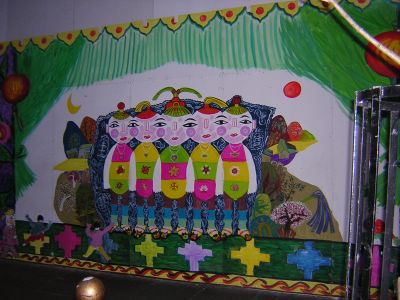
Then I took a stroll in Chinatown. Since some months ago, you see a set of weird paintings on the walls of a little construction site at the east end of Chinatown (48 Gerrard Street). Here's one of them.


-----

On the way home, I was stuck in the tube between stations for 10 minutes due to delay occuring in the Central Line. A normal life in London. (I'm not sarcastic. Every tube station has, since two years ago, had a board indicating how well each Underground line is operating. Initially, if the service had no problem, the board said, "Normal Service." But someone might have complained of its ambiguous meaning. Now the board says, "Good Service," if the service is operating with no problem.)

Thursday, February 17, 2005

Londoners visit Tokyo.

I just found an interesting website by Londoners visiting Tokyo. Behold the Japanese information design.

Tuesday, February 15, 2005

Presentation as an Economist

My presentation at EC501 Work-in-progress Seminar, where econ PhD students at LSE present their work in front of other PhD students plus two professors in charge of running this seminar.

It went well in the sense that I got loads of constructive comments, especially from Robin. It didn't go well in the sense that the way I organised my presentation confused the audience a lot. Shame on me...

But I learned a couple of things. Number one: doing research while thinking of how I will deliver my work to seminar participants improves my productivity a lot. Number two: I don't need to be afraid of talking rubbish. The stuff you're talking at a seminar is not the final product. If it's rubbish, the audience suggest the way to improve its quality. Talking lots, getting as many feedbacks as possible, and use them to improve your work. That's the way to do research.

So I took an offer from Tim to present my work at Konstanz meeting of the Polarization and Conflict research project. That'll be exciting!

Tuesday, January 25, 2005

Shepsle and Shleifer at LSE

In the early afternoon, I worked on building a model and managed to derive an outcome, which isn't what I was expecting...

In the late afternoon, I talked to Professor Ken Shepsle, who has been visiting STICERD for two weeks from Harvard University. I asked him if he knows any papers that theoretically model different ways of choosing the chief executive in a non-democratic political process, as I empirically found this matters for secure property rights.

He suggested Soskice, Bates, and Epstein (1992), which is quite similar to what I have in mind. He asked me more on my research project and kindly gave some comments.

In the evening, Professor Andrei Shleifer, again visiting LSE from Harvard, gave the first of his three public lectures on legal origin. Today's delivery was based on Glaeser and Shleifer (2002). At the end of the lecture, he mentioned three reasons for why he didn't investigate the effect of legal origins (British common law vs. French civil law) on economic growth through changes in 'institutions' like property rights enforcement. (1) Any legal origin can flourish an economy: both Britain and France are now rich countries. (2) There are very few objective measures of institutions. Most of the measures used in the literature are outcomes rather than institutions. (3) Historical indicators like legal origins or European settlers' mortality can hardly satisfy the validity of instruments as it proxies for many things that affect economic growth without going through the quality of institutions (e.g. human capital). The second and third points are from Glaeser, La Porta, Lopez-de-Silanes, and Shleifer (2004).

After the lecture was over, I came up with one question. Shleifer argues that the 12th century saw a divergence of legal systems between England and France, and that this institutional difference has persisted until today. This argument involves inconsistency. Legal institutions changed in the 12th century while they haven't changed at all since then. It's not clear why we saw a change in institutions in the 12th century but we haven't ever since.

I talked about the lecture with Tianxi, who questioned why the English kings, stronger than feudal lords, implemented a relatively independent judiciary system. If the king is more powerful than anyone, he should be able to do whatever he likes. Certainly, an independent judicial system is not what he wants. To think over his question, I read Glaeser and Shleifer (2002). They assume that a legal system is a consequence of Coasian bargaining. In other words, it reflects the maximised social welfare given some exogenous parameters including the powerfulness of feudal lords. So the English king didn't play a role of determining which legal system is beneficial, which I would say is quite controversial.

It was quite stimulating a day, all owing to the fact that I'm a PhD student at LSE, where researchers who I can share my interests with more or less tend to gather. Maybe the coming two years will be the most enjoyable experience in my life as an economist. So I'll make the most of it as much as possible!

Monday, January 24, 2005

JP's EC501 talk. He derived an interesting result in his theory (the government who cares more about manufacturing than about agriculture actually hurts the former), but failed to do an empirical test for that proposition. I tried to think about how to tackle this, but couldn't come up with a good idea...

Lunch with JP, Juan, and Matthieu.

Worked on building a model with a new idea, ending up realising it doesn't work. The idea that I had last Friday and Saturday was better.

Friday, January 07, 2005

I Miss Tokyo, As Always When I Leave There

So I'm back in London now after a more than 12 hour flight. Once unpacking my luggage, I can't do anything but missing Tokyo...

The last breakfast in Tokyo was nanakusa-gayu, rice gruel with seven spring herbs, symbolising that New Year's season was now over.

After checking in at Narita Airport, I bought Gogo-no Kocha Royal, bottled milk tea (500ml for 150 yen or 75p), and Kara-age kun, deep-fried breaded chicken (8 pieces for 210 yen or 1.05 UK pounds), at a Lawson convenience store, and sat down at a table in the observation deck on the 5th floor of Terminal 1, sunbathing in the winter sunshine. Everything I was doing right now would be impossible in London.

I miss Tokyo a lot. This is not surprising at all. That was why I didn't want to go back to Tokyo before leaving London. That was why I couldn't feel happy about staying in Tokyo initially. I was so much scared of missing Tokyo when coming back to London. Plus, now I don't feel comfortable with speaking in English. Everything as expected.

Thursday, January 06, 2005

Misao

Had mentaiko, spicy cod roe, for breakfast. Eating this with a bowl of steamed rice was what I missed a lot in London. I don't wanna go back to London any more...

Today was the de facto last day in Tokyo (tomorrow's flight back to London departs at midday, which means I have to leave home around 8 in the morning). So I was busy going shopping. I bought size AA batteries, which is of better quality and cheaper (12 for 942 yen, or 4.75 UK pounds) than ones in UK; 20 blank mini-disks (10 for 1008 yen, or 5 UK quid), again cheaper than in UK; hair styling wax (75g for 1008 yen), with which I can set my hair much more easily than the wax available in UK; and socks (three pairs for 990 yen, or 5 quid), which are of better design and of better quality than ones available in UK for the same price. Also, my mum gave me hocho, a large kitchen knife much easier to use for cutting vegetables and meat, especially for finely chopping vegetables to cook chahan, or stir-fried rice.

In the afternoon, I met up with Misao at Roppongi Hills. Unfortunately, it was raining today. We missed a chance of strolling around this magnificent redevelopment area where art and design naturally melt into city landscape.

Misao is on a break in Tokyo from her life in Damascus, Syria. I asked her why she chose Syria to live. She'd been learning Arabic and wanted to brush up her skill by living in an Arabic-speaking country. Syria and Saudi Arabia are countries where people speak textbook Arabic. But it's almost impossible for a single woman under the age of 35 to get a visa to stay in Saudi. So she chose to live in Syria.

As Syria is a typical non-democratic country, she showed her interest in my research. It's interesting that many of my non-economist friends are curious about my research.

According to her, Japan is much respected by people in the Middle East, even though the Japanese Self-defence Force has joined the American-led coalition in Iraq. Also, Syrians tend to be despised by other Arabic people partly because the Syrian government opportunistically begged for money, sometimes from the United States, sometimes from Saudi Arabia.

Misao's dream is to engage in the provision of education in the Middle East. She visited Palestinian refugee camps in Lebanon, realising that refugee communities have already established the education system within camps. So her conclusion is there's no room for her potential contribution in Palestine. Her next target is Darfur, Sudan.

----------
In the evening, I held an off kai (literally translated into "off-line meeting", meaning a party where people who usually talk online - via mailing lists, discussion boards, or instant messages - meet up face-to-face) for participants in the development economics mailing list. I set up this discussion group on the web as a means of networking with Japanese fledgling development economists, including Yamada-kun (see 24th December). Those who came to the party were Ono-san, Ikegami-kun, Shoji-kun, Arimoto-san (Congrats for publishing a paper on Journal of Development Economics!), and, as a special guest, Sawada-sensei.

We had dinner at Queen Sheba, an Ethiopian restaurant in Nakameguro. As I found Ethiopian cuisine delicious (see 14th November), I wanted to introduce it to my fellow Japanese development economists. Shoji-kun liked it, but Arimoto-san didn't like it. Personally, this restaurant adjusted Ethiopian dishes to the taste of Japanese people, about which I was a bit grumpy. But when I dipped injera bread (sour crepe) into wat (spicy meat stew) and put it into my mouth, I got extremely happy. :-) The restaurant also serves African cocktails (no Ethiopian one, though). I tried ashanti, Kenya Cane (Kenyan rum) blended with banana liqueur. The taste was gorgeous. Yet another revelation.

We talked a lot about a variety of things related to development economics. But one thing was clear: it's not a good idea to be in Japan if you want to be a development economist. However I like Japanese foods, the quality of Japanese services, the energetic atmosphere of Tokyo, and fashionable and cute Japanese girls :-), I shouldn't get a job in Japan after finishing my study at LSE.

That's a life.

Wednesday, January 05, 2005

Omotesando

Had lunch with Aoki-kun at Darjeeling, an Indian curry restaurant opposite Aka-mon (the Red Gate) of University of Tokyo. For 750 yen (3.75 UK pounds), we enjoyed a delicious Indian curry with a large naan bread and a glass of lassi. What's lacking in the area around LSE is this type of restaurant. Darjeeling seemed to be thriving; it now has seven branches in Tokyo. I'm sure that this restaurant is by far better than most Indian restaurants in London in terms of taste as well as price.

Aoki-kun was my closest classmate when I was a master student of economics at University of Tokyo. We went through the hellish core courses of graduate economics together.

He's now a PhD student of economics at the same university. But he was losing confidence as a researcher. I asked him why, and learned that it was because he had no one who shared his interest in analysis of the economic recession in Japan during the 1990s. I gave him a couple of suggestions to break through such a predicament.

I don't want him to give up his career as a researcher. He always asks questions. He never accepts things as they are. That was why I enjoyed talking to him when we were in the master programme, even though I didn't enjoy conversations with other classmates. That kind of personality is suitable for a researcher, isn't it?

--------
In the evening, I met up with Reiko and walked along Omotesando Street, now dubbed "brand street" of Tokyo because all those international top fashion brands have opened their flagship stores on this street during the past few years. I wanted to check those stores in an architectural sense, but I was too shy to enter these fashion houses alone. So I needed Reiko to come with me.

The first surprise was Dior Omotesando. Inside the white glass building, colourful Dior gears were on display. The third floor dedicated to cosmetics was beautifully designed. I asked Reiko how to choose make-up materials. Choosing colours for foundations, eyeshadows, lipsticks, and so forth, with the total coordination in mind... Sounds fun! :-)

By the way, Dior Omotesando didn't seem to have staircases. We used a lift to go up to the third floor. As Reiko used to live in London, I told her this joke: "This building will be closed if firemen go on a strike." (For non-Londoners, when firemen took industiral actions in years 2002 and 2003, all the underground stations with lifts were closed.)

A disappointing one was Louis Vuitton. The front of the building is designed as a pile of LV trunks stacked at random, which is not too bad. But the inside of the building was quite unimpressive, together with unimpressive LV goods. Reiko said she doesn't like this brand though she used to have the iconic LV bag. Is there anyone who bought the LV monogram bag because they thought it looked cool? (But I like the white "Eye Dare You" bag designed by Takashi Murakami. I don't mind buying a trunk with that design.)

Totally unexpected was Tod's Omotesando. The appearance is quite unusual. What's more, the decor follows the same pattern, creating a sense of consistency. I didn't know what Tod's is. Reiko told me it's a leather shoe company, famous for loafers. As a result, any items on sale (even a jacket) had a touch of loafers, which looked a bit over the top.

The most impressive was Prada Aoyama. (See these photos as well.) The building itself, outside and inside, was impressive. But what strikes me a lot was this Prada boutique not only displayed Prada items but also housed an exhibition featuring Prada's collections of skirts in the past. The combination of consumerism and cultural appreciation, which I think is a great idea.

On the ground floor, this season's Prada bags were on display. Attached to each bag were funny-looking tin toy robots. The idea of attaching this kind of tin toys to a bag probably comes from Japanese high-school girls. They love attaching a lot of figures and the like to their school bag.

Displayed on the second floor was men's wear. As expected, only this floor looked different in a boring way.

-----
We had dinner at Kua'Aina, a burger restaurant chain from Hawaii. I ordered a third pound of avocado burger at 1030 yen (5 UK pounds). The taste was fantastic, better and healthier (slices of fresh tomato and a generous amount of Romaine lettuce included) than any sandwitches available in London. I don't wanna go back to London any more...

During my stay in Tokyo, I saw Reiko three times. I noticed she is an incredibly kind and considerate person. We met each other when she lived in London, but it was after she left London that we became close friends. I think I'm very lucky to have her as a friend, because she's a different type from other friends of mine.

Tuesday, January 04, 2005

Tokyo International Forum

I went shopping at Ito Yokado (Japan's largest half-department half-supermarket store chain) in my hometown Koiwa. For some reason, my hometown is a better place to buy socks and men's underwear. I also bought hairstyle catalogues for Yumiko-san, my hairdresser, to help her catch up the latest trend in Japan as well as to help myself to find a new cool hairdo. Yes, there are men's hairstyle catalogues on sale in Japan. Young Japanese men are probably the most fashionable men in the world if you talk about casual style. (As for formal style, we probably lag far behind Europeans.)

Took a train to Yurakucho Station, where I met up with Mihara, a good friend of mine since our college days. We had lunch at Mansei (a restaurant chain specialising in meat dishes)'s pako ramen, Japanese-style Chinese noodle soup with deep-fried breaded pork. Delicious. Whatever I eat in Tokyo is great - and cheap: a bowl of ramen costs 750 yen, or 3.75 UK pounds. I don't wanna go back to London... (How many times should I say this during my stay in Tokyo?)

As ramen restaurants are not a place to stay long, we walked to La Mer Riche, a cafe inside Tokyo International Forum. (The cafe itself wasn't impressive.)

Mihara is a wicked guy. He's been studying for an exam to become an accountant since he quit a consultancy. But as he couldn't stand being isolated from society, he set up his own company, catering for a nonprofit organization run by, and serving for, the physically handicapped. He used to work as a volunteer for them, and his working experience as a consultant and his study on accountancy help the not-for-profit company to be organised more like a for-profit company. It gives him an incentive to study accountancy, he said. He's cool.

Talking to Mihara is always stimulating. His deep thought gives me food for thought. This time we discussed how to get rid of our deep-thinking mentality when we talk to people who don't like thinking too hard.

Mihara and I are similar guys: when we talk to someone, we tend to ask a reason for what they say, or an example for what they say. We are too logical to make people feel comfortable with talking to us. So we agree that our resolution for year 2005 is to become a person who can manage to talk in a more relaxed way.

He also talked about his newly-acquired respect for women. When he was troubled psychologically, he emailed his friends about it. Obviously, the message was really "heavy" (a Japanese English phrase for 'very serious'). His male friends didn't reply. It was too serious to respond. But his female friends did reply, which helped him a lot.

We've got older, in our late 20's. I don't know whether life has become tougher or we've become weaker, but living as a singleton certainly has become tougher and tougher. Girls have some quality men can never acquire. They are therapeutic to guys who are trying to achieve something.

We shouldn't overstretch ourselves by being single.

-------
After saying good-bye to Mihara, I took a walk through Tokyo International Forum. The Glass Hall Building, designed by Rafael Vinoly, is magnificent. The shape of a ship is said to be a motif for this building; but to me it's like the bone structure of a whale. Crazy.

Monday, January 03, 2005

London-style Party in Tokyo Returns

I went shopping at Shibuya, the most trendy (maybe not stylish like Omotesando, though) area of Tokyo. I got some clothes and CDs. I felt dizzy by a massive number of young people in the area. I used to be all right with the always crowded Shibuya area. But I'm no longer Tokyoite.

For lunch, I got three plastic-packaged omusubi (rice ball) at Family Mart, one of those 24/7 convenience store chains in Japan. Each costs 110 to 140 yen; about 400 yen (or 2 quid) in total makes you feel full. With 2 quid in London, you can only get a pair of cheese sandwitches, which leaves you hungry. With 400 yen in Tokyo, you can get three different tastes (tuna mayonnaise, salmon roe, and fatty tuna with green onion) and get full.

For coffee, I got a small cup of cappuccino (300 yen or 1.5 quid) at Segafredo Zanetti, which has opened 21 branches in Tokyo so far. My life in London released me from Starbuck's brainwashing. (It was Starbucks who popularised espresso and cappuccino in Japan, and it still maintains a high status as a coffee shop in Tokyo.)

In the evening, I threw a Western-style party at Bobby's Cafe Tokyo by inviting friends of mine from different backgrounds, like I did a year ago (see 9th January 2004).

For some reason, I've got a wide variety of friends, which seems to be why my Japanese friends enjoyed themselves even though it's not common for them to come to this kind of party. Big shout goes to Ono-san, Hashizume-san, Mori-Shin, Reiko, Kawamoto-kun and Nagayama-san, Mihara, Daigo, Tomoko and Mark, Dave and his friends, Takeshi, and Genki. Thanks a lot for coming.

All of them seem to have enjoyed the party though I personally didn't enjoy as much as I'd had a year ago: I was frustrated by the fact that I couldn't talk to each of them as much as I (and they) wanted. Of course, that was expected. The London side of Masa didn't care. But the Tokyo side of Masa did care. I used to be like the one who hated this kind of party; all the conversation tends to be superficial, not interesting at all. Seems like my Tokyo side emerged on the surface this time, probably because I just read a novel written by Risa Wataya (see below), who should be like the Tokyo side of myself.

Hatsu

I read a Japanese novel Keritai Senaka (The Back I Wanna Kick Down) by Risa Wataya. This book won Akutagawa Award in 2003, the prize awarded twice a year for the best novel by a new or unknown writer. Risa Wataya was just 19 years old when she won the prize, the youngest prize winner in history.

It is a short novel, the total number of pages is 140. I read it all just one day; I never got bored while I was reading it.

It is a story of Hatsu, a high school girl who has almost no friend in her class. Her inner struggle to communicate with other people is depicted in great detail, which reminds me of my youth. She is too much sensitive to human relationships. She is too acute to notice the difference between what people say and what they really think, which makes it difficult for her to make friends.

I think the author is influenced by Haruki Murakami and Ryu Murakami (and that's why I liked her novel), but the fact that she is a girl adds originality to her novel: deep sensitivity that's special for girls.

I wonder if this novel will be accepted by Westerners if it's translated in English. It is pretty much Japanese, in a sense that it depicts very, very weak ties among teenagers (or Japanese people in general). It may be true and may be not. It's just one way to look at human relationships. Depending on your criteria, any two people can be close or distant.

But comparing people I made friends with in Tokyo and those in London, my friends in London seem to me much nicer, sometimes in an incredible way. It doesn't mean that I don't like my Japanese friends; they are great friends of mine. Still, I see some difference. It may be due to change in my approach to people before and after moving to London. It may be due to the difference of Japanese and English languages or communication cultures. One thing is for sure, though: the London part of myself doesn't appreciate Wataya's novel. It's the Tokyo part of myself that responds to her novel.

In passing, customer reviews at amazon.co.jp seem to be completely split between critical acclaim and severe criticism. It's quite understandable; people of Hatsu type (including me) definitely like this novel while people of Hatsu's classmates type no doubt hate this.

Sunday, January 02, 2005

Yanaka

My parents took me to Yanaka, which is "one of the few areas of Tokyo to offer a real glimpse of what life was like in Edo 150 years ago." (Time Out City Guide Tokyo). This is because Yanaka escaped "destruction in both the 1923 earthquake and the World War II air raids" unlike other parts of Tokyo.

My grandfather's grave is located in this area, so my parents often come here. I wouldn't be interested in exploring Yanaka if I didn't live abroad. But, just like Westerners visiting Japan for the first time, anything that reminds me of old Japan fascinates me after living in London for more than two years, because it's so different.

Getting off the train at Nippori railway station, we first visited Tennonji Temple, the oldest temple in Yanaka (founded over 500 years ago). It enshrines Bishamonten, one of Japan's seven lucky gods. In old days, a pilgrimage to all the seven lucky gods shortly after New Year guarantees a good year ahead. As year 2005 will be very important for my career, I thought it wasn't too bad to visit all the seven gods today.

Then we headed for Yanaka Cemetery, where my grandfather is buried. He was a biologist, but at home he was just an annoying grandpa. I still remember I cried when I knew how great he was as a scientist by hearing one of his students speak of his academic contribution.

The next temple was Choanji with Jurojin, another one of the seven lucky gods.

We walked further to the north on Sakura Dori street, arriving at the top of Fujimizaka, meaning a path on the hill where Mount Fuji, the highest mountain in Japan, can be seen. Although other Fujimizakas in Tokyo (there are 16 in total) are no longer the place to see Fuji mountain (because of construction of high-rise buildings), this one still allows you to catch a glimpse of the mountain, though some stupid high-rise buildings hide a third of Mount Fuji.

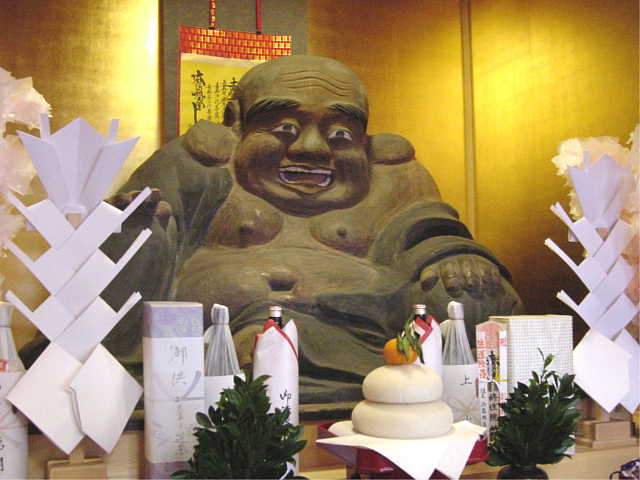
Walk down on Fujimizaka and turn right. Then we arrived at Shusei-in Temple, which has an impressive statue (picture) of Hotei, yet another lucky god.

Walk further to the north, and we arrived at Seiunji Temple, which enshrines Ebisu, the only god originating in Japan among the seven. It's interesting that ancient Japanese people worshiped gods of different origins (three from China and the other three from India) as a group.

We got hungry by then. We walked back and had lunch at Jinenjo, famous for its 'yakuzen curry', or Japanese-style curry containing traditional Chinese medicines (Time Out Tokyo mentions this place to eat). Three of us ordered yakuzen beef curry. Indians may be offended to hear this, but the most popular curry in Japan is the one with beef. And it was marvelous! I felt happy just by eating this curry. Including a cup of coffee (which was also excellent) after lunch, the price of the beef curry was 1830 yen (9 UK pounds or 16 US dollars). For the same price, I could only get a mediocre lunch in London. Now I don't want to go back...

Becoming full, we walked to the west towards Sendagi underground station. We stopped by at an incense shop, where I bought incense sticks of Japanese cypress, green tea, and cherry blossom. I hope these will help me sleep well in London.

As Time Out Tokyo praises its "highly unusual temple building", we visited Daienji Temple on the way. A Japanese temple usually has only one place to worship in front of the building. But Daienji has two in a symmetric way. My parents hadn't noticed this strange temple before. Big up Time Out crew.

Arriving at Sendagi station, we were already tired of walking. I gave up visiting all the seven lucky gods. We conquered four out of seven. Not too bad, eh?

But I realised I needed to buy an amulet for Yumiko-san. So we walked a little bit more to visit Nezu Shrine, which is famous for azalea bushes blooming in April.

We walked more to the south, arrived at Nezu underground station, and went home by train.

Yanaka may not be very famous as a tourist destination in Tokyo, but it's worth strolling. You'll find many interesting little places here.

Incidentally, we had a beef shabushabu dinner at home, putting and swishing incredibly thinly-sliced beef into boiling soup in a nabe pot for a few seconds, dipping cooked beef into sesami sauce, and eating it. (See here for detail if you want to know more about shabushabu.) Fantastic. This is Japan. I no longer want to go back to London...

Saturday, January 01, 2005

Welcoming New Year's Day at Ageha Nightclub

I had the most fascinating nightclubbing experience and the most memorable experience of welcoming a new year.

Although I was staying in Japan now, I didn't follow the Japanese traditional way of seeing an old year out and a new one in, like visiting a temple or a shrine to do hatsumode (the first - and usually the only - worship in a year) at midnight or watching Kohaku Uta Gassen on TV (a long-lasting TV programme on the evening of New Year's Eve where popular singers, divided by sex - male singers form the "white" group and female divas the "red" group - compete with each other). I spent New Year's Eve night and New Year's Day morning at a super-nightclub called Ageha in Shinkiba, one of the bay areas of Tokyo.

There were as many as five dancefloors, each of them featured a different style of music: house, techno, hard house, hip hop, and reggae. Every single one was impressive. If I go into detail, I have a couple of complaints (for instance, why wasn't there a drum & bass floor?). But no single dancefloor made me lose interest in dancing because of, say, poor sound quality, or poorly skilled DJs. This is amazing: especially considering I don't usually appreciate house, techno, and hard house. Actually, the best one was techno. DJ Tasaka made the crowd keep on dancing for ever. I didn't like the idea that one nightclub features a wide variety of styles of music. But it actually worked in this place. It continuously refreshed my interest in dancing whenever I changed the dancefloor.

What's more, it wasn't only about music. This nightclub overturns the idea that nightclubs are dim, scruffy, cramped, and unstylish (in terms of decor in detail). It's quite spacious, high-ceiling, neat, bright (except dancefloors, of course), and stylish (speaker boxes have unusual shapes, for example).

Furthermore, there were quite a few extra entertainments: drug-queen-looking girls called Tokyo Kya-bunny performing naughty dancing on the bar counter tables while bartenders keep working as usual (I didn't like the dancing, but what I liked was it didn't interrupt the stream of passing time: usually when dancing starts in a nightclub, everything stops with all the attention of people forced to be paid to dancers, which I hate). Food stalls set up outside the building, selling jerk chicken, donar kebab, and Thai noodle as well as Japanese winter foods and drinks (so it was like an outdoor music festival in summer).

And last but not least, watching the first sunrise in 2005 while dancing to lounge music at the sides of an outdoor pool. (As the nightclub is located near Tokyo Bay, this was possible.) It's probably unique in Japan; the new year's first sunrise (called hatsuhinode in Japanese) is something special. Some people get up early and go out to see this every new year. This is seen as an happy event in Japan. But waiting for the sun to rise at an uninspiring place in a freezing winter morning while you're sleepy is not a pleasurable experience. However, with dancable music and cool environments, waiting time wasn't boring at all. In a way, this was a great combination of Japanese tradition (hatsuhinode) and Western influence (nightclubbing), which Japanese people have always been good at. The vibes were extremely happy for no reason. Plus, luckily, even if the most parts of the sky were overcast, clouds were cleared away just around the point in the horizon where the sun came up. When the sun finally showed up, everyone cheered. Beautiful.

That was the moment I felt I made the right decision to come back to Tokyo. It was the most enjoyable nightclubbing in my entire life. All the worry that I had has gone with year 2004. Very refreshing.

Big up all the Ageha crew who organised this ridiculously beautiful event. Also big shout goes to Kurosaki-san, Mizoguchi, Kimiko, and Reiko, who came with me. Without you guys, I probably wouldn't have enjoyed that much. Tokyo is a great place. It always energises my soul in an unexpected way.

Thursday, December 30, 2004

Marunouchi, Marui Men again, and Price Level in Tokyo

It was sunny today. This is what I miss a lot in London: winter sunshine. Sunbathing on the tatami mat floor in my house in the morning is a very comfortable experience. Nyanko, our family's cat, does this everyday in winter time. She's been a bit icy to me since I came home. My parents say that she is just shy. :-) But when I started sunbathing next to her, she walked away to another room in the sunshine through windows. Boo.

Day three in Tokyo featured Marunouchi (the area on the east of the Imperial Palace) to meet up with Ono-san, an econ PhD student at the University of Tokyo.

The Marunouchi area has recently been rejuvenated to become a trendy area, featuring, as usual for any redevelopment areas in Tokyo, two new shopping and restaurant complexes (Marubiru and Oazo), stylish cafes/restaurants and fashion boutiques on Marunouchi Naka Dori Street. But the area looked astonishingly inorganic, partly because it was the end of a year when office workers entirely disappeared. But, I don't know, something was missing for this area to be attractive.

Anyway, we had lunch at Brasserie Aux Amis, ordering today's two course lunch (1050 yen, or 5 UK pounds / 9 US dollars): pumpkin soup and sea bass with risotto. Having this kind of lunch in London at this price is impossible. You have to pay double the price or you have to end up eating sandwitches by paying the same amount of money. The taste? Not as bad as lunch in London at all.

Then we went to Oazo, which was pretty much uninspiring except for the entrance hall. So we took away a cup of coffee (350 yen or 1.75 pounds / 3 US dollars) and sat down at a table in the hall.

We talked about each other's pieces of research, the English language, etc. He told me that it is difficult for him to get an PhD because his research is different from what professors at his university are interested in. So his strategy is to publish his paper in an academic journal first. He needs acceptance of his research by academics outside the university.

Ono-san is a very smart guy. I hope he will get out of rather unfriendly research environment for him as soon as possible.

After saying goodbye to him, I headed for Marui Men Shinjuku, one of many Shinjuku branches of Marui department store chain. As I wrote on 4th April 2003 and 3rd January 2004, this is the place I always go to in order to get cool men's gears. The idea that the whole eight-storey building serves for fashion-conscious young men is unbelievable, something you can never imagine in London.

On the way to the store, I felt thirsty. If it had been in London, the only option would have been to get into a supermarket to buy soft drink or to take away a cup of coffee at a coffee shop. But I was in Tokyo now. What I could do was to buy a canned soft drink, priced at 120 yen (60p or 1.1 US dollar) at a vending machine! I got Kirin Beverage's Gogo No Kocha, meaning afternoon tea. With 60p, you never get a cup of tea in London.

In Marui Men Shinjuku, I got a pair of trousers (15800 yen or 80 UK pounds / 140 US dollars) and a red mohair sweater (at 14700 yen or 73.5 UK pounds / 130 US dollars) at Rupert and a long black trench coat (36750 yen or 183.5 UK pounds / 330 US dollars) and a black round-neck sweater (12390 yen or 62 UK pounds / 110 US dollars) at Tornade Mart. You never get cool men's gears at these prices in London. Also, I love Tornade Mart; no other shops sell long coats because they are out of fashion right now. But Tornade Mart always doesn't care about trends. They always sell what they think is really cool. I always appreciate it.

The Marui Men Shinjuku building is packed with many casual fashion brands targeted at young men like Rupert and Tornade Mart. There's no such middle-ranged fashion house for men in London. I told a shop assistant at Tornade Mart that they should come to London. Londoners will love them.

Another impressive thing was the kindness and friendliness of shop assistants. When I bought the clothes at Rupert shop, it was already after eight in the evening, which is a closing time. They never rushed me. What's more, the assistant who served me took me to the exit of the building to see me off. You never expect this at garment shops targeted at young men in London. When I told this to him, he said, "My service isn't that good." Can you believe this?

----------------------------------------------------------
Did you notice that I obsessively wrote down prices of a variety of things yesterday and today? This has a reason. Tokyo is believed to be the most expensive city in the world, even more expensive than London. When it comes to rent, it may be true. But when it comes to eating out and shopping, this is certainly not true at all. Nobody living outside Japan understands this. So I'm trying to give you an idea of how much it actually costs by living in Tokyo.

Well, maybe public transportation in Tokyo costs more than in London. Today's train ticket fees were (1 UK pound = 200 yen; 1 US dollar = 110 yen): Koiwa to Tokyo (17 min by overground) for 210 yen; Tokyo to Shinjuku (18 min by underground) for 190 yen; Shinjuku to Koiwa (33 min by overground) for 290 yen. What's inconvenient in Tokyo's public transportation is that there are several different railway companies in operation and whenever you change to a different railway company, you have to buy another ticket. And these different railway companies issue different one day pass tickets. So buying a one-day pass doesn't pay; travelling around different parts of Tokyo costs you a lot. Plus bus services are not as good as London's, including the fact that there is no night bus service.

Wednesday, December 29, 2004

Tsukiji Fish Market, Matcha Sweet, and Japan's workplace

It was a rainy and cold and windy day today. From the late morning, it started snowing. Why do I need to see wet weather even after running away from London?

Morishita-san took me to Daiwa Zushi (its review at economist.com), Japan's no.1 (according to Zagat Survey a few years ago) sushi restaurant at Tsukiji Fish Market. When we arrived at the place around seven in the morning, more than 20 people were already queuing. After waiting about two hours in a miserable weather like in London, we finally got in. We ordered omakase course (eat whatever the chef serves). How much do you think the course costs? Just 3,150 yen (16 pounds or 29 US dollars)!

In front of Daiwa Zushi with Morishita-san and other people queuing

The first pair of sushi was chu-toro (mildy fatty tuna) and squid. Squid was brilliant. I usually don't like squid sashimi, but this one was delicately soft. The second pair was tuna and shrimp. Brilliant again. Meantime, a waitress served us miso soup with white fish. It's fantastic, too. The third batch was a char-grilled shrimp head (without rice, so it's not sushi, technically). This was a revelation. The fourth batch was gunkan maki (fighting-ship-shaped sushi roll) of sea urchin accompanied with fried egg. This was the ultimate extravagance: even nori seaweed was perfect. The fifth pair of sushi was sea eel and kanburi, which is the name for yellowtail in the winter: they become fatty in order to preserve warmth inside the body. This was again fantastic. The final batch was three sushi rolls (tuna, fatty tuna, and salmon roe). As sea urchin was so impressive, we ordered extra ones (700 yen per piece).

I was extremely happy while I was eating. This is something you never enjoy when you live in London. Happiness never comes from eating.

After strolling around Tsukiji market and taking away for lunch Yoshinoya's gyudon, a rice bowl topped with soy-sauce-marinated sliced beef, which is currently available only at Yoshinoya's Tsukiji branch due to the ban on importing beef from the United States, where mad cow disease broke out a year ago, we headed for Shiodome, the latest redevelopment area of Tokyo. This area was not that impressive except for Caretta Shiodome, one of many shopping and restaurant complexes in this area. On the 46th floor were a couple of cool bars including so/ra/si/o/ (its review by Metropolis Tokyo magazine) and Hibiki. It's a pity that it was in the morning when we arrived there.

The purpose we came here was to try matcha (strong green tea) sweets at Saryo Tsujiri on lower ground floor two. Morishita-san tried its original store in Kyoto a few weeks ago and wanted to have matcha parfait again. It cost 1,365 yen (6.5 UK pounds or 12 US dollars), quite expensive for sweets in Japan. But it was worth trying. The whole mixture of a variety of sweets was excellent: in a tall glass, it's got (from the top) matcha whipped cream, matcha ice cream, matcha kasutera (a kind of cake originating in the Iberia Peninsula), sweet chestnuts, honey-dipped satsuma, shiratama (sweet dumplings made from sticky rice), anko (red bean jam), plain ice cream, and matcha jelly. All come in a compact size. (See its photo.) Coldness of ice cream and warmth of kasutera cake, deep sweetness of matcha whipped cream and mild sweetness of shiratama dumplings, a variety of textures ranging from satsuma orange to chestnuts to anko jam, this subtlety is what's good about Japanese sweets, something you never get in Anglo-Saxon countries. Amazing. I was enormously impressed. No doubt there was a queue of ten people when the shop openned at 11 in the morning.

I'm very much greatful to Morishita-san for taking me to these two excellent eating experiences. Let's meet up again next time in Seoul! (He's moving to South Korea in a few week's time.)

In the evening, I met up with Takeshi at Fonda De La Madrugada, a Mexican restaurant in Harajuku. Whenever we meet up, we go to a Mexican restaurant ever since I introduced him to Mexican cuisine and tequila.

Once entering this restaurant, I lost a sense of where I was. The dining space was on lower ground two, looking like the inside of a cave. The waitress who served us was (probably) Mexican. There was also a mariachi (guitar, accordion, and percussion). Before I knew it, I had spoken in English when I asked something to the Mexican waitress. :-)

Takeshi is a fledgling lawyer. His life was incredibly busy: everyday he comes home at 5 or 6 in the morning and goes to the workplace by midday. He has a girlfriend, but he has almost no time to meet her, only calling her for an hour in the early morning. He told me how outrageous his boss was. One example: they went to a karaoke bar with other colleagues including female personal assistants. It was already in the early hours, but his boss wanted to move to an another bar. He asked Takeshi to ask the PAs to come with them (Takeshi has no choice but coming with his boss). Takeshi asked the PAs, "Would you like to come with us?" His boss got angry. "What are you talking about? You must say, 'You are coming with us, aren't you?' I'm deeply disappointed at you."

His boss is rather exceptional. But this kind of experience with your collegues in the workplace is not that uncommon in Japan. A couple of my Japanese friends quit thier jobs because of this sort of outrageous working environments.

Still, Takeshi said he had been learning a lot from his boss and other senior colleagues. He'll be working with them in coming years. I'm quite sympathetic with his idea. The most important thing in life is the pursuit of your career, even if your private life suffers. Maybe Westerners (especially, Continental Europeans) don't understand this, but my Japanese friends (and myself) tend to be like this. It's not that all Japanese are like this. We always complain that very few people understand us. That's how we are linked up. That's an essential part of our outlook on life.

Tuesday, December 28, 2004

Back in Tokyo for the third time since moving to London

I felt dizzy when I arrived at the fastidiously clean Tokyo Narita Airport. In comparison, London Heathrow looks dim and scruffy.

As a pastime on the Virgin Atlantic plane, I bought Time Out City Guide Tokyo. Reading this guidebook is a revealing experience. It gives a different angle to what's so familiar to me. (I was born and bred in Tokyo until the age of 24.)

From the airport, I took a coach that directly took me to my hometown Koiwa. Last time I came back a year ago, there wasn't such a coach service. My hometown is quite out of the way in Tokyo. It is a town where people don't seem to be interested in going abroad. (Actually, my dad has been abroad only twice in his entire life, and my mum only once.) Fair enough, I was the only passenger on the coach. The ticket cost 1,500 yen (7.5 quid or 14 bucks). But I bet the charge for driving on motorways is more than that (Japanese motorways all charge you a lot of money). I asked the driver if there is any demand for this coach service. He said, "If it's the holiday season, the demand is high." Notoriously, Japanese people take very few holidays in a year. Although it was very convenient for me (it just took one hour to Koiwa railway station), I suspect this service will be discontinued by the time I come back home next time.

Through the coach windows, I saw an awful lot of high-rise residential buildings that look all the same (but by far tidier than the ones in London's East End) and a dozen of 'love hotels'. After the coach took off from the motorway, I noticed quite a few small manufacturing factories and, for some reason, fishing tool shops.

It's so different from where I live in London. But when the coach went across the bridge over Edogawa River, I felt nostalgic.

I got off the coach and took a walk to my house. Only a year made my hometown a facelift. A third of shops on high street have changed. A couple of new residential high-rise buildings are under construction.

As expected, when I arrived at my house, I felt I became taller: Japanese furniture is made for short people.

I talked to my parents. I have a bit of trouble talking to them on the international phone call. But coming face to face with them, conversations naturally flew. Our family is not good at talking on the phone.

I'm so confused. This is my hometown. So it should be so familiar to me. But at the same time, a tremendous degree of difference between London and Tokyo caused me a counter culture shock. I don't know where I am now.

Friday, January 23, 2004

Two weeks after coming back from Tokyo

During the last two weeks back in London, I felt like I wasn't in London. I didn't feel like studying. I was always depressed by how difficult it is for me to manage to speak English in a satisfactory way. When I attended a seminar, I couldn't concentrate myself, something that had never happened to me before.

Sunday, January 11, 2004

I Miss Tokyo.

Come back to London. I was missing London during the first few days of my stay in Tokyo, but now I am missing Tokyo. I really enjoyed the party last Friday, but I can't throw a party in the same way in London. This fact made me even feel I didn't want to go back to London... I usually don't feel this kind of backward emotions (Is "backward" the right word for this? I don't know how to put this in English). I always look forward, though I sometimes stop moving forward. But never going backwards. So this upset me. Why do I feel like this?

Friday, January 09, 2004

London-style Party in Tokyo

I visit University of Tokyo again, meeting Aoki-kun, Takahashi-san, Kato-san, Kanaya-kun, Kawamoto-kun, and Waki-kun.

For lunch, I take away Yoshinoya's gyu-don (a bowl of rice topped with beef). Just paying for 280 yen (1.4 pounds), you can get your lunch. Unthinkable in London. Another moment I'm impressed about Japan.

In the evening, I throw a London-style party at Bobby's Cafe in Shibuya, inviting my best friends in Tokyo: Mihara-kun, Misao-san, Yoo-chan, Jun-chan, Torolin, Ono-san, Reiko, Tomoko, and Mark. Why is this London-style? Because each of my friends doesn't know each other. It's not uncommon in London to invite your friends from different backgrounds. But that's not true in Japan. We usually go to restaurants or bars with our friends from the same background so all of us know each other in the first place.

So I'm a bit anxious about it. Does a friend of mine enjoy talking to another friend of mine who he or she didn't meet before? But it turns out that everybody seems to enjoy the party more than I expected! Of course I enjoy the party, too, surrounded by my best friends. It's really a good evening.

When the party is over, my last train has already gone. In Tokyo, there's no night bus. So I visit and stay at Mihara-kun's place overnight. Actually, it's good to have a chance to talk to him a lot.

Thursday, January 08, 2004

Consumer Electronics Shopping in Tokyo

I go to Yodobashi Camera, a consumer electronics chain, at Shinjuku. First, I have my minidisk player fixed. Then I buy Seiko Instruments Inc's IC Dictionary SR-M6000 at around 30,000 yens (about 150 pounds). IC dictionaries (mobile electronic dictionaries) seem very popular now in Japan. What's good about this product is that it contains Collins Cobuild English Dictionary for Advanced Learners, my favorite English-English dictionary. Cool!

When I walk around the store, I find the same wireless ADSL modem router as the one we got in London (see 5th November). I check the price. 15,000 yen. About 75 pounds. Less than half as much as we paid for it in London. Oh, my God.

This is what's good about living in Japan. Electronics products are of high quality and available at reasonable prices.

Wednesday, January 07, 2004

Menswear Shopping in Tokyo

I visit Reiko working at a boutique called Agosto Shop in Laforet Harajuku, Tokyo's counterpart of Topshop. The last time I saw Reiko was last July, when she left London (see 4th July). Since then, we exchanged some e-mail messages, getting along with each other.

Her shop is mainly for ladieswear. Unless she works there, I'll never visit this shop. It's really different from menswear boutiques. The fitting room is really huge, like a hotel lounge. Reiko shows me some clothes that men can also wear. They are really different from what's available in menswear stores. Actually I get one pair of trousers, though it's not for winter. Thanks to Reiko, I can peep at a different world.

Then I head for Shibuya, where three other Marui department stores are located. I finally get two nice winter trousers of Morgan Homme and Michel Klein Homme. I also buy a green and black mohair scarf of 58 Goya By Jun Men. Shopping menswear in Tokyho is fun!

Tuesday, January 06, 2004

University of Tokyo

I visit the Department of Economics at University of Tokyo, where I got my master's degree. I meet Shoji-kun and Uochi-san, both of them are writing their master theses due this Friday. Then I attend the Microeconomics Seminar, where Hanaki-san presents his joint research on experimental economics. After the seminar, I talk to my ex-supervisor Yanagawa-sensei for one minute. He says, "When you write a paper, send me a copy." I hope this will happen soon...

Monday, January 05, 2004

Women's pro-wrestling again

I still have a cold. But I'm tired of sleeping. So I'm watching Japanese women's pro-wrestling on satellite tv all day. (See 29 March and 6 April last year for my passion for it.) Last year I always checked what was happening in the world of Japanese women's pro-wrestling via the internet. But I didn't watch the actual battles. So it's fun to connect the real images to what I knew. Among the bouts I watch, the best single match is Hotta Yumiko vs Akino (at Kawasaki Taiikukan on 25th July 2003), and the best tag match is Tamura Yoshiko, Ohmukai Michiko, Hyuga Azumi, and Nakanishi Momoe vs Inoue Kyoko, Inoue Takako, Mita Etsuko, and Ito Kaoru (at Korakuen Hall on 3rd November 2003).

Sunday, January 04, 2004

Winter in Tokyo

I catch cold. I have a sore throat. I'm too used to life in London. Winter in London is not so cold as in Tokyo, and it's very warm inside the house owing to central-heating during the night. But my bedroom in my parents' house in Tokyo has an air-conditioner. During my 25 years of life in Tokyo, I'd turn it off when I went to bed. So I followed this habit last night. I was wrong. It got really cold during the night. As I didn't sleep on New Year's Eve, got worn out by the 13-hour flight from London, and walked around a lot yesterday, I gave way to the flu virus... So I'm on bed all day today. What a waste of time in Tokyo!

Saturday, January 03, 2004

Marui Men

I go shopping at Marui Men Shinjuku, the eight-story department store for menswear only (see 4 April 2003). Can you believe this? This reflects how fashionable Japanese young men are.

I'm looking for nice-looking winter trousers, but I fail to find any. It's a bargain sale season. Good stuff flies away soon. I get PPFM's fancy black leather belt, Comme Ca Du Mode Men's socks, and 5351 Pour Les Hommes's thick t-shirt.

In the evening I have dinner with Takeshi at To The Herbs, a budget Italian restaurant, at Harajuku. I order Japanese-style Italian pizza (topped with seaweed) and spaghetti (with soy-sauce).

Takeshi is a fledgling lawyer. He passed the bar exam two years ago, and is now under training at Hakodate, a northern port town of Japan. We share the idea of pursuing our respective careers as far as possible. He says, "Most of my friends don't understand this outlook on life. In this sense, you're one of my precious friends."

Friday, January 02, 2004

Back in Tokyo

I arrive at the Narita Airport at 10 am. My parents are waiting for me there. My dad got his driver's license last year. So he drove to the airport. I get an impression that both of my parents have a different air than before. Do they get old?

When I arrive at my parents' home, I feel like I get taller. This happened last April when I went back to Japan, too. As Japanese people are generally shorter than Western people, the height of every piece of furniture is lower. So I feel like I'm a tall guy.

Nyanko, our pet cat, still remembers me. She's a good-looking cat, but she looks a bit older. Time has passed.

Wednesday, November 05, 2003

From 11 to 12, Neil's pronunciation workshop. For the first time in my life, I learn the meaning of intonation for questions. If you ask a question with a rising intonation (this is the way I learned in Japan), this means that you don't want to hear answers and give signs to the audience that you will continue speaking. It even gives an impression that you are superior to the audience because this way of asking a question is used by policemen and sergeants.

If you want to give a chance of answering to the audience, you should ask a question with a faling intonation. In Japan, I learned that this way of asking meant you didn't want to hear answers or you asked a rhetorical question...

---
I prepare for teaching all day. One of this week's questions is really difficult to explain its answer, so I drop by Oriana's office to ask for help. I learn I shouldn't give the precisely correct answer to undergrads if it's too complicated. If students ask for it in class, it's okay to tell them. But on the answer sheet, I should refrain from explaining sophisticatedly. That's the way of teaching undergrads.

---
After I come home, I set up a wireless LAN network with Netgear DG824M (all-in-one equipment--DSL modem, router, and access point-- for wireless networking), which we bought at Inmac, an online computer shop in UK. After setting up my own laptop, I try to help my two housemates' computer setup. But it doesn't work at all. Why not?

Friday, July 04, 2003

Reiko's farewell party

Reiko's farewell party part two at Japanese restaurant Asakusa in Camden Town (This restaurant is perfectly Japanese. The atmospher inside is exactly the same as Japanese usual restaurants. Food is also authentic Japanese and not bad though I wouldn't say "excellent!" because they don't know how to cook rice. My bowl of steamed rice is too sticky).

Reiko's going to leave London tonight. She shows up with a huge and heavy trunk and a huge and heavy backpack. It's totally not what a girl should carry around. So when she leaves for the Heathrow Airport, I decide to go with her carrying her huge and heavy trunk until Leicester Square station (Tomoko also asks me to do so as I'm one of the two guys at the party). Once she gets on the Piccadilly Line at that station, then for the rest of journey she can drag her trunk (there's no stairs at the Heathrow Airport). As a man, I feel right and complete when I help girls like this way.

Then I go back to the Asakusa restaurant. Fortunately the rest of guys are still there. Then we walk to a bar called Bartok. On the way I have a chat with Mark, a British guy. I met him last December. This is the second time we meet. He says, "You don't have British friends, do you?" Bingo! At my school, there's no British student as far as I know. I ask him, "How do you know that?" He replies, "'Cause your English is the same as when we met before."

Oh, my God.

He's right. I didn't learn English much for the past six months. I was totally busy studying economics. There was no time or energy for learning English.

I really thank him for pointing out this fact. At the same time it's tough to know reality...

Then we arrive at the bar, which is Carola's favorite. All the seats are cosy sofas. And the music played by a DJ is ranging from Baroque to drum & bass of the Good Looking type. Not bad, not bad.

I enjoy talking to Mark and Carola at this bar. They are the kind of people I like. Speaking in a thoughtful and reflective manner. They've been to various countries around the world, so their views are quite flexible. Finally, I meet someone I can share things with.

Also I learn one thing from Mark. He says, "I feel happy when Tomoko (his Japanese girlfriend) talks in her own language." He doesn't understand Japanese. So he doesn't understand what she's talking about. Then why is he happy?

I remember a Vietnamese friend of mine told me the same thing about his Japanese girlfriend. He doesn't understand Japanese, either. Again why?

Mark says, "I'm happy because I can see her feel confident while she's talking in Japanese." Talking in a foreign language makes people feel anxious. That's what he doesn't like. That's how men feel about their girlfriends from other countries. Hmmm....

Then we leave the bar. On the way home, I talk to Carola. It turns out that she lives close to my place. We enjoy having a chat all the way. I'm able to be joking to her. It's weird. It's very unusual. I'm not a droll. I'm very bad at saying jokes. Why?

Wednesday, April 30, 2003

Wrap-up of my stay in Tokyo

I was supposed to go back to London today. But the Virgin Atlantic canceled today's flight probably because there aren't enough passengers due to SARS.

Anyway, this one-month stay in Tokyo (with a trip to Cambodia) has refreshed me totally. I found Tokyo is really a cool city. Things are continuously changing for the better. That gives me new energy.

Now I'm all set for studying in London for exams in June!

Tuesday, April 29, 2003

My First Encouter with Roppongi Hills

I have yakiniku (Japanese-style indoor barbeque) dinner with my parents in Azabu-Juban.

Then we head for newly opened Roppongi Hills. I'm really impressed. It's so cool! I wanna live here! Roppongi Hills is one of the urban redevelopment projects that have been going on all over Tokyo now. If you visit Tokyo, check this one out, then you'll feel the huge potential that Tokyo has.

Monday, April 28, 2003

More Friends in Tokyo

I have lunch with Aoki-kun at Darjeeling (a reasonable and tasty Indian curry restaurant) in Hongo. He's my man since my master study at University of Tokyo.

In the evening I have dinner with Mihara-kun at Ken's Dining in Shinjuku. Later his girlfriend joins us. They are yet another ideal couple. I envy you guys. :-)

I say goodbye to them and then I go clubbing with Hanh and her friend Hang. They are Vietnamese girls living in Tokyo. None of my Japanese friends in Tokyo showed any interest in clubbing. This is Japan. It's really difficult to find someone who you can go clubbing together with.

Anyway, the reason I go clubbing tonight is DJ Fergie from Britain was supposed to be on the decks at Code in Shinjuku. But he doesn't show up probably because of SARS. Damn it!

When we get bored with house music, we leave the club and go to a karaoke box. Unlike in London, we've got no night bus in Tokyo. So we need to kill the time until the first train around half past four in the morning. (For Hanh and Hang, karaoke is much more fun than clubbing, though.) It's been more than four years since the last time I went to karaoke. I try to sing some English songs, but I can't. Singing in English without practice is totally impossible...

Friday, April 25, 2003

Mitsuru-san

I have lunch with Mitsuru-san at Pariya in Aoyama. He's doing internship at the United Nations University, whose headquarters is located in Aoyama. We enjoy having a chat for more than four hours. When we say goodbye, it's like a really hard thing.

Monday, April 14, 2003

My Grad Student Friends in Tokyo

I have lunch with Takagi-san, one of the few rational-choice political science graduate students in Japan.

In the evening I have dinner in Ochanomizu with Japanese graduate students interested in development economics. With them I've set up a mailing list in which we discuss development issues from the perspective of economics. So this dinner is an "off-line meeting" of this mailing list. We have Okinawa (a southern island of Japan) cuisine. It's really good.

Sunday, April 13, 2003

King Crimson in Tokyo

I watch King Crimson's live performance with Ono-san at Showa-Joshi College Hitomi Memorial Hall. As I wrote on 25th Februrary, I didn't like their latest album The Power To Belive. But their live performance completely reverses my impression on their latest tunes. Their stage is really complete. I have no complaint at all. It goes as far as I want to see today's gig again! I respect their live performance skills. It's really amazing. No other rock band in this world does something like this: live performance is better than tunes recorded in the studio.

Saturday, April 12, 2003

My Friends in Kansai Area

Without falling asleep last night, I say goodbye to Naomi-san, Tory-san, and Toshi-san in the morning in Kobe and take a railway to Kyoto. There I meet Tororin. We have lunch at Scorpione (they serve Italian cuisine at a Japanese traditional house - a wicked combination), visit the Shoren-in temple (it has a really nice garden - a must-see when you visit Kyoto), then walk through Maruyama Park to see cherry blossoms and eat takoyaki (octopus balls) at a stall.

I really enjoy having a chat with Tororin. I'm joking all the time, which is very rare for me.

In the evening I have a dinner with Tsuchida-kun at Sol Club Varadero (a Cuban restaurant) in Osaka. Why Cuban cuisine in Japan? 'Cause we met each other on the flight from Japan to Cuba three years ago! The food this restaurant serves is not Cuban. It's rather Spanish or Mexican. But the interior is incredibly Cuban.

Then he drives me with his super-car (wow!) to his favorite bar. I have four shots of tequila, which is very rare for me as I'm not a hard drinker.

I go back to Tokyo by night coach. I enjoy my two-day stay in Kansai. I'm finally able to feel relaxed, which was not possible in London or Tokyo.

Friday, April 11, 2003

Naomi-san

I take the Shinkansen train to the Kansai area. There I spend the whole night with Naomi-san (her weblog in Japanese), her "knights" Tory-san and Toshi-san.

I got to know Naomi-san first at the beginning of the year 2001 via the Internet. Since then, she's influenced me a lot. She's changed me from an introverted person to an outgoing guy, which I'd always been hoping to realise since I was a kindergartener. I really appreciate that.

I wanted to tell her this appreciation, but I can't do that. I get a sense of a huge distance between us, both geographically and psychologically. I really like her but at the same time I'm really tired of trying to get in touch with her. I wish she lived in Tokyo or London...

Thursday, April 10, 2003

Jun-chan

I have a dinner with Jun-chan at Dining Table ATU190 in Odaiba. During the last five months she's been the most frequently-emailing-me friend of mine in Tokyo. She always gives me an optimistic view of what happened to me in London. I really appreciate that.

What surprises me is that she turns out to be a fan of Eminem. She usually doesn't listen to hiphop, let alone go clubbing or whatsoever. Still Eminem's passionate and impulsive rap caught her attention. Amazing.

Wednesday, April 09, 2003

Sei-ichoro-kun

I have gyoza (Chinese dumpling) with Sei-ichiro at Harajuku Gyoza. He's an entreprenuer, operating a firm in Shanghai and Tokyo. I really respect him in this sense. Being an entrepreneur is really cool.

We talk about why the Chinese government has been promoting economic development. I enjoy talking to him a lot. Thanks!

Tuesday, April 08, 2003

Dinner with Misao

I have a dinner with Misao at Transit Cafe in Ebisu. She stayed in the States during her college years, so she's been my advisor on how to live in a Western country.

She says, "You look like a Western guy more than before!" My physique seems to have become more masculine than before. She also tells me that having a handbag is not masculine. A guy with a suitcase or a boxer-bag makes her feel masculinity. All right. I take your point. :-)

Sunday, April 06, 2003

Gaea Japan

I Watch women's pro-wrestling matches by Gaea Japan (a women's pro-wrestling association) at Yokohama Bunka Taiikukan. This is something impossible in London, watching women's pro-wrestling bouts. Click here to see the results and photos today.

The first bout is Nagashima Chikayo versus Carlos Amano. Both of them are great technicians. Their movements are speedy as well. So I expected a lot from this bout. But it seems to me that they know each other's wrestling patterns too much (both of them are the members of the Oz Academy). Both of them skillfully roll with the punch. The winner turns out to be Nagashima. This probably reflects the fact that Nagashima was once the champion of Gaea Japan while Amano has never been.

The second bout is a tag match: Sugar Sato and Ran You-You versus Hamada Ayako and Uematsu Toshie. In the end, this bout becomes a single match between Sugar and Ayako, and, again the winner is Ayako, who was once the champion of Arsion (another women's pro-wrestling association).

The third bout was supposed to be a tag match between Devil Masami and Lioness Aska versus Dynamite Kansai and Yamada Toshiyo. But Aska complained at this match-making (Kansai and Yamada are among weak wrestlers in Gaea Japan these days) and changed it into a triple tag match by bringing Shimoda Mima as their additional partner and demanding a new partner as well from Kansai and Yamada. In response, they invited Mita Estuko, who used to be Shimoda's long-lasting tag partner.

The final part of the bout becomes a single match between Devil and Kansai, who used to be good rivals in the mid-1990s. At that time, Kansai was the champion of JWP (yet another women's pro-wrestling association) while Devil was number two in JWP. It seems to me that Devil is not good at fighting with Kansai. She receives all the attacks from Kansai and takes the count.

The fourth bout is, mysteriously, men's wrestlers' tag match. Four non-Japanese guys called "Gaea Boyz" make their debut on this occasion. Uh, I don't have any comments on this match. Pro-wrestling is interesting to watch because viewers know the background stories of wrestlers (e.g. wrestler A and B hate each other) or because wrestlers are incredibly skillful. I don't know the background story about this Gaea Boyz. As they are beginners, their techniques are not amazing. Plus, they are guys, it's not fun to see them. :-) So I don't enjoy this match.

After a break, the fifth bout begins. This is a special 10-minute match of Aja Kong versus Hotta Yumiko. Why special? It's a long story.

The first thing you need to know is what happened to women's prowrestling in 1997. In that year, Zenjo, the oldest women's prowrestling association founded in 1968, went broke and many wrestlers left the ailing association. One of them was Aja while Hotta chose to stay. Aja then chose Gaea Japan as her battle field.

The second thing you need to know is the relationship between Zenjo and Gaea Japan. Since Gaea Japan was established in 1995, these two associations have never been in touch. Almost no wrestlers in Zenjo fight on the ring of Gaea Japan, and vice versa.

In July of 2002, Toyota Manami, who was the most popular wrestler in Zenjo, suddenly announced that she quit Zenjo, and she appeared on the ring of Gaea Japan on the following day. This was a very surprising incident in the world of women's prowrestling. Who invited Toyota to Gaea? Aja Kong.

This made Hotta, who had taken leadership in troubled Zenjo since 1997, angry enough to demand the bout with Aja. Given the bad relationship between Zenjo and Gaea, Hotta's demand seemed impossible to everyone. Still, Hotta interrupted into Gaea's match in August, which made Aja angry because Hotta's appearance destroyed the whole direction (you know, pro-wrestling has an aspect of drama) prepared by Gaea Japan.

After all, Hotta's demand didn't come true at that time. But she again intruded into Gaea Japan this year. And the both associaitons (Zenjo and Gaea Japan) finally allowed the two wrestlers to fight on the ring of Gaea Japan.

Given this background this bout is really serious. In the first half of the bout Aja takes advantage with her high-angle backdrop, making Hotta almost unconscious. But Hotta resuscitates in the second half and they hear the gong after 10 minutes of the thrilling bout.

The audience seems not satisfied that the match ended in a draw. The Gaea Japan management understand this and decide to give 5 minutes more to the two strong women. Neither Aja's backfist nor Hotta's shotei (hitting with the heel of the hand) knocks the other down.

In the end, the bout is stopped by the referee because Hotta's face starts swelling abnormally. Neither wins. The severity of the match leaves the audience silent.

The semifinal bout is a tag match: D-Fix ( Ozaki Mayumi and Kaoru) versus the Super Eccentrics ( Hirota Sakura and Nagayo Chigusa). This match is actually the most interesting one today for me. One reason is the rule of this match. The team that loses this bout must have their hair cut. You know, hair is said to be "the life of a woman." So this rule is the ultimate as a women's pro-wrestling match. This makes the audience feel excited. In particular, I like D-Fix. Ozaki and Kaoru are good-looking wrestlers. I cannot stand imagining they become bald. But, unlike the past "losers have to cut their hair" matches, this one is not totally coloured by such tension owing to the Super Eccentrics. Hirota, this one-and-only-type wrestler is more like a comedian than a wrestler. She's weak. She almost always loses her single match while she always makes viewers laugh during the match. Her partner Nagayo is a carithmatic wrestler in the world of women's pro-wrestling (she's well known even to those who don't watch women's pro-wrestling). But in this tag team Hirota is in a higher position than Nagayo. They fight as if they are not serious about the match. Still, the Super Eccentrics is surprisingly strong. They lost only once in the past.

The result is that Ozaki and Kaoru have their hair cut. Oh my god...

The final match is the championship match: Toyota Manami (the Champion) versus Satomura Meiko (the Challenger). As I wrote above, Toyota kind of invaded Gaea Japan last year. She defeated then-champion Nagashima Chikayo, formed a group called "Moto Zen", meaning ex-Zenjo, with Aja Kong, Lioness Aska, and Devil Masami, and has been overwhelming Gaea Japan wrestlers. Satomura was once the champion before she was defeated by Nagashima. She has been the most promising Gaea Japan wrestler for years. Now it's time for her to overcome Toyota.

At the middle of the match, Satomura severely damages Toyota's right arm with the Japanese Arm Bar. Toyota is totally unable to use her right arm. Still, she is just like a phoenix, knocking down Satomura with her finishing hold "Queen Bee Bomb."

That's it. I enjoy watching all those bouts. I love Japanese women's pro-wrestling.

Saturday, April 05, 2003

Hiroto

Have lunch with Hiroto and Chieko-san as a celebration for their wedding. Their wedding party will be held next month, but I cannot attend it because I'll be staying in London at that time. So today's lunch with them. We planned to go to the Canal Cafe at Iidabashi (click here for a review in English) because this place has a terrace with a view of cherry blossoms. Yes, now is the time for hanami (seeing cherry blossoms), one of the Japanese long-lasting customes in spring. But unfortunately it's raining today. So we change our plan and have lunch at Pizzeria La VoLPaiA at Kagurazaka.

Hiroto is one of my best friends. I met him when we were college freshmen. As I didn't have any best friends until I finished high school, he's kind of my first best friend. When I first heard he's going to get married, I was a bit jealous of the fact that he's already found someone who he'll devote himself to in the rest of his life. We've just lived for 25 years or so. I honestly envy him.

Having said that, I absolutely want to celebrate the fact that one of my best friends gets married. Happy wedding!

Friday, April 04, 2003

Shopping in Shinjuku

I had a dream in which I dated with Ayumi Hamasaki (one of the most popular divas in Japan). :-)

Go to Shinjuku to get a Mini Disk portable player (see 6th Februray's diary to see why). In Shinjuku, three consumer electronics retailers compete with each other: Yodobashi Camera, Bic Camera, and Sakuraya. So, besides Akihabara, Shinjuku is another place to go for electronics products.

Then I go to Marui Men Shinjuku. As I wrote on 30th March, the Marui department store chain is the place to go for buying cool men's casual wear. But this branch located at Shinjuku specialises in men's wear only. It has eight floors and all you see is men's wear. So you don't need to sigh for realising fashionable clothes turn out to be for ladies. This is amazing. I would say this place is a paradise for young men looking for fashionable wear.

I end up going home with three slacks, one leather belt, and one t-shirt. Also I have my Diesel pants hemmed (see 31st January) at the shop where I buy one of those slacks. It just costs 840 yen (around 4.4 pounds).

Shopping in Tokyo is a fun!

Wednesday, April 02, 2003

Tokyo can be cold in spring.

It's very cold outside in Tokyo today. So I stay at home all day. Since I expected Tokyo to be more warmful, I didn't bring outerwears from London.

I book a return flight from Tokyo to Phnom Penh (the capital of Cambodia). I choose Singapore as a transit city to Cambodia.