Saturday, February 18, 2006

Robotic floor cleaners

Everybody believes that Japan is always at the cutting edge, especially when it comes to consumer electronics products.

Not really true. I'm surprised to find iRobot Roomba. This fancy robot, developed by iRobot three years ago, automatically clean floors, something Japanese household appliance makers couldn't think of.

According to a discussion board on robotic floor cleaners for Japanese people, Roomba is on sale in Japan for 80,000 Japanese yen (near 800 US dollars or 400 British pounds) while you can buy one in the U.S. for 250 US dollars.

Part of the reason is likely to be the fact that Japanese people live in small houses, not enough space for a robotic cleaner to running around the floor. Toshiba produced something similar, but it's now discontinued...

This year iRobot even produces Scooba, which washes, scrubs, and dries the kitchen floor automatically! (See BBC News report.) I want to buy this... (It's not yet to be sold in UK.)

Anyway, that's a distant dream. All I need to do now is to find the best hoover in UK. Do you have any suggestions? Is Henry, the British original hoover, really good? (I found a Japanese website devoted to Henry and his family, which is far more informative than any English webpages on Henry... (Look at the official website of Numatic, the British company making Henry. The company doesn't seem to realize Henry's potential appeal to a wide range of consumers.)

Wednesday, February 15, 2006

The Virtue of Economics

Here's why I love economics.

During the last month, I was trying to explain the difference in agricultural policies between East Asian and Sub-Sahara African dictators: East Asians have promoted agricultural growth while Africans have screwed it up. We have seen this difference despite their similarities in terms of per capita income in the early 1960s, the political trajectory until the early 1990s (both regions were ruled by more or less non-democratic governments), and the motivation to promote industrial development on the part of the government.

My intuitive reasoning was this: a non-democratic government faces a trade-off between maximizing tax revenues and preventing citizens from undertaking insurgencies. Taxing both agricultural and non-agricultural sectors in a similar fashion allows the government to collect as large tax revenues as possible. On the other hand, this leads to citizens in the agricultural sector identifying themselves with those in the non-agricultural sector, and vice versa, in their relationship with the government. Therefore, citizens as a whole have a high incentive to threaten the government with insurgencies in order to demand less taxes.

Taxing two sectors in a different way, on the other hand, certainly reduces the amount of tax revenues but reduces the insurgency incentives for citizens as well. This is because citizens in the less heavily taxed sector do not identify themselves with those in the more heavily taxed sector, and therefore do not cooperate with them if heavily taxed citizens decide to take up arms against the government. This makes an insurgency more costly for the heavily taxed citizens. If the government follows this strategy, it wants to tax agriculture more heavily because taxable incomes are larger in the agricultural sector, at least, in the early stage of economic development (as was the case in the early 1960s for both East Asia and Sub-Sahara Africa).

The differential taxation is more desirable for the government if the loss of tax revenues due to this tax strategy is small. This is the case if there is a huge difference in taxable incomes between the two sectors. In many African countries, agriculture provides far more taxable incomes than non-agriculture as soil and climate conditions allow them to produce export cash crops such as cocoa and coffee. This leads to African dictators severely taxing agriculture while favouring industries. In East Asia, however, agriculture does not yield particularly high incomes relative to the other sector in the economy. This makes East Asian dictators to treat both agriculture and non-agriculture in a similar way (ie. promoting productivity growth by not destroying production incentives due to heavy taxation).

That was my speculation. Based on this idea, I worked on building a model showing this logic in a mathematically rigorous way. It turned out, however, that the above reasoning had a flaw in it. A mathematical model allowed me to realize that if agriculture is far more profitable than non-agriculture, then citizens in the non-agricultural sector are never willing to oust the government even if they are taxed as heavily as those in agriculture. This is because their gain from toppling the government (the amount of incomes taxed away) is small (their taxable income is small by assumption) while the cost of insurgency is independent of the size of taxable incomes. In this situation, therefore, only citizens in the agricultural sector have an incentive for insurgencies. Removing the tax burdens on non-agricultural citizens does not weaken insurgency incentives for agricultural citizens (they need to oust the government on their own anyway), only to reduce the amount of tax revenues. Therefore, the government never chooses the differential taxation as its optimal policy.

I couldn't have noticed this logical flaw if I hadn't tried to build a mathematical model. Your intuition can tell a lie while mathematics never does. This is why I love the way economists engage in theoretical analysis.

This love affair does not mean that I make progress in my research, though.

Monday, February 13, 2006

Baron 'At The Drive In' (Breakbeat Kaos)

Listen to this week's drum & bass chart no.1 tune!

If you like trippy house/trance music, you're gonna like it. What a beautiful track.

The producer of this track, Baron, emerged in the drum & bass scene last year. No one in the mainstream music scene notices this, but drum & bass has been constantly pumping out new amazing talents during the past few years. You may remember the names like Roni Size, LTJ Bukem, Goldie, Adam F, DJ Hype, DJ Zinc. But they are not in the centre of the scene anymore. Instead of pumping out uncreative tracks only taking advantage of their celebrity status, these old names are now busy discovering new talents. Drum & bass music scene is very healthy in this sense right now, unlike some pop music scenes.

Sunday, February 12, 2006

Japan's succession "crisis"

If you are a Japan watcher, you know this issue in Japan: whether the Imperial Household Law (the law on the Japanese royal family) needs to be reformed so that a woman can ascend throne. (See this BBC article last month and this month.)

But BBC doesn't seem to understand the fundamental issue here (nor the Japanese media, though). The issue is not whether or not a woman can succeed to the throne but whether or not a child of a woman in the royal family can become the Emperor of Japan.

In its history of more than 1500 years, the Japanese royal family did have female emperors (there are eight of them, two of whom became the empress twice). The current law prohibiting a woman to succeed is a product of Meiji Japan (in the late 19th century). But no children of these female tennou (the Japanese term for the Emperor of Japan) ascended throne. Which means that the current emperor has blood inherited only through men during the past 1500 years.

Those Japanese putting heavy weight on tradition, therefore, oppose the idea that a woman becomes the Emperor of Japan. Don't misunderstand them as anachronistic sexists.

But does tradition matter that much? They even propose that "former members of the old aristocracy who left the Imperial Family after Japan's defeat in World War II could possibly be brought back." (quoted from BBC article.) This is nonsense.

What's wrong with imperial blood transcended through women? Yes, it never occurred in the last 1500 years. But think about 1500 years later from now. The Japanese Emperor in the year of 3506 will have blood inherited from more than 3000 years ago, through both men and women. What's wrong with this?

Princess Masako, the wife of Crown Prince Naruhito, suffered from depression because she was implicitly accused of having no male children by those tradition fundamentalists in the Imperial Court. If women can pass the Imperial blood, this kind of absurd thing will never happen.

By the way, BBC seems really curious on this issue. Its website allows visitors to post their opinions. I burst into laughter quite hard when I read this:

I think this old-fashioned monarchy should be abolished, as it has no longer any connection with the realities of life in Japan.
Anna, Iran

Which also makes me feel like hearing what people around the world would say to this issue. Can you post your view coupled with your national background? That will be interesting.

Thursday, February 09, 2006

Swerve

Went to the Swerve party at The End nightclub last night. This is a drum & bass party organized by Fabio, one of the leading drum & bass DJs since day one who also has a BBC Radio 1 programme. The theme of the party is smooth drum & bass, in other words, liquid funk.

It's always interesting to see how the guest DJ responds to this concept of the party. Even DJs known for their hard, dancefloor-smashing style play a bit different set than usual. This kind of tension - creative people faced by some constraints in what they can do - sometimes creates a marvelous thing. (If you think DJs are not creative, you're absolutely wrong.)

Tonight's guest DJ was Bailey. He began with a series of liquid funk tunes, which is not his usual style. But he still tore the floor down. As the previous warm-up DJ was terrible at mixining tunes, his skill was in stark contrast. It kept me, and all clubbers in the floor, dancing.

Then he moved on to noisy-but-cosy style (I make up this phrase) - fast beats with slow melody and bass line. I love this style of music. Now I was just standing listening deep into music. It washed my mind away.

It was already fantastic, but Bailey didn't stop there. In the last 20 minutes or so, he revealed his own style, almost leaving the audience behind. The style got harder and the rhythm got totaly unexpectable. Different, irregular rhythms cross over each other, creating a totaly wicked vibe. Yeah, that should have been what drum & bass was all about. Complicated, unexpected, but still danceable. The current drum & bass scene tends to forget this. I couldn't resist dancing madly. There were a few people who understood this, dancing hard to this style of music. That was an amazing moment.

Bailey was too good to appreciate Fabio taking over tonight. Usually, I feel somehow relieved when Fabio takes over at this party, because his set is what attracts me to this party. But tonight, Bailey was too wicked, making Fabio less impressive. So I left the venue before 3am, when the party would be over.

I love drum & bass. It's one of the few, very few things that completely please and satisfy me. It's an increasingly scary thought that I will leave London in a couple of year's time. It's very hard to find a decent drum & bass party outside London...

P.S. I deleted the previous post. Thanks a lot for your comments and encouragements, Mir and Ikem. I appreciate this. I feel pretty much fine now thanks to this drum & bass party. :)

Tuesday, February 07, 2006

Freedom of expression?

Buck-Tick is one of my favorite Japanese rock bands. In 1995, they released an album including a track called Rakuen (a Japanese term meaning Eden). This track features, as an interlude, the reversed version of a melody you hear in an Islamic country - the sound of reading the Koran.

Soon after the release of the album, an Islamic organization in Japan criticised it as a profane treatment of Allah and, in response, the record company recalled the original album CDs and re-released the album with an edited version of the track.

As Buck-Tick was not hugely popular at that time, this news was only reported in a very small column in newspapers. I wonder what would have happened if it had been an album released by a massively popular pop singer.

New District Line train carriage


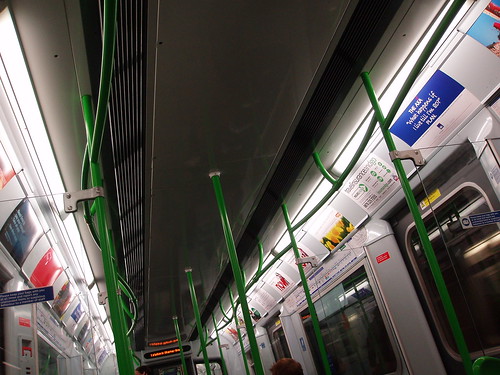
District Line train carriages are the oldest and ugliest among all London Underground lines. Since last year, however, new train carriages have been introduced step by step. They have got fancy grab bars. I love this design.

Saturday, February 04, 2006

Italian guys

I always envy Italian guys. When they see a good-looking girl, they shamelessly approach her and start talking to her until they understand she's not much into talking to them. I can't do this. The extent that I can't do this is increasing with the degree to which this girl is good-looking.

This good-looking-ness thing always bugs me. It's an undeniable truth that talking to a good-looking girl itself is enjoyable for men (and probably even for women) because she entertains you by her appearance, if not by the content of conversations. This often obscures an obvious fact that you want to talk to someone with whom you can strike an interesting chat; even if you don't really enjoy what you are talking to a good-looking girl, you still want to talk to her because she's good-looking.

This annoys me.

Friday, February 03, 2006

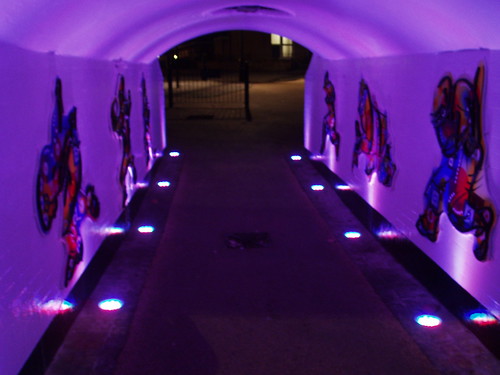
Bow Arts Lane


An alleyway next to Bow Arts Trust (183 Bow Road, E3, London)

A visit to Whitechapel Art Gallery

I needed a break in my mind that has almost always been preoccupied with economics recently. So I paid a visit to Whitechapel Art Gallery this evening as it is open late on Thursday. The Gallery, located in East London, is more or less on the way from the School to my home. So it's also convenient to visit on the way home.


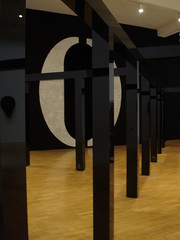
The ground floor exhibition pretty much sucks. Even if a piece of modern art sucks, however, you can still enjoy it with a digital camera in hand. A photograph can be very powerful. You can throw away any unnecessary images out of the picture frame. What you see on the right is such a result. The title of this installation is "zero built a nest in my navel", by the way.

Upstairs, on the other hand, is quite intriguing, personally. It is an exhibition to introduce the works of British architect David Adjaye. I didn't know of him, but it turned out that I did know one of his buildings: Idea Store in Chrisp Market Street, which I believed was the world's coolest local library.

What's more, several more works undertaken by this architect are located in places more or less familiar to me: T-B A21 Olafur Eliasson Pavilion (follow this link and scroll down to see photos) was built in Venice (the link will take you to my photos), which I visited last year (but I missed the Pavilion); a residential building under construction on Fairfield Road, which is within a walking distance from my place in East London; Rivington Place in Shoreditch (again in East London), where I frequently walked around; and Idea Store Whitechapel (yet again in East London), built near a vast Sainsbury's supermarket store I visited a couple of times.

The exhibition explains how he designs such buildings by taking into account the area surrounding the building site and by being inspired by African craft designs, which was quite intriguing.

On the way home, I paid a visit to one of his buildings - Idea Store Whitechapel:

Thursday, February 02, 2006

FT's book review on Acemoglu and Robinson (2005)

I just found FT magazine's book review on Acemoglu and Robinson (2005). (See 18th January 2005 for discussions on this book.) I was always wondering what the general public's response to their innovative theory of democratization would be. Tim Harford - the reviewer - gives a thumbs-up overall. I hope this theory will soon be taught by high-school world history teachers.

Sunday, January 29, 2006

Lent Term 2006 Week 3

Monday (23rd):
1430-1600 Job market seminar by Alvaro Bustos from Princeton
The rest of afternoon - Fatigue from last week's work prevented me from thinking properly...

Tuesday (24th) through Thursday (26th):
Wrote a research memo in which I describe a theoretical model that I have in mind and its solutions and implications. As this process involves mathematics, you can't skip any single step in logic. This requires you to think real hard. So it took longer to finish and I got exhausted more than expected.

But this is why I love economics. This process often takes you somewhere you didn't expect. Which means you find a new thing. I mean, the conclusion derived from this process is often different from what you expected. If you just rely on verbal arguments, this won't happen. Which means you don't really make progress in expanding our knowledge on society. That's why economists hate most arguments without explicit mathematical modelling made by social scientists outside economics.

Friday (27th):
1300-1400 EOPP Work-in-progress Seminar
Afternoon - Wrote email to Professor Caselli, the speaker at today's seminar, on his presentation as what he's trying to do is quite similar to my research - I should talk to him soon. Then figured out how to use Excel2Latex for Ameet. The end result is written down here (look for "EXCEL2LATEX").
1800-1900 EOPP Happy Hour

Saturday (28th):
Complied the dataset for my research. Although it's theoretical, to motivate my research, it's good to present the data showing what I'm trying to explain is in fact a reality. (I followed Tim's advice last week.)

Sunday (29th):
Started reading Esteban and Ray (2006) to hone my skill of writing a theoretical paper. Debraj Ray's papers are good for this purpose - they are theoretically rigorous but still carry a huge relevance to reality so I don't get bored. What struck me during this week (and during the Christmas holidays, when I worked on the same research idea) is the fact that I haven't been exposed enough to theory papers. (This is partly because both development economics and political economy these days tend to be empirical (for development economics, to the extent that Dilip Mookherjee - one of the leading theoretical development economists of the present days - expresses his concern that there is too little theory in the field) and because due to my research topic I've been forced to read tons of descriptive (ie. non-mathematical) papers in political science, which was more often than not agony.) That is why I took almost a week to write up even a sketch of a simple model, or so I thought.
Also started proof-reading the proofs of Tim's forthcoming book as part of research assistance work for Tim.

Friday, January 27, 2006

Royal National Theatre after dark

Illuminated in red is Royal National Theatre, viewed from near Temple tube station.

Monday, January 23, 2006

Swiss Cottage tube station

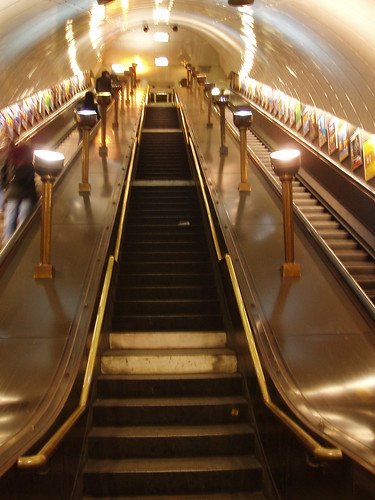
The stairs and escalators in Swiss Cottage tube station.

Sunday, January 22, 2006

Lent Term 2006 Week 2

Here's an example of my daily life as an economics PhD student at LSE interested in development economics.

Monday (16th):
1300-1400 Development & Growth PhD Seminar
1430-1600 Job Market Seminar by Tavneet Suri from Yale
1700-1830 LSE/UCL Development & Growth Seminar by Eric Verhoogen from Columbia
The rest of the day - Read Esteban and Ray (2001) to figure out how larger groups can be more effective in conflict.

Tuesday (17th):
Late morning - Have a brief chat wih Tim on my own research and on our Health & Democracy project.
The rest of the day - Following Tim's advice, try to find data on agricultural tax rates in Africa and East Asia for my own research and get to know Anne Krueger et al. eds. The Political Economy of Agricultural Pricing Policy (John Hopkins University Press, 1991).

Wednesday (18th):
Morning - Following what Tim told me yesterday, run a few regressions for the health & democracy project (in vain).
1600-1730 LSE/UCL Development & Growth Seminar by Alwyn Young from Chicago
The rest of the day - Read Suri (2005) for the health & democracy project.

Thursday (19th):
Morning - An idea occurs to me and run a few regressions for the health & democracy project (in vain).
Lunchtime - Have power lunch with Sonia (by power lunch I mean a lunch over which conversations are all about each other's research)
Afternoon - Read Montalvo and Reynal-Querol (2005) for my own research. Try to find a way to get around an ad hoc assumption made in the theoretical model that I'm working on - and learn that the marginal cost of insurgency must be convex.

Friday (20th):
Morning - Try to find data on cross-country infrastructure data for my own research and remember Canning (1998).
Early afternoon - Have a chat with Maitreesh (my supervisor) on my research and receive a couple of modelling tips, told to write a short memo of the model and its analysis based on which we can talk further.
The rest of the afternoon - Work on the theoretical model for my own research and come up with an idea to implement Maitreesh's advice.
1800-1900 EOPP Happy Hour
The rest of the evening - Talk to Tianxi on where the accountability of the Chinese government comes from and then to Madhav on our potential new research project inspired by today's EOPP Happy Hour. After coming home, read Lemieux (1998) from which Suri (2005) seems to get inspiration.

Saturday (21st):
Continue reading Lemieux (1998). Then start writing a short memo of the model, following what Maitreesh told me yesterday.

Sunday (22nd):
Continue writing a short memo of the model.

Monday, January 16, 2006

Sunday, January 15, 2006

Mackerel stewed with miso (saba no miso-ni)

It's time for lesser-known Japanese cuisine again!

Another whole mackerel was in the fridge today (I bought two yesterday). As one day has passed, eating it raw isn't a choice anymore. So I tried to cook it in a very Japanese way. It's called "saba no miso-ni" (mackerel stewed with miso). Here's a recipe:

1. Mix 400cc of water, 200cc of Japanese sake, one spoonful of sugar, one spoonful of soy sauce, and sliced ginger in a pan, and then bring it to a boil.

2. Place 130g of miso paste in a jar, add about 100cc of the "soup" made in Step 1 to it, and mix it with miso paste until the paste is dissolved into the soup. Keep this aside.

3. Add mackerel fillets to the soup made in Step 1. Place a lid onto the pan and heat gently for 5 minutes.

4. Open the lid and add half of the miso paste soup made in Step 2 to the pan. Then place the lid again and keep heating gently for another 5 minutes.

5. Open the lid and add the remaining miso paste soup and a hint of rice vinegar.

That's it! Miso paste is easy to get burned. That's why you shouldn't add miso from the beginning. A hint of rice vinegar in Step 5 makes the taste milder.

I've kept saying this since yesterday. But it was brilliant! I'm happy to be born as a Japanese. :)

Stewing fish in soup like the one made in Step 1 above is a very Japanese way of cooking fish. (The soup is not for drinking. It is just for stewing fish though we can serve stewed fish dipped in the soup.) We don't just eat raw fish as sushi.

Interestingly, I didn't like stewed fish when I was in Japan. More generally, I didn't like cooked seafood meals when I was in Japan. Since I started a life in London, I've begun missing fish. Then here I am, eager to explain a Japanese recipe for cooking fish!

Tom Thumb's Arch

Tom Thumb's Arch, a recently-renovated railway arch in Bow, East London. I walk through it everyday on the way to/from Bow Road station (see below).

Bow Road tube station

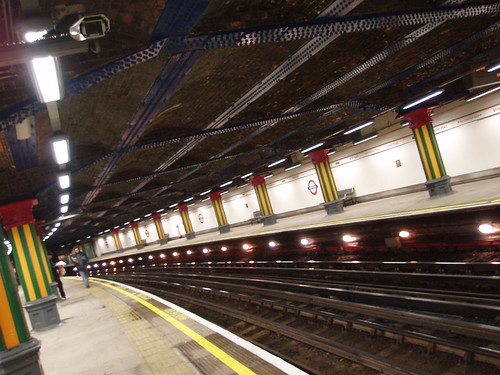
Bow Road tube station, recently renovated. This is the nearest tube station to my place.

Tate Modern and Millenium Bridge at night


Tate Modern and Millenium Bridge, viewed from Paul's Walk at night.