Wednesday, May 21, 2008

Omotesando & Ura-harajuku

The only time I buy clothes is when I visit Tokyo, the world's most friendly city to anti-brand male fashionistas (i.e. fashion-conscious men who don't want to wear Paul Smith, Dior Homme, Giorgio Armani, etc.).

Ura-harajuku, off Omotesando boulevard, is the place to go for such men. Small alleyways are lined with myriads of small-scale boutiques for men (amazingly, there are more shops for men than for women). Various styles are on offer, and they are often creative.

What attract me this time are: a draped long-sleeved t-shirt with two strings hanging from both sides of the crow neck at Jackrose Luv Maison; yukata with contemporary patterns at Tokyo 135; a silver long-sleeved t-shirt at World Exe; and a bell-bottomed pair of trousers at Tornado Mart.

I also stop by at Omotesando Hills. As before, the ad campaign undermines the beauty of the inside of the building designed by Tadao Ando. In the photo below, the ad part is cut off from the frame although this is not the best way of framing the interiors of Omotesando Hills.

But I now learn there are some interesting stores which I can recommend.

Hida Omotesando (floor b2) displays expensive, but elegant wooden furniture made of Japanese cedar from Hida region (in the middle of Japan) designed by Enzo Mari. The grain of cedar makes these pieces of furniture look very unique and beautiful. The collaboration between Japanese traditional furniture makers (which have excellent skills of processing raw materials) and European designers like this one is an emerging trend in Japanese interior design.

Another interesting shop in Omotesando Hills is Kisara (floor b2), selling Japanese traditional textile and other handicrafts presented in a contemporary fashion.

Omotesando Saryo, a cafe at the main entrance of Omotesando Hills, serves Western sweets, pastry, and sandwiches with the decor inspired by Japanese tradition. For 1250 yen (7.67 euro), a croissant sandwich, a small bowl of salad, and yuzu (a kind of citrus only available in Japan) smoothie fill my stomach. The kind of cafes Stockholm never offers me with...

Monday, May 19, 2008

Tokyo Midtown revisited

For the second time I visit Tokyo Midtown. I now come to like its decor. It's not conspicuous, but getting used to it reveals its aesthetics. See these pictures:


And Tokyo Midtown is not just about its appearance:

Edo-kirian

It's near 2pm when I arrive at Tokyo Midtown. I haven't had lunch yet. Among several Japanese restaurants inside the Midtown, Edo-kirian becomes my lunch place today. It's a soba noodle place. The price is very reasonable. For 1080 yen (6.66 euro), I have ebi kakiage seiro (cold soba noodle served on a bamboo steamer with shrimp and sliced vegetable tempura). I'm not particularly a fan of soba noodle, but I'm impressed by the consistent texture of the soba noodle at this place. They also serve soba-yu (hot water used for boiling soba noodle). We drink this after eating soba noodle.

Hinokicho Park

With the full stomach, I take a walk to Hinokicho Park. It is a Japanese style garden, but the garden was just constructed along with the creation of Tokyo Midtown. So it only gives me a superficial impression. Having said that, sitting on a wood bench under the roof of azumaya (a wooden hut meant for garden visitors to take a rest), watching a spacious pond with Tokyo Midtown's contemporary high-rise buildings behind, and listening to the sound of streaming water in the garden makes me relax in the middle of the bustle of megalopolis Tokyo.

Next to Hinokicho Park lies Midtown Garden, which features avant-garde swings and slides for children.
Walking on a slowly curved footpath leads to the low-rise concrete building of 21_21_Design_Sight, designed by Tadao Ando. The curvature of the footpath is well-designed so the horizontal spanning of Ando's building is fully appreciated.

21_21_Design_Sight

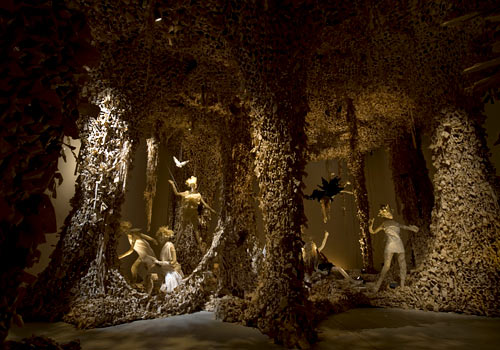
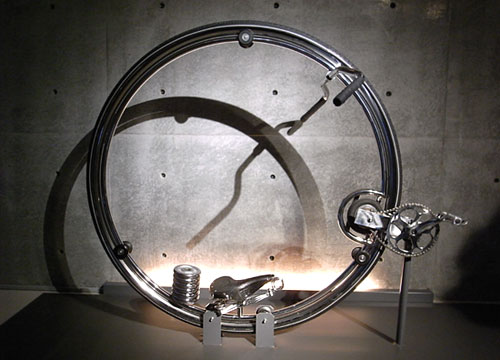
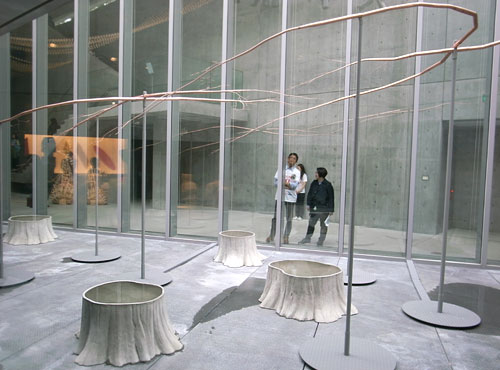
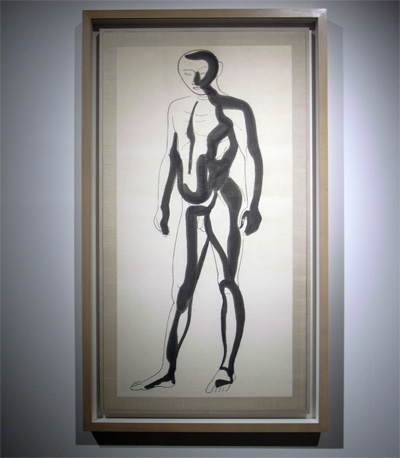
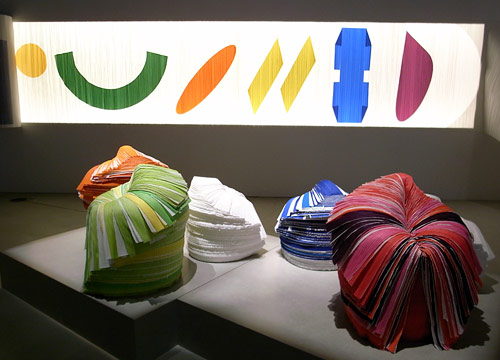
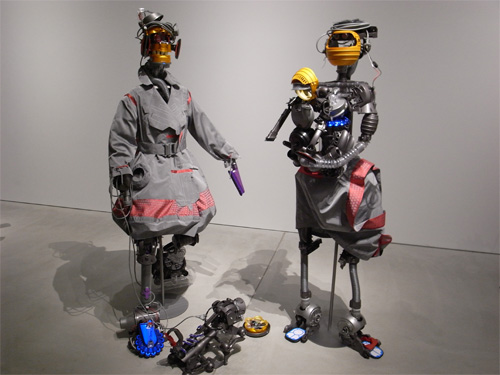
The current exhibition at 21_21_Design_Sight is "XXIst Century Man" curated by Issey Miyake. No photo is allowed at this gallery, but Excite Ism, a Japanese web magazine on design, takes picture of most works on display. Below I link these pictures from the title of each work (except for Tim Hawkinson's Dragon, whose picture comes from The Huffington Post.

There are several key words popping up in my mind while exploring this exhibition. First, recycling. Issey Miyake's "Myth of the 21st Century" uses pieces of paper used during designing clothes. "Cabbage Chair" by nendo utilizes used pleated paper. Koutarou Sekiguchi's "It's a departure at a bright night." is made of only newspaper and duct tape. "Dunan Endeavor" by Yazou Hokama also recycles paper used as a container for industrial material.

Next, what can be called the 21st century version of antimodernism. Ron Arad's "PizzaKobra" reveals a beautiful snake as a result of pursuing the state-of-the-art technology. "The Wind" by Issey Miyake Creative Room transforms parts of Dyson cleaners into human beings who wear the clothes inspired by parts of Dyson cleaners. Ben Wilson's "Monocycle" puts a driver inside the large single wheel, rather than on the top of it.

Third, the creation out of nothing. "Dragon" by Tim Hawkinson is not really a picture of a dragon if you look at it closely, but if you look at it from a distant, it's nothing else than a dragon. "Beginning of Time" by Yasuhiro Suzuki consists of two bronze branches which produce water out of nothing (because we do not see water vapour in the air: bronze induces dew condensation).

Finally, a human body. Isam Noguchi depicts "Standing Nude Youth" in ink brush painting. Stickman creates "Dui Seid" with wood branches as bones and blood vessels.

What should we take from these? Issey Miyake writes, "It is only through the miracles of creativity and imagination that this Earth will see dreams realized..." With environmental issues more serious than ever, we need to be more aware of ourselves as human beings in relation to the nature and what modernism brings to us. And only creation beyond most people's imagination can achieve it. That's my take.

It is a very well-curated exhibition. It would be perfect if visitors couldn't see Koutarou Sekiguchi's "It's a departure at a bright night." until the very end. Due to the space limitation, I suppose, this dream-incubating work of art has to be placed in an area where visitors go downstairs to start a visit. The sight of Sekiguchi's work at the beginning undermines the role of this work as a burst of hope after deep consideration.

Koots Green Tea

After being slightly tired from appreciating art and design, a Japanese tea cafe with an interesting concept refreshes my mind. Koots Green Tea is a perfect copycat of Starbucks in terms of the cafe decor and the presentation of drinks. But it doesn't serve espresso but matcha green tea. Matcha latte comes in several forms including the one topped up by kuromitsu (thick brown sugar in Japanese style) and kinako (soybean flour). Koots's version of Frappuccino is called Korichio (but not espresso but matcha green tea, red bean, or black sesami). Instead of sandwiches, they sell onigiri (rice balls wrapped in sea weed). Instead of biscotti, various Japanese sweets can be ordered. What's interesting is you can order an extra shot of matcha. I love this ridiculousness.

In addition, Koots sells fantastic matcha financiers. This is how Japanese people take French pastry to a next level.

Shopping

Although I was disappointed by the overall inferiority of interior design shops in Tokyo Midtown compared to those in Stockholm, there are two shops worth revisiting. Time & Style sells stylish towels. Hashicho sells myriads of Japanese chopsticks including traditional ones with contemporary design twists.

Monday, May 12, 2008

Guggenheim Museum

After spending a rather boring hour at the Met, I head for Guggenheim Museum by following Emilia's suggestion. She's right. This museum asserts itself with its spirally sloped gallery. What's more, the artist in the current exhibition, Cai Guo-Qiang, uses the spiral structure effectively to locate his works. (Instead of myself reviewing the exhibition, I let you read one by Nicole Wong published in Art It magazine (Spring/Summer 2008 issue).)

I will come to this museum everytime I visit New York.

Alice's Tea Cup Chapter III

On the way back from San Francisco to Stockholm, I stop over at New York, spending about 10 hours in the city. Emilia, who will be a colleague of mine this fall, takes me to a nice tea place called Alice's Tea Cup Chapter III for brunch. They serve more than 100 kinds of tea. I go for African Dew, a black tea without any stupid herbal flavor added. Still, it smells very aromatic and tastes excellent. And also excellent are smoked salmon and scones with poached eggs, rosemary hollandaise sauce, roasted asparagus and pears. There's no cafe like this in Stockholm...
Lipstick Building


At 885 Third Avenue, New York. Designed by Philip Johnson and John Burgee in 1986.
Sunday, May 11, 2008

Valencia Street

Although I do not have time to explore deeply, Valencia Street in the southern part of San Francisco known as the Mission appears to have a lot to offer. A restaurant named Conduit (at 280) has an appealing interior. Jack Hanley Gallery is on this street (at 395). Further down south, an Ethiopian restaurant Cafe Ethiopia at 876. Trendy cafes, boutiques, interior good shops and the like are lined up occasionally.

Murals on Balmy Alley

Balmy Alley in the Mission area of San Francisco (between 24th and 25th Streets) is an open air exhibition space for local mural artists. Below are my favorites:


Transamerica Pyramid


San Francisco's iconic skyscraper is best looked at through between its neighboring skyscrapers.

Hyatt Regent


The lobby of Hyatt Regent San Francisco is gorgeous, a typical example of modernism architecture during the '50s and '60s: the combination of straight concrete with plants interspersed. Eclipse, a round-shaped huge sculpture by Charles O Perry, matches with the atmosphere really well.

Modern Tea

An impressive cafe on Hayes Street (at Laguna Street). They take tea very, very seriously. Try to get a bar counter seat. As if they are serving a glass of cocktail, "tea bartenders" brew a wide variety of tea (from Assam, Darjeeling, Keemum to Japanese and Chinese green tea) in front of you. For each kind of tea, they have a different way of brewing: what tea pot to be used, the degree of temperature of hot water, the amount of tea leaf. For black tea, you need to brew with absolutely boiling water. They exactly do it. They also heat up tea pots and cups by generously using hot water in front of you as the bar counter table is fitted with a long narrow sink covered by a wooden lid with slits. Finally, they don't serve you a tea pot with tea leaf inside. They remove it so tea does not get too strong by the time you have the second and third cups of tea. Splendid. So splendid that I start up a conversation with a bartender (which is very unusual for me).

Tea drinkers are mistreated by way too many cafes around the world. Tea salons like Modern Tea should be more widely available.

Hayes Valley

It is true that Hayes Street between Laguna and Octavia Streets attracts edged boutiques and cafes alongside a contemporary art gallery and a Japanese sake shop, although furniture stores here do not keep up with the high standard of Stockholm. A short tree-lined boulevard in Octavia Street (between Hayes and Feel Streets) is pleasant on a sunny day.

St Mary's Cathedral


This is where liberal and hippy San Francisco meets Christianity. From outside the cathedral looks like a concert hall (see the photo below). Once you get inside the building, it's just mind-blowing to look up (see the photo above). I was tempted to believe in God.

SFMOMA

A very ugly building. So ugly it's not worth being taken picture of. It reminds me of the costume of a dancer in an anti-modernism film The Triadic Ballet by Oskar Schlemmer (like this), which means it makes you puke.

Contemporary Jewish Museum


A building I happened to encounter in San Francisco (On Yerba Buena Lane, off Market Street between Third and Fourth Streets). Log on to www.thecjm.org for detail.

And Beard Papa, a Japanese cream puff chain store, is located on the same street.

Cafe de la Presse

Following the 24 Hours section of Wallpaper* City Guide for San Francisco, I had breakfast at this French cafe in front of the China Town Gate (what an irony). Vanilla French toast with warm berries was beautiful. With a wide variety of international newspapers and magazines on offer (I took FT) and very pleasant waiters and waitresses, you can spend an intelligent but relaxed morning time here.

Saskia Leek @ Jack Hanley Gallery

The Center on Institutions and Governance at UC Berkeley invited me to present my work at their two-day workshop. As UC Berkeley is located near San Francisco, I take this opportunity to explore San Francisco after the workshop was over.

The first visit is Jack Hanley Gallery, recommended by Wallpaper* City Guide. The featured artist is Saskia Leek.

The first look gives me an impression that each picture draws a familiar object like a cat, a bunch of grapes, a plant, etc. The more I look at them, however, the more unfamiliar the pictures become. The sequence of impressions on a piece of contemporary art is usually the other way around. Very unfamiliar at first, but then you realize what it is about (or you never understand what it is about).

Now I head to Golden Gate Park.

Saturday, May 10, 2008

Golden Gate Park


Tourists in San Francisco usually do not explore the western part of the city. Therefore I do.

Taking a bus to the west (pay 1.5 dollars in exact amount of cash, and you'll get a paper slip which allows you to take a bus again during the next 90 minutes) takes me to the eastern edge of Golden Gate Park. It is a loooong park. It takes more than two hours to walk from one end to the other. I only managed to walk over the eastern half. I encountered three memorable things.

First, pick-up drum jams on the Hippie Hill. There were about 10 people jamming with various kinds of drums. It sounded like each participant was hitting their drum on their own. As a whole, however, the drums sounded quite interesting. If I were a resident in San Francisco, I might be willing to join them.

Second, De Young Museum. (See the two pictures above.) Some hate it, but I love its building covered in perforated and textured copper, designed by Herzog & de Meuron. The copper cover creates a very surreal impression of the building's appearance. With mist floating around the building, it looks as if it wasn't there. It looks like a mirage although it stands just in front of you. I never saw such a building before.

Finally, Stow Lake. Deep green water with Far Eastern plants like a narcissus made me forget where I was. Again mist floats over the water. The whole scenery looks like the one deep inland in China where a Chinese wizard hides himself from the world.


A caveat of this park is that many driveways crisscross the park, but that's the only thing that reminds you of where you are: car-infested America.

Friday, May 02, 2008

10th Anniversary: Part II

Dear hide-san,

Ten years on, what you invented in the Japanese pop music scene is now invading not only East Asia but also North America, Europe, and even Latin America. Thanks to this, I feel less lonely by living in the West. Growing up in Japan makes me feel very different from anyone I meet here in Europe. Now, however, I can share with some people here one thing I was passionate about during my adolescence and thus the one shaping my thoughts, attitudes, and feelings.

I thank you for this. You'll be remembered by many around the world. Rest in peace.

Masa

10th Anniversary: Part I

Dear Tomo-chan,

It's been 10 years since you left this world. I remember you and I, with some other college classmates of ours, were talking about our future. You said, "I'll take care of Japan. You take care of outside Japan." I'm not sure I realized what you said, but at least I manage to walk on the path that few other Japanese people follow. I hope you are happy with this.

I never forget you. I'll visit you in Tokyo soon. Until then, rest in peace.

With love,
Masa

Friday, April 04, 2008

Lund


I take a day trip to Lund, a university town in southern Sweden, to give a talk about how economists estimate the impact of climate change in front of meteorologists, hydrologists, biologists, and other non-economic scientists.

After the talk, I explore the town by following the Lund Tourist Office's walking tour route. Honestly speaking, I didn't expect anything from such a small city of 100,000 people. Lund, however, turns out to be quite pretty a city.

First, the cathedral (see the above picture), constructed around 1100, one of the oldest in Sweden. The light blue roofs match nicely in a modest way with white and black stones of the walls. The appearance from outside is rather attracting to me.

Then dotted across the northeastern part of the city are the cottages with walls of a distinct pattern: thick black grids on either white walls or red-brick walls. I've never seen such a pattern elsewhere.


And houses along the cobbled streets, especially on Adelgatan (see the photo below). They are very nicely coloured and do not intrude each other even though each has its own color. The color of walls nicely fits the color of window frames.


In addition, The Botanic Garden is likely to be pleasant during the summertime.

For dinner, I spot a nicely decorated restaurant serving seafoods in a Swedish style. At Klostergatans Fisk (Klostergatan 12), I have "3 flavors of Swedish herring with a small “Janssons frestelse”, boiled egg and cumin-cheese" for a starter. All of the three pickled herring taste very nice, especially the one with peppercorns and chopped onions. So does the Janssons frestelse, a Swedish speciality. And I manage to enjoy eating cumin-cheese even though I don't like cheese in general (unless it's melt).

For the main dish, I choose "Pan-fried monkfish with a grilled crayfish, orange flavored hollandaise and parmesan potato". Monkfish is amazingly juicy (it squirts when I try to slice it with a knife), and orange flavored hollandaise perfectly matches with the texture and taste of monkfish. The crayfish is good, too.

With a very pleasant waitress serving me, a glass of Chilean chardonnay Estampa, and a well-coordinated interior (light-blue candle glasses, black and light-blue abstract paintings covered blatantly with white paint on the walls, pitch-white table clothes, and brown chairs and aprons of waitresses), I have a fantastic dinner even though I am eating alone.