Saturday, October 14, 2006

Which school to apply?

Try to decide 100 schools to apply. Manage to select 45 schools (including six of top 10 schools) so far. At the same time, create an Excel spreadsheet of postal addresses which I will send Mark who will then creates address labels. In this process, I find that the application procedure differs slightly from school to school. A factor contributing to the complication is online application. Some schools require online application only (which can be either filling in an online form or emailing all the documents in the PDF format), some prefer online to postal application, some allow both, some require online "pre-application" in addition to postal application which includes a print-out of the filled-in online pre-application form, and others accept postal application only. This is MAD.

Find the job market information webpage for Harvard job market candidates. Also find that the December 2003 issue of Journal of the European Economic Association features articles on the rankings of economics departments in the world.

Goldin and Fryer (2006b) --- one of the job market guides on the Harvard website --- say "Don't apply to places that you would never consider. But do apply to places that are reasonably good but perhaps not in the right location or not with the best faculty. You don't know at this point ... whether this place will be useful in other ways (e.g., strategically or over the long haul --- you are always in the market)."

Fill in the online application form for NYU Department of Politics, because "applications received by October 15, 2006 have the best chance of being fully considered." The deadline for political science departments is earlier than economics departments. Following Tim's advice (see 10 Oct.), I decide not to apply for political science departments except for NYU. Why? NYU seems to me the most approachable to someone with economics background as several faculty members write papers with economists.

Can't attend Yuri's Japanese dinner party. Instead I eat sandwitches for dinner in front of the computer...

Friday, October 13, 2006

Address spreadsheet

Bump into Robin. Ask how many schools I should apply. His answer: 70 for US, 30 for Europe...

Receive email from Mark to urge me to submit the Excel spreadsheet of addresses of schools I'm going to apply for. Then he will make address labels to be attached on the application packets. I promise him I will do by next Monday, which means I need to decide which schools to apply by next Monday.

Struggle with one pontentially damaging aspect of my job market paper all day.

Submit my CV and job market paper to Mark. This is for the Department's job market candidate webpage.

Submit my job market paper to RES Annual Conference held next April.

Which school to apply???

Morning:
Register the ASSA Meeting, costing 35 US dollars.

Cancel a hotel room in Chicago (see 5 October for why).

Receive email from Tim on the abstracts on our joint research in progress, modify my CV acccordingly, and send it to Mark again.

Replace the CV in the HTML format with the CV in the PDF format on my website, following advice from my supervisor.

Look for teaching evaluation, which I need to give Oriana for helping her write a teaching reference. But I can't find it, and so ask Mark for a copy.

Receive an Excel template address spreadsheet from Leila. She's an assistant for three of my four referees. When she sends recommendation letters to the schools I'm applying for, she needs the addresses of these schools. But she has her own preferred way of managing addresses. That's why she gives me the template Excel sheet.

Afternoon:
Talk to Torsten, visiting LSE this term. He gives me several useful suggestions for the revision of my job market paper.

Try to decide which school to apply. But I'm overwhelmed... The October issue of JOE (this is where you can find job openings for economists) lists hundreds of schools. I begin with 30 schools or so from which I'm sure I would accept a job offer. Then I try to increase the number of applications to check department websites etc. because my referees advise me to aim for 100 schools. Indeed, 25% of economics job market candidates should apply for more than 100 schools (see page 14 of Cawley 2006).

Evening:
Revise the data appendix and abstract for my job market paper.

Email Rocco, a previous year LSE job market candidate, to ask how he chose which school to apply. His answer: "Apply anywhere you would accept an offer, if it was the only one you had." An exception to this is top schools for which he said, "Talk to your referrees frankly."

Wednesday, October 11, 2006

29th Birthday

A busy, busy day...

Morning:
1. Receive an acceptance message from the organizer of the 4th PhD Student In Development Economics Network Seminar at Namur University! The decision has been delayed due to a large number of applicants. My job market paper is still accepted as one of the six papers presented at the seminar. This is a good signal. Also this will be a very good opportunity to present my research to the audience outside LSE: what Tim strongly encouraged me to do.

2. Send a CV to Mark. Struggle on what to do with my contact detail during my stay in Tokyo late December (see below). Receiving a call in Japan with my UK vodafone handset costs 1.25 pound per minute. I put my Japanese pay-as-you-go mobile number in the end.

Afternoon:
1. Book a return flight to Japan. Strictly speaking, I don't need to go back. But why not relax a bit just before the climax of the job market process starts early January? All seats for Virgin Atlantic have already gone for my preferrable dates of departure. All Nippon Airways have got some seats on the aircraft flying to Tokyo on 18th December. I will be back in London on 26th December.

2. Collect job openings advertisements from the JOE website. 22 schools so far...

3. Talk to my supervisor. He read my job market paper thoroughly for the first time before this meeting, and he says, "With this paper, you can apply to anywhere you want." I don't believe my ears. He gives me a couple of suggestions to improve the introduction, which most people will only read. As he's away from London later next week, I need to revise it by next Wednesday. On the issue of the choice of fields of research and teaching, he tells me to write down a field that you want to teach as a secondary field. So applied econometrics is fine. Regarding the fourth reference letter, he says that a teaching reference from Oriana is a good idea given that East Asians have a bad reputation on teaching (which is sadly true...).

Evening:
1. At STICERD Welcome Reception (it's the beginning of a new academic year!), talk to Valentino, who got a PhD in economics and is now a lecturer at Department of Government. Ask him about what is like to get a job in a political science department. Get useful information on it.

2. Book Eurostar return ticket to Brussells for the Namur University conference (see above). Will leave on Thursday 26th, one day before the conference, because the earliest Eurostar train doesn't make it to the beginning of the conference. The conference organizer is very helpful, offering accommodation at some PhD student's place for two nights. Although it's in the middle of a job market process, why not do sightseeing a bit? As Eurostar on Saturday is all pricey, I book the earliest morning train on Sunday. Need to find an accommodation in Brussells on Saturday night.

3. Catch Oriana when she's leaving her office and ask for a teaching reference. She says yes. I will give her a copy of teaching evaluation from students that I got two years ago.

Mass-mailing of CVs of job market candidates

Send my CV to Mark. One reason for this is to mass-mail CVs of all job market candidates at LSE this year to many academic departments (which is "a standard practice amongst many of the top US schools" as Mark puts it). But Cawley (2006, p.19) writes:

Likewise, your department's mailing of CVs is not a substitute for a job packet mailing. Stock et al. (2000) found that only about half of hiring departments even review the packets of CVs, and only about 20% reported scheduling an interview on the basis of the CV packet.

Tuesday, October 10, 2006

Fourth Recommendation Letter

I have already secured three letters of recommendation (from my supervisor, Tim, and Robin). One concern, however, is that none of them know my teaching performance as I never worked for them as a teaching assistant. Noll (2005, p.19) say that one element of recommendation letters is "an assessment of your abilities as a teacher".

So I asked Oriana for writing my fourth recommendation letter because she's the only person who knows my teaching performance. She replied, saying "I don't think it's necessary." I thought this implicitly meant she did not want to write because she couldn't write a good letter for me.

But it was a wrong guess. When I bump into her at the STICERD communal space today, I ask her why she thinks her letter is not necessary. She says, "Robin (my third referree) should know my teaching." If I point out that is not the case, then she explains the reason a bit more, which reveals something I never knew before.

Recommendation letters for job market candidates consist of (1) description of the job market paper and (2) contribution of the job market paper. Your supervisor's letter is the most detailed and long while other letters are shorter. Oriana says that four letters that are all describing my paper and contribution will be too much.

But she says if my supervisor and Tim say it is a good idea for me to have Oriana's letter on teaching, she will write one. So I ask my supervisor on this tomorrow.

CV

Prepare my CV as Mark, our job placement administrator, asks job market candidates at LSE to submit one by midday tomorrow. He gave us a template CV, so it is rather easy as I only need to fill blanks. However, difficulty lies in "Works In Progress" section as I need to explain such works briefly. This takes a lot of time. Especially, two of them are joint works with Tim. So I email him if he thinks I should include them as "works-in-progress" on my CV.

An important item on CV is "Desired Teaching and Research Fields" (Hall 2001). According to Noll (2005, pp.12-15), "[y]our primary ... fields are the areas in which you do research and would advise graduate students; your secondary fields are those that you have the qualifications and interest to teach." A consensus recommendation on this seems to be to "define fields broadly". Noll (2005) also recommends consulting your advisers about your field choices. So I will when I talk to Maitreesh about which level and type of schools to apply tomorrow.

Cawley (2006, p.7)'s recommendations on CV are:
1. "The date your CV was revised should appear somewhere on the document."
2. "Keep detailed lists of every presentation, every award and grant you receive, and the journals for which you have refereed." (So I include a presentation at University of Essex last March.)
3. "[L]ist a phone number at which you can be reached if prospective employers wish to interview you. Make sure that you list a number connected to voice mail or an answering machine. If you list a phone number associated with an office used by a large number of graduate students you may fail to receive some messages." (So I put my mobile number instead of a shared phone number at STICERD.)

---

Receive email from Tim, answering my question on whether I should apply for political science departments: "I doubt that you want to try to break into the pol sci scene. It is very difficult and I doubt that you would share many common interests."

Receive email from my supervisor and we arrange our meeting tomorrow to discuss which school to apply.

Monday, October 09, 2006

Booking a Flight to Chicago, Talking to Seminar Speaker, and Criticized by Public Health Researcher

Book a return flight ticket from London to Chicago to attend the ASSA meeting in early January. I may not get any job interview offers at the ASSA meeting, but booking a flight just before the meeting is risky.

Talk to today's seminar speaker visiting LSE (see 5 October). Although my job market paper is not relevant to his research, he says it's interesting and he understands why I'm on the job market with this paper. That's a good sign, isn't it? He also asks me about other projects in my dissertation, and I talk about the ethnic conflict project. He says the empirical result (ethnic groups losing power suffer in terms of infant mortality) is interesting, but he asks a question of why this is so. That's a fair point and I need to think about it harder.

Attend LSHTM's public health lecture on sanitation and hygiene. After the lecture is over, I talk to the lecturer for asking some questions related to my job market paper. A logical progression is that I talk about my job market paper to this lecturer. She's very skeptical on my findings, making me think harder about my paper.

Revision finished

Finally manage to revise my paper. Send it to my three referrees and Oriana.

Thursday, October 05, 2006

Talking to Seminar Speakers Invited to LSE

Oriana emails me and Paolo (one of my fellow job market candidates), suggesting talking to a seminar speaker for LSE/UCL Growth & Development Seminar next Monday. I thought he wouldn't be interested in my job market paper. But Oriana says it is very useful for job market candidates "to get comments and to practice exposing your ideas in a short span of time." She's right. During the course of the job market process, you will have many opportunities to talk to other economists briefly on your research, either at job interviews or at informal conversations to faculty members during campus visits. This will happen even if your conversation partner has no interest in your research. So we should prepare for that.

Various job market guides recommend getting to know what kind of research the economists you will meet have done in the past before doing job interviews etc. So I will do it for next Monday's seminar speaker.

Hotel booking

Get a room at Sheraton Chicago Hotel & Towers for which I was waitlisted. This hotel stands just between the headquarter hotel and the all-suite interview hotel, probably the best hotel location other than the above two. My waiting-list stragegy worked! (See 26 September. See also 1 October for why staying near the headquarter hotel is important.)

Wednesday, October 04, 2006

Personal Website

Attend an orientation meeting for LSE economics PhD students who plan to go on the job market this academic year. I ask one question to the Placement Director (who happens to be my supervisor).

What should my personal website look like?

Answer: Purely academic in a minimalist way. Discard links to non-academic stuff including your (ie. my) blog. :-)

Mark, the superb administrative assistant at our department, recommends having your personal website because this allows students to update their job market paper and CV regularly. Emailing them to your department assistant to let him/her upload it on the department website takes time.

Introduction and Conclusion

Writing the Introduction has been a headache for me because I can come up with several ways of introducing my main finding that democratization in Africa reduces infant mortality via increased public health service delivery. I can begin by describing poverty in Africa, a hot issue during the last couple of years. I can begin by stating a grand question of whether democracy does any good to people. Or I can begin by talking about the recent economic literature on the effect of political institutions on socio-economic outcomes...

Chapter 15 of Booth, Colomb, and Williams (1995) discusses how to write the introduction for an academic paper. They mention three ways of begining the paper: (1) Open with a striking fact or quotation; (2) Open with a relevant anecdote; and (3) Open with a general statement.

I come to think that one of the most important facts underlying my paper is that many sub-Sahara African countries have been democratized. But few people know this fact: My supervisor was surprised by looking at the list of 24 African countries that introduced multiparty elections for executive office. Robin stresses the fact that few people know many African countries are now democracy. So I should probably "open with a striking fact". Actually, my first draft began with African experience of democratization. And Ikegami-kun, one of my friends interested in development economics, told me that the introduction in the first draft was well-written. Then I changed it in the third draft that I finished this Monday.

So I'm back to the original idea.

For the conclusion, Booth, Colomb, and Williams (1995) offer three ideas.

First, close with a new significance or application. If your research is motivated by a practical problem in the world, stress one additional importance of the problem you solved. Compared to other reasons for why readers should care about the problem in the introduction, this one must be "at a level more general" and "provocative enough." If your research is not motivated by a practical problem in the world, propose an application of your research result that is "some new and perhaps even unexpected benefit of clearer understanding that your solution might have."

Tuesday, October 03, 2006

Revision again, Introduction of the paper, LSHTM lecture

Email my supervisor and Tim if they want to read the current version of the paper or a version after another round of revision to incorporate Robin's comments. Both say they wait for another round of revision. So I start doing it.

As I have difficulty writing the introduction section, I ask my supervisor (when I bump into him) for any suggestion. He recommends this book (and here's some background of the book).

Attend the first of LSHTM's public health lecture series titled "Public Health and Millenium Development Goals". The lecturer mentions one interesting study: a randomized trial in Tanzania that shows the significant effect of matching the burden of diseases and the allocation of financial resources on child death. This implies that even without an increase in funding there is room for child health improvement. That might have been what happened after democratization in Africa.

Monday, October 02, 2006

Mock Job Talk Scheduled

A new academic year begins at LSE today. Every Monday lunchtime (1-2pm) is a PhD student seminar in the field of development economics. Today, we decide in which week each PhD student presents their research. As a job market candidate, I'm allowed to choose a slot first along with Marieke, another job market candidate this year. We received email from Tim already in which he mentions dates when he can come to attend the PhD seminar. My supervisor also emailed me saying that he cannot come to the seminar at one of the dates Tim mentioned. (See 25 September.) So I take 13 November and Marieke takes 6 November. This will be a mock job talk. We will be given one hour and a half, dress formally, and give a presentation on our research as if we gave a job talk.

Remember that there are three stages of selection for PhD students in economics to get a job of assistant professorship: an application in November, an interview at the ASSA Meeting in early January, and a job talk during the campus visit in mid-January to mid-February. A good performance during your job talk gets you a job.

Receive email from Tsuda-san at Institute of Developing Economies, a research centre in Tokyo. I have a couple of friends working there and I've asked them if I could present my research in front of Africanists at the Institute. They have accepted my request and the date of the seminar is decided to be 22 December. I will schedule my stay in Tokyo late December around that time to buy a winter suit and eat delicious Japanese foods immediately before the job market activity enters the crucial stage.

Finish the revision of the paper with lots of compromises and send a PDF file copy of it to the organizer of the fourth Development Economics Network PhD student seminar at Namur University, Belgium, on 27 October. If my paper is accepted, this will be a good opportunity for me to present my research outside LSE before going on the job market (see the end of this previous post). Fingers are crossed.

Receive email from Nagano, one of my best friends during the college days. It is an invitation to his wedding party early November. I need to decline this as it is impossible for going back to Tokyo in the middle of the whole preparation for going on the job market. But I reply to him saying that I want to celebrate when I'm back in Tokyo late December.

Sunday, October 01, 2006

Why booking a hotel room in or near the ASSA meeting headquarters hotel is essential

Revise the paper from 11:30 am to 11:30 pm...

A finding on the Tuesday before the last was incorrect. With alternative measures of democracy, I still obtain similar results. Which is fine, anyway.

By browsing the AEA website, I figure out why booking a hotel room in or near the headquarter hotel is important (see 26 September). This document says,

"Job candidates have difficulty locating interviewers at the ASSA meetings. Interviewers do not know their room numbers prior to check-in and thus cannot tell candidates in advance."

Therefore, the AEA will set up the "Job Interview Suite & Room Information Table", where interviewers come and leave their room numbers, and candidates come and learn the locations of their interviews. And the Table will be set up at the headquarter hotel. Staying in or near the headquarter hotel thus makes it easy for you to locate where your interviews take place.

Saturday, September 30, 2006

Revision...

Revise my paper at LSE from 3 to 8 pm. Doesn't seem to finish by next Monday...

Need to decline Kirsten's invitation to her house-warming party in the evening.

Friday, September 29, 2006

Last Friday of LSE Summer Holiday

Robin's various comments and Sylvia's suggestions yesterday make me think that the amount of time needed to revise the job market paper is more than I initially thought. So I cancel the seminar presentation slot next Friday in which I planned to talk about my new project. (I thought I could make my mind on the job market after next Friday's seminar---if my new project receives a good response, I would be better off by waiting one more year with the possibility of a better job market paper. But as the paper I've already written down has got good responses unexpectedly, the above plan makes no sense now.)

I need to forego the opportunity of going to tonight's V&A late opening with Sue or Kirsten. I need to revise my paper...

Thursday, September 28, 2006

Third Reference

A morning meeting with Robin to hear his view on my paper. He says that the paper is worth going on the job market with. He then gives me several valuable comments to improve the paper.

Now that three faculty members recommend going on the job market, I have no reason for not doing so.

In the evening, I meet Sylvia, a malaria control specialist, through the introduction by Yuri-san. The purpose is to get familiar with the public health literature. I didn't want to be an "imperialist" economist (ie. an economist invading the territory of other academic disciplines) who does not know the common knowledge in the discipline he/she invades. It is a very useful meeting. She shows me a wide range of sources of information as well as some basic ideas of public health in Africa.

Wednesday, September 27, 2006

Abstract, Introduction, and Conclusion

Start revising the paper. Noll (2005, p.17)---last year's job market guide for PhD candidates at Stanford University---convincingly argues for the importance of the abstract, the introduction, and the conclusion of the job market paper. These are the parts of your job market paper that recruiting commitee members at universities actually read.

I think it's better to revise these three parts of the paper first. After revising the main text I will need to modify these parts anyway. So I will spend twice as long time as I would do if I revised these three parts only in the end.

The abstract must be short. The upper limit is 150 words. It must include the research question, the research method, and a brief statement of most important results. (Noll 2005, p.17)

I think that the introduction of a paper is more or less the same as the introduction of a seminar as described in Cox (2000): the question to be addressed, why this question is important, why the existing literature fails to address it properly, what your new and better research method is to address the question, and the summary of results.

More trickly is the conclusion. Cochrane (2005, pp.3-4) even argues that there needs no conclusion. But he suggests some idea for what should be written in the conclusion: a short paragraph or two acknowledging limitations. I think implications for future research and policies can also be included. In addition, David Levine (see under the heading "Stylistic issues") says the conclusion should be "accessible to the nonspecialist reader".

I forego the opportunity to go to Heyward Gallery with Cheyok and to a classical music concert with Katsumata-san tonight. Now I'm on the job market.

Tuesday, September 26, 2006

Hotel Room Booking for ASSA Meeting Interviews

Back at LSE, I immediately try to book a hotel room in Chicago online (the AEA website offers such an online booking system). Job market guides such as Cawley (2004, p.17) recommend booking a room in the headquarters hotel, in an all-suite interview hotel (where most interviews take place), or in hotels near these two. I don't really know why, but just follow the advice.

The updated version of Cawley (2004) (Cawley 2006, p.17) changes its advice. Now the author recommends NOT reserving a room in an all-suite interview hotel for the sake of social welfare.

Unfortunately, I'm already too late to book such hotels. I make a reservation at a hotel which is far away from the headquarters hotel and the all-suite interview hotel. But I learn that I can cancel a hotel reservation until early December without any charge. So I put myself waitlisted at a hotel near both the two hotels.

My strategy is this: those candidates who are sure to go on the job market should have booked either of the two main hotels because they are the first to book. They won't cancel their booking. Those candidates who are not that sure if they go on the market are likely to have booked one near the two main hotels because they are slightly late to book a room and learn that the two main hotels are already fully booked. So the chances that you get a room after waitlisted is higher for these "nearby" hotels.

Tim's advice

Meeting with Tim at his BOE office.

He starts telling me about the procedural stuff on the job market process: where to apply, how to post references, booking a hotel room in Chicago (where preliminary interviews are going to be held) NOW, etc.

I ask him why he thinks my paper is good enough to be on the job market. I don't think so because findings in my paper are not convincing enough. I cannot rule out the possibility that infant mortality drops before democratization.

But Tim says, "What the market looks for is a person who investigates an issue intelligently. You don't need a news-headline result." Then he cites two examples. One is his own work on property rights in Ghana. This paper is celebrated not because of his result (he couldn't find a positive effect of property rights on investment in the end), but due to the fact that he thinks hard about how property rights affect investment and provides a framework to analyze it (so that other researchers can use it). Another example is Angus Deaton's work on estimating demand functions. It ends up finding that the linear demand function does not work with data. But his work is well-respected because of his invention of how to estimate demand functions.

This is something all the PhD students should know.

He advises me to get the job market paper ready by 15th-20th November. The formal package of application isn't very important. For example, some top school does not open it. They contact job placement officers at each school and ask for sending the job application packet of the candidates they are interested in. This will happen after Thanksgiving (Last Thursday of November).

In terms of where to apply, he says, "A good place to be an assistant professor is those with lots of other junior faculty members with similar interest. So you can collaborate with them. Senior professors are important in terms of giving good advice. But nothing more than that."

The final piece of advice: try to book a seminar presentation with different audience (ie. outside LSE).

Monday, September 25, 2006

Mock Job Talk Booking

Find that my result does not hold if I use alternative measures of democracy. Which is not necessarily bad because it suggests that these alternative measures are inappropriate.

Receive email from Tim, suggesting to book a Monday lunchtime PhD student seminar slot on one of the days he can attend. The message sounds like he's already assumed that I'm going on the job market...

Then receive email from my supervisor as well, telling me that he can come except for one of the dates Tim suggested.

Email Oriana to ask for her view on my paper. Initially I thought she wouldn't be interested in my paper, but I realized that what's the most important is to maximize the number of feedbacks.

She emails back immediately with a note on whether or not I can present at the Development & Growth Seminar (see 14 September). Unfortunately there is no seminar slot left.

In case you don't know what I'm talking about, scheduling a seminar presentation is one of the important things to do when you are on the job market. In the final stage of the job market process, what gets you a job is your performance at the seminar presentation in the prospective employers' campus (what we call ''job talk''). Which means you need to practice it beforehand, ideally in front of lots of faculty members from your own school so you can get critical comments.

Friday, September 22, 2006

Last Friday Night Out

A day of data processing, in order to check the robustness of my findings to the use of alternative measures of democracy.

Hang out with Cheyok and her friends in the Brick Lane area in the evening. Perhaps the last Friday night out before the whole job market madness.

Thursday, September 21, 2006

Replication done

Finish replication. Find a minor error (I mistakenly excluded from the sample a few babies), but fortunately it doesn't affect my findings.

Email Sylvia, a public health specialist, to ask many questions related to my paper. I need to learn a lot more on what determines child mortality and related issues in the public health literature.

Wednesday, September 20, 2006

Replication

Start making STATA do files for replication to spot any error in my estimation for the paper before the job market madness may start.

Tuesday, September 19, 2006

New (and Last?) Student Card

Back from St Ives yesterday, get a new LSE student ID card as a new academic year is about to begin. I still don't believe that this new card may become the last student card in my life...

Saturday, September 16, 2006

St Ives

Off to St Ives, the best hidden gem of England in my view, to forget everything for three days. Finding a single room to stay there takes a lot of time as most guesthouses wait for a couple to arrive at their double rooms...

Friday, September 15, 2006

Two more references

I couldn't believe my ears yesterday. I want to hear more views on my paper. In any case, you need to submit at least THREE references when you apply for an academic job. Which means you need to have at least three faculty members who like your research.

Email Tim and Robin to make an appointment.

Thursday, September 14, 2006

The Beginning

Meet my supervisor. I emailed him beforehand to let him know that last month I wrote up the first paper in the four years of my PhD life, and to ask him if he thinks the paper is good enough for me to go on the job market. My expectation was, however, that I needed to take one more year before going on the job market.

During the meeting, my supervisor takes me by surprise, saying, "You can go on the job market with this paper."

He also suggests booking a presentation slot at LSE/UCL Development & Growth Seminar. This is something. Speakers at the Seminar are usually faculty members inside and outside LSE and UCL. Oh my...

Email the Seminar organizers if there is any vacant slot.

LSE RLAB Lift back in operation

So LSE RLAB Lift is finally back in operation after a two-week strike. Fingers are crossed.

Wednesday, September 06, 2006

Metrosexual in Japan

It seems that the term "metrosexual" has now become a buzz word among fashion-conscious young men in Japan.

Yuri-san, who has just arrived in London from Japan, bought me a men's hair catalogue from Japan. I've already said this quite a few times in this blog, but there is such a thing as men's hair catalogue books in Japan, targeted at fashion-conscious young men. (I still haven't seen this in London. Do you?)

The term metrosexual appears on this catalogue. This is the first time I saw this word in Japanese media. It reads, "Metrosexual is an urban celeb pursuing cool-ness not just personality-wise but also appearance-wise."

Okay, now I need to explain another buzz word "celeb" in the Japanese language. It doesn't mean someone famous. Nobody seems to know its real meaning, but it seems to refer to people whose life style is like the one of pop stars, super-rich, and upper-class people. It's been a couple of years since this term was imported into the Japanese language.
I google "metrosexual" in Japanese, and the number of hits is about 122,000.

As far as I understand, the phrase "metrosexual" here in UK refers to a man who uses moisturiser. :-) David Beckam represents all the metrosexuals in UK.

Anyway, what's interesting to me is that the idea that a man takes care of his appearance is nothing new in Japan. It's already been a decade since young Japanese men became appearance-conscious. I believe it was much earlier than here in UK. Then the term metrosexual is now imported to symbolize such men. Maybe those fashion-conscious teenage boys a decade ago are now in the position of creating trend words. They wanted to give a name to themselves to be distinct from the rest of Japanese men. Then they found the term metrosexual in English. Maybe. Maybe not.

An update to LSE RLAB Lift

Here's an excerpt from an email message sent to all members of LSE Research Lab today:

... the faulty component was replaced yesterday but this has highlighted further faults on the electronics in the main lift controller.


Number of days LSE RLAB Lift is out of service since 1st September 2006: 5.

Monday, September 04, 2006

Saga continues...

LSE Rlab lift seems to be trying to undermine my effort. Last Friday, I decided to recode the number of times he - yes, I would say he's he because this kind of behaviour is not typical for women (am I sexist?) - breaks down. But what he cares about is the number of hours he doesn't need to work. So he seems to make each break-down take longer to fix.

So he didn't work last Sunday (I didn't come to the School last Saturday. Maybe he didn't work on that day, either, but to be fair, I won't base my count on guesswork.), and he is still out of service today.

I've changed my strategy. I will count the number of days he is lazy.

Number of days LSE RLAB Lift is out of service since 1st September 2006: 3.

Friday, September 01, 2006

LSE RLAB Lift

I've decided to record the dates when the lift of LSE RLAB is out of order. It has been playing up so many times in the past four years, but today it's egregious because the lift was out of service last Sunday and Bank Holiday Monday due to maintenance. I had to walk up stairs to the fifth floor several times. Four days on, it again breaks down.

I bet it will break down in the next 12 months more than 50 times.

Number of times LSE RLAB lift breaks down since 1 September 2006: 1.

Wednesday, August 23, 2006

Democratization and Infant Mortality in sub-Saharan Africa

Five months on after its conception last March, I finally finished writing up a paper on the empirical investigation of democratization and infant mortality in sub-Saharan Africa. A quick summary is:

Infant mortality has declined since democratization in countries where a new chief executive assumes office by winning the first multiparty election. This is especially true for babies born to uneducated mothers.
Note that I do not claim that democratization has caused the decline in infant mortality, because I cannot rule out the possibility that something else drives both democratization and the survival of babies. (It could be, for example, just NGOs, as a reader of this blog commented on this post. But I wonder if NGOs can make a country-wide difference. Maybe. Maybe not.) But, for babies born to uneducated mothers, a trend in infant mortality definitely changes right after the year of democratization. Plus, the usage of piped water and flush toilet and the take-up rate of immunization and delivery assistance by health professionals seems to have expanded for uneducated mothers since democratization. So it can be democratization that drives infant mortality down.

Now I'm in the process of letting people read this paper and expecting to receive reactions and comments. If you want to join this process :-), here you can download the paper.

If you are not an economist but a political scientist or an Africanist, please have a look at sections 2, 3.2, 6, 8, and perhaps A.1 and A.2. If you are a public health researcher, a demographer, or a medical expert, please have a look at the second half of section 2, and section 7. This is because I rely on not only the previous works done by economists but also on those by political scientists, Africanists, and public health researchers. I want to know if I correctly interpret their research outputs.

Monday, August 21, 2006

Make secure your wireless LAN network

As a new housemate moves in today, I re-think about the security of our wireless home network for broadband acccess.

About.com provides a nice summary of tips.

Its fourth tip talks about something called "MAC address". How to get your MAC address is illustrated succinctly here. The link for Windows XP takes you to the same page as for Windows 2000. But what's written there actually works for Windows XP as well. I also found a couple of similar websites, but they are more complicated than this.

Finally, my additional tip: Don't confuse the MAC address for the wireless network equipment with the MAC address for the ethernet adapter. What you need is the former, not the latter.

Wednesday, August 16, 2006

BBC Prom: The Rite of Spring in 2006

This will become an annual event in London for me: listen live to The Rite of Spring at the Prom (see 7 September 2005).

This year Stravinsky's masterpiece (in my opinion) is performed by Budapest Festival Orchestra with Ivan Fischer as conductor. Honestly I wondered if they could live up to my expectation from this piece of music. But I worried too much. I only need to repeat what I wrote last year:

Stravinsky is a genious composer. The contrast of quietness and loudness, one instrument after another claiming its presence in waves, and very progressive patterns of rhythms continuously coming in an unexpected way.

I've come to think that I probably shouldn't listen to The Rite of Spring (see notes at the Prom website) unless I'm in front of the orchestra, which allows me to enjoy the music in a three-dimensional way. That is probably the best way of appreciating "Stravinsky's immortal hymn to spring". (Still, you can listen to the performance online. Skip the first 5 minutes. The BBC Radio online production teams are so lazy that different programmes are often attached in the first few minutes.)

The composition is often introduced as a piece of classical music that teenagers who like pop music can appreciate. I doubt it. It's totally different from pop music. There's no clear-cut melody, and it's the rhythm that is at the centre stage throughout the tune - very different from pop songs. And the rhythm is extremely irregular - very different from house music. And a lot of contrast in the sound volume - very different from maintream rock music. Unless you like progressive rock or perhaps drum & bass, or unless you simply like "sound", you probably won't find it interesting.

Incidentally, I liked the second movement of Bartok's piano concerto no.3, performed by pianist Garrick Ohlsson with the orchestra before The Rite of Spring on the night. It's probably unusual to like the second movement - which is often the most boring part of the whole composition. But this one, a very subtle "alternation of the piano's hymn and the strings' answering phrases", sneaked deep into my mind. Again, it wouldn't have been like that if I had listened to it on the radio etc.

Tips for enjoying BBC Proms right in front of the orchestra by paying 5 pounds on the day:
1. Make sure you have 5 quid in cash - they don't accept cards for day Arena tickets.
2. The entrance is Door 11. There may be a queue from the Door. Do not confuse it with Door 10, which is the entrance for the Gallery (high up in the Royal Albert Hall), or the Box Office which only sells seat tickets.
3. Once you enter, find Arena A or Arena F entrance. That takes you to right in front of the stage. Even if you come rather late, there is some space to stand within 10 meters from the stage. If you enter through Arena B to E entrances, you will find it difficult to get to the front as people are sitting down on the floor all over the Arena.

POSTSCRIPT on 20th August 2006: I found a review article by Tom Service appearing in The Guardian, 18th August 2006. It seems I was very lucky: Tom Service found that Ivan Fischer and the Budapest Festival Orchestra "revealed new dimensions" of Stravinsky's Rite of Spring.

Sunday, August 13, 2006

This year's BBC Prom

How stupid am I? I missed Steve Reich at the BBC Prom... As my phone line is dead (again) and will be fixed next Tuesday, I can't even listen to it online...

Saturday, August 12, 2006

Vacuum Cleaners Buying Guide

This kind of thing takes time to learn, but it is very easy to forget. So I'll take note of it here.

There are eight types of vacuum cleaners in the market: upright, canister (or cylinder), stick (or broom), handheld, robotic, wet/dry, carpet steam, hard surface steam (for the last three types, see Lowe's how-to-buy guide for details). In addition, you can have a central vacuum system (see Cana-Vac Central Vacuum System Buyers Guide).

Among these, the most basic types are upright and canister. The upright type is for carpets while the canister type is for hard surface such as kitchen floors, though some canister cleaners these days can also be used for carpets. Here is the check list for deciding which to buy.

1. Beater
The upright type usually has a beater to loosen and bringing dirt out of the carpet. Some canister types also have it.

2. Bagless (or cyclonic) versus bagged
With bagged cleaners, you need to purchase a new bag from time to time. Check if the cleaner has a "Bag Full" indicator. Bagless cleaners allow you to empty the dust bin without the hassle of changing a bag.

3. Filter
Bagged cleaners do not have filters. Bagless ones come with filters. HEPA filters are ideal for people with allergies. Of course, a better filter raises the price up.

4. Cord length and its retractability (or automatic cable rewind)
Make sure that the cord length is long enough. The canister type usually has automatic cable rewind while the upright type often requires you to wind the cord on your own.

5. Suction power
The number of amps has nothing to do with the suction power. Some companies use the unit called "airwatt" to measure the cleaning efficiency. (Do not confuse it with "watt" for amps.) The higher the airwatt is, the more powerful the cleaner is. A reviewer at Shopping.com says, "suction alone does not make a vacuum clean efficiently, it also requires airflow [(the volume of air a motor is capable of moving)] to pick up dirt."

However, most cleaner-makers only report the number of watts...

References:
Electricshopping.com
eHow.com
eBay Guides

Sunday, July 30, 2006

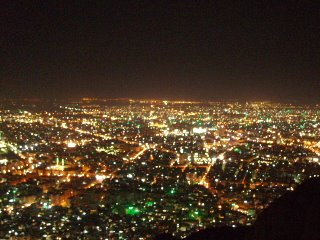
Syria 2005 - Night View of Damascus


On the evening of 29th May 2005, I was stunned at the top of Jebel Qassioun, a 1200m-high mountain towering northwest of Damascus - the capital of Syria - surrounded by exhuberant locals (and almost no tourists), in front of the spectacular night view of Damascus (above).

(If you don't think the above photo is beautiful, then it is my fault - as it was very cold at the top of the mountain, all the photos I took were blurred. Check out this photo by Abenaa instead.)

The manager of the guesthouse where I was staying told me that the night view of Damascus from the summit of Mount Qassioun was the only place he liked in Damascus.

Locals came here with their family members or friends. They brought a pot of tea with a portable stove or narghile (the Middle Eastern water pipe for smoking), spending a relaxed evening with a fantastic view. Even girls became adventurous - this was the only place I was approached by a young Syrian girl. Remember Syria is a rather conservative Islamic country. The sense of euphoria abounded.

Lonely Planet Syria & Lebanon (2nd edition, p.76) quotes a legend of the Prophet Mohammed - when he, on a journey from Mecca, looked down from the Mount Qassioun on Damascus, he refused to visit the city because he wanted to enter paradise only once.

What's different from night views of Western or East Asian cities is the myriads of green lights. Mosques in Syria are lit up with the color of green at night. And Damascus is vast without high-rise buildings. As a result, it was as if I had seen an ocean of jewellery.

When you have an opportunity to visit Damascus, never ever miss this view.

Travel Tips:
1. There is no public transport from the city centre to Mount Qassioun. Hail a taxi. As most taxi drivers in Damascus don't speak English or even read alphabets, ask a member of staff at your hotel to write down the name of Mount Qassioun in Arabic letters on a piece of paper and show it to the taxi driver.
2. It's colder at the top of the mountain. Grab a jacket or something to wear.
3. There are several retaurants with a panoramic view of Damascus. Some are incredibly tacky, though.
4. Catching a taxi on the way back is quite difficult. (It took me half an hour to catch one.) You can ask the taxi driver to wait for, say, half an hour at the top of the mountain. But I'm sure that you don't want to leave only after half an hour or so. So it's a dilemma.

Saturday, July 29, 2006

Fairtrade and Cotton Farmers in Mali

An FT Magazine article last weekend investigated whether Fairtrade has improved the life of cotton farmers in Mali, a West African country.

Fairtrade works like this:

In coffee, for example, the grower of any arabica (higher-quality) coffee beans is guaranteed whichever is the higher of $1.26 per pound or five cents above the world market price, which is currently around $1 per pound. [Farmers'] cooperatives are also paid a variable "social premium" to be spent collectively on projects of communal benefit.
Does this work for Malian cotton farmers? In early June, Alan Beattie, the article author, visited Batimakana, a village in Kita - "a region that will supply cotton for M&S jeans."
Every third or fourth dwelling [which is a typical Malian hut of mud, thatch and straw] has a motorbike outside - a lifeline more than a luxury, given that the nearest medical clinic is 10 kilometers away.
The male elders of the village are swathed in robes and turbans and dignified with venerable age, several with eyes rheumy or sightless from river blindness disease.
For a kilo of raw cotton, the Fairtrade minimum price is 36 eurocents; this year conventional cotton will fetch 24 eurocents.
It lets families send children to school. It means they can buy seeds fro vegetables and ox-drawn ploughs for their fields. It also ... bought the plastic chairs that the translators and [the FT correspondent] are sitting on.
How about the effect of paying "social premium"?
[T]wo years' worth of social premium has built a concrete grain store. ... The village uses the store to prevent big swings in food prices, buying grain cheaply after harvest and releasing it gradually through the year.
In Dougourakoroni, another Fairtrade certified community in the region, the rremium has built a brick school in the village. Previously, children had to walk 7km to school, and fewer attended.
Critics argue that Fairtrade, by paying above the market price, "encourages farmers to stay in unprofitable sectors, inducing oversupply and pushing down prices for everyone else." Does it?
Since cotton is a greedy plant that strips the soil of nutrients, it has traditionally been rotated with other crops, and that has not changed.
In Batimakana, just as before, only 20 percent of the land is used for cotton.
Any co-operative growing any product anywhere in the world can sell only as much at Fairtrade prices as has been ordered from that co-operative by buyers. Cotton is an annual crop, so farmers know their demand before planting. ... If farmers produce more than contracted under a Fairtrade agreement, they can sell the rest at conventional prices, but are not guaranteed to make money from it [because all of Mali's cotton is bought by the state marketing board, which sells it on to the big cotton brokers of Europe and America and is criticised for passing less than half the export earnings on to the farmers].
It seems to be the state marketing board that hinders diversification:
[I]t does deliver seeds, pesticide and fertiliser to farmers on credit ... and collects the cotton after harvest. Malian farmers growing other crops will often also contract to grow cotton because it is their only source of fertiliser.
So everything with Fairtrade is rosy? Turn to the long-term future:
Mali is struggling to rebuild the fully integrated cotton-to-clothing industry it once had before it was blown away by Bangladesh and China. [B]ecause the batch needs to be kept separate, spinning Fairtrade lint requires a faintly bizarre and time-consuming ritual. Every machine has first to be shut down and cleared of conventional cotton from the previous run before the Fairtrade bundles are fed in. It can take several days to do the switchover, and ... some Fairtrade batches are too small to make it worthwhile.

Cited by Ping Pong

I'm shocked to find that Ping Pong - a contemorary Chinese restaurant in London - cites MY blog entry on the restaurant on their website ALONG WITH reviews by The Times and Evening Standard. See the official website's review section and scroll down a bit.

Thursday, July 27, 2006

Measuring and Realizing Good Governance in Poor Countries

Sean, a Jamaican friend of mine working in social policy evaluation in his home country (and a staunch reader of this blog), sent me an email in which he asked the following:

> Tell me, what new and interesting work has been done in economics with
> reference to good governance? I am specifically interested in what
> indicators economists have used and what findings they have obtained on the
> factors that influence the quality of governance.

Some readers of this blog might be interested in this as well. So I copy and paste my email message below:

The latest trend in development economics research on good governance is to look at micro-level objective data rather than country-level subjective data such as International Country Risk Guide, Transparency International's Corruption Perception Index, or the World Bank's Governance Indicators. (See

La Porta, Rafael, Lopez-de-Silanes, Florencio, Shleifer, Andrei and Vishny, Robert W., 1999. The Quality of Government. Journal of Law, Economics, & Organization, 15(1), 222-279.
for the comprehensive investigation in this line of research.)

Let me cite three papers.
Olken, Benjamin A., 2005, "Monitoring Corruption: Evidence from a Field Experiment in Indonesia." NBER Working Paper no.11753 (download the PDF file)

This paper was recently featured in The Economist magazine, by the way.

The paper is about road construction in Indonesian villages. Here,
good governance means road construction without the budget siphoned
off by public officials, doesn't it? To measure the degree of
corruption by village leaders in charge of road construction projects,
Ben Olken asks engineers to dig holes in newly-built roads to measure
the quantity of materials used (sand, rocks, gravel). By obtaining the
prices of these materials, he estimated the actual expense for road
construction. Then he compared this to the reported expense by village
leaders. The difference is the degree of corruption. The author also
collects data on the actual and reported wages paid to construction
workers.

This is one major contribution of this paper - measuring corruption.
But more importantly, the author evaluated two different types of
anti-corruption measures by randomly assing these interventions across
villages. One anti-corruption measure is to send an auditor from the
independent government audit agency with probability one. The other is
to hold villagers' meeting in which village leaders must explain road
construction projects. A recent trend in the development assistance
community on anti-corruption programmes favors the second type,
doesn't it? But the result is the first type - government audit -
works better than the second.

With this piece of research, Ben Olken has become a junior fellow of
the Society of Fellows at Harvard University, which tells how ground-breaking this study is.

Another set of papers is on absenteeism:
Chaudhury, Nazmul; Hammer, Jeffrey; Kremer, Michael; Muralidharan, Karthik; and Rogers, F. Halsey, 2006. "Missing in Action: Teacher and Health Worker Absence in Developing Countries." Journal of Economic Perspectives, 20(1), 91-116. (Download the PDF file)
Banerjee, Abhijit V. and Duflo, Esther, 2006. "Addressing Absence." Journal of Economic Perspectives, 20(1), 117-132. (Download the PDF file)

I'm not sure if this is an issue in Jamaica, but, as you know, in many
developing countries teachers don't come to school to teach children
and doctors and nurses don't come to clinics to see patients. As
schools and clinics are mostly public in these countries, this is an
issue of good governance as well, isn't it?

The first paper conducted the survey for 6 developing countries in
which enumerators visit ten randomly selected schools (or health
clinics) in ten randomly selected admnistrative districts. This visit
is unannounced beforehand, and takes place twice with several month
intervals. Then whether teachers (or doctors, nurses) are present or
not is directly checked instead of interviewing the headmaster or
checking the attendance logbooks. This creates an indicator of "good
governance."

The second paper tackles how to reduce absenteeism based on, again,
randomized evaluation - a fashion in empirical development economics
these days. Effective ways to make teachers come to school turn out to
be these two:

1. Give them a camera with tamper-proof date and time function and ask
them to take a photo of himself/herself and students everyday at
opening and closing times. Based on these pictures, the number of days
each teacher actually taught is calculated and the higher their salary
is the larger the number of days they teach. What's good about this
incentive scheme is its cost-effectiveness - 6 US dollars per child
per year for an increase of over 30 percent in the number of days the
child is taught. The cost is mainly to develop films.

2. Annouce that, at the beginning of the school year, the highest
scoring female students will be awarded scholarships that cover next
two-year tuitions and expenses. This not only boosted the attendance
of female students but also that of male students AND teachers as
well. The authors speculated the reason for this as scholarships
boosted demand for good teaching from students' parents, who then
exerted pressure on teachers to come to school.

The paper also discusses failed attempts. These include
1. A similar incentive scheme as above but the headmaster, instead of
cameras, checks the attendance. The headmaster allows every teacher to
win a prize though these teachers actually didn't show up at school.
2. Giving teachers incentive payments based on test scores of
students. Although test scores actually went up, teacher's attendance
didn't change.
3. Letting local residents monitor the presence of health
professionals at clinics once a weak, on unannounced days, without any
formal reward to doctors for showing up. This didn't affect attendance
rates - a similar result to Olken's in the sense that "social capital"
doesn't seem to work.
4. Providing school meals to students coming to school. This might
increase demand for teaching from parents. But it didn't. Teachers'
absenteeism didn't change.

Tuesday, July 25, 2006

Syria 2005 - Quneitra


Maybe time is right to update Syria 2005 - the travelogue of my trip to Syria a year ago.

On 1st June 2005, I visited Quneitra, the former administrative capital city of the Golan Heights. Following what's written on page 129 of Lonely Planet Syria & Lebanon (2nd ed.), I first went to the Ministry of the Interior early in the morning to obtain a permit to enter Quneitra. The Ministry building located in north-west Damascus was guarded by a man with a machine gun. After passing my passport to an official and waiting for around 15 minutes next to the machine-gun wielding man, I received the entry permit.

Then I went down to the Baramke bus garage in south Damascus. If I remember correctly, I walked down to the bus garage for an hour because Syrian taxi drivers were not reliable at all - they don't speak English at all and don't know how to get anywhere in Damascus.

At the bus garage, I just asked anybody there for which bus goes to Quneitra, by just repeating "Quneitra" as most Syrians don't understand English. Syrians always try to be helpful, if they're actually not helpful. I re-read Lonely Planet, learning that a bus from here only goes to Khan Arnabah, a town about 10km short of Quneitra. I showed people at the garage the Arabic letters written next to "Khan Arnabah" on Lonely Planet, and finally managed to take a microbus - a white van (perhaps Toyota or Nissan) used as a bus - which goes to Khan Arnabah.

After an hour or so, the bus arrived at Khan Arnabah. I don't really remember how I got to Quneitra after that, but somehow I managed to get on a final ride to Quneitra.

On the way, the car pulled up in front of a police(?) office at which I presented the entry permit. A "tour guide" appeared and he joined my journey to Quneitra.

I finally arrived at Quneitra. The guide took me around the town.


Literally flattened houses

Everything here has remained the same since Israelis withdrew from the town after the 1973 cease-fire. Syria alleges Israelis for destroying Quneitra upon their withdrawal while Israelis claim that the town was destroyed by battles between Israel and Syria during their occupation of the town (1967-73) - see an article by Alex Safian.


A former hospital with a billboard attached by Syria which reads "Golan Hospital - Destructed by Zionists and changed it to firing target!"

Inside the hospital


In any case, this ghost town vividly shows how deeply Syrians - or at least the government of Syria - distrust Israelis.

Taking picture of this town was no problem unless my camera headed for where Israeli soldiers were stationed.


By Googling "Quneitra", I found that the former pope visited Quneitra in 2001.

Monday, July 24, 2006

This is a life in London.

After almost four years of living in London, I'm no longer surprised by most inconveniences repeated in this city. No matter how many times London Underground causes delays and suspensions, no matter how many times supermarkets sell broken eggs on the shelf, no matter how many times I hear London's running water is wasted by leaking water pipes, no matter how many times LSE's Research Lab lift has a fault, I no longer get upset.

But this time, I'm a bit upset. I noticed my home phone has been quiet recently. I thought maybe something was wrong with my phone equipment. So I called my home number from my mobile handset. No sound from the home phone. A message of answering machine came into my ear through my mobile a few seconds later.

I then checked if my home phone was capable of making a phone call. I called my mobile number. My mobile rang. So it worked.

I picked up my mobile, seeing an unfamiliar number showing up on display.

???

I called this number back from my mobile phone.


My home phone rang!

Sunday, July 23, 2006

Modernism and Economics

To the best of my knowledge, nobody has ever tried to associate modernism with economics. When you talk about modernism, it's usually about architecture and furniture.

Visiting V&A yesterday was not just to see the Jameel Gallery but also not to miss its Modernism exhibition (which ended today - you can download the panel text that succinctly explains the evolution and different aspects of modernism).

It was educational in many ways. I understand why buildings in socialist countries are extremely modernist (ie. made of concrete and purely geometric) - the origin of modernism is intrinsically linked with socialism. I understand what modernism did to Europe is what aid agencies try to do to developing countries today - allowing ordinary people to enjoy hygienic, healthy life. The chair invented by Dutch architect Mart Stam - the two-leg cantilever chair - must have been an inspiration for the iconic Panton Chair, designed by Verner Panton in the late 1960s.

The concept underlying deep in modernism is an extreme distrust in anything human. This is well reflected in Oskar Schlemmer's dance The Triadic Ballet. Dancers in this ballet wear geometrically-shaped costumes (like this) which deprive the wearer's body of freedom to move. Even though this is a ballet, the variety of body movement is severely restricted - one of them simply keeps jumping and that is. This kind of extremism in modernism created a reaction such as Chaplin's Modern Times.

So the exhibition helped me synthesize different bits and bits of my knowledge.

Then I came to think that perhaps the general equilibrium theory (or so-called the Invisible Hand) and macroeconomic theory before the Lucas Critique are a manifestation of modernism in economics. The fundamental idea of the general equilibrium theory is that even if everyone behaves selfishly, the market disseminates information on everyone else's behaviour through change in prices of goods, leading to the efficient allocation of resources. Macroeconomics before the Lucas Critique saw a macroeconomy as a machine - that's why William Phillips created this to demonstrate the circular flow of income in an economy. Yes, it's machine - one of the keywords representing modernism. This view on macroeconomics certainly led to the idea of central planning economy. If it's a machine, the government can run it. (See this article appearing in The Economist a couple of weeks ago for the evolution of macroeconomics during the last century.)

But, as we now all know, this is too simplistic a view on economics. The Lucas Critique along with the rise of game theory in economics has overcome the deficiency of "modernism in economics".

Some people critical of economics still think that economics is a manifestation of modernism. That's no longer the case. Such critics can be said to be part of the anti-modernism camp - which has long been out of date.

Saturday, July 22, 2006

The Jameel Gallery of V&A


Impressive more than the Ardabil Carpet itself - the world's oldest dated carpet - is its display design. Carpets of archaeological value tend to be hung on the wall in museums. But that's not really how carpets are supposed to be viewed.

The V&A had the courage to lay the Carpet on the floor even though this takes up a huge space available for the gallery room. But they didn't just lay it down. The Carpet is covered by the mirror ceiling with many small lights - which are turned on only for 10 minutes in half an hour to preserve the color of the Carpet. The mirror ceiling itself hangs by wire from the gallery's celing. Plus, viewers can sit down on a sofa on the shorter edges of the Carpet (that's how I took the above picture), allowing them to appreciate the Carpet in a relaxed way - that's what the Carpet does to your mind, isn't it?

The Jameel Gallery, just opened last Thursday, now becomes another favorite place of mine in the V&A. (See also FT magazine's article on this gallery.)

Haruki Murakami's account of Japan

Just to cite a couple of Haruki Murakami's accounts of Japan in his interview that appeared in FT Magazine on 1/2 July 2006 (subscription required). (I found that the whole of this article can be read for free here.)

"I wasn't interested in working for a big company like Toyota or Sony. I just wanted to be independent. But that's not easy. In this country, if you don't belong to any group, you're almost nothing."
"You know the myth of Orpheus. He goes to the underworld to look for his deceased wife, but it's far away and he has to undergo many trials to get there. There's a big river and a wasteland. My characters go to the other world, the other side. In the Western world, there is a big wall you have to climb up. In this country, once you want to go there, it's easy. It's just beneath your feet."
(Thanks goes to Ameet, who brought this interview into my attention.)

Friday, July 14, 2006

Under-5 Mortality in sub-Saharan Africa

We often hear the number of children dying from a certain cause of death in, say, sub-Saharan Africa. I always wonder where such information comes from.

I learned that since the 1990s, there has been an effort to estimate the number of deaths by cause for different age categories across different regions of the world. It's called the Global Burdern of Disease project. Estimates for year 1990 were published in The Global Burden of Disease: A comprehensive assessment of mortality and disability from diseases, injuries, and risk factors in 1990 and projected to 2020 edited by Christopher J. L. Murray and Alan D. Lopez (Harvard University Press, 1996). Follow-up estimates for years 2000 to 2002 (for 2002 estimate, country-by-country statistics as well) are provided by the WHO website.

Regional categorization for the 2002 estimates is different from the 1990 estimates. However, this page of the WHO website offers a comparable data for the 2002 estimates.

Comparaing these two sets of estimates for sub-Saharan Africa, an interesting picture emerges. Of course, the issue of data reliability is a significant concern given that most countries in sub-Saharan Africa lacks vital event registration. Still, it's worth taking note of.

Under-5 mortality (here I simply divide the number of deaths for children under age of five by the population of such children) has declined from 42.87 deaths per 1,000 in 1990 to 39.54 in 2002. Given that the population of under-5 children went up from 94 million to 115.4 million, this should have been something. Major causes of death for children under five in 1990 were, in a descending order of importance, diarrhoea, lower respiratory infections (mainly pneumonia), malaria, measles, and perinatal conditions (e.g. low birth weight, birth asphyxia). These five causes account for nearly 80 percent of deaths of children in sub-Saharan Africa. By 2002, the order of importance has changed: malaria, lower respiratory infections, diarrhoea, perinatal conditions, HIV/AIDS, and measles. These six factors still account for nearly 80 percent of child deaths. Under-5 mortality by cause has increased only for malaria and HIV/AIDS. Diarrhoea and measles have seen a sizable decline. Mortality from lower respiratory infections and perinatal conditions has moved sideways.

People keep talking about corrupt governments and dismal conditions for well-being in sub-Saharan Africa. It seems, however, that some changes were under way during the 1990s.

Thursday, July 13, 2006

Electoral rigging as partial enfranchisement

The Economist magazine is probably one of the best Western media in English to get to know about poor countries (which of course does not mean that it is the perfect source of information - The Economist is certainly biased towards free market and democracy in a bit naive way). The latest issue includes a survey of Pakistan. The third article in the survey describes how General Musharraf rigged the 2002 election:

Step 1: "[E]nsure that judges in the provinces are sympathetic, because they appoint the magistrates who conduct the polls in the constituencies." This is done by "[Requiring] senior judges to swear allegiance to [General Musharraf] and sack the ones who won't."

Step 2: Tell the returning officers in areas dominated by the opposition to "put polling stations in inaccessible places and select compliant people to staff them."

I've come to think that electoral rigging abundant in today's developing countries is the 21st century form of partial enfranchisement. In Western Europe during the 19th century (and Japan during the early 20th century as well), the suffrage is gradually expanded. First, only rich men are allowed to vote. Then the income threshold for acquiring the voting right is gradually reduced. Later, all adult men gain the suffrage. Finally, all adult women become entitled to vote.

Presidents and prime ministers in today's poor countries cannot do this form of gradual suffrage expansion either because Western donors dislike it or because the enforcement mechanism to ensure that the income threshold requirement is observed is lacking due to the weakness of state capacity.

But poor countries' presidents do not want all adult citizens to vote if they will otherwise be kicked out. (See Llavador and Oxoby (2005) for the formal modelling of this kind of logic.) Therefore, they manipulate the electoral process in a sophisticated way. The location of polling stations as in the above example of Pakistan is one thing. The registration of voters can also be done arbitrarily. This way, only a fraction of citizens who are presumably the supporters of the ruling party are allowed to vote.

If this is true, there is one implication. If citizens engage in retrospective voting - that is, they decide to vote based on the performance of the incumbent - the government has an incentive to target transfers to a certain group of citizens in order to "buy" their votes. During the 19th century, European governments could do this by favouring rich people or men. Today, poor countries' governments can do this by targeting citizens region-wise rather than their socioeconomic status or gender. Why? Because rigging the voter registration or the location of polling stations can only be done region-wise. By targeting government policies to a certain region and allowing citizens in this region to vote, the government can ensure re-election.

This suggests that there must be a correlation between electoral rigging and regional targeting. Which requires empirical investigation.

Wednesday, July 12, 2006

Public "Art" at LSE

During the past couple of months, several weird sculptures have popped up around the LSE campus.

Before moving on, click here to open the map of the LSE campus in a seprate window to understand the location of each sculpture .

It was a couple of months ago that a penguin and a baby elephant suddenly appeared on Clare Market (a street between the Old Building and St Clement's Building). Look at this:


Do you think these two sculptures have improved the landscape? I seriously don't think so. First of all, the color of these sculptures, especially the penguin, does not match the landscape at all. Second, this is NOT art at all. It's just animals that we are used to seeing at a zoo or on television. It does not evoke any new sensation. I really thought that vandalism wouldn't be a public nuisance in this case.

The LSE didn't stop there. At the centre of John Watkin's Plaza, a newly-paved square in front of the Library building, a weird sculpture was erected a couple of weeks ago. Look at this:

Can't see it clearly? Let me zoom it up:


Do you think this fox head has improved the landscape? I seriously don't think so. I liked John Watkin's Plaza. Its design is quite contemporary. With this sculpture standing at the centre, however, the Plaza has become a very dull public space that you can find anywhere else. You certainly know at least one public space where a weird, incongruent public art scuplture stands at the centre, don't you?

A few days ago I realized that the LSE has erected 12 sculptures in total around the campus. From which I learned that the disgusting sculptures outside Tower Three were also part of this public "art" project. Look at this:


Do you think this contemporary(?) sculpture has improved the landscape? I seriously don't think so. Again the colour of these three poles DOES NOT match the landscape AT ALL. Plus what's on the top of each pole is this:


Hedious. Absolutely hedious.

This passage called Clement's Inn is just next to the Royal Courts of Justice. Entering from the Strand, it's quite nice a view:


But if you keep walking, then you'll see

and


Worse, at the other end of Clement's Inn sits an eagle head


WHY ARE THEY ALL ANIMALS?

Admittedly, the location of each sculpture seems to be a solution to the contrained optimization problem - choosing the best combination of a sculpture and a place among sculptures donated by Canadian businessman Louis Odette (according to the LSE's explanation) and locations within the LSE campus. Each scuplture is erected at the best place around the campus. I would like to take my hat off for the LSE staff in charge of this decision. But this is a solution to the CONSTRAINED optimization problem. If the choice set of sculptures hadn't been limited to those donated by Louis Odette, the LSE staff wouldn't have chosen these ANIMALS. If the choice set hadn't been limited to the LSE campus, these sculptures would have been erected somewhere FAR AWAY from the LSE campus.

True, this kind of thing is a matter of personal taste. I don't like them, but somebody else might like them. I'm sure Louis Odette - "a noted patron of sculptures to public spaces" according to the LSE's plea - likes them.

Why don't you just appreciate them in your personal space, rather than forcing people to appreciate them in public spaces?

I would like to know what you would say. Am I the only person who is strongly offended by these ANIMALS? Leave your comment, please.

Monday, July 10, 2006

Japanese exceptionalism

A book review article appearing on the latest issue of The Economist (subscribers only) writes about Kamikaze Diaries: Reflections of Japanese Student Soldiers by Emiko Ohnuki-Tierney. The main claim of the book seems to be that those kamikaze pilots - suicide bombers during the Second World War - were all forced to commit suicide under the order of their superiors (who themselves never wanted to do something like that). They were not brainwashed under Japan's fanatic militarism. As evidence for this, the diaries of these pilots are full of emotional dilemma, fear for death, and other feelings and thoughts understandable to Westerners.

Which is nothing surprising for us, Japanese people. We know - or are taught in school - that those kamikaze pilots were victims of the war.

And perhaps this accounts for our lack of understanding - especially among Japanese politicians - of the feelings of victims in Korea, China, and Southeast Asia. The majority of Japanese people would say, "We were victims as well."

A Japanese friend of mine told me that those class-A war criminals enshrined at Yasukuni were also victims because these criminals actually didn't want to wage a war.

This view is somehow reflected in the exhibition of the Yushukan museum at Yasukuni: Japan was forced to wage a war by the United States (see this post on my visit at Yasukuni).

By looking closer at the war history of Japan, this sort of irresponsible perspective is actually understandable. Since the 1930s until the end of the war, Japan was de facto ruled by some factions in the military. These guys started a war on their own. The government in Tokyo couldn't do anything but follow the suit. But we are talking about elusive Japan. These military factions never claimed for executive power, which firmly remained in the hands of the Emperor, who was in turn never ever an absolute monarch. This sort of situation where no one knows who is ultimately responsible is still pervasive in today's Japan. As a result, everybody thinks that they are not responsible for anything. They did what they did because someone else started doing it.

This raises other mysteries, however. Why does no one try to be responsible in Japan? Why isn't there any social pressure on those responsible to recognize themselves as responsible?

Another book review article (on a different book on Japan) appearing in FT Magazine last weekend talks about "Japanese exceptionalism". The more you learn about Japan's involvement in the Second World War, the even more you don't understand it. I'm now in the middle of such a cycle.

Sunday, July 09, 2006

Foreign exchange tips for Londoners

If you are a Londoner, how do you exchange your sterling when you travel to the Euro area?

I knew Marks and Spencer (M&S) did money exchange service. But I thought it was expensive.

It seems I was wrong.

On 8th July 2006, the interbank rate of 1 British pound is equal to 1.44007 euro according to Oanda.com. On the M&S website, its exchange rate on the same day is 1 quid equal to 1.396 euro.

I went to Italy last month to attend Alberto's wedding. I withdrew 50 euro in Venice by my Maestro card. It was on 12th June. Including cash advance fees etc., 50 euro cost 36.31 pounds. So the effective exchange rate was 1 pound equal to 1.377031. With Oanda.com, you can check the exchange rate on a specific day in the past. On 12th June, 1 British pound was 1.45579 euro at the interbank rate. Even though the interbank rate becomes more unfavourable for sterling owners during the last one month, the M&S rate yesterday is better than the effective rate last month.

So it's obvious that the M&S offers a better deal than withdrawing cash in the euro zone. Of course, it makes every sense. If M&S offers a worse deal, who will bother to go to a M&S store to exchange money before their trip to Europe by sacrificing their precious time in London?

Anyway, next time I go to the euro zone from London, I will use M&S Travel Money service.

Saturday, July 08, 2006

Black Buddafly ft. Fabolous - "Bad Girl"

Not again. Every time I like some tune played on BBC 1Xtra and try to legally download it at Napster or iTune, it's not available.

This time, it's a tune titled "Bad Girl" by Black Buddafly featuring Fabolous. It's been at least two months since I first heard this track on 1Xtra. So it should be about the time for it to be released. According to Black Buddafly's website, it was released last February. It doesn't seem to be the case in the UK, however. As you can't buy tracks at Napster USA or iTune USA with a credit card issued by UK banks, I can't download it legally. This is why I stopped checking the latest pop music. In the end, I cannot consume it because of stupid Napster and iTune. Do you know any way to legally download music tracks that are only released abroad?

Anyway,

I like the chorus of this track. The lyrics turns out to be cheesy - "Ay if you feel me. Move wit me and don't stop. Put your hands up. Soon as the beat drops. Cuz usually I'm not like this but tonight. I'm a bad girl. I'm a bad girl. And tonight we gonna show u how we get down" (taken from this message board) - but it doesn't matter because I, as a Japanese, can't catch it at all anyway. But it's very rhythmical until the phrase "I'm a bad girl" in which Black Butterfly (I don't know who she is at all) sings melodiously. This contrast just does the thing to me.

Tuesday, July 04, 2006

Refreshing my desk

Over the last weekend, I refreshed my desk at the School. Not surprisingly for a PhD student (?), my desk was completely covered with piles and piles of paper, showing how disorganized I was. I came to think that this was depressing, disorganizing my thought as well.

But how did I refresh this? It took a while to figure out. All these piles of paper must be stored in a cabinet at the back while those academic papers neatly organized in magazine file boxes inside the cabinet right now must be brought onto desk. Actually, I more often open the cabinet to pick up some academic papers than I search for something amid piles of paper on the desk.

The problem was that most of these magazine files were coloured in red - I used to love red, but not anymore because it makes me feel uncomfortable, especially with my brain exhausted.

What colour will work instead? I thought lime green with grey would be nice. Lime green is now kind of popular in my mind. It goes well with black, the colour of most of my clothes. But black and lime green is a bit too much. The contrast is too strong. Grey instead of black would be more soothing.

I went to the Bureau stationary store. They didn't have any grey magazine files. I'm not a compromising type. I went on to other stylish stationary stores such as Paperchase on Tottenham Court Road and Ordning and Reda on the ground floor of the Selfridges, while English people on streets were all glued to any television screen (at pubs or at electronics stores) to watch the devastating England's defeat against Portugal in the World Cup quarter final. But these stores didn't have grey ones either. Plus their magazine files are more expensive than Bureau's. I need to buy at least 12 magazine files.

That was last Saturday. I went home, rethinking about my desk-refreshing plan. I came to conclude that white magazine files would work. During this process, I also realized that lime green looks nice only if it is used as an accessory. This colour must play a role of spice, not of the main dish. Nine white, three lime green, and four black that I already have will be randomly mixed. Yes, this is it.

I went to Bureau again last Sunday, buying 12 magazine files for 18.90 pounds (10 percent student discount inclusive). Then I went to the School and refreshing my desk. Here's the result:

Bureau is a nice shop, just a couple of minute walk from Leicester Square tube. On the same street (Great Newport Street) stands the Photographer's Gallery (free to enter). Opposite sits a Japanese pizza place Abeno Too (a branch of the one near the British Museum).

Saturday, July 01, 2006

Why blog? (continued)

In a response to last Wednesday's post, a reader named Chen kindly left the following comment:

Blogging is more than telling people stuff. It is more about bloggers themselves. For economists, writing or giving opinions should be a huge part of career. To bad, Ph.D. training does not entail many of the writing training. Blogging is definitely a good way to do that. [...]
This reminded me of two things I totally forgot. Yes, blogging makes you a better writer. Yes, economists need to write and give opinions in their career.

These days I find it a bit difficult to orally express my ideas. I guess it has something to do with the recent infrequency of updating my blog. You may say there is a logical jump here. The above comment talks about writing, not speaking. For me, it's closely connected. I'm no doubt less good than the average people at transforming ideas in my mind into words understandable for other people. Without incessant practice of this transformation, my skill at it naturally deteriorates. (And this is the biggest factor for my kind of depression.) As I'm not the kind of guy who hang out with other people every day and keep talking to them nonstop, only blogging forces me to express something.

By the way, I have a question for you, Chen. Why do you think "some people out there are actually interested in [my] life"? Unless my life is somewhat unusual, this won't be the case. What aspect of my life is not totally predictable?

A museum as a place for culinary delights

Went to V&A Friday Late. The theme of this month it Cuba. But it wasn't really Cuba at all - I can tell because I've been to Havana, the capital city, twice.

Having said that, barbequed whole chicken served at the renovated John Madejski Garden was absolutely excellent - tender and juicy. I don't think this is a Cuban dish, but it was worth visiting V&A only for this chicken. I didn't know a museum could give you a culinary sensation. (Actually, when Friday Late featured Africa last year, I had a stunning Tanzanian stew at V&A. So I should have known this.)

Friday, June 30, 2006

Why did Britain want to spare the Japanese Emperor?

I've long been wondering why the Allied Forces spared the Japanese Emperor after the Second World War was over. A usual explanation is that if the Allied Forces executed the Emperor, occupying Japan would have become difficult for the Allied Forces. Well, maybe.

A novel explanation - or novel at least to me - is given by Ian Nish and Peter Lowe (2001) "From Singapore to Tokyo Bay, 1941-1945" in Ian Nish and Yoichi Kibata eds. History of Anglo-Japanese Relations Volume II: The Political-Diplomatic Dimension, 1931-2000 (Palgrave MacMillan). From the viewpoint of Britain, which lost its colonial territories in Southeast Asia to Japan during the early phase of the war - symbolizing the loss of prestige long enjoyed by the British Empire, the Japanese Emperor needed to be saved and allowed to order all Japanese soliders stationed in Southeast Asia to surrender. Otherwise, these Japanese forces would have continued fighting against the British forces. To minimize the death toll on the British side during the process of re-colonizing Southeast Asia, the authority of the Japanese Emperor was indispensable.

Wednesday, June 28, 2006

Why blog?

I've started wondering what is the point of blogging when being a blogger is fast becoming like watching a blockbuster movie at a cinema or on a DVD, eating cheese or chocolate, drinking pints of beer, listening to the Beatles or Morzart, or having an i-Pod?

The reason I like reading someone else's blog is this: I can get to know what life is like for the kind of people I would never meet. Even when I meet them, they usually don't talk about their life at a deep level. I always annoy someone I first met by asking questions on what their life is like. On weblogs, however, they talk about such deep stuff when they feel like doing so. So I can enjoy knowing it as well.

I rarely understand someone else's preference as it is more often than not quite different from mine (who the hell loves drum & bass?). So I cannot understand what kind of blog will please many people. The only guideline for blogging is, therefore, what kind of blog will please me. Given what I wrote in the previous paragraph, consequently, I should blog about my life.

The life of a PhD student, however, is quite boring and depressing. It's a simple life that can easily be depicted in a cartoon like Piled Higher and Deeper.

I used to be a guy who always tries to be different from anyone else. Being a PhD student for almost four years has gradually made me forget about it. I can't find a way to make this blog different.

Saturday, June 17, 2006

Gary Becker at Lunch with the FT

This weekend's FT magazine features Nobel laureate economist Gary Becker in its "Lunch with the FT" section. Tim Harford, probably one of the best non-economist columnists (or the one and only?) understanding economics well, is a host.

There are several interesting episodes in this article.

... 40 years ago, when [Gary Becker] was running late to examine a doctoral student[,] [w]ith no time to find a free space, he quickly weighed the cost of paying for parking against the risks of being fined for parking illegally. By the time he arrived at the examination, the then-unfashionable idea that criminals would respond to the risks and costs of punishment was taking shape in his mind. The unfortunate student was immediately asked to discuss.

Frank Knight, a founder of the so-called Chicago school of economics, persuaded a journal editor not to publish Becker's early paper on the incentives behind how democracies reach decisions.

Becker's PhD thesis was on discrimination - how to measure it and what effects it might have on the wealth of both the discriminators and their victims. It was thought to be no fit subject for an economist, and the Chicago faculty persuaded a sociologist with little interest in Becker to oversee his work. Becker later struggled to publish his book, The Economics of Discrimination.

Before he was 30, Becker presented to the American Economic Association his then- new idea of "human capital" (that people would invest in their own education as they might invest in shares, mindful of the rate of return). He recalls that the response was "absolutely outraged".

"There was a sea change. I began to notice it in the 1970s and 1980s. A lot of the younger people coming out of Harvard, MIT and Stanford were very interested in what I was doing, even though their faculty were mainly - not entirely - opposed to the sort of stuff I was doing."


Finally, this is probably why I like Tim Harford:
... non-economists accuse him of reducing emotional decisions to monetary ones. I suggest to him that this is a straightforward misunderstanding and most people have not realised that economics is not the study of money. "You're absolutely right[," says Becker.]