Lunch price in Stockholm
A survey reveals the average price for lunch (main dish, side salad, and coffee) in Stockholm is 76.9 kronor (8.2 euro, 10.2 US dollars, 6.7 UK pounds, 880 yen). My impression is that this is the minimum price for lunch.
A survey reveals the average price for lunch (main dish, side salad, and coffee) in Stockholm is 76.9 kronor (8.2 euro, 10.2 US dollars, 6.7 UK pounds, 880 yen). My impression is that this is the minimum price for lunch.
A friend of mine living in UK told me about this article on Sweden by The Observer, a Sunday newspaper. It's a long article, but worth reading if you wonder what Sweden is like.
The general election is approaching in Sweden, and the incumbent government ministers are proposing what I would call "normalization" of Swedish society, presumably with an aim to win votes in the election reported to become quite close a race.
Two days ago, the minister in charge of immigrants' integration to society proposed to allow low wage jobs for refugees, by saying, "There is a difference between a well paid job and one that is poorly paid. However, the difference between having and not having a job is much greater."
Yesterday, the education minister proposes to allow smart students to take advanced classes in high school rather than to wait their fellow pupils to catch up, by referring the current Swedish education system as following the Jante Law, the key word to understand the Scandinavian societies.
For someone living in most other countries, it's hard to understand why these two policies are just proposals rather than the reality. But that's Sweden, cherishing the equality of its citizens more than anything else.
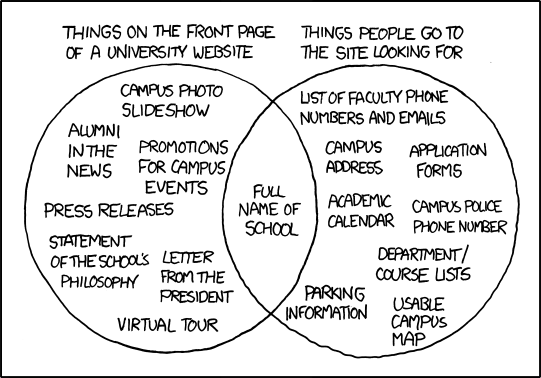 |
| Source: XKCD |
I'm staying at a friend's place in Italy this week. This friend of mine is running a cafe in Pordenone, a town in northeastern Italy. Today I worked with my laptop all day at this cafe, and I came to a conclusion that Leaf (the cafe's name) is my ideal cafe: proper coffee, quality sweets, stylish but not intrusive decor, soothing background music, free wifi, tasty lunch, and some twist in menu such as matcha latte.


A long time ago, I listed up the requirements for a country to be a democracy often mentioned in social science studies. Here's the list:
A1: Suffrage is universal - (nearly) all adults can vote.
A2: The executive is directly elected or indirectly elected by legislature.
A3: Elective legislature exists.
A4: Opposition parties are allowed to exist.
A5: No gerrymandering (ie. manipulating electoral rules and districts in favour of the ruling party) is undertaken.
A6: Press freedom is ensured.
B1: Opposition candidates can freely run for office.
B2: Opposition candidates can freely conduct their electoral campaign.
B3: Voters can freely cast their ballots.
B4: Votes are neutrally counted.
C1: The executive is checked and balanced by legislature and judiciary.
C2: Non-elective veto players do not intervene politics.
The Economist magazine recently reported how the Egyptian ruling party has held power for a long time.
First, those who would oppose the ruling party find it difficult to register as voters.
Few people register because the legal period for doing so is short and comes many months before elections. Besides, registration involves a visit to a police station, which many Egyptians prefer to avoid.This can be seen as violation of condition B3 above.
The parties allowed to run for the People’s Assembly, Egypt’s parliament, are selected by a committee controlled by the ever-ruling National Democratic Party (NDP), which is headed by Mr Mubarak. Independents can stand, which is how the Muslim Brothers, banned as an organisation, field their candidates. But they risk arrest on some pretext, and harassment even without one. (...) Since 2005 there have been elections for the presidency, too, replacing the previous embarrassingly unanimous referendums. The next one of those is scheduled for September 2011, albeit under restrictive rules that, in essence, allow the NDP to choose not only its own candidate but his opponents as well.
In the previous presidential poll, in 2005, nine selected opponents were allowed to run against Mr Mubarak, yet he still grabbed 89% of the vote by the official count. His closest challenger, Ayman Nour, a youthful lawyer, was locked up in prison on flimsy charges of forgery soon afterwards and released only last year.
In the parliamentary election of November 2005 voting was spread over three rounds because a ruling by the constitutional court required that judges should monitor it closely. The Brotherhood, wary of showing too much strength and so provoking a backlash, fielded candidates for only a third of the 454 seats. In the first round they trounced most rivals. In the second and especially the third round police simply locked many polling stations and sent everyone home.
Kuwait, a country friendly to Egypt’s regime, summarily expelled a group of Egyptian workers who had innocently created a local support group for Mr ElBaradei. In advance of his scheduled visit to the rural province of Fayoum in May, companies that rent equipment for public events received warnings not to work with him or risk having their equipment seized. Private television stations have been “advised” to pay less attention to the upstart, well aware that their owners’ useful government links may be at stake.These episodes violate condition B2 in a broad sense. But we could treat them as an additional condition for democracy: opposition supporters are not economically threatened by the government.
A work of art can be more powerful than any social science studies or any politician's speech.
Chris Blattman's blog post took me to this video today. Please watch this with sound.
The video shows when and where which country conducted nuclear weapon tests (and the two actual uses of the weapon) in the periods 1945-1998.
After slowly showing three explosions in 1945, each second of the video represents a month and locates nuclear weapon tests conducted in that month (if any) on a map of the world. Each test comes with a tone (different for each conducting country), which is particularly effective to create a sense of something chilly going on when many tests are shown to be conducted in successive months.
You could convey the same information by listing these tests this way. But Isao Hashimoto's work is way more powerful to convey the message.


From this week's edition (June 14, 2010) of Nikkei Weekly...
Having been raised in Beijing, Sara Arai acquired the ability to combine the cultures of China and Japan --- sweeping dynamism and delicate beauty --- to create original fashions. ... In [her latest collection for autumn/winter 2010-2011], Arai used a traditional Japanese dying technique called yohenzome, which gives color a unique characteristic. This little-known technique is said to have its origins in the early Heian period (794-1185). Yohenzome-dyed fabrics seem to change color when light hits them from different angles. ... Under fluorescent light, a yohenzome article that is red under the sun changes to black.
Although I just moved in to the current apartment two weeks ago, I have to keep looking for the next apartment to move in because I have to move out by the end of September.
Today I view one apartment in Kristineberg, the area I've never heard of before. It's located at the western edge of Kungsholmen (perhaps the least fashionable---the most laid-back, in other words---district of central Stockholm). It's a very quiet area with lots of green space. On the way to the apartment from Kristineberg metro station, I only see one supermarket in front of the station.
However, somehow it feels different from other uninspiring (sometimes even depressing) suburbs of Stockholm. After viewing the flat, I explore the area a bit. Just a few minute walk takes me to a good view of Tranebergsbron (an arch bridge connecting Kungsholmen and the area called Traneberg). Then, totally out of blue, I find a Tanzanian restaurant called Jambokula. Unlike usual eateries in a suburb of Stockholm, the decor is very neat and, when I'm browsing the menu at the entrance, a very tempting smell of foods floats into my nose. This is very, very unusual in Stockholm, I must say. When I think about it, I've almost never had this experience in this city. Swedish cuisine doesn't smell anything. All those trendy cafes and restaurants never ever tempt me by smell (even if food is actually good). It's such a shame that it is about 3 pm when I'm not hungry...
Then I walk down to Kristnebergs Strand, an unpaved footpath on the edge of the island of Kungsholmen. The view of Ulvsundasjön bay is beautiful. I'm told during the summer people barbecue here. That would be very nice, indeed.
I keep walking and enter the area known as Hornsberg, a former industrial area where urban redevelopment projects are ongoing. Red-bricked factories appear to date back to the early 20th century, judging from the presence of ornaments on the facade. It even looks beautiful. There is a well-designed skateboard rink, too. Post-industrial chic. That's what I miss in Stockholm. Finally, the missing piece for my image of a city is found here.
Then a massive shopping complex called Lindhagen where a branch of the major supermarket chain ICA, probably Stockholm's biggest, spans two floors of the spacious building. For every consumer good, all the brands available in Sweden seem to be on the shelf although, for some reason, the meat section is rather small (smaller than the entire section for sausages or for cheese), and they don't sell my favorite Nuremberg sausages. The shopping complex is far away from any metro station. Bus 49 stops in front but every 20 minute at best. Unless you have a car or live really close by, there's no point of visiting this place.
If I live in this area, Fridhemsplan is the closest busy area. I have lunch at a French-influenced cafe called Et Encore, located inside Grandpa, a well-known hip boutique. The menu is different from other standard cafes in Stockholm. A toast sandwich is fine, but the accompanied salad of not very fresh tomatoes, cucumber, and lettuce (a very typical salad in Stockholm) makes everything collapse. What's worse, their coffee is Caffe Monteriva, which I hate. By the way, they forget serving me with coffee. When I claim it after finishing the sandwich, a shop attendant gives me a macaron for free (which tastes good), telling me with a smile, "It's French, not Swedish." It seems a pure quality of Swedish sweets is what some Swedes also notice.
In Fridhemsplan, there are two big supermarkets. On the way home, I shop at one of them, DagLivs, which turns out to be one of the best supermarkets in Stockholm.
Although a low-cost airline is a great way of traveling in Europe, you always feel ripped off when you book a ticket. This is because the amount you pay is always higher than the price you first see on the booking webpage.
To reduce this psychological pain, I take note of how much I need to pay more than the price shown immediately after the search, for four low-cost airlines that I often use, if I need to check in luggage, want to take the desired seat, and pay by credit card.
Ryanair: 29 euro (20 for 1 check-in luggage up to 15kg, 4 for priority q, and 5 for credit card payment).
EasyJet: 29.75 euro (11 for 1 check-in luggage up to 20kg, 9.5 for speedy boarding, and 9.5 for credit card payment)
Norwegian: 21 euro (8 for 1 check-in luggage up to 20kg, 8 for seat reservation, and 5 for credit card payment)
Air Berlin: 5 euro (for credit card payment)
One thing I don't like about Stockholm is the taste of coffee. Swedes, the world's second most coffee consumer in per capita terms (after Finland), seem to like sour coffee with a higher amount of caffeine than the average in the world. This taste preference extends to espresso, too.
Here's the typical experience of me drinking espresso or cafe latte in Stockholm. The first taste is pretty bad. But as I spend some money for this cup of coffee, I cannot really throw it away. So I keep drinking. By the time my tongue gets used to (or paralyzed by) the taste, my head starts feeling dizzy.
After three years in Stockholm, I almost dislike coffee.
But finally, finally I encounter a good cup of coffee in Stockholm. I visit Mellqvist Kaffebar on Rörstrandsgatan, the street known as little Paris (which I rather strongly disagree with), on the early Saturday afternoon. Just like other popular cafes in Stockholm, the cafe is rather small and, of course, packed with customers. The seating is not designed for a long stay, however. By the time I get a cup of single espresso, a counter table facing the window to the street gets vacant. I sit down and sip the espresso. A taste with several layers spreads within my mouth. This is a rare experience in Stockholm. What makes coffee fascinating is the mixture of different flavors which cannot be immediately verbalized. Coffee in Stockholm is easy to verbalize: sour. This one is not. When I look up, a board on the wall tells me that the coffee beans at this cafe are a blend of Brazilian Carmo Sitio Grota Sao Pedro (Google suggests Sítio Grota São Pedro is a famous coffee farm in Brazil) and Ethiopian Yirgacheffe Gibi Natural. And the beans are roasted by Haugaard (whose blog seems to be this one). Although its brie and salami sandwich is not perfect due to hard-to-bite bread, it seems I finally find my favorite cafe in Stockholm.
Instead of Magasin 3, which is already on summer vacations (see yesterday's post), I visit Hudiksvallsgatan, known by some as Stockholm's Chelsea, referring to the area of New York well-known for the clustering of art galleries. (For details about this area, see the post in my other blog Stockholm4Foreigners.)
Crystal Palace, a gallery that only recently moved to Hudiksvallsgatan, showcases video installations by a New York-based artist Kate Gilmore. Her work entitled "Blood From A Stone" catches my eyes. (A clip of this video can be seen on the artist's website.)
The video begins with the dark grey wall with ten shelves (also in dark grey) at the height of a person's head. The artist herself, dressed in a red top and a white skirt with little pink patterns at the hem, starts putting a white cubic box on one of the shelf. By watching her struggling to lift up the box, we learn she's trying to do a job that appears to be too tough for a woman. Once she manages to place the box on the shelf, white blood splashes at the back of the box and flows down the dark grey wall. She keeps lifting up white heavy boxes, one by one, and every time she places it on the shelf, white blood splashes and flows down the wall. She repeats this ten times until all the shelves are complete with the white box. The video ends.
Her movement in this video essentially goes against two laws of nature: gravity and the fact (or the artist may say everyone's perception) that female human beings are born to be physically weak. Each time she overcomes these two challenges, white blood splashes as if it suggested going against nature would hurt. But she places white boxes against the grey wall, and the color of blood is white, not red. It seems what she is doing is morally correct if the color of white represents purity
A few walks away, Galleri Andersson Sandström features another New York-based artist Barton Lidice Benes. His 2005 work entitled Painting attracts my attention. It consists of five picture frames in green, blue, brown, orange, and purple, respectively, which showcase dozens of tiny items the artist collects around the world, ranging from a fragment of a banknote of some country (a recurrent motif in his works) to a tiny toy doll, from a used condom package to a case of drawing pins. Since each item's color matches the picture frame's color, each set of junk looks very pretty as a whole. This is perhaps a nice way of displaying your own tiny, junky objects that you accumulate over your life.
Hudiksvallsgatan really appears to be Stockholm's Chelsea this weekend.
I feel worn out every day this week. I feel like being stimulated by unexpected contemporary art works. From all the pieces of information that I gather, Magasin 3 appears to be the best contemporary art gallery in Stockholm. Why not visiting Magasin 3 this weekend?
So I visit its official website for what's on right now, only to find that it's already closed for the summer.
I knew this place closes down during the summer vacation period, which typically spans from mid June to mid August. But it's still the first half of June!
I really don't understand this city...
By reading The Nikkei Weekly, the English version of Japan's financial newspaper, I've learned one recent fad in Japan.
A website called Bijin-tokei features a photograph of a Japanese bijin (good-looking girl) showing the current time written on a chalk board. It automatically renews the photo every minute so the website does work as tokei (clock). According to the Nikkei Weekly, the website attracts 370 million hits a month.
It's also available as an iPhone app, a Google gadget, or a Dashboard widget for Mac OS.
This is very Japanese. I just laughed out loud when I read the Nikkei Weekly article about this website.
What's more, the website recognizes where you are on the earth. I'm in Stockholm and the bijin shows the Central European time instead of the Japanese time.
If you are an anti-sexism Swede, don't worry. There is a male version called Binan-tokei as well. :)
Although I'm not particularly into house music, the name of Swedish House Mafia has reached my ears. Initially, I thought they were British or some other nationalities using the term "Swedish" without any reason. The Wikipedia reveals that that's not the case. They are Swedish, or at least living in Stockholm.
If I go to the nightclub in Stockholm where they play on the DJ deck, therefore, it should be the world class nightclub party. I check their DJ schedule. For the next three months, they have no plan to play in Stockholm.
It seems I should really forget about nightclubs in Stockholm.
The annual World Bank's conference on development economics (abbreviated as ABCDE) is currently held in Stockholm. I attended a couple of sessions and below is what I learned. Some are backed by solid evidence while others are speculation.
From Abhijit Banerjee's speech:
The failure of microfinance to have a large impact on firm creation and firm growth (Banerjee et al. 2009; Karlan and Zinman 2009; a summary by FT) may be due to its targeting of poor people and small-scale firms. It is medium to large scaled firms that are missing in less developed countries (LDCs) if the firm size distribution is compared to the one from developed countries (Hsieh and Klenow 2009), and that type of firms is probably the driver of economic growth. Governments in LDCs and development assistance agencies, however, have ignored these medium and large scaled firms.
The lack of evidence for the positive impact of education on economic growth may be due to the falling return to primary schooling relative to secondary schooling while education policies have been targeting primary school attendance in the past.
Evidence from conditional cash transfers shows just a small amount of cash incentives dramatically improve human capital investment. We do not have a good conceptual framework to explain this phenomenon.
The issue is how to get policy-makers to stop and think when we do not know at all how to change institutions as the fundamental cause of economic development.
From Geoffrey Heal's speech:
A solar panel power generator today costs 1.8 dollars per KW, cheaper than a diesel power generator. Like mobile phones which have revolutionized telecommunication in LDCs, solar panel may revolutionize power generation in LDCs in the near future.
From Keijiro Otsuka's speech:
Nigerians used to eat rice only on festivities like Christmas, wedding parties, and funerals. Now they eat rice every Sunday.
Back in the 1960s, rice yields were the same in Africa and in Asia. Now yields in Asia double while those in Africa stay the same.
The green revolution in Asia was initiated purely due to technological reasons, not driven by policy or institutions. Then the market and policy responds to promote the use of high-yielding varieties by selling fertilizer or by installing irrigation. In Africa, this didn't happen because of the price control imposed by the government.
Rice yield can be higher in some parts of Africa (Senegal, Tanzania, and Uganda) than in Asia. But rice farmers in Africa do not know even simple ways to increase yields such as creating bunds between fields and leveling fields (which are the norm in Asia).
From Sabine Bruntrup-Seidemann's speech:
In Benin in the 1990s, many civil servants were fired due to the structural adjustment programme. University students were no longer guaranteed government jobs upon graduation. These skilled, but unemployed people formed NGOs because it was when the international development assistance community started putting money to NGOs rather than the governments of LDCs.
From Tomoya Matsumoto's speech:
In a randomized experiment in Uganda (a joint work by Matsumoto and Takashi Yamano from GRIPS), giving fertilizer for free to maize farmers (and one-off 2 hour training of how to use fertilizer) increases the amount of fertilizer purchase in the following growing season. There was a similar intervention in Uganda several years ago. At that time, farmers didn't respond. What has changed in Uganda since then is the scarcity of land due to the rapid population growth and the opportunity to sell maize produce for good prices (merchants now come to rural areas to purchase produce). Maize farmers in Uganda, therefore, do care about how to maximize the amount of yields now.
While packing my stuff to move to a new apartment, I was listening to Sonar Radio. And this DJ mix was played. (Click "JACKMASTER - mix for Lower End Spasm" to listen.) Excellent stuff.
