Sunday, January 29, 2006

Lent Term 2006 Week 3

Monday (23rd):
1430-1600 Job market seminar by Alvaro Bustos from Princeton
The rest of afternoon - Fatigue from last week's work prevented me from thinking properly...

Tuesday (24th) through Thursday (26th):
Wrote a research memo in which I describe a theoretical model that I have in mind and its solutions and implications. As this process involves mathematics, you can't skip any single step in logic. This requires you to think real hard. So it took longer to finish and I got exhausted more than expected.

But this is why I love economics. This process often takes you somewhere you didn't expect. Which means you find a new thing. I mean, the conclusion derived from this process is often different from what you expected. If you just rely on verbal arguments, this won't happen. Which means you don't really make progress in expanding our knowledge on society. That's why economists hate most arguments without explicit mathematical modelling made by social scientists outside economics.

Friday (27th):
1300-1400 EOPP Work-in-progress Seminar
Afternoon - Wrote email to Professor Caselli, the speaker at today's seminar, on his presentation as what he's trying to do is quite similar to my research - I should talk to him soon. Then figured out how to use Excel2Latex for Ameet. The end result is written down here (look for "EXCEL2LATEX").
1800-1900 EOPP Happy Hour

Saturday (28th):
Complied the dataset for my research. Although it's theoretical, to motivate my research, it's good to present the data showing what I'm trying to explain is in fact a reality. (I followed Tim's advice last week.)

Sunday (29th):
Started reading Esteban and Ray (2006) to hone my skill of writing a theoretical paper. Debraj Ray's papers are good for this purpose - they are theoretically rigorous but still carry a huge relevance to reality so I don't get bored. What struck me during this week (and during the Christmas holidays, when I worked on the same research idea) is the fact that I haven't been exposed enough to theory papers. (This is partly because both development economics and political economy these days tend to be empirical (for development economics, to the extent that Dilip Mookherjee - one of the leading theoretical development economists of the present days - expresses his concern that there is too little theory in the field) and because due to my research topic I've been forced to read tons of descriptive (ie. non-mathematical) papers in political science, which was more often than not agony.) That is why I took almost a week to write up even a sketch of a simple model, or so I thought.
Also started proof-reading the proofs of Tim's forthcoming book as part of research assistance work for Tim.

Friday, January 27, 2006

Royal National Theatre after dark

Illuminated in red is Royal National Theatre, viewed from near Temple tube station.

Monday, January 23, 2006

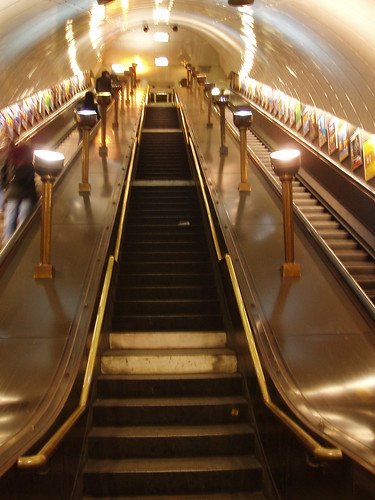
Swiss Cottage tube station

The stairs and escalators in Swiss Cottage tube station.

Sunday, January 22, 2006

Lent Term 2006 Week 2

Here's an example of my daily life as an economics PhD student at LSE interested in development economics.

Monday (16th):
1300-1400 Development & Growth PhD Seminar
1430-1600 Job Market Seminar by Tavneet Suri from Yale
1700-1830 LSE/UCL Development & Growth Seminar by Eric Verhoogen from Columbia
The rest of the day - Read Esteban and Ray (2001) to figure out how larger groups can be more effective in conflict.

Tuesday (17th):
Late morning - Have a brief chat wih Tim on my own research and on our Health & Democracy project.
The rest of the day - Following Tim's advice, try to find data on agricultural tax rates in Africa and East Asia for my own research and get to know Anne Krueger et al. eds. The Political Economy of Agricultural Pricing Policy (John Hopkins University Press, 1991).

Wednesday (18th):
Morning - Following what Tim told me yesterday, run a few regressions for the health & democracy project (in vain).
1600-1730 LSE/UCL Development & Growth Seminar by Alwyn Young from Chicago
The rest of the day - Read Suri (2005) for the health & democracy project.

Thursday (19th):
Morning - An idea occurs to me and run a few regressions for the health & democracy project (in vain).
Lunchtime - Have power lunch with Sonia (by power lunch I mean a lunch over which conversations are all about each other's research)
Afternoon - Read Montalvo and Reynal-Querol (2005) for my own research. Try to find a way to get around an ad hoc assumption made in the theoretical model that I'm working on - and learn that the marginal cost of insurgency must be convex.

Friday (20th):
Morning - Try to find data on cross-country infrastructure data for my own research and remember Canning (1998).
Early afternoon - Have a chat with Maitreesh (my supervisor) on my research and receive a couple of modelling tips, told to write a short memo of the model and its analysis based on which we can talk further.
The rest of the afternoon - Work on the theoretical model for my own research and come up with an idea to implement Maitreesh's advice.
1800-1900 EOPP Happy Hour
The rest of the evening - Talk to Tianxi on where the accountability of the Chinese government comes from and then to Madhav on our potential new research project inspired by today's EOPP Happy Hour. After coming home, read Lemieux (1998) from which Suri (2005) seems to get inspiration.

Saturday (21st):
Continue reading Lemieux (1998). Then start writing a short memo of the model, following what Maitreesh told me yesterday.

Sunday (22nd):
Continue writing a short memo of the model.

Monday, January 16, 2006

Sunday, January 15, 2006

Mackerel stewed with miso (saba no miso-ni)

It's time for lesser-known Japanese cuisine again!

Another whole mackerel was in the fridge today (I bought two yesterday). As one day has passed, eating it raw isn't a choice anymore. So I tried to cook it in a very Japanese way. It's called "saba no miso-ni" (mackerel stewed with miso). Here's a recipe:

1. Mix 400cc of water, 200cc of Japanese sake, one spoonful of sugar, one spoonful of soy sauce, and sliced ginger in a pan, and then bring it to a boil.

2. Place 130g of miso paste in a jar, add about 100cc of the "soup" made in Step 1 to it, and mix it with miso paste until the paste is dissolved into the soup. Keep this aside.

3. Add mackerel fillets to the soup made in Step 1. Place a lid onto the pan and heat gently for 5 minutes.

4. Open the lid and add half of the miso paste soup made in Step 2 to the pan. Then place the lid again and keep heating gently for another 5 minutes.

5. Open the lid and add the remaining miso paste soup and a hint of rice vinegar.

That's it! Miso paste is easy to get burned. That's why you shouldn't add miso from the beginning. A hint of rice vinegar in Step 5 makes the taste milder.

I've kept saying this since yesterday. But it was brilliant! I'm happy to be born as a Japanese. :)

Stewing fish in soup like the one made in Step 1 above is a very Japanese way of cooking fish. (The soup is not for drinking. It is just for stewing fish though we can serve stewed fish dipped in the soup.) We don't just eat raw fish as sushi.

Interestingly, I didn't like stewed fish when I was in Japan. More generally, I didn't like cooked seafood meals when I was in Japan. Since I started a life in London, I've begun missing fish. Then here I am, eager to explain a Japanese recipe for cooking fish!

Tom Thumb's Arch

Tom Thumb's Arch, a recently-renovated railway arch in Bow, East London. I walk through it everyday on the way to/from Bow Road station (see below).

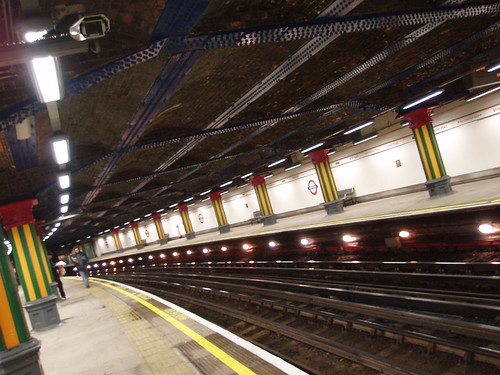
Bow Road tube station

Bow Road tube station, recently renovated. This is the nearest tube station to my place.

Tate Modern and Millenium Bridge at night


Tate Modern and Millenium Bridge, viewed from Paul's Walk at night.

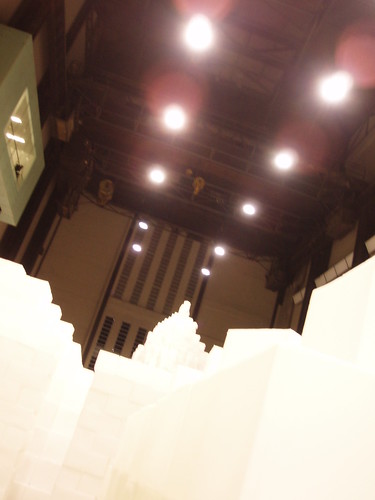
The Unilever Series 2005/6 at Tate Modern

Embankment by Rachel Whiteread, an installation for The Unilever Series 2005/6 at Tate Modern

Honestly speaking, this installation is just a bunch of white boxes piled up if you see it alone. But this art must be coupled with Tate Modern's Turbine Hall and viewed as a whole. This leads me to the above photograph, different from any other photos of this installation.

Saturday, January 14, 2006

Neginuta

This blog sometimes becomes a Japanese cuisine guide. It's such time again.

After coming home from the Billingsgate fish market, where I bought two whole mackerel for 3.50 pounds, I pickled one of them as described on 21st August 2005. For lunch, I ate a half by dipping in soy sauce. It was gorgeous as always.

For dinner, I tried a new thing: neginuta. I didn't know this way of eating pickled mackerel. But it is brilliant. Here's the recipe:

1. Slice pickled mackerel and chop spring onions.
2. In a bowl, put three spoonfuls of miso paste, one and a half spoonful of rice vinegar, and a spoonful of sugar (you can change the amount to your taste as long as you keep the ratio, just like making cocktails).
3. Add sliced mackerel and chopped spring onions into the bowl, and marinate them all.

That's it! The sweet taste of miso and the sour taste of pickled mackerel along with the crunchy texture of raw spring onions melt together in your mouth, producing a pleasant sensation.

By googling Japanese websites, I found that neginuta refers to marinating spring onions (or, more precisely, negi (Japanese leeks) - but I prefer using spring onions as I doubt Western leeks fit this cuisine) in the miso/vinegar/sugar mixture. Some seafoods like boiled octopus or squid are sometimes added. Adding pickled mackerel is probably not a standard thing to do. Anyway, I'm probably the first person who introduces neginuta to English speakers as googling it in English doesn't yield any result. :)

Friday, January 06, 2006

Making Presentation Slides including Maths

I can sometimes become a computer geek. Here's proof.

Economics uses mathematics. Writing an academic paper in economics requires a word processor capable of inputing and outputing mathematical expressions. Microsoft Word is horrible for this purpose. So most economists use a word processor software called Scientific Workplace.

Still, Scientific Workplace is horrible. Its help files are hieroglyphics. I've already wasted tons of time to figure out how to do one thing or another with this software. But as long as writing a paper is concerned, it is not too bad.

When it comes to making slides for presentation, however, Scientific Workplace is even more horrible. Basically it's useless for making decent slides. Microsoft PowerPoint coupled with TexPoint doesn't work quite properly, either.

I figure out the ideal software environment for making slides for presentation in the economics profession (or any academic discipline using mathematics): MiKTex + TeXinicCenter + Prosper. (For Prosper, this page at University of Colorado is more useful than the official one.) They are all free to download and install.

In case you're interested, here's the recipe:
1. Download and install MiKTex.
2. Download and install TeXinicCenter.
3. Download and install Ghostscript (this is required to use Prosper).
4. Join TeXnicCenter-Users Yahoo! Group (this is necessary to download a batch file in the next step).
5. After your Yahoo! Group membership is accepted, download prospermake.zip by following the link provided in this message.
6. Unzip prospermake.zip and follow the instructions given in readme.txt to create a new output profile for TeXnicCenter.

One warning: do not install any software (MiKTeX, TeXnicCenter, or Ghostscript) under the directory of "C:\Program Files". The reason is this directory name includes a space, which prevents the new output profile from working properly (yes, this is Microsoft's fault). The simplest way to do this is install them all right under "C:" directory.

Now you're ready to use Prosper. You don't need to download and install Prosper itself; MiKTeX automatically does it when you compile a TeX file meant to use the Propser package. (You need an Internet connection, though.)

A couple of technical notes: Steps 3-6 are needed as TeXnicCenter is not compatible with Prosper by default. The main reason is that PDFLaTeX accompanied with TeXnicCenter doesn't work with Prosper. You need PS2PDF to create a PDF file. Ghostscript has this, and a batch file included in prospermake.zip allows you to use it properly.

Sunday, January 01, 2006

Toshikoshi soba

I just had a New Year's Day soba noodles, a Japanese tradition.

Sorry I just lied. What's traditional in Japan is a New Year's Eve soba noodles (toshikoshi soba). I simply forgot eating soba noodles last night.

I bought chasoba noodles (noodles made of soba powder and green tea leaf powder) the other day in Oriental Delight supermarket, a newly opened East Asian food market in Chinatown. I boiled it for three minutes. British-managed or American-managed Japanese restaurants, notably Wagamama, don't seem to understand how long you should boil Japanese noodles to serve, by the way. They always boil it too long, serving jellyish noodles to disappoint Japanese customers. Italians know this. Their phrase "al dente" says it all.

While waiting, I sliced spring onions very thinly. In a very small bowl, I poured soba dipping sauce (made of soy sauce, mirin, and dashi soup (soup containing umami) and added the sliced spring onions.

Serve soba noodles boiled al dente, after washed with cold water, onto a large plate with a small amount of wasabi paste put on the edge. Pick up a few noodles with chopsticks and dip them into the dipping sauce. Add a hint of wasabi on top of it. Then quickly put them all into your mouth before wasabi melts into the dipping sauce. The al dente texture of soba noodles, the bitterness of raw spring onions, the umami taste of the dipping sauce, and the distinctively spicy taste of wasabi melt together in your mouth.

Lovely.

The moment I feel happy to be born as Japanese. After eating them all, have a cup of hot Japanese green tea. It clears the umami taste left in your mouth. This is how we Japanese do our thing.

Year 2005

The following is what I wrote before year 2006 arrived...

I hate this atmosphere of New Year's Eve. It forces everyone to look back at what happened this year and feel more or less sentimental about the year that's almost gone. I always try to defy this temptation. After having a Sainsbury's Indian curry and a vitamin tablet for supper (I don't feel like cooking tonight) and sitting at desk in my bedroom alone (my housemate is back at home in Scotland) on this quiet, cold evening in London, I give up.

The year of 2005 was certainly not the greatest in my life, but much, much better than the previous years in London. Speaking English is no longer a headache. In the past couple of months, even speaking academic things in English stops being a source of frustration.

A large part of the improvement in my life in London comes from two of my best friends - Alberto and Cheyok. Alberto (see his blog in English) is probably the one who understands me the most. Although he left London earlier this year, I visited his house in Italy last September. He's the guy I talked to for the longest time this year. Talking to him definitely made my life with English easier. Cheyok has always been incredibly nice to me. Without her permission, I think of her as my beautiful elder sister. :) From time to time we exchange email, talking about my private stuff, and meet up on several occasions. She's the one who always cheers me up.

The biggest event this year is nothing but a trip to Syria. (I will never be able to finish the Syria 2005 blog...) Thanks to Arabic-speaking Misao (see her essays on Syria in Japanese), I spent an enormously great time there - good food, nice people, total safety, and lots of historical sites. Honestly speaking, I partly sympathize the idea of Islam on women's outfits. During my stay there, I was relieved from being aroused by seeing scantily-clad girls. On the other hand, I realize Mohammed's aim (I believe he was too ashamed of his potential as a womanizer) is not perfectly achieved: a slender woman wearing a black burka still looks sexy. :) This trip certainly broadens my perspective on the world, something you never acquire if you just follow what America says.

Research-wise, this year has been extremely difficult. At the end of the three years as a PhD student, I couldn't finish writing up a single paper. But Tim has always been helpful. I started working for him as a research assistant last summer. One end result is his forthcoming book. (Chapter 2 "The Anatomy of Government Failure" is a must-read for everybody. Trust me.) I proof-read the whole manuscript and pointed out mistakes and made some suggestions. Beyond my expectation, he quite liked my work performance and, at the beginning of this month, offered co-authorship of a paper prepared for the American Economic Association Conference next month. This experience gave me kind of self-respect as a researcher, something that had kept deteriorating during the best part of this year. Now I came up with a new idea on my own research, working hard on it to make it to the presentation on 9th January.

Last but not least, I'm very lucky to meet Kotono, Alberto's girlfriend's friend. She's incredibly sweet and at the same time very assertive, a very rare combination for a girl. I like her a lot. Since I met her, my life has become much easier.

At the end of the day, it's people surrounding you who make you feel better. I couldn't learn this until I left Tokyo for London.

My best tune of 2005
Hiphop/R&B: Amerie - '1 Thing'
Dancehall raggae: Damian Marley - 'Welcome to Jam Rock'
Drum & bass: Shy FX and T-Power - 'Feelings' (see 19th September 2005)

The best DJ set:
Artificial Intelligence at Fabric on 25th June

The best CD album:
Influx UK 2 Million and Rising

Saturday, December 31, 2005

A hilarious paper

Debraj Ray's website (click "Miscellany" on the left column) took me to a hilarious (but quite serious) paper. If your surname is something like Zaitsu (a Japanese surname), you won't succeed as an economist as much as the person with the same background and the same ability and a surname like Akamatsu (another Japanese surname).

Tuesday, December 20, 2005

Diary 2006

This post is just to play a role of my 2006 diary, which I haven't found time for buying.

January
9(mon) 1pm: My presentation at EC501 Development & Growth PhD Seminar.

February
21(tue)-23(thu) 6pm: Alan Krueger's LSE public lecture

Sunday, December 18, 2005

G Child's Refix

I supposedly have no time for updating this blog. But I've got to tell you this. I found a brilliant urban music DJ here in UK. His name is G Child.

Every Saturday night (from 10pm to midnight) his radio show on BBC 1Xtra, a DAB digital radio station in UK, features two sets of his 15-minute DJ mix called "the refix". This is not an ordinary DJ mix. G Child mixes vocals and beats from completely different sources. For example, last night, he mixed the vocals of Mary J. Blige - the queen of R&B - with various hiphop and dancehall reggae beats. In his second session last night, UK garage beats were mixed with US hiphop raps and vocals. This was absolutely HEAVY. It made sense a lot. UK garage artists often produce very innovative beats but they tend to be poor singers/rappers. US hiphop artists are much better skilled rappers/singers but the beats they make these days are so predictable and uninteresting. And G Child is very good at making a perfect combination from two different genres of music. I urge you to listen to last night's show online. The Mary J. Blige set begins after around 35 minutes while the UK garage vs US hiphop set starts at around 1 hour 40 minutes.

He needs to be known more widely. More generally, DJs tend to be underrated in public, often accused of their lack in creativity. That's absolute nonsense. True, there are many crappy DJs out there. But some are really making new music by mixing the existing tracks. Ever since I found this in London, probably the capital city of DJ culture, I've stopped buying CDs and begun recording DJ sets broadcast in radio shows instead. Artists can rarely make CD albums full of excellent tunes. CD singles are always coupled with rubbish tracks. Online music stores like iTunes and Napster only sell boring mainstream music while those selling tracks from independent labels online only sell tunes widely unknown because of its rubbish quality. Your music life will become much more interesting if you find good DJs mixing good tunes only in an unexpected way as G Child does.

(It's funny that mix CDs (CDs recording DJ sets) are almost always of poor quality. Maybe DJs lose their concentration when they are aware that their play is being recorded to preserve it in the CD forever.)

Saturday, December 10, 2005

Zambia and the WTO for poor countries

I think this FT magazine article by Alan Beattie today is a well-written one on the reality of an African country's bureaucracy and economy, and of the World Trade Organization for poor countries.

Some interesting excerpts:

"God," Patel [- trade minister from the impoverished southern African state of Zambia -] says... "The FT has more capacity to do trade policy than we do."


Being a minister in a desperately poor country throws up unimaginable challenges. One of Patel's first jobs under Chiluba [the former Zambian president] was as minister of sport. On his second day in office, the entire Zambian national football team died in a plane crash in Gabon, an event that stunned the footballing world. "I had never even been to a bloody football match," he says. But he pushed and cajoled and eventually got the Danish government to agree to train Zambia's new team at the national football centre outside Copenhagen. "Then the next year we got to the finals of the African Cup."


In late June this year trade ministers from the LDCs [short for least developed countries] meet in Livingstone, Zambia ... There is a short debate about including commas around the expression "inter alia". Because of the francophone African countries present, the communique is translated into French and there is a discussion about whether the correct interpretation of "market access" is "acces sur le marche" or "acces au marche". ... The first day of the conference ends early because the interpreters are only paid to work until late afternoon. Finally, towards the end of the second day, Patel takes the conference chair himself and charges through the rest of the agenda in about half an hour, cajoling and demanding, flattering the delegates by calling them "brothers and sisters", and then bulldozing the communique into coherence. A Cambodian delegate, evidently impressed by this unusual display of executive decisiveness, suggests leaving all the negotiations to Patel. He reads out Patel's personal e-mail address to the conference and implores all present to send their ideas to him and let him decide. ... Later that night in the bar his frustration is evident. "We have no analysis, no data. That is why we spend our time changing commas and arguing about translations."


[Zambia's trade minister Patel] picks me up from the hotel five minutes early, waiting impatiently in the car while I get ready. "I caught you early, huh?" He drives himself to the office, railing against the lack of a Lusaka bypass when he is held up in traffic for two minutes.


The ministry has just moved to an impressive new tower block. The building was funded by an aid package from the Chinese government, which, Patel says, offered countries in southern Africa either a new party headquarters or a football stadium. "Most countries chose the stadium."


[A] more pressing matter this morning is the need to boot out the human resources people who have taken up residence in offices down the corridor, offices [Patel's] staff are supposed to move into.


[Patel] cites a computer simulation showing that EU demands for cuts in Zambian tariffs will lose the government $15m in precious tax revenue. But Zambia's ability to do such research is limited. It has access to an online computer model developed by the World Bank, which allows it to do simulations. "But I don't have the bandwidth, so I often get cut off," Patel says.


Often, he relies on briefing notes prepared by NGOs based in rich countries, such as Oxfam. "We get criticised for allowing NGOs to dictate our policy. But if we don't have the capacity to do our own research, what can we do?"


In October, in a drab, strip-lit room in the WTO's unglamorous Geneva headquarters, 21 officials from a variety of countries - Yemen, Afghanistan, Uganda, the tiny Pacific nation of Kiribati - sit in rows taking instruction on the agreements that underlie the organisation. Twice a year - once in English, once in French - the WTO offers three- week training courses to officials from LDCs. The class is taken by Claude Trolliet, an earnest shirt-sleeved WTO employee who has been with the organisation for 10 years. ... To me, Trolliet says: "Providing assistance to developing countries was not one of the functions of the WTO when it was set up. We have had to change ourselves."


This summer British Airways cancelled its weekly freight flight from Lusaka [- the capital city of Zambia -], citing the rising cost of airline fuel as global oil prices soared. Zambia's growers, left with tonnes of rotting produce, had to scrabble around to find space on other flights or truck their goods out through South Africa.


One afternoon Ronnie Parbhoo, an old schoolfriend of Patel's, shows me round his milk-packaging plant in Livingstone. Parbhoo is one of the few remaining members of Livingstone's formerly thriving business community - as in much of southern and east Africa, this is largely ethnic Indian. ... He once owned one of Livingstone's 40 factories in a flourishing textile industry. But output collapsed under east Asian competition, aided by president Chiluba's decision, egged on by the International Monetary Fund and World Bank, to slash protective tariffs rapidly in the early 1990s. So quick was the resulting implosion that most of the factory owners, disillusioned, left the country altogether. Of the 2,000 or so Indians formerly in Livingstone, about 150 are left. "The rest went to the US or Canada," Parbhoo says. "Or they are running corner shops in London." ... The industrial zone of Livingstone - now largely abandoned and overgrown, an African version of a midwestern American steel town - used to employ 10,000 workers. It now employs about 300, a third of whom work for Parbhoo.


Parbhoo sells his milk mainly to Zambians, limiting the size of his market. In theory, he could export his milk to Zimbabwe, but they don't have the hard currency to pay for it. Exporting it to Zambia's other southern African neighbours often runs foul of their hygiene rules - frequently used as a form of protectionism - and the country no longer has the government-backed testing facilities to make its own checks. It is, moreover, a long way across terrible roads to neighbouring countries, and the railway through Livingstone that crosses Zambia has been abandoned.

Sunday, November 27, 2005

A hectic week

It's been a hectic week.

Last weekend I came to conclude that some kind of democratization does increase government consumption (see 19th October). If the dictator holds democratic elections without running for office himself, government consumption goes up. If the dictator runs for office, either winning or losing, government consumption does not change.

Last Monday I attended Torsten's lecture, realising one of his latest working papers deals with almost exactly the same question as the one I've been investigating - how democratization affects government consumption. His conclusion is that democratization followed by the parliamentary form of government increases government consumption while that follwoed by the presidential form of government does not.

Which is correct? The rest of Last Monday was spent on finding it out. The conclusion is Torsten is right and I'm wrong.

The next morning I talked to Torsten on this. He seems happy. :) But it seems to me that this is the result I was looking for. This government consumption project seems to reach its conclusion. So what should I do next?

On Thursday, I talked to Tim on this. When I started talking about my idea that turned out to be wrong, he showed his interest in whether or not the dictator runs for office. I used it as a right hand side variable (a variable explaining something else). He suggested to use it as a left hand side variable (a variable to be explained). Conversations flew and leadership survival in autocracy - when economic conditions make a difference in leadership turnover in autocracy - came out as a promising research topic. There is a huge literature on this in politicla science. But, as usual with political science, there has been no formal theory and their regressions always suffer from endogenous bias (ie. unable to tell the direction of causality). So there is room for an economist (ie. me) to investigate the issue.

Somehow, I saw some light. But the story didn't end here. (To be continued...)

Friday, November 25, 2005

A French dinner with Kotono at Victoire Pierre

It's been more than a month since I had dinner with Kotono last time.

Tonight we have a French dinner at Victoire Pierre, probably the one and only French restaurant in London that's affordable. It is a fantastic dinner. Especially what Kotono ordered is all big hits: mussels in tomato soup for a starter and duck with burgundy sauce for a main dish. My starter, foie grass, is excellent while my main dish, salmon fillets with cauliflowers in white sauce, is too peppery...

Kotono, a violinist, is going to compose several tracks and release an album from an independent record label next year. She says she wants to make music that's comfy but not cheesy. So I say, "Why not liquid funk, smooth drum & bass?"

Unexpectedly she shows her interest in this underground genre of music. I'm going to send her MP3 files of liquid funk to inspire her creativity. That's exciting!