Sunday, December 18, 2005

G Child's Refix

I supposedly have no time for updating this blog. But I've got to tell you this. I found a brilliant urban music DJ here in UK. His name is G Child.

Every Saturday night (from 10pm to midnight) his radio show on BBC 1Xtra, a DAB digital radio station in UK, features two sets of his 15-minute DJ mix called "the refix". This is not an ordinary DJ mix. G Child mixes vocals and beats from completely different sources. For example, last night, he mixed the vocals of Mary J. Blige - the queen of R&B - with various hiphop and dancehall reggae beats. In his second session last night, UK garage beats were mixed with US hiphop raps and vocals. This was absolutely HEAVY. It made sense a lot. UK garage artists often produce very innovative beats but they tend to be poor singers/rappers. US hiphop artists are much better skilled rappers/singers but the beats they make these days are so predictable and uninteresting. And G Child is very good at making a perfect combination from two different genres of music. I urge you to listen to last night's show online. The Mary J. Blige set begins after around 35 minutes while the UK garage vs US hiphop set starts at around 1 hour 40 minutes.

He needs to be known more widely. More generally, DJs tend to be underrated in public, often accused of their lack in creativity. That's absolute nonsense. True, there are many crappy DJs out there. But some are really making new music by mixing the existing tracks. Ever since I found this in London, probably the capital city of DJ culture, I've stopped buying CDs and begun recording DJ sets broadcast in radio shows instead. Artists can rarely make CD albums full of excellent tunes. CD singles are always coupled with rubbish tracks. Online music stores like iTunes and Napster only sell boring mainstream music while those selling tracks from independent labels online only sell tunes widely unknown because of its rubbish quality. Your music life will become much more interesting if you find good DJs mixing good tunes only in an unexpected way as G Child does.

(It's funny that mix CDs (CDs recording DJ sets) are almost always of poor quality. Maybe DJs lose their concentration when they are aware that their play is being recorded to preserve it in the CD forever.)

Saturday, December 10, 2005

Zambia and the WTO for poor countries

I think this FT magazine article by Alan Beattie today is a well-written one on the reality of an African country's bureaucracy and economy, and of the World Trade Organization for poor countries.

Some interesting excerpts:

"God," Patel [- trade minister from the impoverished southern African state of Zambia -] says... "The FT has more capacity to do trade policy than we do."


Being a minister in a desperately poor country throws up unimaginable challenges. One of Patel's first jobs under Chiluba [the former Zambian president] was as minister of sport. On his second day in office, the entire Zambian national football team died in a plane crash in Gabon, an event that stunned the footballing world. "I had never even been to a bloody football match," he says. But he pushed and cajoled and eventually got the Danish government to agree to train Zambia's new team at the national football centre outside Copenhagen. "Then the next year we got to the finals of the African Cup."


In late June this year trade ministers from the LDCs [short for least developed countries] meet in Livingstone, Zambia ... There is a short debate about including commas around the expression "inter alia". Because of the francophone African countries present, the communique is translated into French and there is a discussion about whether the correct interpretation of "market access" is "acces sur le marche" or "acces au marche". ... The first day of the conference ends early because the interpreters are only paid to work until late afternoon. Finally, towards the end of the second day, Patel takes the conference chair himself and charges through the rest of the agenda in about half an hour, cajoling and demanding, flattering the delegates by calling them "brothers and sisters", and then bulldozing the communique into coherence. A Cambodian delegate, evidently impressed by this unusual display of executive decisiveness, suggests leaving all the negotiations to Patel. He reads out Patel's personal e-mail address to the conference and implores all present to send their ideas to him and let him decide. ... Later that night in the bar his frustration is evident. "We have no analysis, no data. That is why we spend our time changing commas and arguing about translations."


[Zambia's trade minister Patel] picks me up from the hotel five minutes early, waiting impatiently in the car while I get ready. "I caught you early, huh?" He drives himself to the office, railing against the lack of a Lusaka bypass when he is held up in traffic for two minutes.


The ministry has just moved to an impressive new tower block. The building was funded by an aid package from the Chinese government, which, Patel says, offered countries in southern Africa either a new party headquarters or a football stadium. "Most countries chose the stadium."


[A] more pressing matter this morning is the need to boot out the human resources people who have taken up residence in offices down the corridor, offices [Patel's] staff are supposed to move into.


[Patel] cites a computer simulation showing that EU demands for cuts in Zambian tariffs will lose the government $15m in precious tax revenue. But Zambia's ability to do such research is limited. It has access to an online computer model developed by the World Bank, which allows it to do simulations. "But I don't have the bandwidth, so I often get cut off," Patel says.


Often, he relies on briefing notes prepared by NGOs based in rich countries, such as Oxfam. "We get criticised for allowing NGOs to dictate our policy. But if we don't have the capacity to do our own research, what can we do?"


In October, in a drab, strip-lit room in the WTO's unglamorous Geneva headquarters, 21 officials from a variety of countries - Yemen, Afghanistan, Uganda, the tiny Pacific nation of Kiribati - sit in rows taking instruction on the agreements that underlie the organisation. Twice a year - once in English, once in French - the WTO offers three- week training courses to officials from LDCs. The class is taken by Claude Trolliet, an earnest shirt-sleeved WTO employee who has been with the organisation for 10 years. ... To me, Trolliet says: "Providing assistance to developing countries was not one of the functions of the WTO when it was set up. We have had to change ourselves."


This summer British Airways cancelled its weekly freight flight from Lusaka [- the capital city of Zambia -], citing the rising cost of airline fuel as global oil prices soared. Zambia's growers, left with tonnes of rotting produce, had to scrabble around to find space on other flights or truck their goods out through South Africa.


One afternoon Ronnie Parbhoo, an old schoolfriend of Patel's, shows me round his milk-packaging plant in Livingstone. Parbhoo is one of the few remaining members of Livingstone's formerly thriving business community - as in much of southern and east Africa, this is largely ethnic Indian. ... He once owned one of Livingstone's 40 factories in a flourishing textile industry. But output collapsed under east Asian competition, aided by president Chiluba's decision, egged on by the International Monetary Fund and World Bank, to slash protective tariffs rapidly in the early 1990s. So quick was the resulting implosion that most of the factory owners, disillusioned, left the country altogether. Of the 2,000 or so Indians formerly in Livingstone, about 150 are left. "The rest went to the US or Canada," Parbhoo says. "Or they are running corner shops in London." ... The industrial zone of Livingstone - now largely abandoned and overgrown, an African version of a midwestern American steel town - used to employ 10,000 workers. It now employs about 300, a third of whom work for Parbhoo.


Parbhoo sells his milk mainly to Zambians, limiting the size of his market. In theory, he could export his milk to Zimbabwe, but they don't have the hard currency to pay for it. Exporting it to Zambia's other southern African neighbours often runs foul of their hygiene rules - frequently used as a form of protectionism - and the country no longer has the government-backed testing facilities to make its own checks. It is, moreover, a long way across terrible roads to neighbouring countries, and the railway through Livingstone that crosses Zambia has been abandoned.

Sunday, November 27, 2005

A hectic week

It's been a hectic week.

Last weekend I came to conclude that some kind of democratization does increase government consumption (see 19th October). If the dictator holds democratic elections without running for office himself, government consumption goes up. If the dictator runs for office, either winning or losing, government consumption does not change.

Last Monday I attended Torsten's lecture, realising one of his latest working papers deals with almost exactly the same question as the one I've been investigating - how democratization affects government consumption. His conclusion is that democratization followed by the parliamentary form of government increases government consumption while that follwoed by the presidential form of government does not.

Which is correct? The rest of Last Monday was spent on finding it out. The conclusion is Torsten is right and I'm wrong.

The next morning I talked to Torsten on this. He seems happy. :) But it seems to me that this is the result I was looking for. This government consumption project seems to reach its conclusion. So what should I do next?

On Thursday, I talked to Tim on this. When I started talking about my idea that turned out to be wrong, he showed his interest in whether or not the dictator runs for office. I used it as a right hand side variable (a variable explaining something else). He suggested to use it as a left hand side variable (a variable to be explained). Conversations flew and leadership survival in autocracy - when economic conditions make a difference in leadership turnover in autocracy - came out as a promising research topic. There is a huge literature on this in politicla science. But, as usual with political science, there has been no formal theory and their regressions always suffer from endogenous bias (ie. unable to tell the direction of causality). So there is room for an economist (ie. me) to investigate the issue.

Somehow, I saw some light. But the story didn't end here. (To be continued...)

Friday, November 25, 2005

A French dinner with Kotono at Victoire Pierre

It's been more than a month since I had dinner with Kotono last time.

Tonight we have a French dinner at Victoire Pierre, probably the one and only French restaurant in London that's affordable. It is a fantastic dinner. Especially what Kotono ordered is all big hits: mussels in tomato soup for a starter and duck with burgundy sauce for a main dish. My starter, foie grass, is excellent while my main dish, salmon fillets with cauliflowers in white sauce, is too peppery...

Kotono, a violinist, is going to compose several tracks and release an album from an independent record label next year. She says she wants to make music that's comfy but not cheesy. So I say, "Why not liquid funk, smooth drum & bass?"

Unexpectedly she shows her interest in this underground genre of music. I'm going to send her MP3 files of liquid funk to inspire her creativity. That's exciting!

Tuesday, November 22, 2005

Tips 4 Economists

Created a list of links to tips for economists. Some are famous; others are probably less famous. If you know any other sources, let me know.

Sunday, November 20, 2005

Dim sum in style

Had dim sum lunch at Ping Pong with Cheyok and her friends.

I don't particularly like Chinese cuisine. But when it is served in style, I like it. Ping Pong, a dim sum restaurant in Soho, is hardly an ordinary Chinese restaurant. As the design of its official website suggests, its decor is like a cafe in a contemporary art museum. What impressed us was their jasmine tea. A tall glass with a ball-shaped dried jasmine leaf in it is served for each of us. A waiter pours hot water in it. Then the jasmine leaf ball begins budding, a jasmine flower emerging. It does taste proper jasmine tea. When you finish it, a waiter adds hot water again. I should have brought my camera to show this to this blog's readers...

If you like the way Chinese people eat foods, maybe this place is a bit too sophisticated and pretentious. But if you like Chinese foods but don't like the messy atmosphere typical of East Asia, this is your place to go.

There's another Chinese restaurant of this kind in Soho: Yauatcha (see 11th September 2004). Some say, according to Cheyok, that if Yauatcha is Prada in the comtemporary Chinese restaurant industry, Ping Pong is Miu Miu. I personally prefer Ping Pong.

Oh, the bill was 15 quid each. Not too bad at all, heh?

Thursday, November 17, 2005

A "cabaret club"

A weird court ruling in Tokyo.

But I suppose non-Japanese people are puzzled at reading this news. What's a "cabaret club"? It's not a cabaret. My English dictionary says, "A cabaret is a restaurant or nightclub where live entertainment such as dancing, singing, or comedy is performed." No, if you go to a cabaret club in Japan, you won't see live entertainment.

This is a place for adult men to drink and have a chat with hostesses. That's the whole purpose of cabaret clubs. Some customers end up having intimate relationships with hostesses though cabaret clubs themselves are not part of Japan's infamous sex industry. (A distinction is a bit blurry, though.) It sometimes happens that a married man costs his family by falling in love with a cabaret club hostess. Smart businessmen or elite bureaucrats can be customers as well. Hostesses are therefore required to have a good skill to strike interesting conversations with such smart guys. Appearance is obviously an important factor to get loyal customers. In a way, the above court ruling is understandable.

If you are a man and work in a company or in a government office, your boss - who is almost always a man in Japan - often takes you to a cabaret club after working hours. As you might know, you can't reject such offers even if you have a girlfriend or wife. Going to cabaret clubs is not a shameful thing in front of your male collegues and friends. This kind of thing is part of the reasons I didn't try to get a job in Japan after finishing a college.

By the way, Japanese people call cabaret clubs kyabakura ("caba" plus "clu" - we like abbreviating a phrase this way). You almost never hear someone say "cabaret club" in full length.

The above description of cabaret clubs may be wrong as I haven't been to such places - I don't like drinking in the first place, plus I don't like such girls as working at cabaret clubs. If you are a Japanese man and spot a wrong description, post a comment anonymously.

---

I think the judges are frequent customers...

Saturday, November 12, 2005

Mikami Chisako

Maybe I can sometimes introduce Japanese pop music to the reader of this blog.

Mikami Chisako (her offical website is unfortunately all in Japanese, but you can still enjoy photo gallery etc.) is definitely not a household name in Japan, but I think she represents a kind of Japanese-ness that Westerners increasingly appreciate these days. Soundwise, those who like British music probably like her music. Her music videos are art-house-ish, a bit underground, though. Check out her music videos (click links to play videos with your Windows Media Player):

Sou Tai Kei (meaning relative form - but "Sou Tai" can be read as "Aitai (I miss you)", which is endlessly repeated in the song)

3set

Fundamental (version 1)

Fundamental (version 2)

Viva la Revolucion

I still remember when I first saw her on television. I thought she was my ideal person. :) That's not true any more, but I still feel some kind of sympathy with her. Maybe I plainly like her skinny, fragile, and sensitive (but aggressive and dangerous at the same time) appearance mixed perfectly with her music.

Wednesday, November 09, 2005

A reflection on inefficient policies

(This is a preliminary draft. Comments are welcome.)

Why do governments in poor countries implement growth-retarding policies? Acemoglu (2005) discuss the following two mechanisms leading to inefficient policies: revenue extraction and factor price manipulation. (He suggests yet another mechanism, namely, political consolidation. But I personally don't buy this idea. So I put it aside here.)

Revenue extraction is a mechanism in which the government expropriates portions of profits earned by entrepreneurs. By taxing production, entrepreneurs' incentive to produce is discouraged, which also limits the scope of expropriation. Therefore, this mechanism does not completely discourage private production.

Factor price manipulation, on the other hand, is more deleterious. In this mechanism, the government distorts the allocation of factors of production by applying different de facto tax rates across production sectors. This creates rent earned by owners of production factors, which is extracted by the government. This is more harmful to the economy than revenue extraction for two reasons. First, if the government is not constrained at all, it prefers shutting down some industries completely in this case. In the case of revenue extraction, that would reduce tax revenues to zero, which the government does not want. Second, factor price manipulation hinders not only investment - as in the case of revenue extraction - but also the economy's overall productivity as well. A typical example of factor price manipulation is the regulation of entry of start-up firms.

Notice that while revenue extraction requires the government's capability of tax collection (including demanding bribe payments - if you don't pay me money, I'll shut down your business - and asset confiscation), factor price manipulation does not because the government can simply put up entry barriers to a certain sector. (This may not be true as the government still needs some means of enforcement in the case of factor price manipulation...)

Revenue extraction can be prevented if either of the following two conditions is satisfied.

1. The government is unable to collect taxes.

2. Separation of power along with checks and balances is set up. See Persson et al. (1997).

In terms of political development, it's the middle stage of development that is most susceptible to rent extraction.

Factor price manipulation can be prevented if either of the following two conditions is satisfied.

3. Factor price is inelastic. For example, Acemoglu (2005) shows that if the labour market is loose (supply of labor exceeds demand) in the absence of government policies, factor price manipulation is impossible as wages cannot be lowered further.

4. Political competition is stiff enough for the government's survival probability to be less than one and the electorate prefers no factor price manipulation. See Besley et al. (2005). Djankov et al. (2002)'s finding that limited and representative governments tend to have fewer entry regulations (after controlling for income) may or may not support this claim as they do not use a measure of political competition, which can be proxied by measures of limited and representative governments.

Condition 4 may not be sufficient to eradicate factor price manipulation. Krusell and Rios-Rull (1996) show that even a pure majority voting by citizens ends up preventing the adoption of new technology if managers with old technology outnumbers the rest of society. In reality, however, this is unlikely. The distribution of managers and workers in their model should be interpreted as de facto power (voting plus lobbying etc.) distribution.

For growth to be maximised, at least one of conditions 1 and 2 and at least one of conditions 3 and 4 have to be satisfied. Rich countries can be said to satisfy conditions 2 and 4. A very poor economy may be growing fast because condition 1 is met due to a poor government capability and because condition 3 is satisfied due to abundant labour.

It may be the case that East Asia follows a path from one situation in which conditions 1 and 3 are satisfied to another in which the government becomes capable of collecting taxes but labour market is still loose. As revenue extraction is less harmful than factor price manipulation, the failure of condition 1 only can sustain a reasonably high growth.

Africa, on the other hand, may follow a different path in which condition 3 fails before condition 1 does. This may be true given that African countries are generally not so densely populated. As a result, factor price manipulation completely retards growth, which sounds similar to what Bates (1981) describes (Robin Burgess's lecture note succinctly summarises this book).

Evidence seems to suggest that factor price manipulation matters more than revenue extraction to understand economic growth. Jones and Olken (2005) find that when economic growth accelerates, it is not because factor accumulation accelerates but because technological progress accelerates. As revenue extraction per se does not affect technological progress (it just discourages private investment, hence factor accumulation), it is when the government stops manipulating factor prices that economic growth takes off.

Sunday, November 06, 2005

What is democracy?

(This post is a preliminary draft - comments are welcome. Last modified on 17th November 2005)

Political scientists and economists love to explore the relationship between democracy and socio-economic outcomes (Barro 1996, 1999; Przeworski et al. 2000; Bates et al. 2003; Glaeser and Shleifer 2005; Persson and Tabellini 2005). By democracy, however, we can mean different things. Unless we define democracy in a certain way, we are unable to develop a theory to understand the effect of democracy on, say, economic growth. It may be the case that some aspects of democracy are good for growth while others are not. Or, all aspects of democracy are complementary - a single aspect of democracy alone is not enough to ensure some outcomes; it works only if other aspects of democracy are also present.

Motivated by Levitsky and Way (2002)'s article on what they call "competitive authoritarianism", here I try to make a checklist for a country to be qualified as "democracy".

There are three stages to look at: (A) pre-election, (B) electoral process, and (C) post-election.

A: Pre-election

In the pre-election stage, the incumbent government lays the ground rule for competition for national political office (executive and legislature). A country is democratic at this stage if the following six criteria are met.

A1: Suffrage is universal - (nearly) all adults can vote.
A2: The executive is directly elected or indirectly elected by legislature.
A3: Elective legislature exists.
A4: Opposition parties are allowed to exist.
A5: No gerrymandering (ie. manipulating electoral rules and districts in favour of the ruling party) is undertaken.
A6: Press freedom is ensured.

Outright autocratic countries are disqualified at this stage - South Africa during apartheid did not satisfy A1 though it did satisfy A2-4. The military government seizing power by a coup is disqualified due to requirement A2, even if it satisfies A3 and A4 as is the case in Brazil during 1964-1985. The communist countries such as China and Cuba do not satisfy A4 while A2 and A3 may be satisfied - elections can take place without opposition such as Saddam Hussein, who claimed 100% voting share in an uncontested presidential election in 2002 (see a BBC article on it).

A1 is more subtle than it appears to be. In the United States South, black voters were de facto denied participation in elections by poll taxes and literacy tests until the 1960s. See Besley et al (2005).

Kenneth A. Bollen provides a dataset of suffrage across countries for 1950-2000. As long as you decide the threshold, you can tell whether or not A1 is satisfied in a country in a certain year with this dataset.

Acemoglu and Robinson (2005)'s theory of democratization mainly looks at A1 though the fact that in their model policies preferred by the median voter are adopted in a democracy implies that A2-A4 are implicitly taken into consideration. (If no opposition candidate is allowed to run for office, the single candidate can choose whatever policy he/she wants and gets elected.)

The minimalist way of defining democracy only looks at A2-4 (sometimes A1 as well). A good example is Przeworski et al. (2000)'s definition of democracy. As they are only concerned with the period after the Second World War, they ignore A1. But when you look back at pre-WWII periods, today's Western democracies initially didn't satisfy A1 by, for example, denying women their voting right. So Carles Boix, when he extends Przeworski (2000)'s dataset to the 19th and early 20th centuries, includes A1 as requirement for democracy.

The minimalist definition of democracy becomes problematic if you see countries such as Singapore, which satisfies A1-4 - it does satisfy A4: look at the list of political parties by Singapore-elections.com - but does not meet requirement A5 and A6. To avoid such complications, Przeworski et al (2000) come up with another requirement, which is to say power has to be alternated under the same electoral rule. This disqualifies Singapore as the same party has ruled the country ever since independence. This qualifying rule is quite successful to exclude "dodgy" democracies - Mexico and Senegal until 2000. But this is an outcome-oriented way of defining democracy. Theoretically, it's not clear whether, say, the Singaporean ruling party keeps power because of its undemocratic feature or because of its popularity among citizens. (Japan and Botswana are cases in point.) If you want to analyze the effect of democracy on political and economic outcomes, this is not appropriate to measure democracy. So I drop this requirement here.

A6 may not be appropriate either. Theoretically, press freedom is important to ensure that the incumbent's bad performance leads to electoral defeat - if voters do not know what the incumbents do, they may not want to vote them out. See Besley and Burgess (2002) and Besley and Prat (2005). So A6 is probably more appropriate to label as an institution complementing democracy, rather than a requirement for democracy. Freedom House's Press Freedom Survey provides yearly cross-country data on the degree of press freedom since 1980.

B: Electoral process

In the electoral process, the incumbents and opposition candidates compete for office given the conditions characterised by the above six aspects of pre-election. A country is called a democracy in this stage if it meets the following four criteria.

B1: Opposition candidates can freely run for office.
B2: Opposition candidates can freely conduct their electoral campaign.
B3: Voters can freely cast their ballots.
B4: Votes are neutrally counted.

Here what Levitsky and Way (2002) call competitive authoritarianism kicks in. It satisfies A1-A6 and B3-B4 more or less but it doesn't meet B1 and B2. B1 can be violated if the government arrests opposition politicians. B2 can be violated if the government denies opposition parties access to media.

B3 is related to the issue of secret balloting. Even in Western countries the secret ballots were introduced quite recently. See Baland and Robinson (2004).

B3 is also violated if voters are physically prevented from voting, as seen in Sri Lanka's 2005 election (in this case it's a rebel group, not the government, who prevented voters from voting, though).

The violation of B4 is what we call electoral fraud. The World Bank's Database of Political Institutions provides cross-country data (since 1975) on this (see variable FRAUD). Levitsky and Way (2002) point out that competitive authoritarianism often breaks down when it resorts to the violation of B4 - Marcos in the Phillipines and Milosevic in Serbia and Montenegro are cases in point. Ukraine's "Orange Revolution" can be included in this case though the incumbent himself didn't run.

C: Post-election

In the post-election stage, even the government elected in elections satisfying all the above conditions can become non-democratic if either of the following conditions is violated.

C1: The executive is checked and balanced by legislature and judiciary.
C2: Non-elective veto players do not intervene politics.

C1 is violated if a democratically elected president disbands legislature - such as Marcos in the Phillipines and Fujimori in Peru - or if the executive fires constitutional court judges after their ruling against the government. POLITY IV's "Executive Constraint" variable (named XCONST or EXCONST) measures this aspect of democracy, and according to North and Weingast (1989) - "Constitutions and Commitment: The Evolution of Institutions Governing Public Choice in 17th Century England," Journal of Economic History, vol.49, pp.803-32 - this is an important factor for secure property rights.

C2 is violated if the military or some religious authority intervenes politics. Examples of the former case are Thailand until the early 1990s and Turkey while Iran is a typical example of the latter.

An Application - Zimbabwe since 2000 -

With this list in hand, this article by The Economist magazine on Zimbabwe's parliamentary elections in 2005 is much easier to understand.

(Note that MDC is the main opposition party in Zimbabwe, and ZANU is the ruling party led by President Robert Mugabe.)

This country satisfies conditions A1-A4. A1 may not be satisfied as

"the 3m-odd Zimbabweans, most of them very likely MDC backers, who have been driven into exile by economic collapse or government repression, are barred from postal voting."
(But it wasn't until 2000 that Japanese citizens living abroad were allowed to vote, either.)

But Zimbabwe violates almost all other criteria.
"Since last time, constituency boundaries have been gerrymandered. A handful of MDC-held seats in populous urban areas have been abolished and new constituencies demarcated in rural areas where land-hungry peasants are friendlier to ZANU. Some urban seats have been merged with neighbouring rural ones, where voters are more pliable and ballot boxes in remote parts more easily stuffed."
This is a violation of A5.
Zimbabwe's most independent newspapers, notably the Daily News, remain closed, and ZANU virtually monopolises radio broadcasts.
This is a violation of A6.
Human Rights Watch, a New York-based group, reported less violence than before but said that intimidation and partisan laws give ZANU a huge advantage. It enumerates dozens of recent cases of MDC people being beaten, kidnapped and harassed by police and ZANU thugs.
B1 seems violated as well.
During the last general election, thugs and veterans of the independence war were paid to kill opposition campaigners... Now, because he wants to avoid shocking observers from South Africa (even though he is letting in only those he thinks most sympathetic), he is adopting subtler rigging techniques.
B2 was violated in the previous election but to a lesser degree in 2005 as
the MDC and Mr Tsvangirai are being given a few minutes of air time on the state television news (followed, of course, by an hour or so of Mr Mugabe and other ZANU leaders).


In the 2002 presidential election, B3 was violated:
Two years later, in 2002, the MDC's leader, Morgan Tsvangirai, a trade unionist, would surely have unseated Mr Mugabe in a presidential election, had the police not beaten up opposition voters, blocked people from reaching polling stations...
In 2005, the situation remains the same as
villagers are being told that ZANU agents will know, by looking through the transparent new boxes, who has voted for the MDC.
In the 2000 general election, B4 was violated:
The MDC lodged complaints about alleged vote-rigging in 37 constituencies which ZANU was adjudged to have won; but the courts, heavily influenced by the president and his friends, have failed in the past five years to deal with a single such case.
In 2005, the situation remains the same:
Of a sample group of 500 voters, barely half were listed correctly. Nearly a fifth of those named were dead; officials ensure that such "ghosts" are loyal ZANU voters.

Thursday, November 03, 2005

Presentation postponed

My presentation, scheduled a week on Monday (14th), is postponed to the first week of next term. A job market candidate who was supposed to present next Monday takes my slot as another job market candidate also presents his work at the same time next Monday in a different PhD student seminar (the macroeconomics field), dividing LSE faculty members as the audience. For job market candidates, giving presentations at this time of the year is a practice for their job talks early next year. So it's good for them to have as many faculty members as possible in the audience and to have them provide critical comments. Since last year, the LSE faculty has got more serious on the placement of their job market candidates (that's my impression). So their presentations are given higher priority than mine.

Which is very lucky to me. I was still struggling to find what I could talk about a week on Monday. I repeatedly thought about cancelling the presentation. Now I can cancel it for a good reason. Hooray!

(If you don't know anything about "job market candidates", have a look at this guide, and you'll know what job hunting for economics PhD graduates is like.)

Tuesday, November 01, 2005

Chase and Status - 'Duppy Man'

The second instalment of the Let-Everyone-Listen-At-Least-Once-To-Drum-and-Bass campaign. :)

One reason for why the majority of people don't listen to drum & bass is its instrumental nature. Most drum & bass tracks feature no vocals. The majority do not like music without someone singing.

Things seem to begin changing in the drum & bass scene these days. More and more vocal tunes are produced - a good example is Shy FX and T-Power's 'Feelings'. Pendulum, an Australian trio emerging in the drum & bass scene during the past couple of years, put out 'Tarantula', which broke into top 50 of the UK Official Chart a few months ago.

Now you have this: Chase & Status 'Duppy Man' (listen to a sample). This track is a good example of how drum & bass meets dancehall reggae. It hits the top spot in BBC 1Xtra drum & bass chart this week. Listen, then you'll decide whether you like it or not. Do not hate it without listening to it.

Sunday, October 23, 2005

Tokyo girls

The Sunday Times Style magazine today features an article of Tokyo girls. As is often the case with Western media (a notorious example is New York Times; its article in 2002 argues that the popularity of manga in Japan is due to low literacy rates as a result of the difficulty of learning Japanese characters...), some parts of the article are not quite right. So let me correct them here.

Now, to be part-time (or freeter) is the chosen career dream for the next generation of Japanese youth. You work three days a week in shops and spend the rest of your time chasing creative dreams.
Although there are indeed such Japanese young people, the majority of freeters are those without any dreams. They don't know what they want. But they do know that being employed by a big company is not what they want. So to be part-time is NOT "career dream" at all. It's a passive choice.
Off Omotesando, Tokyo's Champs-Elysées, hair salons are training their beautiful male stylists to flirt with the ladies (it's all part of the service).
It's true that there are loads of stylish hair salons off Omotesando, where "carisma" hairstylists cut your hair. But I haven't heard that they flirt female customers. (Yumiko-san, who used to work at a hairsalon in Japan, says it can happen, though.)
Dressing isn't about showing off your body to men. Japanese girls aspire to something much more elusive: mote. Mote is softer than sexy. It means delicious and perfect, and Japanese girls set about the pursuit of it with alacrity.

Mote is NOT a word meaning delicious and perfect. It means popular among people of the opposite sex.
Girls such as Hikaru Utada (who releases her first English-language album here this month), the duo Hi Hi Puffy Ami Yumi (described as "Led Zeppelin meets Hello Kitty") and the band Morning Musume don't just do pricey pop videos, in-store promotions and the odd fashion line. To be adored by Japan's idol-worshipping masses, 100% media saturation is necessary. JPop stars are expected to be television stars, cartoon and video-game characters, models, performing dolls and film actors in blockbuster movies...
Although this characterization of JPop stars is correct, Hikaru Utada is not a good example. She's more of an artistic type. When you want to talk about JPop divas, you shouldn't miss Ayumi Hamasaki (her official Japanese website) though her popularity has passed its peak.

Thursday, October 20, 2005

A helping hand

(Before reading this post, have a look at 14th October.)

Tim asked me to come to his office to talk about my research. He knew that I got stuck with my dictatorship project. And what he told me was kind of a helping hand.

He suggested as an alternative research plan the investigation of the findings by Mulligan et al. (2004). They argue that democracy doesn't matter for economic policies empirically. This is a manifestation of the Chicago political economy school in the 1970s and 80s - political institutions do not matter for economic policies as efficiency concerns always drive the policy-making whatever political institutions are in place.

Obviously Tim doesn't like this argument - he is one of the founding-fathers of the new political economy literature, the main theme of which is how political institutions shape policies.

As their empirical strategy is quite half-hearted, this project, if less ambitious, will more likely yield returns immediately. Plus it's more or less related to what I've been doing, so it may give me a break-through in the dictator project as well.

Psychologically, this suggestion does a lot to me. Tim is a great economist - as it can be seen in this LSE news - but he's also great in terms of stimulating researchers (including PhD students) surrounding him. I believe that these years of sitting at a desk in Sticerd, the research institute directed by him, will benefit my future life as a researcher. I've learned a lot on how to create an active research environment.

Wednesday, October 19, 2005

A Japanese dinner with Kotono at Hazuki

Had a Japanese dinner with Kotono at Hazuki, a Japanese restaurant near Charing Cross station.

It was a fantastic dinner. I now declare that Hazuki is one of the best affordable Japanese restaurants in London, alongside Yanbaru. We had a huge number of dishes - salmon roe with grated radish, deep-fried tofu, grilled ox tongue, assorted tempura, deep-fried oysters, and, among others, grilled samma (Pacific saury - the fish of autumn in Japan), which I haven't eaten in the past three years as I didn't go back to Japan in autumn since I started my life in London.

You see? This is the Japanese-style - or Far East style - dinner. Share dishes among many and taste a wide variety of dishes at once. Europeans never understand this.

For dessert we had green tea icecream. This is NOT a typical Japanese dessert, I must say. It's only popular at Japanese restaurants outside Japan. Having said that, the icecream was delicious. Kotono especially liked it.

She is a violinist and I a drum & bass maniac. As I blatantly argued before in this blog (I forgot when it was, though) that classical music and drum & bass are closest cousins, our conversation never stops, especially when it is about music.

Good foods and good talk. An excellent dinner.

Tuesday, October 18, 2005

Supervision on what to do next

Talked to my supervisor. What I should do now is (1) try to extract something from the dictatorship project, even if it's not that interesting; (2) find an applied theory work given that running regressions in the past year didn't take me anywhere, which indicates that I'm probably not good at empirical research; and (3) make even more efforts because not even having a single paper written at this stage of the PhD life (the beginning of the fourth year - PhD students usually finish their study by the end of the fifth year by writing three papers) is pretty much a red alert.

Although investigating the determinants of economic performance in dictatorship is an exciting topic, the difficulty with this topic is that there is no stylised fact on this issue at all. You can come up with any theories you like. But if that theory has no empirical backing, then it's useless. That's what I learned from my supervisor a year ago - which is why I started doing empirics.

So the best strategy right now should be to find a stylised fact that's not been fully explained by any theories...

EC501 Development & Growth PhD student seminar at lunchtime. Until last year, present at this seminar were only one junior faculty member (Oriana in the Michaelmas term or Robin in the Lent term) plus one senior public economics professor. This year, senior development economics faculty members (Tim and Maitreesh) are also among the audience. Looks like professors in the development & growth field get really serious about educating PhD students. That's definitely a good thing for us. Hooray!

Saturday, October 15, 2005

A dead end

I finally conclude that the research project that I've been doing for the past three years won't go anywhere. Dictators are totally random in terms of their economic management. Amazing.

Tuesday, October 11, 2005

Econometric analysis of econ PhD graduates

Today's Labour Markets Workshop at LSE was quite interesting. The main finding of the paper presented is that economics PhD graduates get a better job in booming years (years with more job offers and/or favourable macroeconomic conditions) and that those students who got a better initial placement are more productive in research outputs for the first 12 years of their career. (If you're interested, have a look at the paper. Especially, read the acknowledgement on the first page. The last sentence indicates the author, Paul Oyer, is quite funny a guy.)

In the paper, the economics department ranking data at econphd.net (see my post on 23th June) is extensively used. The speaker said this ranking was great because it also ranked non-academic research institutions (e.g. the World Bank), which is important for his research purpose as not every economics PhD graduates became professors.

Thursday, October 06, 2005

Lecture Notes on Applied Microeconometrics

This new academic year sees a couple of changes in the courses offered to PhD students of economics at LSE. One of such changes is a new course EC524: Empirical Methods in Applied Economics. This course aims to bridge the gap between pure econometrics and empirical economic research. It's often the case that what you learn in a standard econometrics course is not enough to do empirical research in applied fields (labor economics, development economics, etc). You often find that what econometric researchers - those developing estimation techniques by using statistical theories - say in their econometrics lectures is different from the consensus among empirical researchers - those analysing economic data by using the estimation techniques - in applied fields. Such differences can be learned by reading empirical papers on your own, through research guidance by your supervisor, or from comments to your seminar presentation on your work.

Obviously this is not the most efficient way to learn. Hence this course. I think this kind of course is very rare even amont US top schools. Luckily, the lecture notes of the first part of the course - nonstructural identification lectured by labour economist Professor Steve Pischke - are accessible to anyone. If you're interested, check them out. It's very useful to anyone conducting microeconomic empirical analysis, especially program evaluation.

Monday, October 03, 2005

Academic Year 2005/6 Begins

A new academic year begins, after the whole summer of unproductive research of mine. (It was not that I was lazy. I mean that returns to efforts I put into my research were very low.)

The Department of Economics at LSE runs EC501 Work-in-progress Seminar - the seminar where PhD students have to make presentations on their research - separately in several fields of specialization (see here for the list of fields). This year development economics (called Development & Growth) and public economics are separated, which is a good thing as last year there were so many PhD students in the combined field so not every student could present their work. (But these separated two seminars are scheduled at the same time, which is inconvenient for those interested in both.)

The Development & Growth PhD seminar takes place in Monday lunchtime. Today, after we go through guidelines for presentation (which could be useful for any econ PhD students), presentation slots are allocated among us. Higher-year students are required to present first. So my slot is 14th November even though at the present moment I don't have anything to talk about...

Friday, September 30, 2005

V&A Friday Late - Africa

This month's Friday Late at V&A features Africa, including Fashion In Motion (V&A's free catwalk show) by three African designers.

On the way from the School to V&A I felt a bit sick. Maybe I caught cold as the temparature in London was much lower than in Italy this week. But as soon as I watched West African drums and dance performance (by a group called Kaago) taking place as part of tonight's friday late opening event, I got upbeat. The V&A Cafe served African dishes tonight. I had Cameroon vegetable soup and Tanzanian coconut milk curry. The Cameroon soup had lots of pumpkins in it. Not too bad - certainly better than English soup. The Tanzanian curry was marvelous, making me feel like going to Tanzania.

And Fashion In Motion - the main attraction of tonight's Friday Late. (See pictures at the V&A website). The designers featured were Xuly Bet, Joel Andrianomearisoa, and Hassan Hajjaj - all Africans. The most interesting - I believe this was a consensus among the viewers - was the one by Hajjaj, a Moroccan designer. All the models wore a colourful burka made of Bedouin textile mixed with European one (a football player's t-shirt, for example). They appeared on the catwalk dancing and dancing - in Arabic style - instead of model-walking. The background music began with Arabic-flavoured dancable tunes and gradually turned into Sean Paul's Gimme Da Light - not the original one but the remixed version featuring Busta Rhymes. Crazy.

Wednesday, September 28, 2005

Italy

I'm back from a five-day trip to north-east Italy. If you know about me fairly well, you may wonder how come Masa visited Western Europe. You're correct. The purpose of this trip was not to experience Italy but to meet a good friend of mine Alberto, working at his family's manufacturing company in Oderzo, a town near Venice.

I secretly expected Italy to surprise me. I hadn't been to continental Europe before. So maybe I was just wrong to assume that Western Europe was not interesting for me to visit. Well, I was more or less correct. I enjoyed a lot talking to Alberto, but Italy itself was just not too bad. (Don't get me wrong if you're from Western Europe. If you are a good friend of mine, visiting your place will be wonderful. But otherwise it will not be as attractive for me to visit as developing countries, which always surprise, refresh, and energize me. I'm not an ordinary person as you may already know. :))

I stayed at Alberto's house, which impressed me a lot - big and very clean. It's got fancy stuff as well - automatically opening gates for a car garage are the least of it. The most impressive was Automower: everyday this little machine automatically starts mowing grass in the whole area of your lawn garden. Whenever it hits the edge of the garden, it turns at some degrees so that it covers every part of the lawn in the end. What's more, it just cuts the little tips of grass and leaves them on the lawn. So you don't need to throw the cut-out leaves away, and it keeps the fertility of soil as well. I haven't seen such a smart machine either in Tokyo or in London. In Tokyo, you don't have houses with gardens. In London, people are awkward with fancy technology. :)


Above and below: The Automower in operation


And this vacuum hole on the wall of each room:


When you open the black lid, it absorbs the air just like a Hoover. The holes are connected through pipes inside the walls to the vacuum machine in the car garage. So you only need to connect a vacuum tube to the hole to clean each room. You don't need to carry a heavy Hoover from one room to another. You don't need to disentangle an electric cable while and after vacuuming. I haven't seen this in technologically most developed Tokyo, let alone in technologically less developed London. Well, more precisely, what Japanese are good at is electronics technology. Italians are better at mechanical technology. Britons are awkward with fancy technology.

Finally, a bedroom where I stayed has a light switch attached to a cable from the wall (see the picture on the right) so that I didn't need to walk in the darkness after switching off the light.


Enough with Alberto's place. During my stay, I visited several towns in this northeastern part of Italy (mainly the region of Veneto). First, of course, Venice or Venezia in Italian. This is the most disgustingly touristy city in the world. True, its landscape is enormously unique. There's no car running - all streets are narrow alleyways. Boats are the means of transportation. Water buses (called vaporetto - there are even "nightbuses") and boat taxis are running across the city. Construction workers use a crane boat, not a crane car. The view from Canal Grande - an S-shaped, wide canal going through the centre of Venice - is amazing. Venetian glass is stunningly beautiful. (See some pictures of Venice that I took if you dare - Everybody takes pictures in Venice. So these photos are not a big deal at all).

But 90% of the people you see are tourists - from Westerners to Chinese. Locals are all selling goods and services to them or hiding in the backstreets away from tourists. The city is basically dead - the population is in decline as housing cost keeps soaring. Most houses seem to be empty. Some rich people buy these houses just for using them once or twice a year to throw a gorgeous party.

Entrance to any public toilets costs one euro. The seaside is packed with tourists and souvenir shops including dodgy brand bag sellers (I saw Louis Vuitton bags with prints of red cherries). I couldn't relax by sitting at the seaside at all, though the sea itself looked beautiful. The worst is Piazza San Marco, the main square of the city, where I saw a horribly huge number of pigeons in the square - much more than in the Trafalgar Square in London! And I paid 12.50 euro for caffe latte at Caffe Florian, a very old cafe - since 1720 and frequented by many celebrities - facing Piazza San Marco. The price on the menu was 7.50 euro. It's already pricey, but I went for it given its historical significance. But when I got the bill, it said 12.50 euro. 7.50 euro for caffe latte (which was actually excellent - they served in a pot so I had three cups of it) and 5 euro for MUSIC! Outside the cafe there were some musicians playing mediocre classical music. If it were the table charge, it wouldn't be so outrageous, given its historical significance. But it was for unsolicited crappy music performance outside the cafe!

I realised that if you want tranquility in this city, you have to go to the east of Arsenale - the eastern tip of the main island is much more quiet. Murano, an island to the north (20 minutes by boat) famous for its glass works - Dale Chihuly (see 30th July) studied glassblowing here - is another option. I saw a glass worker making a glass horse in a factory. His skill was amazing. During just a few minutes after taking out glass from a furnace and before glass cools down completely, this guy quickly molds heated glass into a horse by using numerous tools one after next. I bought a very beautiful piece of glasswork for 20 euro.

Aside from Venice, I visited Trieste, Caorle, and Treviso. Trieste, the easternmost city in Italy, next to Slovenia, was not worth visiting at all though lunch at Audace Cafe, a cafe facing Piazza di Unita d'Italia (the city's main square), was wonderful.
Audace Cafe, Piazza di Unita d'Italia, Trieste, Italy
Above: Tables outdoors at Audace Cafe, on the Piazza di Unita d'Italia of Trieste. Below: San Guiusto cathedral, on the hill of Trieste.
San Giusto cathedral, Trieste, Italy

Plus I managed to experience the infamous delay of Italian railways on the way to Trieste - the train delayed 65 minutes and I took the next train that came first. How can you delay more than the next train?

Trenitalia infamous for its frequent delays
Above: A monitor screen at the waiting room of San Dona di Piave railway station (click the picture to enlarge). Look at the first and second rows. The first train to Trieste Centrale, scheduled at 0851, delayed 65 minutes. The next train came on time at 0946.

Caorle is a seaside town to the northeast of Venice. According to Alberto, this is where the elderly prefer to come. That's why the town has managed to avoid becoming tacky - for a seaside town it is surprisingly relaxing and tranquil. At a cafe I had a glass of sgroppini - cold drink made of icecream, lemon juice, and vodka. I found there was no decent soft drink in Italy except for coffee - almost every drink contains alcohol. I was surprised to know there is no Italian law prohibiting young people from drinking. At the age of around 13, every Italian starts drinking.

And Treviso. We visited this town after dark. It's got this beautiful, contemporary-designed bridge.
A contemporary-designed bridge in Treviso
Near this bridge was, though, a London-style tacky bar - trying to be stylish not so successfully, with loud music pumped out from crappy sound systems, and full of smoking and alcohol smells. Well, this is a bar in a small town. You shouldn't expect that much.

But this bar was rather an exception than the rule. Caorle, Treviso, Oderzo, and San Dona (a town with the nearest railway station from Alberto's house) all have pleasant townscapes. Plus girls walking around in these towns are not dowdy at all. This is very surprising. If you visit a small town in Japan, you can't expect any girls stylish or attractive in a sophisticated way. Even in Osaka or Nagoya, a city with more than 50 million people, girls' fashion is clearly less impressive than in Tokyo. In London, except for in nightclubs, girls are not stylish - or slender - at all.

And Italian foods. They were tasty, of course. Naturally, I didn't want to go back to London in this sense. But there are a couple of things I couldn't stand about the Italian way of eating. First, they don't eat breakfast. They just have a cup of coffee and some chocolate cookies. How can they work properly in the morning with their stomach almost empty? Even England is better in this respect - it boasts the best English food - English breakfast.

The other thing I can't stand is that Italians eat delicious dishes but only one or two per meal. At one dinner, Alberto took me to a ristorante. He explained the Italian style of dinner - antipasto, primo piatto (the first dish - usually pasta), secondo piatto (the second dish - meat or fish), and side dishes like salad. He warned that each plate has a large amount of food. But I wanted to try a wide variety of meals. So I ignored his warning. I ended up unable to finish delicious beef steak as secondo piatto. For another dinner, we went to a pizzeria. Each of us ordered one pizza. I wanted to share so that I could taste two different piazzas. Alberto didn't want that. He wanted to eat the whole pizza. I remembered when I went to Strada, London's best - Alberto don't agree, though - pizzeria chain, with three Italian colleagues at LSE, I asked them to share each other's pizza. One of them didn't want that while the others reluctantly agreed to my suggestion. I now understood their reaction. (So I apologize for my insensitiveness to Italian culture - Riccardo, Rocco, and Barbara.) But I don't get it. Even the most delicious food loses its tastiness if you keep eating it. As typified in kaiseki ryori (very expensive Japanese dinner where one very small dish after another is served almost endlessly), Japanese people like to taste a wide variety of meals at dinner. Italians don't get this. Or, if I use an economics jargon, their marginal utility from eating the same dish is very slowly diminishing.

But a good thing about eating out in Italy is that everytime Alberto said it was expensive, as soon as I converted the price into the British pounds, I said, "Not too bad at all!" My sense of fair prices has got totally screwed up in London.

Finally, one surprising thing to me was the rural landscape in Veneto looked very much like Japan! Although there was no rice field in this part of Italy, natural landscape looked very familiar to me.

On the way back to London, the degree of pleasure gradually declined. After checking-in at Treviso Airport, the world's second smallest airport (not sure if it's true, but as Alberto knew one smaller airport in Australia, we concluded that this was the second smallest), we went to a bar across the road. Serving at the bar counter were two Chinese people. Alberto told me they bought this bar from an old Italian family just before the low-cost airlines - EasyJet and Ryanair - started using the airport to carry passengers from and to London. As the airport had no drinking facility, this bar became very popular. I ordered caffe latte. My last coffee in Italy was basically made by a Chinese guy, which wasn't tasty at all.

I arrived at London Luton Airport at 2345, 10 minutes ahead of the schedule. At immigration, I waited for 45 minutes, watching EU nationals from the same airplane and the next airplane passed the passport check swiftly. (There were three immigration officers working, one for non-EU nationals and two for EU nationals though the time taken per person is much shorter for EU nationals.)

The train service (Thameslink) to central London was already over. I took a coach (Green Line) to Victoria for one hour. When I arrived there, the nightbus to my place was just gone. I waited for the next bus for 30 minutes under the freezing weather - it's already winter in London - and surrounded by rubbish spread around on the ground. I'm back in London.

Let me finally show you a picture of the most desired souvenir of Italy: David's trunks. (I always think that Michelangelo's David was made for gay men at that time.)
David's trunks, the most desired souvenir of Italy :)

Tuesday, September 20, 2005

Lecture notes on Japan's economic development

I'm not just drum & bass nuts. So today I let you know a more academic thing.

I just found a set of lecture notes on how Japan became a rich country, written in English by a Japanese economist, Professor Kenichi Ohno, at the National Graduate Institute for Policy Studies (GRIPS), the leading university in development economics in Japan.

Although Westerners have lost interest in the Japanese economy since its plunge into the decade-long recession, people in developing countries can still learn a lot from the Japanese experience of economic development in the past century, or so says Professor Ohno. If interested, check it out.

Monday, September 19, 2005

Shy FX & T Power - 'Feelings'

I've decided to launch Let-Everyone-Listen-At-Least-Once-To-Drum-and-Bass campaign. I believe that drum & bass is one of the few music genres right now where creativity keeps sparking. But its exposure to a wider audience is limited. You may not like it. But also you may like it. You never know unless you listen to it at least once in your life.

So the first instalment is Shy FX & T Power's 'Feelings'. This track has been big in the club scene during the past few months. A passionate female vocal with latin-flavoured drum & bass beats and '60s rock keyboards. Sounds interesting, yeah? Click here to watch the promo video! (If you have a narrowband connection, then click here instead.) Ignore the first 30 seconds. It's just a commercial.

Thursday, September 08, 2005

The Tube Today

The Central Line is suspended between Liverpool Street and Ealing Broadway/West Ruislip due to signaling faliure today, which doubles my commuting time from my home to LSE.

I think I'm not lucky to live in London today.

BBC Prom: The Rite of Spring

Following Vinayak's recommendation, I experience the BBC Prom for the first time in my three-year London life. If you're uninitiated, this is a rare opportunity to catch the world's leading classical music performers just in front of you by paying just 4 quid (about 7.5 US dollars) on the day of the performance (see here for more detail about the Proms).

I like the idea of paying for a concert on the day of the performance. Concerts, either classical or popular, shouldn't be so big an event. If you want to listen to live music on the day of a performance, you should be able to do so.

And the reason I feel like going to the Prom is Stravinsky's The Rite Of Spring conducted by Zubin Mehta. This was the first piece of symphonic music that I found interesting. That was when I was a high school kid. I really didn't get what's called classical music at that time. It was either boring, sleepy, or hard to understand how to appreciate. But when I watched a broadcast of this highly-elaborate-but-never-boring piece of music, played by an orchestra (I forgot which orchestra it was) with conductor Mehta, on a satellite television in Japan, it blew my mind. What the hell is this music?

I still remember that moment. Almost 10 years on, here in London, I have an opportunity to listen LIVE to this tune conducted by the same guy who impressed me as a high school boy. After queuing for about 45 minutes to buy a 4-quid day ticket, I enter the Arena of the Royal Albert Hall. The stage is just 10m ahead from where I am. People are standing to watch and listen, just like an indie rock band's gig. This is what I like about UK. Classical music in Japan is always associated with "high society". This kind of event is almost impossible there. (Speaking of Japan, I see quite a few Japanese (and Chinese/Korean) people, mostly girls, at the concert hall, which is very rare for my usual kind of music events.)

The first tune, Haydn's Symphony no.103, is not too bad. I like the third and fourth movements. The second one, Berg's Wozzeck, is terrible, just boring.

During the interval, a man next to me starts talking about The Rite of Spring to his girlfriend, explaining how extraordinary it was at the time of its production (the early 20th century). Overhearing it, my expectation surges. For the first time in years, my heartbeat quickens because of an anticipation of the coming live music performance.

And it does live up to my expectation. Stravinsky is a genious composer. The contrast of quietness and loudness, one instrument after another claiming its presence in waves, and very progressive patterns of rhythms continuously coming in an unexpected way. I realise the reason I like this music is not so different from why I love drum & bass. But I admit it's more than drum & bass. With a panoramic sound of the Vienna Philharmonic Orchestra in front, I can't think of any other form of musical experience that's more luxurious than this.

As I'm a layman when it comes to classical music, I can't tell how much Zubin Mehta contributes to this wonderful experience. But I guess his interpretation of The Rite of Spring is quite close to my taste. My late grandfather, a big classical music fan, didn't like Zubin Mehta. So when I told him about my crush on The Rite of Spring, he lent me a CD of this tune conducted by someone else, and I didn't like it as much.

I feel I'm lucky to live in London today.

Saturday, August 27, 2005

No risk, no creativity.

I'll remember this everytime things let me down.

Sunday, August 21, 2005

How do you eat mackerel?

The cooking page of The Sunday Times' Style magazine today has a point.

Don't cook mackerel if you want to extract maximum flavour.
I completely agree. And all Japanese people know this. We pickle mackerel fillets (called shime saba, where shime means pickled, and saba mackerel).

The last time I went to the Billingsgate Market, I bought a mackerel for 99p. I filleted it at home, spread a generous amount of salt on a large flat metal plate, placed the mackerel fillet on it, add more salt on top of it, and left it for an hour and a half. Then I washed the fillet with water, dried it with paper towels, soaked it into rice vinegar on a metal plate, placed paper towels over it as a lid, and left it for 20 minutes. That was it. Eating sliced pickled mackerel fillets with soy sauce (just like when you eat sashimi) was full of pleasure.

Everytime I talked about this, people here in London was like "You eat raw mackerel?" They don't understand. Heston Blumenthal, the guy quoted above, understands this. But he is still an amateur when he says, "When the fish is ready, wash it thoroughly to remove all the salt, then remove the skin from the fillets." Come on! The skin of a mackerel is an important part of appreciating the taste of a mackerel.

This is why Japanese people sometimes find it hard to live abroad: nobody but Japanese people seems to understand how to eat fish "properly". I'm always amazed by looking at how small the area for selling fish is in Britain's supermarkets and how unfresh and pricey the fish fillets they sell are. That's why I have to go to the Billingsgate Market from time to time. Japan's per capita fish consumption tops the world ranking, which sometimes troubles the rest of the world, including the whale conservation debate and the environmentally-unfriendly fish farming in Southeast Asia to export fish to Japan.

Saturday, August 20, 2005

Saturday afternoon at Hoxton Square

I had lunch at Macondo, a little cafe-restaurant facing Hoxton Square, East London. I had came here previously a couple of times (see, for example, 1st May 2005). Everytime I come here, my impression of this place improves. What's good about this place is three little nice dishes of my own choice from the menu of the day for "only" (by London standards) 6.95 quid. The basic thrust of the menu at this place is Spanish (including Latin Americans). The choices include tortillas (Spanish omelettes), nicely cooked vegetables, and other specialties of the day. Today I chose a broccoli tortilla (which is tasty unexpectedly as I'd never had broccolis inside an omelette), baked asparagus with cheese, and Bolivian prawn ceviche.

This thing called ceviche is a revelation. Prawn, chopped tomatoes and onions in lemon juice, olive oil, and coriander. Now I want to try proper Bolivian cuisine.

Macondo also boasts its fresh juice. Unfortunately, mixed berry juice (which was fantastic the last time I came here) ran out today. So I ordered banana smoothie (which was fantastic as well the last time I came here). But unfortunaly again ice cubes ran out. So mine was warm... (A few minutes later a guy carrying two large bags of ice cubes came to the cafe.)
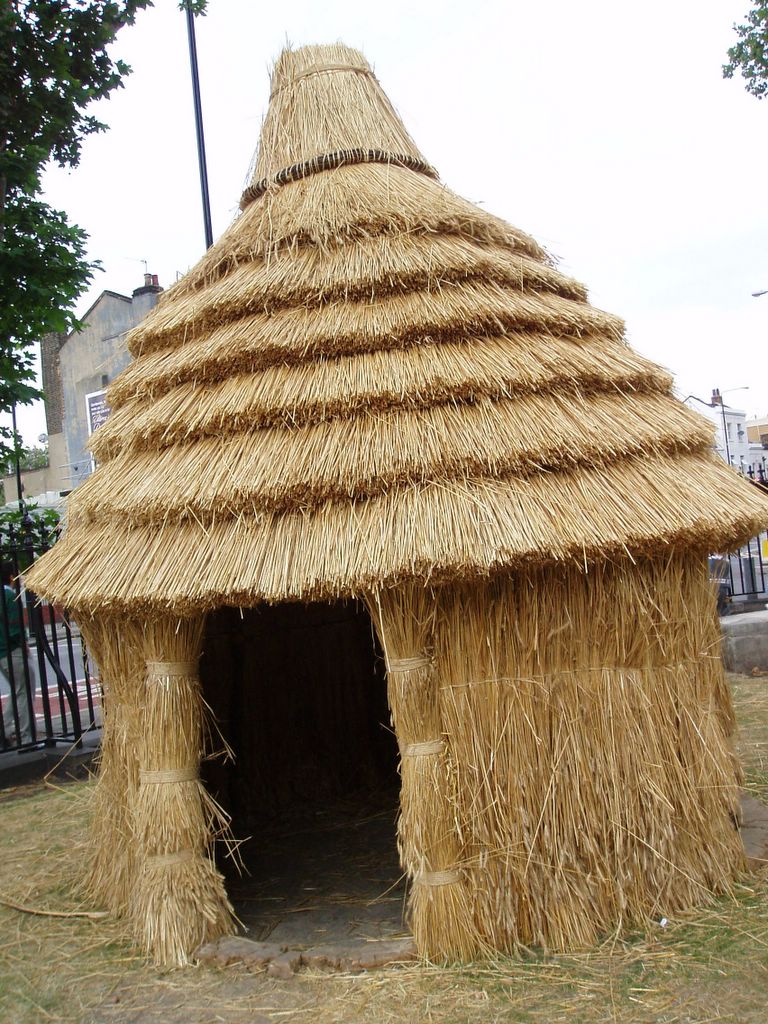
But ceviche makes up for all this.

---

Then I visited Whitecube, a contemporary art gallery facing Hoxton Square. This month's featured artist is Anselm Kiefer, who, of course, I didn't know anything about.

You can learn what is in display by reading the Whitecube's description (Look for the paragraph beginning with "Part II opens on 2 August with ...").

The installations clearly indicate something couldn't be achieved: derelict concrete staircase stuck on the wall leading to nowhere, scattered pieces of shattered glass, a lead boat looking like running aground against rumps of concrete...

All the same, I simply felt they looked beautiful, very beautifully "organised".

I saw a few people having a five-second look and quickly leaving the place as if they didn't understand anything. I guess these people didn't go through severe setbacks in the past or everything for them currently is going well.

Saturday, August 13, 2005

Lesser-known "Good" Dictators - Part III

This post is a sequel to 17th June.

Marien Ngouabi (Republic of Congo, 1968-1977)

Under his 9-year rule, real GDP per capita in purchasing power parity terms increased by 50%. As he was said to have established the first Marxist-Leninist state in Africa (according to Wikipedia), it was probably the case that he managed the Soviet-style economic growth (ie. growth solely due to capital accumulation). Actually, the investment rate during his rule was staggering 30 percent on average.

Sunday, August 07, 2005

A jumbo power point


At the east end of Ganton Street (southside), Soho, W1 (off Carnaby Street)

Sunday, July 31, 2005

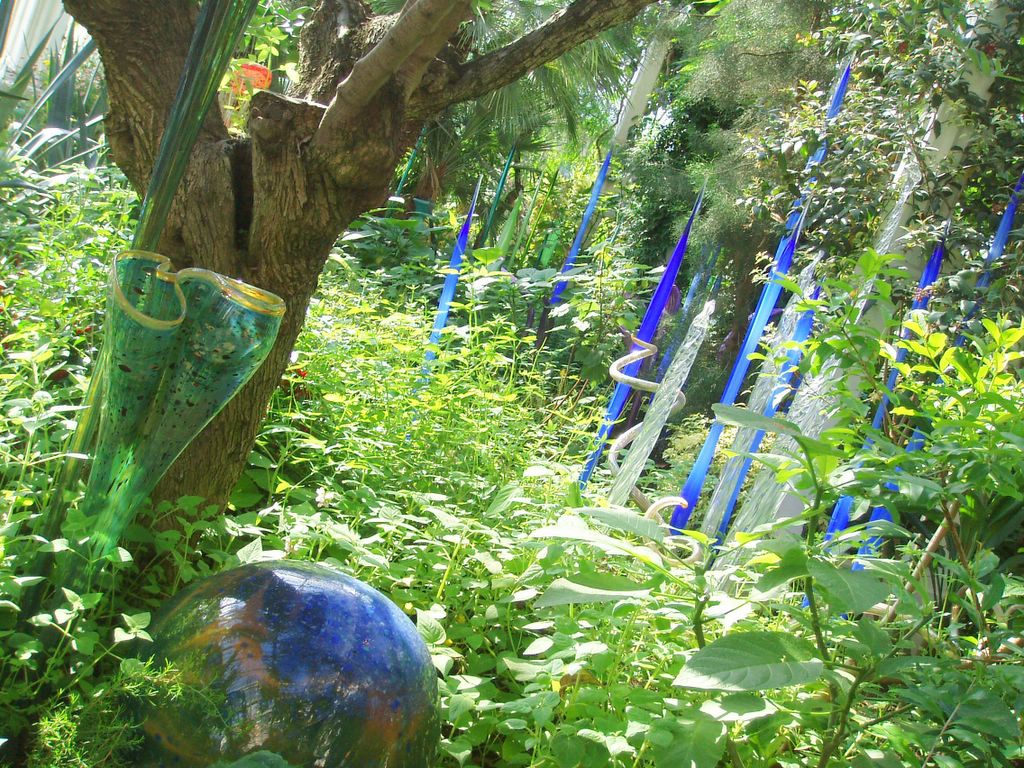
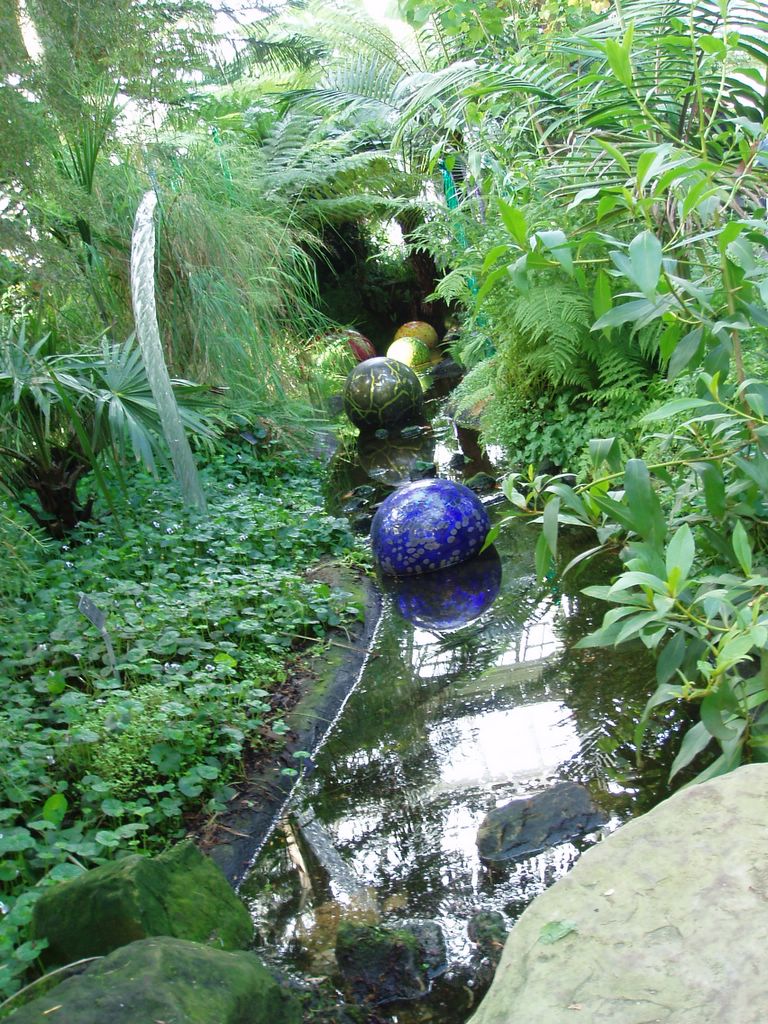
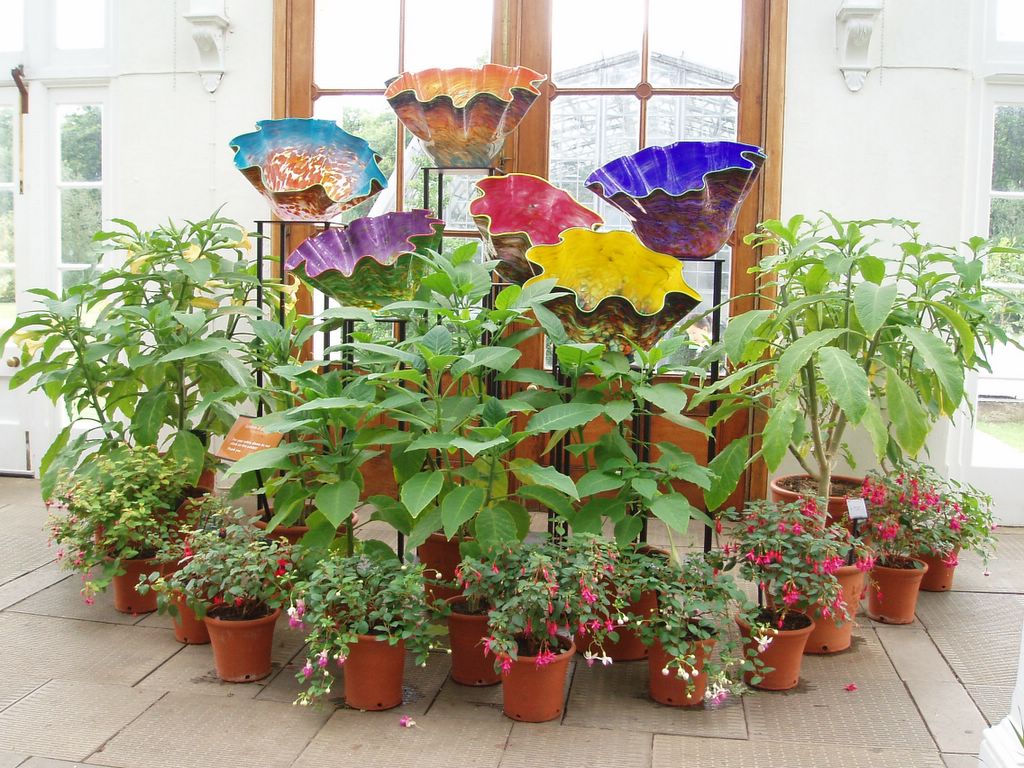
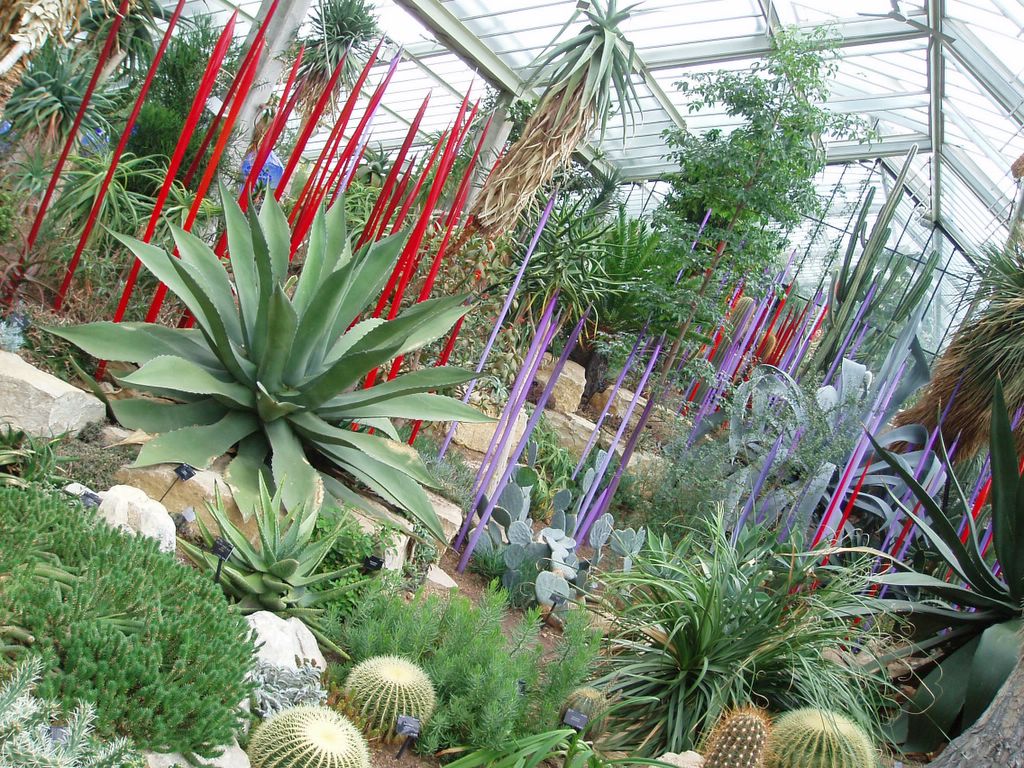
Kew Gardens featuring Dale Chihuly

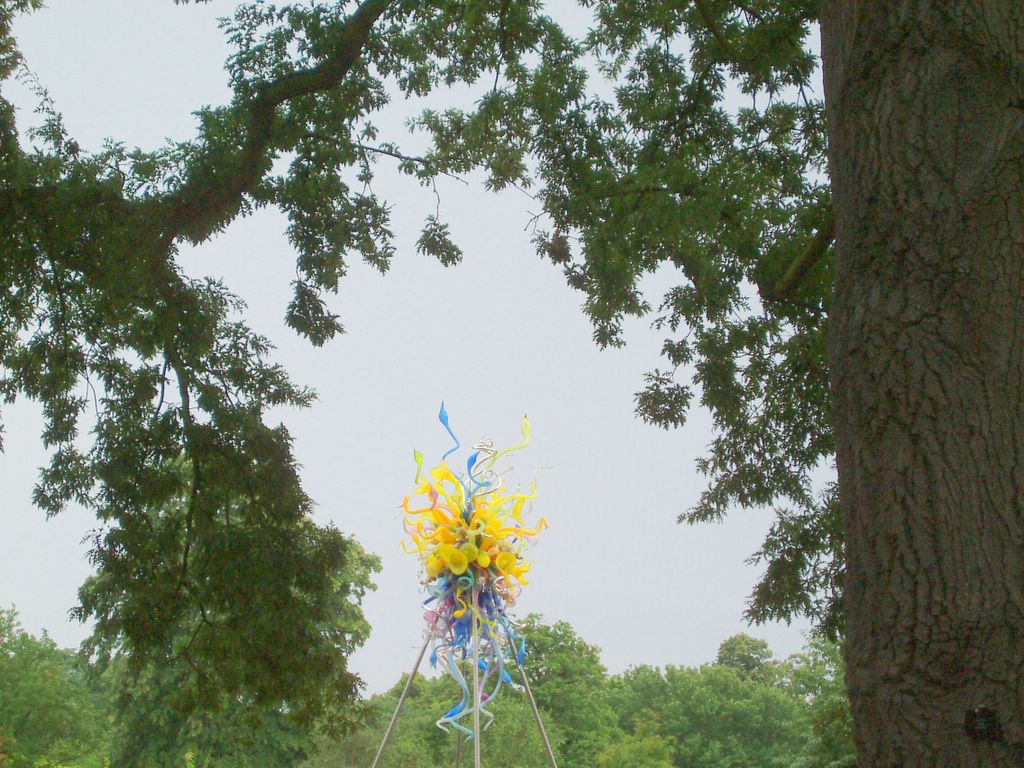
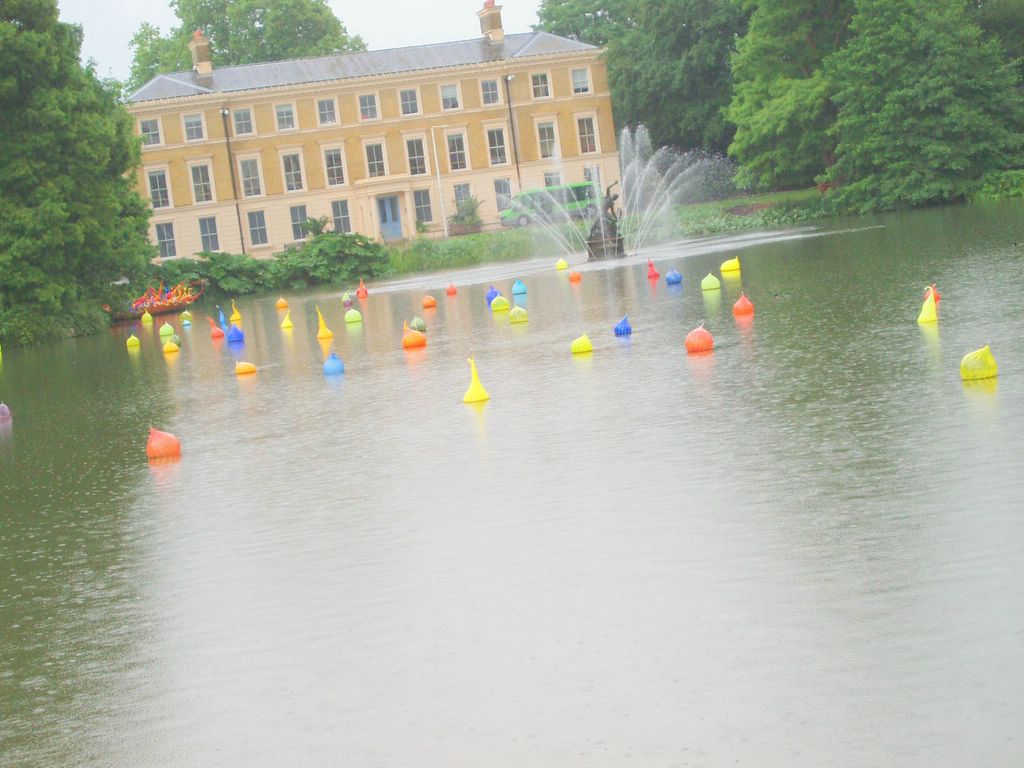
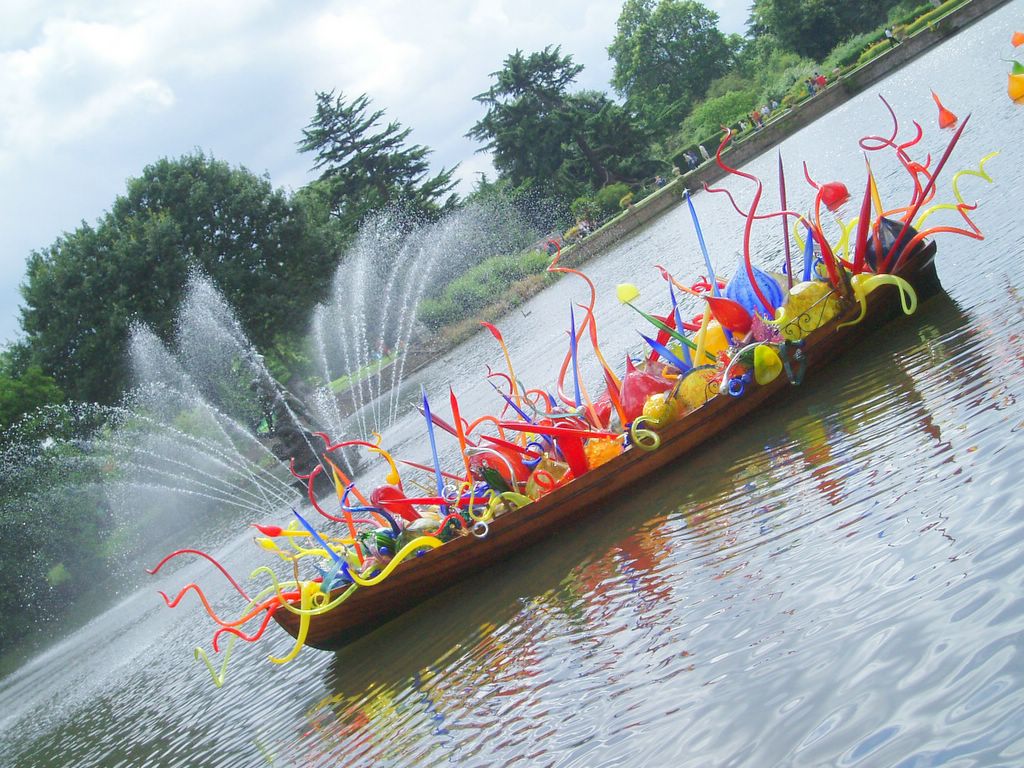
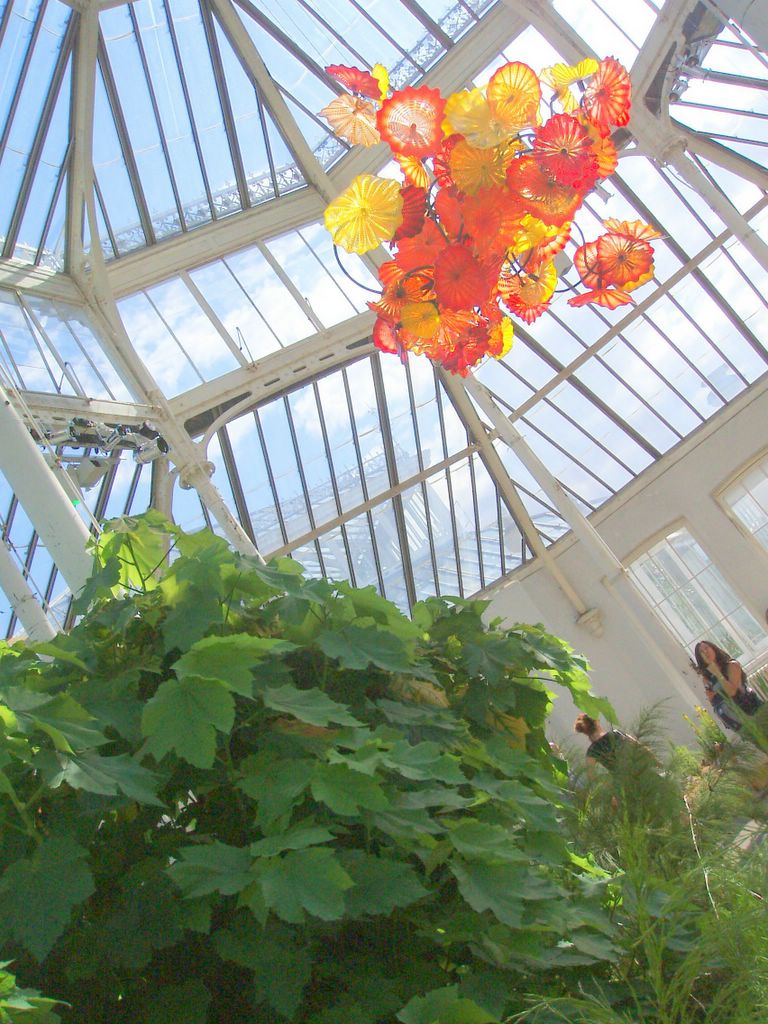
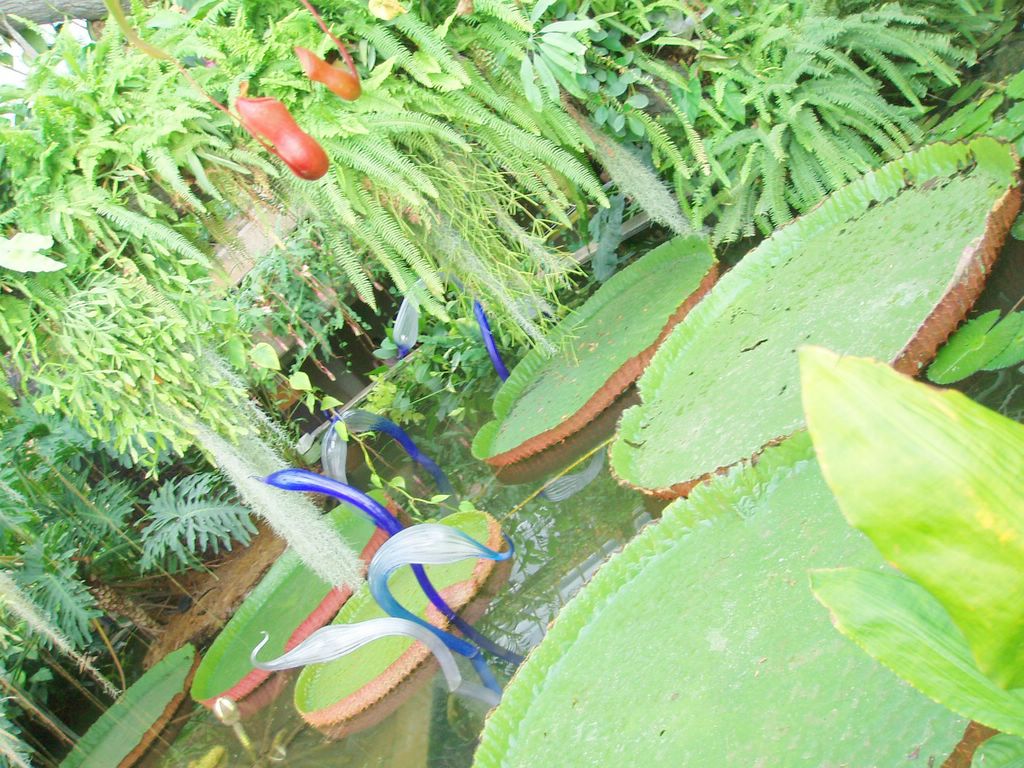
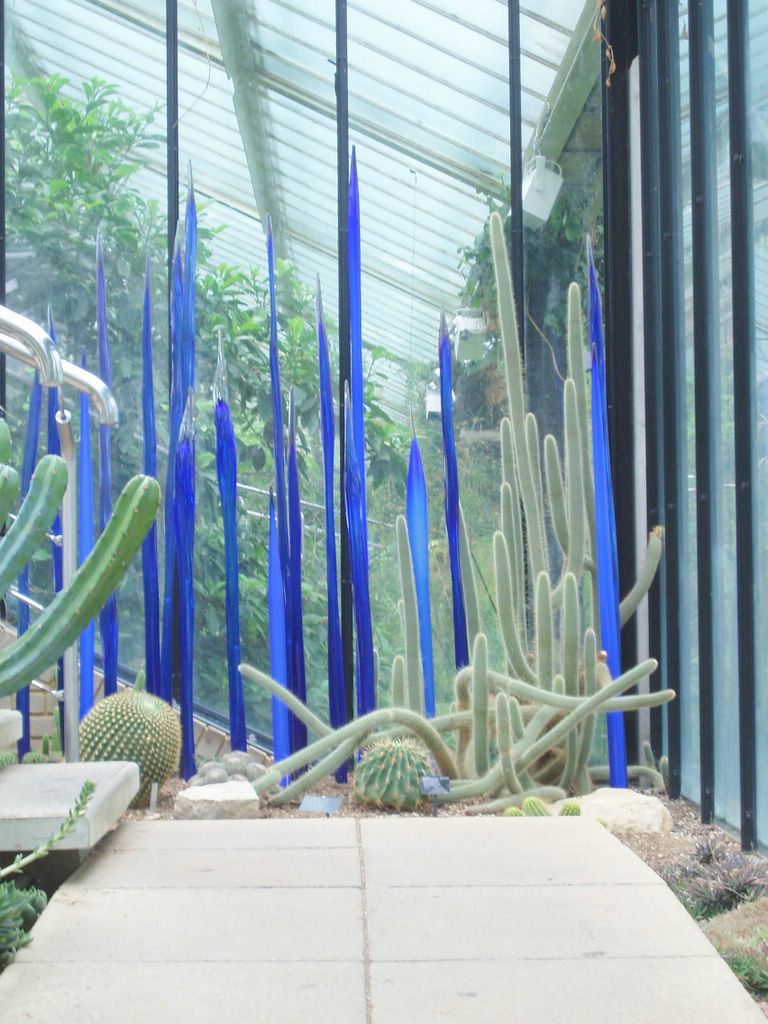
Until 15th January 2006, visiting the Kew Gardens gives you a surreal experience. The Gardens, especially inside the greenhouses, are dotted with Dale Chihuly's glass works. You don't expect colourful, beautifully-shaped pieces of glass standing or sitting amid trees, bushes, plants, or flowers, do you? This is a wonderful exhibition. You must go there. If you're coming to London on holidays, don't miss this out.

Unconvinced? Then look at pictures below.


On the way from the Victoria Gate to the Palm House


Walla Wallas, on the Palm House Pond


Thames Skiff, on the Palm House Pond


Red Palm House Tower, in front of the Palm House


Inside the Palm House


Inside the Temperate House


Inside the Temperate House


Persian Chandelier, at the atrium space in the Temperate House


Inside the Temperate House


Inside the Temperate House

Saturday, July 30, 2005


Inside the Temperate House


Inside the Temperate House


A stream inside the Temperate House


Inside the Temperate House


A pond in the Temperate House


Inside the Temperate House


A pond inside the Temperate House


Green Grass, inside the Temperate House


Macchia, at the west entrance of the Temperate House


Inside the Temperate House


Ikebana, in the Temperate House


Inside the Temperate House


Inside the Princess of Wales Conservatory


A pond inside the Princess of Wales Conservatory


Inside the Princess of Wales Conservatory


Reeds, at the Princess of Wales Conservatory


Basket Sets at The Princess of Wales Conservatory


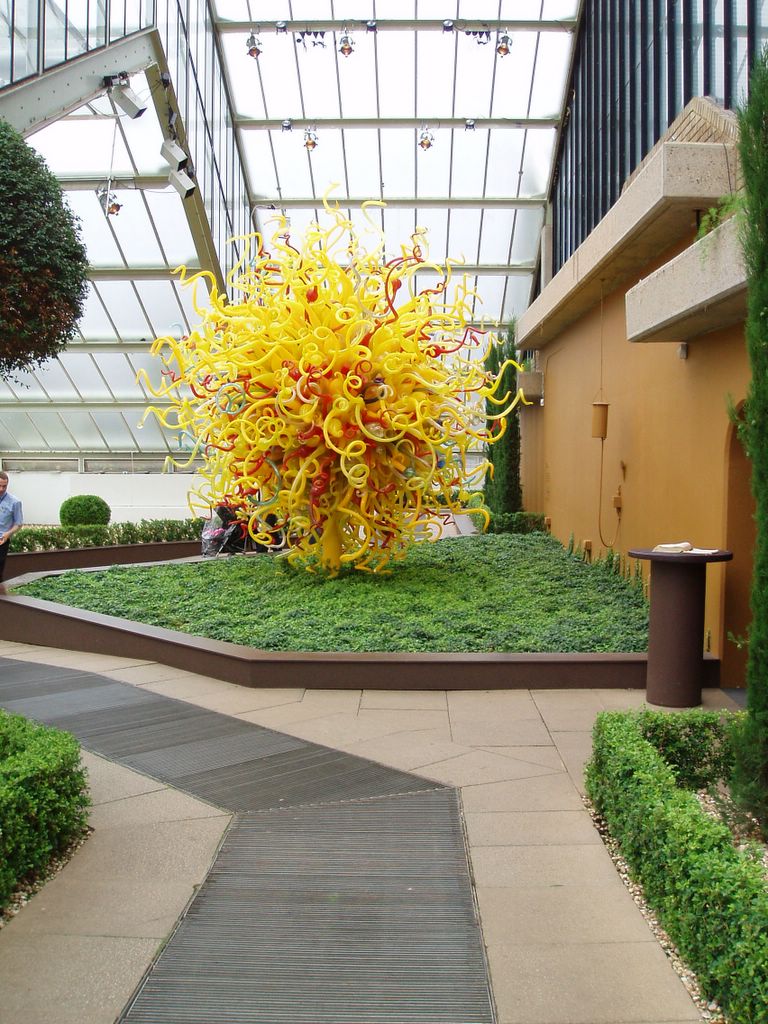
The Sun, at the north end of The Princess of Wales Conservatory. Although this is supposed to be the leading installation of this surreal exhibition, it is not as impressive to me as others...

An extra


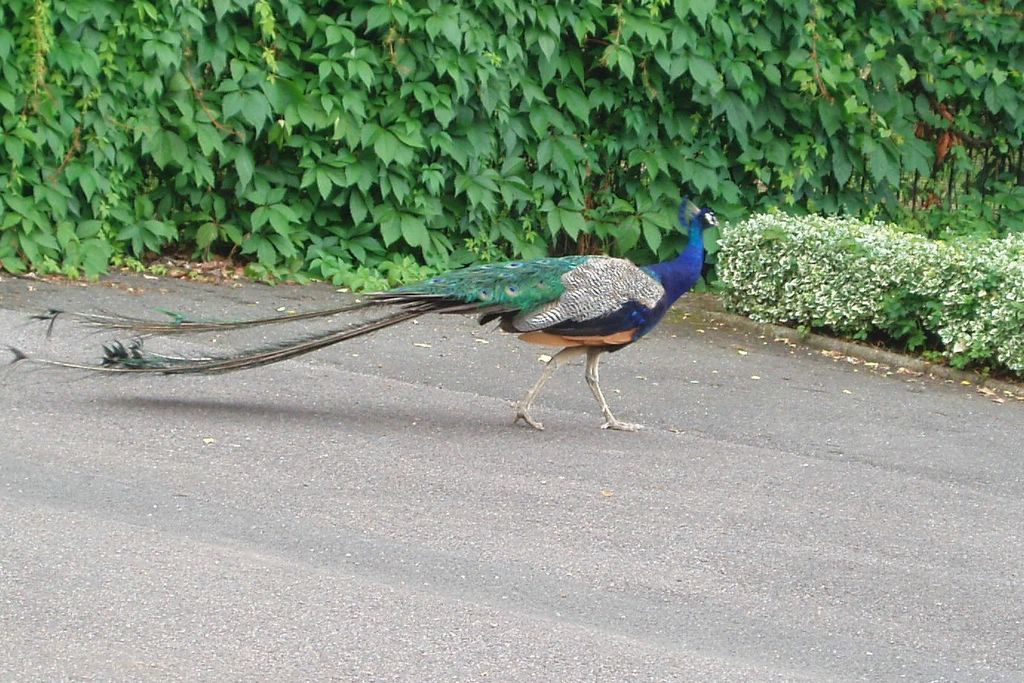
A peacock wandering (just like pigeons!) in the Pavilion Restaurant of the Kew Gardens

Sunday, July 24, 2005

Bedroom Curtain


This week was all about changing my bedroom curtain.

On Tuesday, I went to Ikea in Brent Park with Yumiko-san. (Hence the photo on 19th July). For those uninitiated, Ikea is a Swedish furniture store chain very popular in Europe. They sell pieces of furniture with minimalist design and for very reasonable prices. Some say every household in Britain has at least one piece of Ikea furniture.

Incidentally, Ikea will at last land in Japan next year. But I'm not sure if they will be successful in Japan. Minimalist design is nothing new to Japanese people. (Just remember Muji from Japan.) Plus, the popularity of Ikea in Europe seems to rely on its cheap prices at the cost of convenience and good services. (You need to assemble the pieces of Ikea furniture for yourself by reading very unhelpful instruction booklets.) Japanese consumers take good prices and good services for granted. I suspect Ikea will find it hard to penetrate into the Japanese market.

Anyway, I took this opportunity of visiting Ikea to change my bedroom curtain. Ever since I moved into my current house two years ago, my bedroom curtain, which was already there before I moved in, has been the same: a worn-out blue one. It has certainly been letting me down everytime I saw it.

I looked for one of contemporary design at Ikea store. Then I got the one shown in the above picture. Cool, isn't it?

The problem was I needed to fix a new curtain rod into the wall. The Ikea curtain was not compatible with the curtain rail in my bedroom. Which meant I needed to drill a couple of holes. But I didn't have a drill...

After coming home, I contacted a couple of my friends, none of whom had got one. So on Wednesday I went to Woolworths in the neighbourhood, finding one on sale for half a price (10 quid). So I bought it on Thursday.

Back in my bedroom, I realised that my window was wider (more than 2m) than I expected (my old curtain always hid the left edge of the window). The curtain rod that I bought at Ikea was too short!

On Friday, I went to Ikea again, all the way from East London to Northwest London (about one and a half hour trip). There is one Ikea branch in East London, but that one is in the middle of nowhere unless you have a car.

Today I began drilling my bedroom wall around midday. I realised the wall was so old that when I turned a screw into the hole I drilled, the screw simply scraped the hole further and never stopped turning...

Fortunately, a wooden bar was attached to the wall above the window. By drilling this bar, I finally managed to fix the new curtain rod into my bedroom wall by 6 pm.

Now I'm happy with my bedroom. :)

Wednesday, July 20, 2005


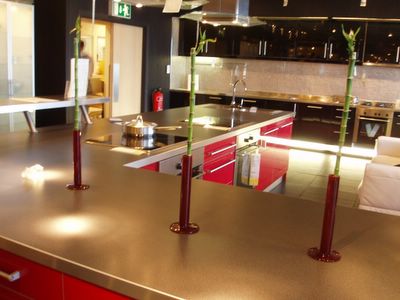
A kitchen showroom at Ikea Brent Park Store

Sunday, July 17, 2005

Economics in the view of Japanese bureaucrats

People outside Japan seem to believe that, as Japan now has the world's second biggest economy, the Japanese government relies on the wisdom of economists to manage its economy.

This is absolutely wrong.

A good example came out on an article of Yomiuri Shinbun, Japan's most-read (and a bit right-wing) newspaper today. (Special thanks to Hayashi-san for calling attention to this article.)

Three professors of economics/statistics in Japan - Takamitsu Sawa at Kyoto University, Naosumi Atoda at Keio University, and Toshihiko Igawa at Meikai University - have shown that statistically there is no correlation between the bidding prices for public works projects and the quality of such projects, counterarguing the view held by the Ministry of Construction and Transport that open bidding for public works projects is not appropriate as it deteriorates the quality of such projects.

What's "fascinating" is the comment by the Ministry official on this research result:

"The ministry holds that there certainly is a relation between bidding price ratios and evaluation scores. Quality is low when bids are low. We have no plan to further examine the data (used for the analyses)."
It's not a counter-argument at all. It's like the Ministry doesn't believe such an econometric/statistical analysis to evaluate government policies.

See? Economic policies in Japan are made by those bureaucrats who know nothing about economics.

Well, the research done by the Japanese econometricians and statisticians is itself not a good reason to believe that open bidding does not sacrifice the quality of projects: the data used in the analysis is about what happened under the system of "bidding among designated companies", not under open bidding. Presumably, the relationship between bidding prices and the quality of projects undertaken will change if open bidding is introduced. It may still be the case that what the Ministry argues is correct. Alas, there is no one in the Ministry who is exposed to econometric analysis enough to counter-argue in such a way.

Tate Modern

Went to Tate Modern to meet Cheyok, Eugene, and their friends. We watched the exhibition of Frida Cahlo, a Mexican surrealist painter. Her paintings are impressive, very unique, versatile, and beyond your imagination; but not pleasant to see.

The Turbine Hall houses an exhibition by Herzog and De Meuron, whose architectural works include Tate Modern itself. They display mock-ups of building designs that were discarded before reaching the final idea. In other words, a bunch of waste products. The curator insists that this way the exhibition shows the thought process that architects go through. But as so many mock-ups are scattered on many desks in the Hall and as little explanation is provided on which model came before which, it just confuses me. Well, confusion itself is probably the process of creativity. But it is not pleasant.

I always feel what's most fascinating about Tate Modern is not exhibitions themselves but the former power station that has turned into the contemporary art museum. Look at this (click to enlarge):


Also, the view of the Millennium Bridge and St Paul's Cathedral from here is magnificent. Everybody takes a picture here. I tried to take a bit different one. What do you think?

Thursday, July 07, 2005

The Mayor of London's statement

"... Finally, I wish to speak directly to those who came to London today to take life.

"I know that you personally do not fear giving up your own life in order to take others - that is why you are so dangerous. But I know you fear that you may fail in your long-term objective to destroy our free society and I can show you why you will fail.

"In the days that follow look at our airports, look at our sea ports and look at our railway stations and, even after your cowardly attack, you will see that people from the rest of Britain, people from around the world will arrive in London to become Londoners and to fulfil their dreams and achieve their potential.

"They choose to come to London, as so many have come before because they come to be free, they come to live the life they choose, they come to be able to be themselves.

"They flee you because you tell them how they should live. They don't want that and nothing you do, however many of us you kill, will stop that flight to our city where freedom is strong and where people can live in harmony with one another. Whatever you do, however many you kill, you will fail."

(Ken Livingston, upon arrival in London from Singapore, where the 2012 Olympics decision was made the day before. See the whole transcript.)

London under attack

On the day after it got the 2012 Olympics, and on the day when everyone's attention is directed at the G8 summit in Scotland, London seems to have been attacked by terrorists. A number of explosions in the public transport system were heard. (One bus blast near Russell Square, and 20 fatal casualties, is now confirmed by the Scotland Yard.)

All the tube lines are being suspended. Mobile networks are down now, for preserving phone communication for emergency services. All the buses in central London are just suspended.

I was at home, as usual, when things happened around 8:45 am. I'm physically fine, but feel depressed by this.

And, annoying Indian sales pitch calls are in operation normally. (I just got one.)

Tuesday, July 05, 2005

Kiyo's lunchtime concert


St. Bride's Church, (Fleet Street, London, EC4)

My concert pianist friend Kiyo, with a soprano performer Natalie, held a lunchtime concert at St. Bride's Church. As seen in the above picture, the interior of the church is beautiful. Among the pieces they performed, I liked Schubert's 'Libesbotschaft' and 'Fruhlingstraum'.

After the performance, we, along with Kiyo's friends, had lunch at a pub next door. I hate having lunch at English pubs because, you know... But Club Mangia at The Punch Tavern (99 Fleet Street) is a revelation. Their lunchtime buffet (7.5 pounds, and you can eat as much as you like) is extremely excellent. See its Time Out review.

Sunday, July 03, 2005

Somali cuisine

My Singaporean friend Linus loves trying obscure ethnic restaurants in London. I like to join his exploration. In the past he discovered the Ethiopian restaurant Menelik on Caledonian Road (see 14th November 2004) and the Turkish Bursa Inegol Koftecisi in Hackney (see 2nd April 2005).

Today, it's a Somali restaurant in Mile End Road: Tayo Restaurant. Everyone but us in the restaurant is Somali people, a good sign for authenticity.

When I arrived at the restaurant, Linus already had a spaghetti. Oh, yes, Italians colonised Somalia in the early 20th century. But, acoording to Linus, the taste is more of Indian. Yeah, East African coasts have a sizable population of South Asians because Muslim traders came to East Africa during the times of Islamic empires.

I don't know the name of what I ordered, something like meat and vegetable stew. It tasted like a Jamaican meal. Well, both countries have black people...

Accompanied with the stew was Somali bread, looking like Ethiopia's ingera (sour crepe). But it tasted different and good!

We noticed all Somali customers were easting bananas with the stew or other meals. Next time we should order bananas as well to have a proper Somali lunch.

The problem with such obscure ethnic restaurants is it is difficult to take girls there. Linus does take his girlfriends and enjoy seeing how they react. He's so mean. :)

Next door to the restaurant is a Somali clothes shop, where Linus got the incense and the decorated stand on which you burn incense with charcoal for the Ethiopian coffee ceremony. (Google "Ethiopian coffee ceremony, and you'll find its popularity!)


A replica Darfur hut, built by refugees from Darfur, western Sudan, in the front garden of the Museum of Childhood. Building this hut, say the Sudanese refugees, reminded them of their happy moments in Darfur.

Saturday, July 02, 2005

Spanish names

By tracking the names of dictators in Latin America, I'm confused with their names a lot. Take the Somoza dynasty in Nicaragua. The founder's name is Anastasio Somoza Garcia, who ruled the country since 1937. When he was assassinated in 1956, his son Luis Anastasio Somoza Debayle succeeded. In 1967, Anastasio Somoza Debayle, Luis's brother, succeeded.

How complicated! Especially, the last guy's name has no original part!

Then I found this website explaining how Spanish-speakers name their children. Finally it makes sense. Take the second-to-last name as the family name!