Friday, October 31, 2008

Thursday, October 30, 2008
Impact of Successful Assassinations on Political Regime and Wars
My memory has been weakening recently. As an attempt to remedy this, I'll start writing down on this blog what I learn from reading papers, books, news media, etc.
Empirical findings from Jones and Olken (2008) "Hit or Miss? The Effect of Assassinations on Institutions and War":
When an assassination is attempted against the national leader...
1. If the dictator is killed, democratization is likely to follow.
2. It does not matter for subsequent political regime change if a leader in democracy is killed.
3. If the leader facing a small-scale war (less than 1000 battle-related death per year) is killed, the war is likely to be intensified.
4. It does not matter for the onset of a war whether the leader is killed.
5. If the leader facing a large-scale war (1000 deaths or more per year) is killed, the war is likely to be terminated.
Monday, October 27, 2008
A source of great research ideas in economics
I've decided to get this blog back in operation. But each post will be brief.
Reading Chris Blattman's blog for the first time in weeks reminds me of an important tip for applied economists. Hal Varian says, "Look for ideas in the world, not in the journals." Ray Fisman says, "I always tell graduate students that if they want innovative thesis ideas, to read the newspaper, not the economics literature. ... You usually don’t get exciting new research ideas while reading Econometrica."
I almost forgot this important tip. At least, when you think about building a model, the kind of assumptions you want to make should be what you have learned from world events, not from academic papers in economics.
And this reminder seems to have an immediate impact on my research today.
Friday, October 17, 2008
FT on rating agencies
A very good article from FT magazine on one of the causes of the current world financial crisis.
Sunday, September 21, 2008
Chase & Status
So the most creative music producers right now are Chase & Status coming out of my favorite drum & bass scene? Click below to see if it's true.
Take Me Away, the most selling drum & bass tune in the past one month
Eastern Jam, one of the biggest dubstep tunes this year
And here you can listen to their DJ set, including many of their own tracks, broadcast on BBC Radio 1 on 9 August 2008.
The End
I just learned that The End, my favorite nightclub in London and the nightclub I visited many, many times during my 5-year life there, will close its doors for good next January after 13 years in business. I'll try to catch one of its final nights.
Saturday, September 20, 2008
A boutique designed by Zaha Hadid
Yet another must-visit was opened in Tokyo: Neil Barrett's flagship store designed by Zaha Hadid.
Address: 3-17-6 Minami-Aoyama Minato-ku Tokyo
The photos on the right are obtained from Excite Ism Concierge (18 September, 2008).


Sunday, September 14, 2008
Michele McLaughlin "The Eternal City"
Video-wise, nothing particularly interesting. But this piece of simple piano music sounds good to me.
Saturday, September 13, 2008
Annika Larsson "Dolls" at Andrehn-Schiptjenko
(The image below is taken from Andrehn-Schiptjenko's website)
A video installation that lasts almost 50 minutes. You never understand what is going on in this video. There are five guys appearing in an artificially constructed white cube with a few lines and signs of red, blue, or black on the floor and the wall alongside a white cupboard on the wall and a small square platform on the floor with stairs on two sides. The video starts with a scene of a coffee maker making coffee with the sound of the coffee-maker replaced by some abstract music mocking the sound of coffee dripping. Once coffee is ready, a gray-haired guy in ski boots starts trying to bring a cup of coffee and a toast to another guy with glasses sitting on a chair just a couple of meters away. But he takes almost 20 minutes to do so, by dropping coffee cups on the floor and climbing up to the platform with help of a black, stout guy, etc. Another guy in a black suit who appears to be the principal along with the guy with glasses helps him by pouring coffee into a cup and putting a slice of bread into a toaster, which is hidden inside the cupboard. When the toast is done, the gray-haired guy, who appears to be the two principals' agent number one, smiles, by the way. He finally manages to pass the cup of coffee and the toast to the glasses-wearing principal, who simply put them on the side table without drinking or eating. Above the cup of coffee and the plate of the toast is the black, reversed-triangle mark on the wall. The next turn is the black, stout guy, or agent number 2, in boots with spikes beneath the sole. His task is to detach the cupboard from the wall and to destroy it with a hammer placed by the black suit principal under the wall sign of three parallel short blue lines. He also takes almost 20 minutes to do this task with help from other guys, because he drops the driller from his hand so one of the principal ends up detaching the cupboard, etc. Finally, a man with a black mask covering around his eyes, wearing a pair of skate shoes, challenges the task of passing a key to the black suit principal standing on the blue circle mark on the floor, just a couple of meters away from him. He also needs help from other guys. When he finally reaches where the black suit principal is standing, he stands with his back facing the principal. He inserts the key into the principal's pocket inside the suit jacket, by using his hands behind his back. When the task is complete, the video ends.
It doesn't make much sense, but it is much better than most movies and television programs. The video manages to stay at the borderline between absolute nonsense and something deep. And the video shooting technique is impressive. How each scene is framed by the video camera, and the sequence of scenes, is well-crafted. The shoes or the face expressions of the five guys are focused many times, making the viewer guess the emotion and character of these guys. The images of lines and signs in the white cube are inserted many times, making the viewer wonder the meaning of these geometric marks. Finally, the background sound construction is superb, too. The sound of dropping coffee cups or keys is erased, making the whole scene somewhat out of this world. The very abstract music actually expresses the anxiety of protagonists very well.
Certainly, this is not everybody's kind of video. But I love it because I love it without understanding it. That's the sufficient condition of good art.
For the detail on the artist and the work, visit the gallery's website.

Wednesday, August 20, 2008
My former job market paper submitted
I've finally done with the submission of my former job market paper to a journal, the most urgent task for any tenure-track assistant professor in economics during the first year of the job, on the 366th day since I moved to Stockholm. Phew.
Sunday, August 17, 2008
Wallpaper by Hanna Werning
These photos are obtained from www.byhanna.com.
The wallpaper design is good, and the idea to display it in the ruins amazingly suits these patterns. For more works by Hanna Werning, visit her website.


Saturday, July 19, 2008
Private property rights enforcement
A great example of private property rights enforcement when the state is weak. HT: Dani Rodrik.
The 10 most livable cities in CHINA
Monocle and many others have published the list of the world's most livable cities. Usually, no Chinese city appears in the list. What if you have to live in China but you can choose which city to live? Here's the list of the 10 most livable cities in China, based on opinion polls by Chinese.
Twist by 4 Use
The photo is from Excite Ism Concierge, July 18, 2008.
Moroso Twist tables, designed by 4 Use.

Sunday, July 06, 2008
If you have to say goodbye to your beloved one...
If you have to say goodbye to your beloved one, and if it hurts so much you don't know what to do, just acquire the characteristics of that person that you love. (Mikami Chisako, October 8, 2007)
I've probably been doing this unconsciously.
Saturday, July 05, 2008
Electrolux E-dish
The photo is obtained from Excite Ism Concierge.
I hate electrical cookers. But if they come in style, I'm tempted.
Electrolux will start selling E-dish (see the picture above), which you can put anywhere in your kitchen as long as it connects to the power socket. That's a revolutionary concept.
And the design is sleek.
But I realize this is not an electric cooker. It is an induction cooker. It requires pans and pots tailored to such cookers...

Friday, July 04, 2008
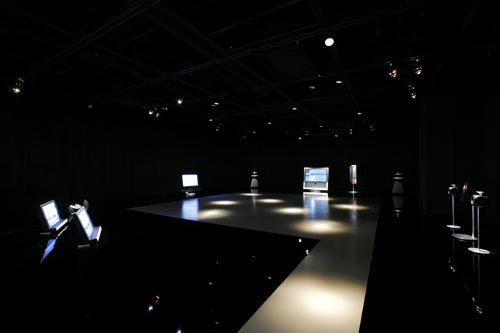
Bang & Olufsen's exbition in Tokyo
The photo is obtained from Excite Ism Concierge
Excite Ism reports Bang & Olufsen's exhibition in Tokyo. The above is the photo of the exhibition entrance. The art director of this exhibition is Tatsuya Matui, a robot designer. The black parts of the floor reflect light, looking like the surface of a lake at night. Beautiful.
Saturday, May 31, 2008
Meguro
Have lunch with a friend at Kioku, a restaurant in the entrance lobby of Hotel Claska on Meguro Street. It's got a nice ambience, perfect for Saturday branch, and the food is good enough (if not excellent).
Meguro Street has attracted many furniture and interior goods stores. Brunch+time stands out among them. It stocks many table boards made of one piece of natural wood (i.e. not engineered wood), reminding me of the beauty of wooden pieces of furniture.
Friday, May 30, 2008
Supermarkets in Tokyo
I follow my mother to buy foods and other daily stuff at supermarkets in the neighborhood. Three things surprise me.
First, the package of vegetables allows you to see in your mobile screen the face photo of farmers who produced them. The package has a QR code on it. Scan the code with your mobile handset, and you'll see the farmers' face on the mobile screen. (QR codes are everywhere in Japan now.)
Second, after passing the till, ice cubes are on offer for free of charge so customers can keep vegetables etc. cold and fresh on the way home.
Finally, Ito Yokado, one of the major supermarket chains in Japan, delivers what you just bought to your home on the same day for just 100 yen (0.61 euro). What's more, for what need to be kept refrigerated, they keep them in a special bag that keeps the inside cool.
Do you want to live in Tokyo by now?
Thursday, May 29, 2008
Emily Kame Kngwarreye vs. Turner Prize Winners
Roppongi has become a place for art lovers. Located within a walking distance are three major art museums in Tokyo. I visit two of them today: The National Art Center Tokyo and The Mori Museum. (The third museum is The Suntory Museum.) Photo: The lobby hall at the National Art Center Tokyo.
The National Art Center Tokyo exhibits the works by Emily Kame Kngwarreye, an Aborigine painter. The exhibition collects about 100 pieces of her work, spanning her entire career.
The first glance at them puzzles me. All the paintings are very abstract, presenting a very different world. The curator's explanation in a video playing in a separate booth from the gallery helps me realize that her paintings reflect the place where she lived in her entire life: a desert in the middle of Australia. She basically drew what her eyes had always caught. Once I'm used to her ways of expression, I start noticing her mind-blowing sense of color. She mixes different colors in a pleasant way. This aspect of her talent blossoms in Earth Creation. Now that I have had an experience to seeing green leaves and colorful flowers burst into blooming suddenly right after the end of winter in Stockholm, I can appreciate what Emily painted in this work.
Another aspect of her talent, the use of dots to paint a canvass, allows the picture to look three-dimensional. The best to watch her paintings is from a distance. (And this exhibition is laudable in that it allows viewers to do this by using the vast exhibition space fully.) It is like when we see the cityscape from the top floor of a skyscraper as beautiful. Each dot is rather ugly, but when these dots get together and viewed from a distance, they produce a beautiful picture. How did she manage to envision this effect when she was drawing on a canvas on the ground (that's her way of painting)?
Once she established her fame in the contemporary art world by the early 1990s, she changed her style. That was when she was over 80 years old. She stopped using dots. Instead, she focused on line drawing. The exhibition shows her pieces of work during this period, which are honestly speaking not very good. But she made a break-through by painting Big Yam Dreaming with white lines on a black background, that is, by ditching what made her famous: dot painting and the incredible use of colors. That was just one year before her death in 1996.
Even after that, she tried a new approach. In the last series of paintings (drawn just two weeks before her death), she discarded even line drawings. She attempted to create a new world just by her keen sense of color. Would you start doing a new thing when you expected the end of your life in the very near future?
The pictures of her painting are scattered on the web. None of these do her any justice. Her works are best appreciated by watching the original from a distance. If your city invites her exhibition, do visit it. You won't regret it.
-----
After Kngwarreye, contemporary art pieces by Turner Prize winners displayed in the Mori Museum inevitably look small-scaled. Each artist does reveal something new. In Mother and Child, Divided, Damian Hirst, for example, makes me realize the difference in what is inside the body between a cow and a calf. It's not like every part of the body becomes larger when one grows up. In a project House, Rachel Whitered managed to visualize the space inside a house that is going to be demolished, that is, something nobody cares about, by making a concrete cast. In a video entitled Deadpan, Steve McQueen shows what each person cares most about is different. (And I realize one of the video works that I saw in Venice Biennale 2007 (Sophie Whettnall's Shadow Boxing) is basically a copycat of McQueen's work, although I prefer Whettnall's.)
Overall, however, what Turner Prize winners try to convey to viewers appears to be rather trivial in comparison to Kngwarreye's works. Maybe because Turner Prize winners fail to produce beauty.
------
Tokyo is not just a city for great foods and amazing shopping experience anymore. It is now a place to allow the luxurious comparison of totally different strands of great art. Chanel has chosen Tokyo as the second city to exhibit Mobile Art. Tokyo allows its residents to keep up with what's happening in the world.
Subscribe to:
Posts (Atom)