Tuesday, January 25, 2005

Shepsle and Shleifer at LSE

In the early afternoon, I worked on building a model and managed to derive an outcome, which isn't what I was expecting...

In the late afternoon, I talked to Professor Ken Shepsle, who has been visiting STICERD for two weeks from Harvard University. I asked him if he knows any papers that theoretically model different ways of choosing the chief executive in a non-democratic political process, as I empirically found this matters for secure property rights.

He suggested Soskice, Bates, and Epstein (1992), which is quite similar to what I have in mind. He asked me more on my research project and kindly gave some comments.

In the evening, Professor Andrei Shleifer, again visiting LSE from Harvard, gave the first of his three public lectures on legal origin. Today's delivery was based on Glaeser and Shleifer (2002). At the end of the lecture, he mentioned three reasons for why he didn't investigate the effect of legal origins (British common law vs. French civil law) on economic growth through changes in 'institutions' like property rights enforcement. (1) Any legal origin can flourish an economy: both Britain and France are now rich countries. (2) There are very few objective measures of institutions. Most of the measures used in the literature are outcomes rather than institutions. (3) Historical indicators like legal origins or European settlers' mortality can hardly satisfy the validity of instruments as it proxies for many things that affect economic growth without going through the quality of institutions (e.g. human capital). The second and third points are from Glaeser, La Porta, Lopez-de-Silanes, and Shleifer (2004).

After the lecture was over, I came up with one question. Shleifer argues that the 12th century saw a divergence of legal systems between England and France, and that this institutional difference has persisted until today. This argument involves inconsistency. Legal institutions changed in the 12th century while they haven't changed at all since then. It's not clear why we saw a change in institutions in the 12th century but we haven't ever since.

I talked about the lecture with Tianxi, who questioned why the English kings, stronger than feudal lords, implemented a relatively independent judiciary system. If the king is more powerful than anyone, he should be able to do whatever he likes. Certainly, an independent judicial system is not what he wants. To think over his question, I read Glaeser and Shleifer (2002). They assume that a legal system is a consequence of Coasian bargaining. In other words, it reflects the maximised social welfare given some exogenous parameters including the powerfulness of feudal lords. So the English king didn't play a role of determining which legal system is beneficial, which I would say is quite controversial.

It was quite stimulating a day, all owing to the fact that I'm a PhD student at LSE, where researchers who I can share my interests with more or less tend to gather. Maybe the coming two years will be the most enjoyable experience in my life as an economist. So I'll make the most of it as much as possible!

Monday, January 24, 2005

JP's EC501 talk. He derived an interesting result in his theory (the government who cares more about manufacturing than about agriculture actually hurts the former), but failed to do an empirical test for that proposition. I tried to think about how to tackle this, but couldn't come up with a good idea...

Lunch with JP, Juan, and Matthieu.

Worked on building a model with a new idea, ending up realising it doesn't work. The idea that I had last Friday and Saturday was better.

Friday, January 07, 2005

I Miss Tokyo, As Always When I Leave There

So I'm back in London now after a more than 12 hour flight. Once unpacking my luggage, I can't do anything but missing Tokyo...

The last breakfast in Tokyo was nanakusa-gayu, rice gruel with seven spring herbs, symbolising that New Year's season was now over.

After checking in at Narita Airport, I bought Gogo-no Kocha Royal, bottled milk tea (500ml for 150 yen or 75p), and Kara-age kun, deep-fried breaded chicken (8 pieces for 210 yen or 1.05 UK pounds), at a Lawson convenience store, and sat down at a table in the observation deck on the 5th floor of Terminal 1, sunbathing in the winter sunshine. Everything I was doing right now would be impossible in London.

I miss Tokyo a lot. This is not surprising at all. That was why I didn't want to go back to Tokyo before leaving London. That was why I couldn't feel happy about staying in Tokyo initially. I was so much scared of missing Tokyo when coming back to London. Plus, now I don't feel comfortable with speaking in English. Everything as expected.

Thursday, January 06, 2005

Misao

Had mentaiko, spicy cod roe, for breakfast. Eating this with a bowl of steamed rice was what I missed a lot in London. I don't wanna go back to London any more...

Today was the de facto last day in Tokyo (tomorrow's flight back to London departs at midday, which means I have to leave home around 8 in the morning). So I was busy going shopping. I bought size AA batteries, which is of better quality and cheaper (12 for 942 yen, or 4.75 UK pounds) than ones in UK; 20 blank mini-disks (10 for 1008 yen, or 5 UK quid), again cheaper than in UK; hair styling wax (75g for 1008 yen), with which I can set my hair much more easily than the wax available in UK; and socks (three pairs for 990 yen, or 5 quid), which are of better design and of better quality than ones available in UK for the same price. Also, my mum gave me hocho, a large kitchen knife much easier to use for cutting vegetables and meat, especially for finely chopping vegetables to cook chahan, or stir-fried rice.

In the afternoon, I met up with Misao at Roppongi Hills. Unfortunately, it was raining today. We missed a chance of strolling around this magnificent redevelopment area where art and design naturally melt into city landscape.

Misao is on a break in Tokyo from her life in Damascus, Syria. I asked her why she chose Syria to live. She'd been learning Arabic and wanted to brush up her skill by living in an Arabic-speaking country. Syria and Saudi Arabia are countries where people speak textbook Arabic. But it's almost impossible for a single woman under the age of 35 to get a visa to stay in Saudi. So she chose to live in Syria.

As Syria is a typical non-democratic country, she showed her interest in my research. It's interesting that many of my non-economist friends are curious about my research.

According to her, Japan is much respected by people in the Middle East, even though the Japanese Self-defence Force has joined the American-led coalition in Iraq. Also, Syrians tend to be despised by other Arabic people partly because the Syrian government opportunistically begged for money, sometimes from the United States, sometimes from Saudi Arabia.

Misao's dream is to engage in the provision of education in the Middle East. She visited Palestinian refugee camps in Lebanon, realising that refugee communities have already established the education system within camps. So her conclusion is there's no room for her potential contribution in Palestine. Her next target is Darfur, Sudan.

----------
In the evening, I held an off kai (literally translated into "off-line meeting", meaning a party where people who usually talk online - via mailing lists, discussion boards, or instant messages - meet up face-to-face) for participants in the development economics mailing list. I set up this discussion group on the web as a means of networking with Japanese fledgling development economists, including Yamada-kun (see 24th December). Those who came to the party were Ono-san, Ikegami-kun, Shoji-kun, Arimoto-san (Congrats for publishing a paper on Journal of Development Economics!), and, as a special guest, Sawada-sensei.

We had dinner at Queen Sheba, an Ethiopian restaurant in Nakameguro. As I found Ethiopian cuisine delicious (see 14th November), I wanted to introduce it to my fellow Japanese development economists. Shoji-kun liked it, but Arimoto-san didn't like it. Personally, this restaurant adjusted Ethiopian dishes to the taste of Japanese people, about which I was a bit grumpy. But when I dipped injera bread (sour crepe) into wat (spicy meat stew) and put it into my mouth, I got extremely happy. :-) The restaurant also serves African cocktails (no Ethiopian one, though). I tried ashanti, Kenya Cane (Kenyan rum) blended with banana liqueur. The taste was gorgeous. Yet another revelation.

We talked a lot about a variety of things related to development economics. But one thing was clear: it's not a good idea to be in Japan if you want to be a development economist. However I like Japanese foods, the quality of Japanese services, the energetic atmosphere of Tokyo, and fashionable and cute Japanese girls :-), I shouldn't get a job in Japan after finishing my study at LSE.

That's a life.

Wednesday, January 05, 2005

Omotesando

Had lunch with Aoki-kun at Darjeeling, an Indian curry restaurant opposite Aka-mon (the Red Gate) of University of Tokyo. For 750 yen (3.75 UK pounds), we enjoyed a delicious Indian curry with a large naan bread and a glass of lassi. What's lacking in the area around LSE is this type of restaurant. Darjeeling seemed to be thriving; it now has seven branches in Tokyo. I'm sure that this restaurant is by far better than most Indian restaurants in London in terms of taste as well as price.

Aoki-kun was my closest classmate when I was a master student of economics at University of Tokyo. We went through the hellish core courses of graduate economics together.

He's now a PhD student of economics at the same university. But he was losing confidence as a researcher. I asked him why, and learned that it was because he had no one who shared his interest in analysis of the economic recession in Japan during the 1990s. I gave him a couple of suggestions to break through such a predicament.

I don't want him to give up his career as a researcher. He always asks questions. He never accepts things as they are. That was why I enjoyed talking to him when we were in the master programme, even though I didn't enjoy conversations with other classmates. That kind of personality is suitable for a researcher, isn't it?

--------
In the evening, I met up with Reiko and walked along Omotesando Street, now dubbed "brand street" of Tokyo because all those international top fashion brands have opened their flagship stores on this street during the past few years. I wanted to check those stores in an architectural sense, but I was too shy to enter these fashion houses alone. So I needed Reiko to come with me.

The first surprise was Dior Omotesando. Inside the white glass building, colourful Dior gears were on display. The third floor dedicated to cosmetics was beautifully designed. I asked Reiko how to choose make-up materials. Choosing colours for foundations, eyeshadows, lipsticks, and so forth, with the total coordination in mind... Sounds fun! :-)

By the way, Dior Omotesando didn't seem to have staircases. We used a lift to go up to the third floor. As Reiko used to live in London, I told her this joke: "This building will be closed if firemen go on a strike." (For non-Londoners, when firemen took industiral actions in years 2002 and 2003, all the underground stations with lifts were closed.)

A disappointing one was Louis Vuitton. The front of the building is designed as a pile of LV trunks stacked at random, which is not too bad. But the inside of the building was quite unimpressive, together with unimpressive LV goods. Reiko said she doesn't like this brand though she used to have the iconic LV bag. Is there anyone who bought the LV monogram bag because they thought it looked cool? (But I like the white "Eye Dare You" bag designed by Takashi Murakami. I don't mind buying a trunk with that design.)

Totally unexpected was Tod's Omotesando. The appearance is quite unusual. What's more, the decor follows the same pattern, creating a sense of consistency. I didn't know what Tod's is. Reiko told me it's a leather shoe company, famous for loafers. As a result, any items on sale (even a jacket) had a touch of loafers, which looked a bit over the top.

The most impressive was Prada Aoyama. (See these photos as well.) The building itself, outside and inside, was impressive. But what strikes me a lot was this Prada boutique not only displayed Prada items but also housed an exhibition featuring Prada's collections of skirts in the past. The combination of consumerism and cultural appreciation, which I think is a great idea.

On the ground floor, this season's Prada bags were on display. Attached to each bag were funny-looking tin toy robots. The idea of attaching this kind of tin toys to a bag probably comes from Japanese high-school girls. They love attaching a lot of figures and the like to their school bag.

Displayed on the second floor was men's wear. As expected, only this floor looked different in a boring way.

-----
We had dinner at Kua'Aina, a burger restaurant chain from Hawaii. I ordered a third pound of avocado burger at 1030 yen (5 UK pounds). The taste was fantastic, better and healthier (slices of fresh tomato and a generous amount of Romaine lettuce included) than any sandwitches available in London. I don't wanna go back to London any more...

During my stay in Tokyo, I saw Reiko three times. I noticed she is an incredibly kind and considerate person. We met each other when she lived in London, but it was after she left London that we became close friends. I think I'm very lucky to have her as a friend, because she's a different type from other friends of mine.

Tuesday, January 04, 2005

Tokyo International Forum

I went shopping at Ito Yokado (Japan's largest half-department half-supermarket store chain) in my hometown Koiwa. For some reason, my hometown is a better place to buy socks and men's underwear. I also bought hairstyle catalogues for Yumiko-san, my hairdresser, to help her catch up the latest trend in Japan as well as to help myself to find a new cool hairdo. Yes, there are men's hairstyle catalogues on sale in Japan. Young Japanese men are probably the most fashionable men in the world if you talk about casual style. (As for formal style, we probably lag far behind Europeans.)

Took a train to Yurakucho Station, where I met up with Mihara, a good friend of mine since our college days. We had lunch at Mansei (a restaurant chain specialising in meat dishes)'s pako ramen, Japanese-style Chinese noodle soup with deep-fried breaded pork. Delicious. Whatever I eat in Tokyo is great - and cheap: a bowl of ramen costs 750 yen, or 3.75 UK pounds. I don't wanna go back to London... (How many times should I say this during my stay in Tokyo?)

As ramen restaurants are not a place to stay long, we walked to La Mer Riche, a cafe inside Tokyo International Forum. (The cafe itself wasn't impressive.)

Mihara is a wicked guy. He's been studying for an exam to become an accountant since he quit a consultancy. But as he couldn't stand being isolated from society, he set up his own company, catering for a nonprofit organization run by, and serving for, the physically handicapped. He used to work as a volunteer for them, and his working experience as a consultant and his study on accountancy help the not-for-profit company to be organised more like a for-profit company. It gives him an incentive to study accountancy, he said. He's cool.

Talking to Mihara is always stimulating. His deep thought gives me food for thought. This time we discussed how to get rid of our deep-thinking mentality when we talk to people who don't like thinking too hard.

Mihara and I are similar guys: when we talk to someone, we tend to ask a reason for what they say, or an example for what they say. We are too logical to make people feel comfortable with talking to us. So we agree that our resolution for year 2005 is to become a person who can manage to talk in a more relaxed way.

He also talked about his newly-acquired respect for women. When he was troubled psychologically, he emailed his friends about it. Obviously, the message was really "heavy" (a Japanese English phrase for 'very serious'). His male friends didn't reply. It was too serious to respond. But his female friends did reply, which helped him a lot.

We've got older, in our late 20's. I don't know whether life has become tougher or we've become weaker, but living as a singleton certainly has become tougher and tougher. Girls have some quality men can never acquire. They are therapeutic to guys who are trying to achieve something.

We shouldn't overstretch ourselves by being single.

-------
After saying good-bye to Mihara, I took a walk through Tokyo International Forum. The Glass Hall Building, designed by Rafael Vinoly, is magnificent. The shape of a ship is said to be a motif for this building; but to me it's like the bone structure of a whale. Crazy.

Monday, January 03, 2005

London-style Party in Tokyo Returns

I went shopping at Shibuya, the most trendy (maybe not stylish like Omotesando, though) area of Tokyo. I got some clothes and CDs. I felt dizzy by a massive number of young people in the area. I used to be all right with the always crowded Shibuya area. But I'm no longer Tokyoite.

For lunch, I got three plastic-packaged omusubi (rice ball) at Family Mart, one of those 24/7 convenience store chains in Japan. Each costs 110 to 140 yen; about 400 yen (or 2 quid) in total makes you feel full. With 2 quid in London, you can only get a pair of cheese sandwitches, which leaves you hungry. With 400 yen in Tokyo, you can get three different tastes (tuna mayonnaise, salmon roe, and fatty tuna with green onion) and get full.

For coffee, I got a small cup of cappuccino (300 yen or 1.5 quid) at Segafredo Zanetti, which has opened 21 branches in Tokyo so far. My life in London released me from Starbuck's brainwashing. (It was Starbucks who popularised espresso and cappuccino in Japan, and it still maintains a high status as a coffee shop in Tokyo.)

In the evening, I threw a Western-style party at Bobby's Cafe Tokyo by inviting friends of mine from different backgrounds, like I did a year ago (see 9th January 2004).

For some reason, I've got a wide variety of friends, which seems to be why my Japanese friends enjoyed themselves even though it's not common for them to come to this kind of party. Big shout goes to Ono-san, Hashizume-san, Mori-Shin, Reiko, Kawamoto-kun and Nagayama-san, Mihara, Daigo, Tomoko and Mark, Dave and his friends, Takeshi, and Genki. Thanks a lot for coming.

All of them seem to have enjoyed the party though I personally didn't enjoy as much as I'd had a year ago: I was frustrated by the fact that I couldn't talk to each of them as much as I (and they) wanted. Of course, that was expected. The London side of Masa didn't care. But the Tokyo side of Masa did care. I used to be like the one who hated this kind of party; all the conversation tends to be superficial, not interesting at all. Seems like my Tokyo side emerged on the surface this time, probably because I just read a novel written by Risa Wataya (see below), who should be like the Tokyo side of myself.

Hatsu

I read a Japanese novel Keritai Senaka (The Back I Wanna Kick Down) by Risa Wataya. This book won Akutagawa Award in 2003, the prize awarded twice a year for the best novel by a new or unknown writer. Risa Wataya was just 19 years old when she won the prize, the youngest prize winner in history.

It is a short novel, the total number of pages is 140. I read it all just one day; I never got bored while I was reading it.

It is a story of Hatsu, a high school girl who has almost no friend in her class. Her inner struggle to communicate with other people is depicted in great detail, which reminds me of my youth. She is too much sensitive to human relationships. She is too acute to notice the difference between what people say and what they really think, which makes it difficult for her to make friends.

I think the author is influenced by Haruki Murakami and Ryu Murakami (and that's why I liked her novel), but the fact that she is a girl adds originality to her novel: deep sensitivity that's special for girls.

I wonder if this novel will be accepted by Westerners if it's translated in English. It is pretty much Japanese, in a sense that it depicts very, very weak ties among teenagers (or Japanese people in general). It may be true and may be not. It's just one way to look at human relationships. Depending on your criteria, any two people can be close or distant.

But comparing people I made friends with in Tokyo and those in London, my friends in London seem to me much nicer, sometimes in an incredible way. It doesn't mean that I don't like my Japanese friends; they are great friends of mine. Still, I see some difference. It may be due to change in my approach to people before and after moving to London. It may be due to the difference of Japanese and English languages or communication cultures. One thing is for sure, though: the London part of myself doesn't appreciate Wataya's novel. It's the Tokyo part of myself that responds to her novel.

In passing, customer reviews at amazon.co.jp seem to be completely split between critical acclaim and severe criticism. It's quite understandable; people of Hatsu type (including me) definitely like this novel while people of Hatsu's classmates type no doubt hate this.

Sunday, January 02, 2005

Yanaka

My parents took me to Yanaka, which is "one of the few areas of Tokyo to offer a real glimpse of what life was like in Edo 150 years ago." (Time Out City Guide Tokyo). This is because Yanaka escaped "destruction in both the 1923 earthquake and the World War II air raids" unlike other parts of Tokyo.

My grandfather's grave is located in this area, so my parents often come here. I wouldn't be interested in exploring Yanaka if I didn't live abroad. But, just like Westerners visiting Japan for the first time, anything that reminds me of old Japan fascinates me after living in London for more than two years, because it's so different.

Getting off the train at Nippori railway station, we first visited Tennonji Temple, the oldest temple in Yanaka (founded over 500 years ago). It enshrines Bishamonten, one of Japan's seven lucky gods. In old days, a pilgrimage to all the seven lucky gods shortly after New Year guarantees a good year ahead. As year 2005 will be very important for my career, I thought it wasn't too bad to visit all the seven gods today.

Then we headed for Yanaka Cemetery, where my grandfather is buried. He was a biologist, but at home he was just an annoying grandpa. I still remember I cried when I knew how great he was as a scientist by hearing one of his students speak of his academic contribution.

The next temple was Choanji with Jurojin, another one of the seven lucky gods.

We walked further to the north on Sakura Dori street, arriving at the top of Fujimizaka, meaning a path on the hill where Mount Fuji, the highest mountain in Japan, can be seen. Although other Fujimizakas in Tokyo (there are 16 in total) are no longer the place to see Fuji mountain (because of construction of high-rise buildings), this one still allows you to catch a glimpse of the mountain, though some stupid high-rise buildings hide a third of Mount Fuji.

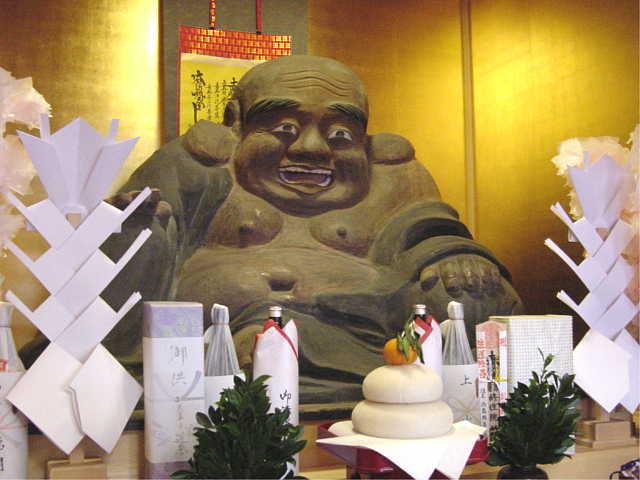
Walk down on Fujimizaka and turn right. Then we arrived at Shusei-in Temple, which has an impressive statue (picture) of Hotei, yet another lucky god.

Walk further to the north, and we arrived at Seiunji Temple, which enshrines Ebisu, the only god originating in Japan among the seven. It's interesting that ancient Japanese people worshiped gods of different origins (three from China and the other three from India) as a group.

We got hungry by then. We walked back and had lunch at Jinenjo, famous for its 'yakuzen curry', or Japanese-style curry containing traditional Chinese medicines (Time Out Tokyo mentions this place to eat). Three of us ordered yakuzen beef curry. Indians may be offended to hear this, but the most popular curry in Japan is the one with beef. And it was marvelous! I felt happy just by eating this curry. Including a cup of coffee (which was also excellent) after lunch, the price of the beef curry was 1830 yen (9 UK pounds or 16 US dollars). For the same price, I could only get a mediocre lunch in London. Now I don't want to go back...

Becoming full, we walked to the west towards Sendagi underground station. We stopped by at an incense shop, where I bought incense sticks of Japanese cypress, green tea, and cherry blossom. I hope these will help me sleep well in London.

As Time Out Tokyo praises its "highly unusual temple building", we visited Daienji Temple on the way. A Japanese temple usually has only one place to worship in front of the building. But Daienji has two in a symmetric way. My parents hadn't noticed this strange temple before. Big up Time Out crew.

Arriving at Sendagi station, we were already tired of walking. I gave up visiting all the seven lucky gods. We conquered four out of seven. Not too bad, eh?

But I realised I needed to buy an amulet for Yumiko-san. So we walked a little bit more to visit Nezu Shrine, which is famous for azalea bushes blooming in April.

We walked more to the south, arrived at Nezu underground station, and went home by train.

Yanaka may not be very famous as a tourist destination in Tokyo, but it's worth strolling. You'll find many interesting little places here.

Incidentally, we had a beef shabushabu dinner at home, putting and swishing incredibly thinly-sliced beef into boiling soup in a nabe pot for a few seconds, dipping cooked beef into sesami sauce, and eating it. (See here for detail if you want to know more about shabushabu.) Fantastic. This is Japan. I no longer want to go back to London...

Saturday, January 01, 2005

Welcoming New Year's Day at Ageha Nightclub

I had the most fascinating nightclubbing experience and the most memorable experience of welcoming a new year.

Although I was staying in Japan now, I didn't follow the Japanese traditional way of seeing an old year out and a new one in, like visiting a temple or a shrine to do hatsumode (the first - and usually the only - worship in a year) at midnight or watching Kohaku Uta Gassen on TV (a long-lasting TV programme on the evening of New Year's Eve where popular singers, divided by sex - male singers form the "white" group and female divas the "red" group - compete with each other). I spent New Year's Eve night and New Year's Day morning at a super-nightclub called Ageha in Shinkiba, one of the bay areas of Tokyo.

There were as many as five dancefloors, each of them featured a different style of music: house, techno, hard house, hip hop, and reggae. Every single one was impressive. If I go into detail, I have a couple of complaints (for instance, why wasn't there a drum & bass floor?). But no single dancefloor made me lose interest in dancing because of, say, poor sound quality, or poorly skilled DJs. This is amazing: especially considering I don't usually appreciate house, techno, and hard house. Actually, the best one was techno. DJ Tasaka made the crowd keep on dancing for ever. I didn't like the idea that one nightclub features a wide variety of styles of music. But it actually worked in this place. It continuously refreshed my interest in dancing whenever I changed the dancefloor.

What's more, it wasn't only about music. This nightclub overturns the idea that nightclubs are dim, scruffy, cramped, and unstylish (in terms of decor in detail). It's quite spacious, high-ceiling, neat, bright (except dancefloors, of course), and stylish (speaker boxes have unusual shapes, for example).

Furthermore, there were quite a few extra entertainments: drug-queen-looking girls called Tokyo Kya-bunny performing naughty dancing on the bar counter tables while bartenders keep working as usual (I didn't like the dancing, but what I liked was it didn't interrupt the stream of passing time: usually when dancing starts in a nightclub, everything stops with all the attention of people forced to be paid to dancers, which I hate). Food stalls set up outside the building, selling jerk chicken, donar kebab, and Thai noodle as well as Japanese winter foods and drinks (so it was like an outdoor music festival in summer).

And last but not least, watching the first sunrise in 2005 while dancing to lounge music at the sides of an outdoor pool. (As the nightclub is located near Tokyo Bay, this was possible.) It's probably unique in Japan; the new year's first sunrise (called hatsuhinode in Japanese) is something special. Some people get up early and go out to see this every new year. This is seen as an happy event in Japan. But waiting for the sun to rise at an uninspiring place in a freezing winter morning while you're sleepy is not a pleasurable experience. However, with dancable music and cool environments, waiting time wasn't boring at all. In a way, this was a great combination of Japanese tradition (hatsuhinode) and Western influence (nightclubbing), which Japanese people have always been good at. The vibes were extremely happy for no reason. Plus, luckily, even if the most parts of the sky were overcast, clouds were cleared away just around the point in the horizon where the sun came up. When the sun finally showed up, everyone cheered. Beautiful.

That was the moment I felt I made the right decision to come back to Tokyo. It was the most enjoyable nightclubbing in my entire life. All the worry that I had has gone with year 2004. Very refreshing.

Big up all the Ageha crew who organised this ridiculously beautiful event. Also big shout goes to Kurosaki-san, Mizoguchi, Kimiko, and Reiko, who came with me. Without you guys, I probably wouldn't have enjoyed that much. Tokyo is a great place. It always energises my soul in an unexpected way.

Thursday, December 30, 2004

Marunouchi, Marui Men again, and Price Level in Tokyo

It was sunny today. This is what I miss a lot in London: winter sunshine. Sunbathing on the tatami mat floor in my house in the morning is a very comfortable experience. Nyanko, our family's cat, does this everyday in winter time. She's been a bit icy to me since I came home. My parents say that she is just shy. :-) But when I started sunbathing next to her, she walked away to another room in the sunshine through windows. Boo.

Day three in Tokyo featured Marunouchi (the area on the east of the Imperial Palace) to meet up with Ono-san, an econ PhD student at the University of Tokyo.

The Marunouchi area has recently been rejuvenated to become a trendy area, featuring, as usual for any redevelopment areas in Tokyo, two new shopping and restaurant complexes (Marubiru and Oazo), stylish cafes/restaurants and fashion boutiques on Marunouchi Naka Dori Street. But the area looked astonishingly inorganic, partly because it was the end of a year when office workers entirely disappeared. But, I don't know, something was missing for this area to be attractive.

Anyway, we had lunch at Brasserie Aux Amis, ordering today's two course lunch (1050 yen, or 5 UK pounds / 9 US dollars): pumpkin soup and sea bass with risotto. Having this kind of lunch in London at this price is impossible. You have to pay double the price or you have to end up eating sandwitches by paying the same amount of money. The taste? Not as bad as lunch in London at all.

Then we went to Oazo, which was pretty much uninspiring except for the entrance hall. So we took away a cup of coffee (350 yen or 1.75 pounds / 3 US dollars) and sat down at a table in the hall.

We talked about each other's pieces of research, the English language, etc. He told me that it is difficult for him to get an PhD because his research is different from what professors at his university are interested in. So his strategy is to publish his paper in an academic journal first. He needs acceptance of his research by academics outside the university.

Ono-san is a very smart guy. I hope he will get out of rather unfriendly research environment for him as soon as possible.

After saying goodbye to him, I headed for Marui Men Shinjuku, one of many Shinjuku branches of Marui department store chain. As I wrote on 4th April 2003 and 3rd January 2004, this is the place I always go to in order to get cool men's gears. The idea that the whole eight-storey building serves for fashion-conscious young men is unbelievable, something you can never imagine in London.

On the way to the store, I felt thirsty. If it had been in London, the only option would have been to get into a supermarket to buy soft drink or to take away a cup of coffee at a coffee shop. But I was in Tokyo now. What I could do was to buy a canned soft drink, priced at 120 yen (60p or 1.1 US dollar) at a vending machine! I got Kirin Beverage's Gogo No Kocha, meaning afternoon tea. With 60p, you never get a cup of tea in London.

In Marui Men Shinjuku, I got a pair of trousers (15800 yen or 80 UK pounds / 140 US dollars) and a red mohair sweater (at 14700 yen or 73.5 UK pounds / 130 US dollars) at Rupert and a long black trench coat (36750 yen or 183.5 UK pounds / 330 US dollars) and a black round-neck sweater (12390 yen or 62 UK pounds / 110 US dollars) at Tornade Mart. You never get cool men's gears at these prices in London. Also, I love Tornade Mart; no other shops sell long coats because they are out of fashion right now. But Tornade Mart always doesn't care about trends. They always sell what they think is really cool. I always appreciate it.

The Marui Men Shinjuku building is packed with many casual fashion brands targeted at young men like Rupert and Tornade Mart. There's no such middle-ranged fashion house for men in London. I told a shop assistant at Tornade Mart that they should come to London. Londoners will love them.

Another impressive thing was the kindness and friendliness of shop assistants. When I bought the clothes at Rupert shop, it was already after eight in the evening, which is a closing time. They never rushed me. What's more, the assistant who served me took me to the exit of the building to see me off. You never expect this at garment shops targeted at young men in London. When I told this to him, he said, "My service isn't that good." Can you believe this?

----------------------------------------------------------
Did you notice that I obsessively wrote down prices of a variety of things yesterday and today? This has a reason. Tokyo is believed to be the most expensive city in the world, even more expensive than London. When it comes to rent, it may be true. But when it comes to eating out and shopping, this is certainly not true at all. Nobody living outside Japan understands this. So I'm trying to give you an idea of how much it actually costs by living in Tokyo.

Well, maybe public transportation in Tokyo costs more than in London. Today's train ticket fees were (1 UK pound = 200 yen; 1 US dollar = 110 yen): Koiwa to Tokyo (17 min by overground) for 210 yen; Tokyo to Shinjuku (18 min by underground) for 190 yen; Shinjuku to Koiwa (33 min by overground) for 290 yen. What's inconvenient in Tokyo's public transportation is that there are several different railway companies in operation and whenever you change to a different railway company, you have to buy another ticket. And these different railway companies issue different one day pass tickets. So buying a one-day pass doesn't pay; travelling around different parts of Tokyo costs you a lot. Plus bus services are not as good as London's, including the fact that there is no night bus service.

Wednesday, December 29, 2004

Tsukiji Fish Market, Matcha Sweet, and Japan's workplace

It was a rainy and cold and windy day today. From the late morning, it started snowing. Why do I need to see wet weather even after running away from London?

Morishita-san took me to Daiwa Zushi (its review at economist.com), Japan's no.1 (according to Zagat Survey a few years ago) sushi restaurant at Tsukiji Fish Market. When we arrived at the place around seven in the morning, more than 20 people were already queuing. After waiting about two hours in a miserable weather like in London, we finally got in. We ordered omakase course (eat whatever the chef serves). How much do you think the course costs? Just 3,150 yen (16 pounds or 29 US dollars)!

In front of Daiwa Zushi with Morishita-san and other people queuing

The first pair of sushi was chu-toro (mildy fatty tuna) and squid. Squid was brilliant. I usually don't like squid sashimi, but this one was delicately soft. The second pair was tuna and shrimp. Brilliant again. Meantime, a waitress served us miso soup with white fish. It's fantastic, too. The third batch was a char-grilled shrimp head (without rice, so it's not sushi, technically). This was a revelation. The fourth batch was gunkan maki (fighting-ship-shaped sushi roll) of sea urchin accompanied with fried egg. This was the ultimate extravagance: even nori seaweed was perfect. The fifth pair of sushi was sea eel and kanburi, which is the name for yellowtail in the winter: they become fatty in order to preserve warmth inside the body. This was again fantastic. The final batch was three sushi rolls (tuna, fatty tuna, and salmon roe). As sea urchin was so impressive, we ordered extra ones (700 yen per piece).

I was extremely happy while I was eating. This is something you never enjoy when you live in London. Happiness never comes from eating.

After strolling around Tsukiji market and taking away for lunch Yoshinoya's gyudon, a rice bowl topped with soy-sauce-marinated sliced beef, which is currently available only at Yoshinoya's Tsukiji branch due to the ban on importing beef from the United States, where mad cow disease broke out a year ago, we headed for Shiodome, the latest redevelopment area of Tokyo. This area was not that impressive except for Caretta Shiodome, one of many shopping and restaurant complexes in this area. On the 46th floor were a couple of cool bars including so/ra/si/o/ (its review by Metropolis Tokyo magazine) and Hibiki. It's a pity that it was in the morning when we arrived there.

The purpose we came here was to try matcha (strong green tea) sweets at Saryo Tsujiri on lower ground floor two. Morishita-san tried its original store in Kyoto a few weeks ago and wanted to have matcha parfait again. It cost 1,365 yen (6.5 UK pounds or 12 US dollars), quite expensive for sweets in Japan. But it was worth trying. The whole mixture of a variety of sweets was excellent: in a tall glass, it's got (from the top) matcha whipped cream, matcha ice cream, matcha kasutera (a kind of cake originating in the Iberia Peninsula), sweet chestnuts, honey-dipped satsuma, shiratama (sweet dumplings made from sticky rice), anko (red bean jam), plain ice cream, and matcha jelly. All come in a compact size. (See its photo.) Coldness of ice cream and warmth of kasutera cake, deep sweetness of matcha whipped cream and mild sweetness of shiratama dumplings, a variety of textures ranging from satsuma orange to chestnuts to anko jam, this subtlety is what's good about Japanese sweets, something you never get in Anglo-Saxon countries. Amazing. I was enormously impressed. No doubt there was a queue of ten people when the shop openned at 11 in the morning.

I'm very much greatful to Morishita-san for taking me to these two excellent eating experiences. Let's meet up again next time in Seoul! (He's moving to South Korea in a few week's time.)

In the evening, I met up with Takeshi at Fonda De La Madrugada, a Mexican restaurant in Harajuku. Whenever we meet up, we go to a Mexican restaurant ever since I introduced him to Mexican cuisine and tequila.

Once entering this restaurant, I lost a sense of where I was. The dining space was on lower ground two, looking like the inside of a cave. The waitress who served us was (probably) Mexican. There was also a mariachi (guitar, accordion, and percussion). Before I knew it, I had spoken in English when I asked something to the Mexican waitress. :-)

Takeshi is a fledgling lawyer. His life was incredibly busy: everyday he comes home at 5 or 6 in the morning and goes to the workplace by midday. He has a girlfriend, but he has almost no time to meet her, only calling her for an hour in the early morning. He told me how outrageous his boss was. One example: they went to a karaoke bar with other colleagues including female personal assistants. It was already in the early hours, but his boss wanted to move to an another bar. He asked Takeshi to ask the PAs to come with them (Takeshi has no choice but coming with his boss). Takeshi asked the PAs, "Would you like to come with us?" His boss got angry. "What are you talking about? You must say, 'You are coming with us, aren't you?' I'm deeply disappointed at you."

His boss is rather exceptional. But this kind of experience with your collegues in the workplace is not that uncommon in Japan. A couple of my Japanese friends quit thier jobs because of this sort of outrageous working environments.

Still, Takeshi said he had been learning a lot from his boss and other senior colleagues. He'll be working with them in coming years. I'm quite sympathetic with his idea. The most important thing in life is the pursuit of your career, even if your private life suffers. Maybe Westerners (especially, Continental Europeans) don't understand this, but my Japanese friends (and myself) tend to be like this. It's not that all Japanese are like this. We always complain that very few people understand us. That's how we are linked up. That's an essential part of our outlook on life.

Tuesday, December 28, 2004

Back in Tokyo for the third time since moving to London

I felt dizzy when I arrived at the fastidiously clean Tokyo Narita Airport. In comparison, London Heathrow looks dim and scruffy.

As a pastime on the Virgin Atlantic plane, I bought Time Out City Guide Tokyo. Reading this guidebook is a revealing experience. It gives a different angle to what's so familiar to me. (I was born and bred in Tokyo until the age of 24.)

From the airport, I took a coach that directly took me to my hometown Koiwa. Last time I came back a year ago, there wasn't such a coach service. My hometown is quite out of the way in Tokyo. It is a town where people don't seem to be interested in going abroad. (Actually, my dad has been abroad only twice in his entire life, and my mum only once.) Fair enough, I was the only passenger on the coach. The ticket cost 1,500 yen (7.5 quid or 14 bucks). But I bet the charge for driving on motorways is more than that (Japanese motorways all charge you a lot of money). I asked the driver if there is any demand for this coach service. He said, "If it's the holiday season, the demand is high." Notoriously, Japanese people take very few holidays in a year. Although it was very convenient for me (it just took one hour to Koiwa railway station), I suspect this service will be discontinued by the time I come back home next time.

Through the coach windows, I saw an awful lot of high-rise residential buildings that look all the same (but by far tidier than the ones in London's East End) and a dozen of 'love hotels'. After the coach took off from the motorway, I noticed quite a few small manufacturing factories and, for some reason, fishing tool shops.

It's so different from where I live in London. But when the coach went across the bridge over Edogawa River, I felt nostalgic.

I got off the coach and took a walk to my house. Only a year made my hometown a facelift. A third of shops on high street have changed. A couple of new residential high-rise buildings are under construction.

As expected, when I arrived at my house, I felt I became taller: Japanese furniture is made for short people.

I talked to my parents. I have a bit of trouble talking to them on the international phone call. But coming face to face with them, conversations naturally flew. Our family is not good at talking on the phone.

I'm so confused. This is my hometown. So it should be so familiar to me. But at the same time, a tremendous degree of difference between London and Tokyo caused me a counter culture shock. I don't know where I am now.

Friday, January 23, 2004

Two weeks after coming back from Tokyo

During the last two weeks back in London, I felt like I wasn't in London. I didn't feel like studying. I was always depressed by how difficult it is for me to manage to speak English in a satisfactory way. When I attended a seminar, I couldn't concentrate myself, something that had never happened to me before.

Sunday, January 11, 2004

I Miss Tokyo.

Come back to London. I was missing London during the first few days of my stay in Tokyo, but now I am missing Tokyo. I really enjoyed the party last Friday, but I can't throw a party in the same way in London. This fact made me even feel I didn't want to go back to London... I usually don't feel this kind of backward emotions (Is "backward" the right word for this? I don't know how to put this in English). I always look forward, though I sometimes stop moving forward. But never going backwards. So this upset me. Why do I feel like this?

Friday, January 09, 2004

London-style Party in Tokyo

I visit University of Tokyo again, meeting Aoki-kun, Takahashi-san, Kato-san, Kanaya-kun, Kawamoto-kun, and Waki-kun.

For lunch, I take away Yoshinoya's gyu-don (a bowl of rice topped with beef). Just paying for 280 yen (1.4 pounds), you can get your lunch. Unthinkable in London. Another moment I'm impressed about Japan.

In the evening, I throw a London-style party at Bobby's Cafe in Shibuya, inviting my best friends in Tokyo: Mihara-kun, Misao-san, Yoo-chan, Jun-chan, Torolin, Ono-san, Reiko, Tomoko, and Mark. Why is this London-style? Because each of my friends doesn't know each other. It's not uncommon in London to invite your friends from different backgrounds. But that's not true in Japan. We usually go to restaurants or bars with our friends from the same background so all of us know each other in the first place.

So I'm a bit anxious about it. Does a friend of mine enjoy talking to another friend of mine who he or she didn't meet before? But it turns out that everybody seems to enjoy the party more than I expected! Of course I enjoy the party, too, surrounded by my best friends. It's really a good evening.

When the party is over, my last train has already gone. In Tokyo, there's no night bus. So I visit and stay at Mihara-kun's place overnight. Actually, it's good to have a chance to talk to him a lot.

Thursday, January 08, 2004

Consumer Electronics Shopping in Tokyo

I go to Yodobashi Camera, a consumer electronics chain, at Shinjuku. First, I have my minidisk player fixed. Then I buy Seiko Instruments Inc's IC Dictionary SR-M6000 at around 30,000 yens (about 150 pounds). IC dictionaries (mobile electronic dictionaries) seem very popular now in Japan. What's good about this product is that it contains Collins Cobuild English Dictionary for Advanced Learners, my favorite English-English dictionary. Cool!

When I walk around the store, I find the same wireless ADSL modem router as the one we got in London (see 5th November). I check the price. 15,000 yen. About 75 pounds. Less than half as much as we paid for it in London. Oh, my God.

This is what's good about living in Japan. Electronics products are of high quality and available at reasonable prices.

Wednesday, January 07, 2004

Menswear Shopping in Tokyo

I visit Reiko working at a boutique called Agosto Shop in Laforet Harajuku, Tokyo's counterpart of Topshop. The last time I saw Reiko was last July, when she left London (see 4th July). Since then, we exchanged some e-mail messages, getting along with each other.

Her shop is mainly for ladieswear. Unless she works there, I'll never visit this shop. It's really different from menswear boutiques. The fitting room is really huge, like a hotel lounge. Reiko shows me some clothes that men can also wear. They are really different from what's available in menswear stores. Actually I get one pair of trousers, though it's not for winter. Thanks to Reiko, I can peep at a different world.

Then I head for Shibuya, where three other Marui department stores are located. I finally get two nice winter trousers of Morgan Homme and Michel Klein Homme. I also buy a green and black mohair scarf of 58 Goya By Jun Men. Shopping menswear in Tokyho is fun!

Tuesday, January 06, 2004

University of Tokyo

I visit the Department of Economics at University of Tokyo, where I got my master's degree. I meet Shoji-kun and Uochi-san, both of them are writing their master theses due this Friday. Then I attend the Microeconomics Seminar, where Hanaki-san presents his joint research on experimental economics. After the seminar, I talk to my ex-supervisor Yanagawa-sensei for one minute. He says, "When you write a paper, send me a copy." I hope this will happen soon...

Monday, January 05, 2004

Women's pro-wrestling again

I still have a cold. But I'm tired of sleeping. So I'm watching Japanese women's pro-wrestling on satellite tv all day. (See 29 March and 6 April last year for my passion for it.) Last year I always checked what was happening in the world of Japanese women's pro-wrestling via the internet. But I didn't watch the actual battles. So it's fun to connect the real images to what I knew. Among the bouts I watch, the best single match is Hotta Yumiko vs Akino (at Kawasaki Taiikukan on 25th July 2003), and the best tag match is Tamura Yoshiko, Ohmukai Michiko, Hyuga Azumi, and Nakanishi Momoe vs Inoue Kyoko, Inoue Takako, Mita Etsuko, and Ito Kaoru (at Korakuen Hall on 3rd November 2003).