Wednesday, December 17, 2008

Central Chengdu (Part II): Zhaixiangzi Alley


Next, taking taxi again, I'm taken to an alley called Zhaixiangzi (窄巷子). This is an up-and-coming district of Chengdu, where old, single-story houses with a courtyard inside were (and are being) restored to become trendy restaurants and bars. I'm rather surprised that Chengdu, a local city of China, has already reached such a stage of modernization: mixing tradition with the latest trend to create something new, which Westernized Japan just managed to achieve only less than a decade ago. Sometimes the aesthetic of people involved in this restoration project is in doubt, as exemplified by Starbucks on this alley, but the whole atmosphere is what I haven't experienced anywhere else in this world. It's an intriguing area of Chengdu.

Central Chengdu (Part III): Chunxi Road

The final destination of my half-day trip around central Chengdu is Chunxi Road (春照路), the city's main shopping street. It is the kind of ugly, tacky street every city in developed countries has, like Oxford Street in London and Drottningsgatan in Stockholm. Every travel guide for Chengdu seems to feature this street, but it's not really worth visiting. If I had visited the street in the evening, I might have had a different impression, though.

0102030405

01: Probably the only old building in this area
02: China Keep Walking
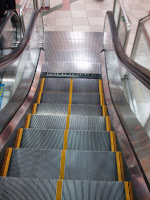
03: An escalator (inside the Ito Yokado department store) with a yellow line in the middle separating the walking lane on the left and the standing lane on the right
04: An electric cooking gadget for Chinese people which saves the time for preparing broth from chicken bones etc. I've never seen something like this in Japan.
05: Ito Yokado, a Japanese department store chain

Hotel Review: Mt Emei International Hotel

I stayed at Room 716 in Mt Emei International Hotel from 13 to 17 December, 2008.

The Good:
The internet access in bedrooms (with a LAN cable provided) for free of charge.

A kettle, rather than a coffee maker, in the bedroom (but only with Chinese tea bags; I forget bringing my favorite Twining English Breakfast teabags...)

All the written messages in the hotel are both in Chinese and in English (although the staff rarely speak English).

Near the hotel is an area with lots of small restaurants, bars, toy stores, and foot massage parlours, many of which are open until very late where you feel what must be the old Chinese town life before all the modernization took over.

Opposite the hotel across the large street is a big, Sichuan hot pot restaurant called 呉銘火鍋, where you can enjoy the local cuisine.

The Bad:
The bedroom faces a large, busy street. Even on the seventh floor, I hear the street noise.

On some floor below, loud music plays until 4 am, making the bedroom on the 7th floor noisy.

The restaurant serves breakfast of mediocre quality without few Western options, offering warm orange and lemon juice for some reason.

Even though the hotel has about 15 floors, there are only two lifts. It always takes a while to go down to, or up from, the ground floor.

Toothbrushes and toothpaste are provided, which is good, but the brush is not new, and the toothpaste tastes like bad medicine.

The toilet is easily blocked by flushing too much paper.

The glass door of a shower cubicle cannot be shut completely, allowing shower water to spill over to the bathroom floor.

The shower head is fixed to the wall.

Even though I put the sign "Don't disturb" all day, the front desk calls my room to ask me if I need cleaning. After telling them, "I'm fine," a room cleaner knocks on the door. Seems like the front desk didn't understand my English.

The Ugly:
Receptionists are horrible.

When I first arrived at the hotel, there were a few people standing in front of the front desk, talking to the receptionists. So I was waiting for them to finish. There were 3 receptionists, looking in their 20s, and 2 of them deal with these customers together, with another one doing something else. None of these 3 receptionists tried to make an eye contact with me. After 20 minutes, they seemed to finish dealing with the customers, but they never made an eye contact with me. Some other guests came to the reception without looking at me, talking to the receptionists. And they got served. Seems like there is no such a concept as queuing in this city. So I talked to one of the receptionists. It turned out she cannot speak English. Nor can the other receptionists. Maybe that's why they won't try to notice my presence. By handing out my passport, without speaking English, they figured out what I was asking for. But while she was dealing with me, a group of hotel guests came, asking her to return their luggage. And she did. There's no such a concept of queuing in this city.

When I was about to take a shower (so I was naked) in my bedroom after checking-in, a phone rang. It was from the front desk. A guy who did speak English told me I needed to pay a deposit of 200 yuan. I put on my clothes back, went down to the front desk, and gave my credit card. It didn't work. I paid a deposit in cash.

When a Chinese friend of mine asked where to have a drink near the hotel, the receptionist who dealt with my checking-in recommended the bar in the hotel. When my friend said we preferred a place outside, she just said, "Just go over there across the street."

At 11 pm on the day of arrival and in the last evening, the phone in the bedroom rings. It's an offer of massage. Very annoying if you go to bed early.

Verdict:
Unless you need to provide accommodation to international guests for a conference held in South Western University of Finance and Economics (which is located a 15-minute walk away from the hotel), you may want to avoid using this hotel. If you speak Chinese, the service may be much better, though.

Tuesday, December 16, 2008

Sichuan hot pot


Have dinner at 呉銘火鍋, a popular restaurant chain for Sichuan hot pot, with my former Japanese supervisor, his Chinese student, this student's female friend from Sichuan, and her former middle school classmate.

Broth in a pot (as shown in the above) is heated to boil, and a variety of meats, seafoods, and vegetables are poured into it. For some foods like thinly sliced beef, you pick up a piece with your chopsticks and dip and hold it into the broth until baked (about a minute). Cooked foods are then dipped in dipping sauce mixed with sesame oil, coriander, etc. before you put them into your mouth. It's very hot (the broth includes not only chili but also Sichuan pepper, which adds a distinct, tongue-paralyzing flavor to chili's hotness). But I cannot stop eating because it's very delicious. I'm also impressed by the variety of foods that Chinese people eat with this hotpot.

I end up eating a lot. For the following two days, my stomach feels uneasy. :)


Restaurants in China typically offer the cover sheet for a coat or a jacket that customers hang over the back of a chair.

Monday, December 15, 2008

Dinner at Shun Xing Ancient Tea House

The conference dinner is held at Shun Xing Ancient Tea House (順興老茶館), a restaurant located on the third floor of the Chengdu International Exhibition and Convention Center. The Sichuan dinner is excellent. (Some dishes are too hot to eat, though.) When everyone is about to finish eating, the dinner show begins. Dance by good-looking girls in traditional costume, shadow play, three masked men fire-spitting and face-changing (click here for a YouTube video), comedy by a woman and a guy who puts a lit candle on top of the head, singing by an old guy with rudimentary instruments. Honestly speaking, it is shabby. I'm a bit offended as the show interrupted my conversation with other diners.

By searching through Japanese websites, I learn that this restaurant is one of the three major places in Chengdu where tourists can enjoy chuanju or Sichuan opera. And the consensus among Japanese tourists is that the quality of the opera at this restaurant is the worst among the three. No wonder.

But the quality of food is still excellent.

Suburban Chengdu

Photos that I took in the area to the north of South Western University of Finance and Economics (north-west Chengdu). Notice that many photos are foggy, and no one seems to know whether Chengdu is foggy all day because of natural fog or smog. (Chengdu is traditionally famous for foggy weather.)
010203
0405

01: A convenience store chain ubiquitous in Chengdu, where I keep buying Gogo no Kocha Milk Tea (produced by a Japanese beverage company Kirin), my favorite bottled milk tea back in my high school days.
02: The gate of a residential complex. There are quite a few residential complexes like this one in Chengdu where high-rise buildings surround a square that functions as a parking lot and as a playground for kids.
03: A typical apartment building in Chengdu with green-white stripe roofs (no balcony though).
04: A bank branch. All the bank branches in China seem to have a long electric signboard which advertises financial items in scrolling messages.
05: A pedestrian crossing that leads to a signboard. Pedestrians need to walk outside the crossing to reach the sidewalk.

06070809

06: A covered food market surrounded by high-rise residential buildings.
07: High-rise residential buildings in Chengdu usually come with shops on the ground floor.
08: A trendy hair salon sandwiched by uninspiring shops.
09: A square with several restaurants.

101112
10: A chaotic traffic crossing
11: Residential buildings with a rather well-maintained bus.
12: The gate of a middle school

13141516

13: The sun in the thickly foggy (or smoggy) sky in the afternoon
14: South Western University of Finance and Economics
15: Pedestrians waiting for the green light. Motorcyclists and bikers completely ignore traffic signals in China. Pedestrians therefore wait between car lanes and bike lanes.
16: Toy stores open late in the evening.

Sunday, December 14, 2008

lunch in Chengdu

(This blog entry includes Chinese letters. If you see garbled letters, try to change your browser's letter encoding.)

I stayed in my hotel room for the whole day as I needed to prepare my presentation at the Hong Kong Economic Association conference tomorrow, except when I needed to have lunch.

A five-minute walk from the hotel takes me to a street called 石人西路, which seems to be an old high street in this part of Chengdu. Several small restaurants without any wall on the street, typical for developing countries, line up. I pick the one that looks the most hygienic, even though the one next door attracts the most customers. I say to myself, "Chinese people's taste may not be the same as mine."

Naturally, the waitress serving me does not speak English. She starts communicating in writing Chinese letters. She first writes down two letters, one meaning rice and the other meaning noodle. I pick rice. Then she recommends one particular rice dish on the menu. But I know what I want to eat: stir-fried rice, and I know the Chinese spelling of it (炒飯) because we Japanese use the same letters for this Chinese dish popular in Japan. I identify these letters in the menu, but there are several. I pick one. The waitress writes another Chinese letter which is not the one in Japanese. But I figure out it means hot or spicy (as a part of the letter looks similar to the letter meaning hot in Japanese kanji). The waitress seems to try to make sure that I don't mind a hot dish. I'm a bit scared, but give it a try.

A cup of barley tea and a small plate of chopped cabbage fried with sesami oil are immediately served. The cabbage is good, much, much better than the shredded raw cabbage soaked in vinegar that every pizzeria in Stockholm serves as a side dish. (Don't ask me why Swedes choose such salad as a side dish for pizza.)

Then the hot stir-fried rice with chopped pork and a variety of vegetables including chili comes. It's not very hot but very tasty, perhaps better than any lunch that I had in Stockholm in the last one year and three months. For the first time in a couple of months, lunch makes me happy. And all of this costs 7 yuan (0.7 euro).

I do not remember the name of this restaurant. Instead I take a picture of it:

Saturday, December 13, 2008

A trip to China

A trip to a foreign country always involves "surprise, surprise". Here's the list of surprises on the first day of my trip to China.

At immigration in the Beijing airport:
In front of the immigration officer's counter, there is a small gadget with which you can give a feedback to the service of the immigration officer who is checking your passport. You can press one of the four buttons to judge by a 4-scale measure. And this gadget is out of the immigration officer's sight, located on a small shelf on your side below the counter.

A dragon statue in front of the path to the security checks in Beijing Capital International Airport
Beijing Capital International Airport domestic departure lounge
No coffee shop around at all (Starbucks and some cafes are available before passing the security gate). The only place you can get a cup of coffee is KFC, which also serves an excellent egg tart. (In the international departure lounge, on the other hand, there are only coffee shops of mediocre quality with so-so sweets.)

Air China
Economy seats of an Air China plane flying from Beijing to Chengdu are very comfortable. Much better than a seat of SAS's plane from Stockholm to Beijing, which hurt my buttocks within an hour. The seat width is quite generous by making the corridor quite narrow.

Chengdu Airport
In the baggage claim area, three people are waiting for passengers, collecting their baggage tags to make sure no one takes a wrong suitcase.

Taxi from Chengdu Airport
Outside the airport, there is no obvious taxi stand. There was a queue of dusty taxi cars, which makes me wonder if it's safe to take these taxis. Then a young woman, dressed in tidy clothes, approached me, offering a taxi ride to my hotel. She doesn't speak English, but after I show her the name of my hotel in Chinese letters, she types 100 with her mobile phone keypad. More expensive than what I heard, which is 60 yuan. But I gave it a try. Then she took my luggage and walked towards the outside of the airport parking area for 5 minutes, by calling someone with her mobile repeatedly. Another woman who speaks a bit of English joins her, and they took me to the highway path outside the airport. Two minutes later, a car that doesn't look like a taxi comes with a male driver, and I was rushed into the front seat. Seems like they are running an illegal taxi service. So they cannot enter the airport. But the car is much luxurious than those taxis queuing just outside the airport building, and the seat was comfortable. And the driver passes many cars by changing the lane frequently on the highway. Maybe it was a good deal.

Saturday, December 06, 2008

Designer shaver


Brought to you by Hitachi. (The above photo is taken from Amazon.co.jp).

Wednesday, November 26, 2008

Why a Japanese DJ hugely popular in Europe doesn't want to live in Europe

Yoji Biomehanika, a Japanese DJ, is hugely popular in Europe, and therefore travel to Europe many, many times a year, taking more than 10 hours to fly from Japan each time. His friends wonder why he doesn't live in Europe. An European promoter even offered him a house in Europe.

But he still lives in Japan. Why? He says,

"No matter how many times I stay there, I still don't understand the way of life in Europe. Especially, I can't stand horrible foods. I want to say this out loud. There's no country like Japan where you can eat great foods. I won't be able to compose good music if I eat bad foods."


I agree with him.

Political Economy of Reform

There is a small theoretical literature on the political economy of reform. Here's an attempt to relate each paper to each other.

The seminal paper by Fernandez and Rodrik (1991) considers two kinds of reform. First, welfare-improving reform. Second, majority-benefiting reform. Both types of reform can be stalled due to individual-level uncertainty (whether or not each citizen benefits from reform is unknown to themselves).

Jain and Mukand (2003) show that welfare-improving reform can be implemented even with individual-level uncertainty if voters can vote on whether to compensate the losers from reform after reform is enacted. However, majority-benefiting reform still cannot.

Dewatripont and Roland (1995) instead analyze the case where citizens do not know whether each reform improves welfare.

All the above papers analyze the political feasibility of reforms in terms of conflicts of interest among citizens. Majumdar and Mukand (2004) instead look at it in the political agency framework (conflict of interest between government and citizens), showing why policy-makers often resist scrapping their failing policies and adopt high-risk policy experiments.

Saturday, November 15, 2008

Who must pay bribes and how much?

Development economists interested in bribery should read Svensson (2003) before designing their research. I've seen a couple of papers on corruption which completely ignore the contribution made by this piece of research.

He takes great care of designing the firm survey to solicit reliable information on bribe-paying behavior, which should be followed by anyone who wants to collect bribe data by surveys.

His empirical findings include:

(1) Firms are more likely to pay bribes if they are required to deal with the public sector officials (using public infrastructure, engaging in international trade, and paying taxes). In other words, formal sector firms are more likely to pay bribes than informal sector ones. A theoretical reason is that such firms lose a lot by refusing to pay bribes.
(2) More profitable firms are as likely to pay bribes as less profitable firms. But more profitable firms pay a larger amount of bribes than less profitable ones, conditional on bribe payments. This is an interesting fact. Barely profitable firms still need to pay bribes, if a very small amount, so that they can keep operating.
Any theory on bribery contradicting to these findings is hard to appreciate (unless counter-evidence is provided). If your empirical finding is different from these findings, you need to explain why.

Wednesday, November 12, 2008

Hotel Review: Hotel Commonwealth in Boston

www.hotelcommonwealth.com

I stayed in room 515 (with a king-sized bed) for 3 nights from 7 November 2008.

The Good:
1. Location. Just within a minute from Kenmore subway station on the Green Line.
2. Friendly staff.
3. Pleasant antique furniture. The pale turquoise color is pretty.
4. Very comfy bed. I got very good sleep.
5. Tasty room service breakfast.
6. Very tasty puddings in the lobby for breakfast.
7. Wireless internet in bed rooms for free of charge

The Bad:
1. Elevators. You need to insert the room key card before pushing the floor button. (Except when you go down to the lobby floor.) Otherwise, the elevator won't take you to the floor of your room. And you need to insert the card several times until it works.
2. Sockets (for electricity and for internet) on the desk. It's hidden behind a wooden panel that looks like a drawer. As the distance between the sockets and the wooden panel is very short, the panel cannot be closed if you use a socket converter.
3. No coffee maker, let alone a kettle. Unless you use room service or take away from a coffee shop nearby, therefore, you can't drink coffee or tea in your room.
4. Although wireless internet is available, the room directory instructs you to use an ethernet cable hidden inside the desk drawer for access to the internet. And this cable doesn't work.

The Ugly
1. Shower. The shower head is fixed on the wall. The ugliest thing is its water pressure, which goes up with water temperature. When the warmth of water becomes just right, water pressure is so strong that my skin hurts. I couldn't rinse my body.

Verdict:
If you don't take shower, this hotel is recommended.

Monday, November 03, 2008

Nigeria (continued)

A while ago, I featured some articles on Nigeria that show the country's potential both in a good way and in an ugly way. Here's another installment (for the ugly way).

Sunday, November 02, 2008

From The Economist this week

"A biased market" - Media bias results not from its owner's political slant but from the demand of news consumers, according to studies by economists.

"Another country" - A dictator stepped down after his electoral defeat in the Maldives.

"Keep'em guessing" - Prime minister of Japan won't call a snap election because he might barely win it.

"Cross straits" - Taiwanese hate mainland China.

"Spine" by Suilen (2007)

One of my recent favorite music pieces.

Ill Flava

For the first time since I moved to Stockholm, I go to a nightclub featuring drum & bass. Since last September, Bysis (Hornsgatan 82, 5 min walk from Mariatorget tube station) has been hosting the drum & bass party Ill Flava every Saturday. I finally manage to have an opportunity to check it out.

Arriving at the venue shortly after 11 pm, there are only 3 English-looking guys sitting at a table at the back. The music is not drum & bass but lounge-ish breakbeat. A couple arrive just before 11:30 after which the entrance fee of 60 krona is imposed. The 3 guys leave the venue. The DJ starts spinning drum & bass beats. Several more punters (half male half female) come to the venue, sit at the table, and leave without dancing ever by midnight. The couple starts dancing. By the time I leave the venue around 1 am, no one else comes to the venue.

Horrible. Is it because tonight is too cold (below zero degree)? Is it because everyone is tired of celebrating Halloween last night? (Young Swedes do celebrate Halloween, perhaps as a pretext for drinking.)

Compared to London nightclubs, the quality of sound systems is not excellent, probably not ideal for bass-intensive drum & bass music. But it's reasonably decent for this size of a nightclub. The illumination system is quite good. The DJ is actually good at mixing different tunes in a smooth way. The venue interior is cozy.

I guess what's lacking in this party is advertisement. The venue is not located in a happening area during the night. Unless you aim for this particular party, people won't show up. Perhaps it needs an additional attraction. Fabric, London's nightclub that has been supporting drum & bass after its demise in the late 1990s, attracts punters by its maze-like structure and an incredibly good sound system. It certainly contributes to the survival of drum & bass by exposing to drum & bass those people who otherwise would not even know what it is.

Anyway, during the past one year or so, I have been appallingly demotivated about work and life. A nightclub atmosphere with my favorite drum & bass music playing makes me feel down to earth, probably for the first time ever since I came to Stockholm, and allows me to think hard about what motivated me in the past and what makes my life happy.

And I find it tonight.

Saturday, November 01, 2008

How to buy foreign currency in cash if you live in Sweden

Buy foreign currency in cash at Forex in Sweden: No fees but a 4 percent commission against the interbank exchange rate.

Withdraw cash at an ATM in a foreign country with your Swedish bank card: a fee of 35 krona plus a 2.5 percent commission against the interbank exchange rate.

KREJCI's bags

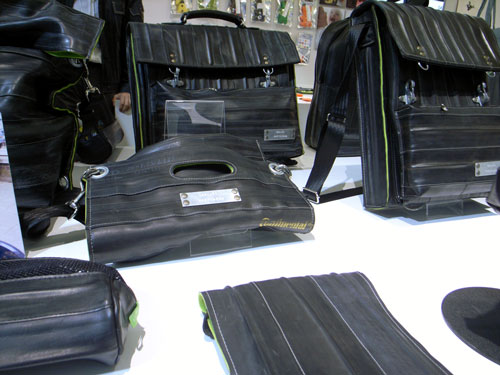
(This photo is taken from Excite Ism Concierge "Tokyo Designers Week 2008 Report" 31 October 2008)

Bags made of recycled bicycle tires produced by Krejci from the Netherland.

Recycling is one major trend among designers these days, but design usually suffers. Krejci manages to achieve both good design and environmental friendliness. What impresses me is that good design of these bags is achieved by the recycled material itself, rather than by coating them with something else that's good-looking.