Saturday, November 22, 2008

Saturday, November 15, 2008
Who must pay bribes and how much?
Development economists interested in bribery should read Svensson (2003) before designing their research. I've seen a couple of papers on corruption which completely ignore the contribution made by this piece of research.
He takes great care of designing the firm survey to solicit reliable information on bribe-paying behavior, which should be followed by anyone who wants to collect bribe data by surveys.
His empirical findings include:
(1) Firms are more likely to pay bribes if they are required to deal with the public sector officials (using public infrastructure, engaging in international trade, and paying taxes). In other words, formal sector firms are more likely to pay bribes than informal sector ones. A theoretical reason is that such firms lose a lot by refusing to pay bribes.
(2) More profitable firms are as likely to pay bribes as less profitable firms. But more profitable firms pay a larger amount of bribes than less profitable ones, conditional on bribe payments. This is an interesting fact. Barely profitable firms still need to pay bribes, if a very small amount, so that they can keep operating.Any theory on bribery contradicting to these findings is hard to appreciate (unless counter-evidence is provided). If your empirical finding is different from these findings, you need to explain why.
Wednesday, November 12, 2008
Hotel Review: Hotel Commonwealth in Boston
www.hotelcommonwealth.com
I stayed in room 515 (with a king-sized bed) for 3 nights from 7 November 2008.
The Good:
1. Location. Just within a minute from Kenmore subway station on the Green Line.
2. Friendly staff.
3. Pleasant antique furniture. The pale turquoise color is pretty.
4. Very comfy bed. I got very good sleep.
5. Tasty room service breakfast.
6. Very tasty puddings in the lobby for breakfast.
7. Wireless internet in bed rooms for free of charge
The Bad:
1. Elevators. You need to insert the room key card before pushing the floor button. (Except when you go down to the lobby floor.) Otherwise, the elevator won't take you to the floor of your room. And you need to insert the card several times until it works.
2. Sockets (for electricity and for internet) on the desk. It's hidden behind a wooden panel that looks like a drawer. As the distance between the sockets and the wooden panel is very short, the panel cannot be closed if you use a socket converter.
3. No coffee maker, let alone a kettle. Unless you use room service or take away from a coffee shop nearby, therefore, you can't drink coffee or tea in your room.
4. Although wireless internet is available, the room directory instructs you to use an ethernet cable hidden inside the desk drawer for access to the internet. And this cable doesn't work.
The Ugly
1. Shower. The shower head is fixed on the wall. The ugliest thing is its water pressure, which goes up with water temperature. When the warmth of water becomes just right, water pressure is so strong that my skin hurts. I couldn't rinse my body.
Verdict:
If you don't take shower, this hotel is recommended.
Monday, November 03, 2008
Nigeria (continued)
A while ago, I featured some articles on Nigeria that show the country's potential both in a good way and in an ugly way. Here's another installment (for the ugly way).
Sunday, November 02, 2008
From The Economist this week
"A biased market" - Media bias results not from its owner's political slant but from the demand of news consumers, according to studies by economists.
"Another country" - A dictator stepped down after his electoral defeat in the Maldives.
"Keep'em guessing" - Prime minister of Japan won't call a snap election because he might barely win it.
"Cross straits" - Taiwanese hate mainland China.
Ill Flava
For the first time since I moved to Stockholm, I go to a nightclub featuring drum & bass. Since last September, Bysis (Hornsgatan 82, 5 min walk from Mariatorget tube station) has been hosting the drum & bass party Ill Flava every Saturday. I finally manage to have an opportunity to check it out.
Arriving at the venue shortly after 11 pm, there are only 3 English-looking guys sitting at a table at the back. The music is not drum & bass but lounge-ish breakbeat. A couple arrive just before 11:30 after which the entrance fee of 60 krona is imposed. The 3 guys leave the venue. The DJ starts spinning drum & bass beats. Several more punters (half male half female) come to the venue, sit at the table, and leave without dancing ever by midnight. The couple starts dancing. By the time I leave the venue around 1 am, no one else comes to the venue.
Horrible. Is it because tonight is too cold (below zero degree)? Is it because everyone is tired of celebrating Halloween last night? (Young Swedes do celebrate Halloween, perhaps as a pretext for drinking.)
Compared to London nightclubs, the quality of sound systems is not excellent, probably not ideal for bass-intensive drum & bass music. But it's reasonably decent for this size of a nightclub. The illumination system is quite good. The DJ is actually good at mixing different tunes in a smooth way. The venue interior is cozy.
I guess what's lacking in this party is advertisement. The venue is not located in a happening area during the night. Unless you aim for this particular party, people won't show up. Perhaps it needs an additional attraction. Fabric, London's nightclub that has been supporting drum & bass after its demise in the late 1990s, attracts punters by its maze-like structure and an incredibly good sound system. It certainly contributes to the survival of drum & bass by exposing to drum & bass those people who otherwise would not even know what it is.
Anyway, during the past one year or so, I have been appallingly demotivated about work and life. A nightclub atmosphere with my favorite drum & bass music playing makes me feel down to earth, probably for the first time ever since I came to Stockholm, and allows me to think hard about what motivated me in the past and what makes my life happy.
And I find it tonight.
Saturday, November 01, 2008
How to buy foreign currency in cash if you live in Sweden
Buy foreign currency in cash at Forex in Sweden: No fees but a 4 percent commission against the interbank exchange rate.
Withdraw cash at an ATM in a foreign country with your Swedish bank card: a fee of 35 krona plus a 2.5 percent commission against the interbank exchange rate.
KREJCI's bags
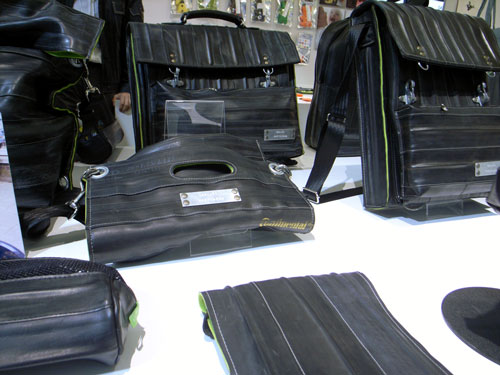
Bags made of recycled bicycle tires produced by Krejci from the Netherland.
Recycling is one major trend among designers these days, but design usually suffers. Krejci manages to achieve both good design and environmental friendliness. What impresses me is that good design of these bags is achieved by the recycled material itself, rather than by coating them with something else that's good-looking.
Friday, October 31, 2008
Venice Architecture Biennale 2008
Thursday, October 30, 2008
Impact of Successful Assassinations on Political Regime and Wars
My memory has been weakening recently. As an attempt to remedy this, I'll start writing down on this blog what I learn from reading papers, books, news media, etc.
Empirical findings from Jones and Olken (2008) "Hit or Miss? The Effect of Assassinations on Institutions and War":
When an assassination is attempted against the national leader...
1. If the dictator is killed, democratization is likely to follow.
2. It does not matter for subsequent political regime change if a leader in democracy is killed.
3. If the leader facing a small-scale war (less than 1000 battle-related death per year) is killed, the war is likely to be intensified.
4. It does not matter for the onset of a war whether the leader is killed.
5. If the leader facing a large-scale war (1000 deaths or more per year) is killed, the war is likely to be terminated.
Monday, October 27, 2008
A source of great research ideas in economics
I've decided to get this blog back in operation. But each post will be brief.
Reading Chris Blattman's blog for the first time in weeks reminds me of an important tip for applied economists. Hal Varian says, "Look for ideas in the world, not in the journals." Ray Fisman says, "I always tell graduate students that if they want innovative thesis ideas, to read the newspaper, not the economics literature. ... You usually don’t get exciting new research ideas while reading Econometrica."
I almost forgot this important tip. At least, when you think about building a model, the kind of assumptions you want to make should be what you have learned from world events, not from academic papers in economics.
And this reminder seems to have an immediate impact on my research today.
Friday, October 17, 2008
FT on rating agencies
A very good article from FT magazine on one of the causes of the current world financial crisis.
Sunday, September 21, 2008
Chase & Status
So the most creative music producers right now are Chase & Status coming out of my favorite drum & bass scene? Click below to see if it's true.
Take Me Away, the most selling drum & bass tune in the past one month
Eastern Jam, one of the biggest dubstep tunes this year
And here you can listen to their DJ set, including many of their own tracks, broadcast on BBC Radio 1 on 9 August 2008.
The End
I just learned that The End, my favorite nightclub in London and the nightclub I visited many, many times during my 5-year life there, will close its doors for good next January after 13 years in business. I'll try to catch one of its final nights.
Saturday, September 20, 2008
A boutique designed by Zaha Hadid
Yet another must-visit was opened in Tokyo: Neil Barrett's flagship store designed by Zaha Hadid.
Address: 3-17-6 Minami-Aoyama Minato-ku Tokyo
The photos on the right are obtained from Excite Ism Concierge (18 September, 2008).


Sunday, September 14, 2008
Michele McLaughlin "The Eternal City"
Video-wise, nothing particularly interesting. But this piece of simple piano music sounds good to me.
Saturday, September 13, 2008
Annika Larsson "Dolls" at Andrehn-Schiptjenko
(The image below is taken from Andrehn-Schiptjenko's website)
A video installation that lasts almost 50 minutes. You never understand what is going on in this video. There are five guys appearing in an artificially constructed white cube with a few lines and signs of red, blue, or black on the floor and the wall alongside a white cupboard on the wall and a small square platform on the floor with stairs on two sides. The video starts with a scene of a coffee maker making coffee with the sound of the coffee-maker replaced by some abstract music mocking the sound of coffee dripping. Once coffee is ready, a gray-haired guy in ski boots starts trying to bring a cup of coffee and a toast to another guy with glasses sitting on a chair just a couple of meters away. But he takes almost 20 minutes to do so, by dropping coffee cups on the floor and climbing up to the platform with help of a black, stout guy, etc. Another guy in a black suit who appears to be the principal along with the guy with glasses helps him by pouring coffee into a cup and putting a slice of bread into a toaster, which is hidden inside the cupboard. When the toast is done, the gray-haired guy, who appears to be the two principals' agent number one, smiles, by the way. He finally manages to pass the cup of coffee and the toast to the glasses-wearing principal, who simply put them on the side table without drinking or eating. Above the cup of coffee and the plate of the toast is the black, reversed-triangle mark on the wall. The next turn is the black, stout guy, or agent number 2, in boots with spikes beneath the sole. His task is to detach the cupboard from the wall and to destroy it with a hammer placed by the black suit principal under the wall sign of three parallel short blue lines. He also takes almost 20 minutes to do this task with help from other guys, because he drops the driller from his hand so one of the principal ends up detaching the cupboard, etc. Finally, a man with a black mask covering around his eyes, wearing a pair of skate shoes, challenges the task of passing a key to the black suit principal standing on the blue circle mark on the floor, just a couple of meters away from him. He also needs help from other guys. When he finally reaches where the black suit principal is standing, he stands with his back facing the principal. He inserts the key into the principal's pocket inside the suit jacket, by using his hands behind his back. When the task is complete, the video ends.
It doesn't make much sense, but it is much better than most movies and television programs. The video manages to stay at the borderline between absolute nonsense and something deep. And the video shooting technique is impressive. How each scene is framed by the video camera, and the sequence of scenes, is well-crafted. The shoes or the face expressions of the five guys are focused many times, making the viewer guess the emotion and character of these guys. The images of lines and signs in the white cube are inserted many times, making the viewer wonder the meaning of these geometric marks. Finally, the background sound construction is superb, too. The sound of dropping coffee cups or keys is erased, making the whole scene somewhat out of this world. The very abstract music actually expresses the anxiety of protagonists very well.
Certainly, this is not everybody's kind of video. But I love it because I love it without understanding it. That's the sufficient condition of good art.
For the detail on the artist and the work, visit the gallery's website.

Wednesday, August 20, 2008
My former job market paper submitted
I've finally done with the submission of my former job market paper to a journal, the most urgent task for any tenure-track assistant professor in economics during the first year of the job, on the 366th day since I moved to Stockholm. Phew.
Sunday, August 17, 2008
Wallpaper by Hanna Werning
These photos are obtained from www.byhanna.com.
The wallpaper design is good, and the idea to display it in the ruins amazingly suits these patterns. For more works by Hanna Werning, visit her website.


Subscribe to:
Posts (Atom)