
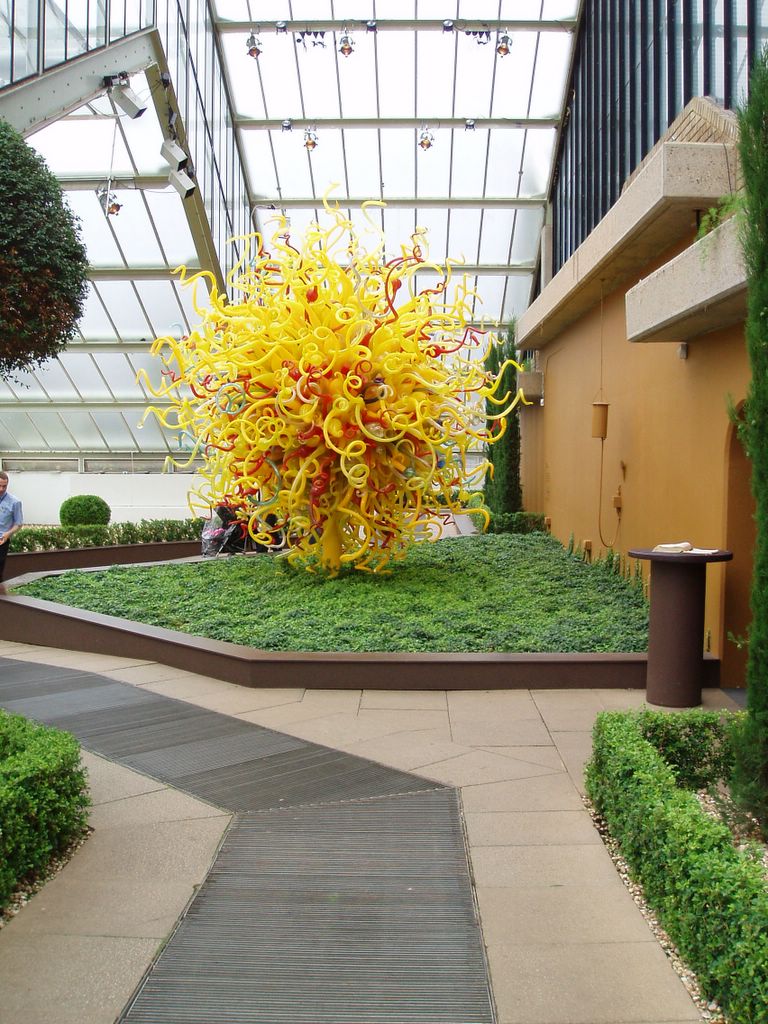
Basket Sets at The Princess of Wales Conservatory
Saturday, July 30, 2005


Sunday, July 24, 2005
Bedroom Curtain

This week was all about changing my bedroom curtain.
On Tuesday, I went to Ikea in Brent Park with Yumiko-san. (Hence the photo on 19th July). For those uninitiated, Ikea is a Swedish furniture store chain very popular in Europe. They sell pieces of furniture with minimalist design and for very reasonable prices. Some say every household in Britain has at least one piece of Ikea furniture.
Incidentally, Ikea will at last land in Japan next year. But I'm not sure if they will be successful in Japan. Minimalist design is nothing new to Japanese people. (Just remember Muji from Japan.) Plus, the popularity of Ikea in Europe seems to rely on its cheap prices at the cost of convenience and good services. (You need to assemble the pieces of Ikea furniture for yourself by reading very unhelpful instruction booklets.) Japanese consumers take good prices and good services for granted. I suspect Ikea will find it hard to penetrate into the Japanese market.
Anyway, I took this opportunity of visiting Ikea to change my bedroom curtain. Ever since I moved into my current house two years ago, my bedroom curtain, which was already there before I moved in, has been the same: a worn-out blue one. It has certainly been letting me down everytime I saw it.
I looked for one of contemporary design at Ikea store. Then I got the one shown in the above picture. Cool, isn't it?
The problem was I needed to fix a new curtain rod into the wall. The Ikea curtain was not compatible with the curtain rail in my bedroom. Which meant I needed to drill a couple of holes. But I didn't have a drill...
After coming home, I contacted a couple of my friends, none of whom had got one. So on Wednesday I went to Woolworths in the neighbourhood, finding one on sale for half a price (10 quid). So I bought it on Thursday.
Back in my bedroom, I realised that my window was wider (more than 2m) than I expected (my old curtain always hid the left edge of the window). The curtain rod that I bought at Ikea was too short!
On Friday, I went to Ikea again, all the way from East London to Northwest London (about one and a half hour trip). There is one Ikea branch in East London, but that one is in the middle of nowhere unless you have a car.
Today I began drilling my bedroom wall around midday. I realised the wall was so old that when I turned a screw into the hole I drilled, the screw simply scraped the hole further and never stopped turning...
Fortunately, a wooden bar was attached to the wall above the window. By drilling this bar, I finally managed to fix the new curtain rod into my bedroom wall by 6 pm.
Now I'm happy with my bedroom. :)
Wednesday, July 20, 2005
Sunday, July 17, 2005
Economics in the view of Japanese bureaucrats
People outside Japan seem to believe that, as Japan now has the world's second biggest economy, the Japanese government relies on the wisdom of economists to manage its economy.
This is absolutely wrong.
A good example came out on an article of Yomiuri Shinbun, Japan's most-read (and a bit right-wing) newspaper today. (Special thanks to Hayashi-san for calling attention to this article.)
Three professors of economics/statistics in Japan - Takamitsu Sawa at Kyoto University, Naosumi Atoda at Keio University, and Toshihiko Igawa at Meikai University - have shown that statistically there is no correlation between the bidding prices for public works projects and the quality of such projects, counterarguing the view held by the Ministry of Construction and Transport that open bidding for public works projects is not appropriate as it deteriorates the quality of such projects.
What's "fascinating" is the comment by the Ministry official on this research result:
"The ministry holds that there certainly is a relation between bidding price ratios and evaluation scores. Quality is low when bids are low. We have no plan to further examine the data (used for the analyses)."It's not a counter-argument at all. It's like the Ministry doesn't believe such an econometric/statistical analysis to evaluate government policies.
See? Economic policies in Japan are made by those bureaucrats who know nothing about economics.
Well, the research done by the Japanese econometricians and statisticians is itself not a good reason to believe that open bidding does not sacrifice the quality of projects: the data used in the analysis is about what happened under the system of "bidding among designated companies", not under open bidding. Presumably, the relationship between bidding prices and the quality of projects undertaken will change if open bidding is introduced. It may still be the case that what the Ministry argues is correct. Alas, there is no one in the Ministry who is exposed to econometric analysis enough to counter-argue in such a way.
Tate Modern
Went to Tate Modern to meet Cheyok, Eugene, and their friends. We watched the exhibition of Frida Cahlo, a Mexican surrealist painter. Her paintings are impressive, very unique, versatile, and beyond your imagination; but not pleasant to see.
The Turbine Hall houses an exhibition by Herzog and De Meuron, whose architectural works include Tate Modern itself. They display mock-ups of building designs that were discarded before reaching the final idea. In other words, a bunch of waste products. The curator insists that this way the exhibition shows the thought process that architects go through. But as so many mock-ups are scattered on many desks in the Hall and as little explanation is provided on which model came before which, it just confuses me. Well, confusion itself is probably the process of creativity. But it is not pleasant.
I always feel what's most fascinating about Tate Modern is not exhibitions themselves but the former power station that has turned into the contemporary art museum. Look at this (click to enlarge):
Also, the view of the Millennium Bridge and St Paul's Cathedral from here is magnificent. Everybody takes a picture here. I tried to take a bit different one. What do you think?

Thursday, July 07, 2005
The Mayor of London's statement
"... Finally, I wish to speak directly to those who came to London today to take life.
"I know that you personally do not fear giving up your own life in order to take others - that is why you are so dangerous. But I know you fear that you may fail in your long-term objective to destroy our free society and I can show you why you will fail.
"In the days that follow look at our airports, look at our sea ports and look at our railway stations and, even after your cowardly attack, you will see that people from the rest of Britain, people from around the world will arrive in London to become Londoners and to fulfil their dreams and achieve their potential.
"They choose to come to London, as so many have come before because they come to be free, they come to live the life they choose, they come to be able to be themselves.
"They flee you because you tell them how they should live. They don't want that and nothing you do, however many of us you kill, will stop that flight to our city where freedom is strong and where people can live in harmony with one another. Whatever you do, however many you kill, you will fail."
(Ken Livingston, upon arrival in London from Singapore, where the 2012 Olympics decision was made the day before. See the whole transcript.)
London under attack
On the day after it got the 2012 Olympics, and on the day when everyone's attention is directed at the G8 summit in Scotland, London seems to have been attacked by terrorists. A number of explosions in the public transport system were heard. (One bus blast near Russell Square, and 20 fatal casualties, is now confirmed by the Scotland Yard.)
All the tube lines are being suspended. Mobile networks are down now, for preserving phone communication for emergency services. All the buses in central London are just suspended.
I was at home, as usual, when things happened around 8:45 am. I'm physically fine, but feel depressed by this.
And, annoying Indian sales pitch calls are in operation normally. (I just got one.)
Tuesday, July 05, 2005
Kiyo's lunchtime concert

St. Bride's Church, (Fleet Street, London, EC4)
My concert pianist friend Kiyo, with a soprano performer Natalie, held a lunchtime concert at St. Bride's Church. As seen in the above picture, the interior of the church is beautiful. Among the pieces they performed, I liked Schubert's 'Libesbotschaft' and 'Fruhlingstraum'.
After the performance, we, along with Kiyo's friends, had lunch at a pub next door. I hate having lunch at English pubs because, you know... But Club Mangia at The Punch Tavern (99 Fleet Street) is a revelation. Their lunchtime buffet (7.5 pounds, and you can eat as much as you like) is extremely excellent. See its Time Out review.
Sunday, July 03, 2005
Somali cuisine
My Singaporean friend Linus loves trying obscure ethnic restaurants in London. I like to join his exploration. In the past he discovered the Ethiopian restaurant Menelik on Caledonian Road (see 14th November 2004) and the Turkish Bursa Inegol Koftecisi in Hackney (see 2nd April 2005).
Today, it's a Somali restaurant in Mile End Road: Tayo Restaurant. Everyone but us in the restaurant is Somali people, a good sign for authenticity.
When I arrived at the restaurant, Linus already had a spaghetti. Oh, yes, Italians colonised Somalia in the early 20th century. But, acoording to Linus, the taste is more of Indian. Yeah, East African coasts have a sizable population of South Asians because Muslim traders came to East Africa during the times of Islamic empires.
I don't know the name of what I ordered, something like meat and vegetable stew. It tasted like a Jamaican meal. Well, both countries have black people...
Accompanied with the stew was Somali bread, looking like Ethiopia's ingera (sour crepe). But it tasted different and good!
We noticed all Somali customers were easting bananas with the stew or other meals. Next time we should order bananas as well to have a proper Somali lunch.
The problem with such obscure ethnic restaurants is it is difficult to take girls there. Linus does take his girlfriends and enjoy seeing how they react. He's so mean. :)
Next door to the restaurant is a Somali clothes shop, where Linus got the incense and the decorated stand on which you burn incense with charcoal for the Ethiopian coffee ceremony. (Google "Ethiopian coffee ceremony, and you'll find its popularity!)

A replica Darfur hut, built by refugees from Darfur, western Sudan, in the front garden of the Museum of Childhood. Building this hut, say the Sudanese refugees, reminded them of their happy moments in Darfur.
Saturday, July 02, 2005
Spanish names
By tracking the names of dictators in Latin America, I'm confused with their names a lot. Take the Somoza dynasty in Nicaragua. The founder's name is Anastasio Somoza Garcia, who ruled the country since 1937. When he was assassinated in 1956, his son Luis Anastasio Somoza Debayle succeeded. In 1967, Anastasio Somoza Debayle, Luis's brother, succeeded.
How complicated! Especially, the last guy's name has no original part!
Then I found this website explaining how Spanish-speakers name their children. Finally it makes sense. Take the second-to-last name as the family name!
Sunday, June 26, 2005

Sienna Cafe, on the lower ground of Selfridges department store in London (400 Oxford St., W1)
Saturday, June 25, 2005
A Night of True Playaz at Fabric
So I went to Fabric last night. Going to Fabric seems to give people an impression of hard-core nightclubbing. They don't understand. Going to Fabric means getting exposed to the world's best sound system.
I finally discovered the best place to enjoy this high-quality sound in Fabric: the upstair balcony of Room 1. Fabric has three dancefloors. Soundwise, the best one is Room 1 (the worst is Room 2, where high-pitched sound is squeaking; Room 3's soundsystem seems to have been renovated - its bass sound is better than before). But the downstair dancefloor of Room 1 has some drawbacks: it's so ram-packed you can hardly move your body at will; bottles of beer are scattered around on the floor; some parts of the floor are wet and slippery (due to beer spilt out of the bottles), making it hard to dance; those who seem to be on drugs keep dancing as if they were alone, shoving people around them; and finally the MC's microphone sometimes causes feedback. These things had kept me away from Fabric for a year.
But in the upstair balcony, all these problems are solved. Surprisingly fewer people - and they are much nicer than those downstairs - dance here, and the acoustics is much, much better. I was listening to - and dancing to - DJ Hype's wicked 2 hour set (his impromptu mix of Pendulum's 'Masochist' is just incredible - he's been doing this since a few months ago, but now it's reached perfection) and A.I.'s liquid funk set (their new approach to drum & bass production - the combination of rather simple rhythm patterns and very fat low bass line - permeates their djing style as well) from 1 to 4am. I felt enormously happy. One of the happiest moments in my life. Although I was tired (see yesterday's post), I kept dancing without interruption. Although I felt hungry around 3am, I couldn't leave the place.
I went to Fabric with Daiten-san, a Japanese guy who got into drum & bass after starting living here in London three months ago. We met for the first time - Yumiko-san introduced him to me by giving us each other's email address. He's a nice guy. If you're a Japanese speaker, check out his blog. It's ridiculously funny, like a story of mushrooms budding in his bathroom. :)
Friday, June 24, 2005
I need toughness.
Today quite a few people told me that I looked tired. Yes, they were right. I was (and am) very tired.
The only thing I want now is toughness. I'm easy to get tired from hard working, which certainly hampers my productivity in research. Some say toughness, rather than intelligence, is the most important thing to be a good researcher. I agree.
Now I start babbling. If I had a girlfriend, I would certainly get tougher. No doubt. The problem is that when I'm tired, I stop bothering to talk, and get very unfriendly and very unthoughtful. Obviously girls don't like such guys. I'm trapped.
Thursday, June 23, 2005
econphd.net
For those who frequent Princeton Review Discussion Board to gather information on PhD programs in economics, econphd.net requires no introduction.
Probably lesser known is the fact that its ranking of economics departments is now linked from a couple of official websites of economics departments (UBC and UTI, as far as I know). Presumably, those departments which are ranked higher than usually perceived love this ranking.
What I like about this ranking is that those non-academic institutions are also ranked. By comparing the score, we see that the World Bank's research productivity is ranked as 14th in the world, falling in between those nearly top 10 (UCLA, LSE, Columbia) and those whose research productivity is almost half of top 10. I didn't know that the World Bank did that well.
What's also interesting is its new "network" ranking. This ranking counts publications not only by faculty members belonging to the university of concern but also by their co-authors outside the university. Compared to the original ranking, noticeable is the LSE's breaking in to top 10 (12th in the original; 7th in the network ranking). I suppose that this is reflected in the gorgeous list of visiting professors and seminar speakers invited to the LSE. If you keep reading my blog for the past three years, you may notice quite a few big names coming to LSE from time to time. I belive that there is a correlation between the number of professors in a university who co-author papers with a lot of people (which implies they also know quite a few researchers outside the university) and the variety of visitors to the university.
I think this is one factor - an obscure one, though - that you need to take into account when you decide which university to go. I'm not sure if this applies to pure theorists. But if you aim to be an applied economist, your research productivity depends on how widely you know the literature in economics. Take Montalvo and Reynal-Querol's paper forthcoming in American Economic Review, one of the best academic journals in economics (see 16th May). Their breakthrough comes from their familiarity with the literature on civil war and ethnicity and with a highly technical paper Esteban and Ray (1994). If Drs Montalvo and Reynal-Querol - the latter got her PhD at LSE! (I didn't know this) - just read papers directly related to civil war and ethnicity, they would never be able to write this paper.
Obviously, just talking to your supervisor and attending lectures by professors at your own university, the scope of your knowledge is limited. If, in addition, a variety of scholars visit your university and give talks on their pieces of research, your horizon expands.
Friday, June 17, 2005
Lesser-known "Good" Dictators - Part II
This post is a sequel to the post on 8th April.
Mohammad Zia ul-Haq (Pakistan, 1977-1988)
General Zia ul-Haq staged a coup after parliamentary elections earlier in 1977 resulted in the opposition party's accusation of the government, led by Zulfiqar Ali Bhutto, of vote-rigging.
During his rule, real GDP per capita (in PPP term) steadily grew, though not impressively, from 1040 US dollars in 1977 to 1580 dollars in 1987. Zia finally agreed to hold parliamentary elections in autumn 1988 though he was killed in an air crash on 17 August of the same year.
Googling "Zia ul-Haq" reveals that he was a pro-business dictator.
After 1977 the government of Mohammad Zia ul-Haq (1977-88) began a policy of greater reliance on private enterprise to achieve economic goals, and successive governments continued this policy throughout the late 1980s and early 1990s. Soon after Zia came to power, the government instituted constitutional measures to assure private investors that nationalization would occur only under limited and exceptional circumstances and with fair compensation. A demarcation of exclusive public ownership was made that excluded the private sector from only a few activities. Yet government continued to play a large economic role in the 1980s. Public-sector enterprises accounted for a significant portion of large-scale manufacturing. (Source: Country Studies - Pakistan)
Saturday, June 11, 2005
Congo
This week's The Economist magazine features a special report on Congo (no subscription required). The following story in the article is quite intriguing.
Veronique, an office worker, was separated from her daughter by the war. When peace broke out, she booked an aeroplane ticket for her (penniless) girl to rejoin her. But before the daughter could board the plane, she was detained. Her yellow fever vaccination card had been stamped by rebel health authorities, and so was invalid, the officials tut-tutted. Alas, she had no money for a bribe.
But Veronique was able to send her the equivalent of cash by mobile telephone. She bought $20 worth of telephone cards. These give you a code number which you key into your phone and thereby "recharge" it with pre-paid airtime. Veronique called the obstructive officials and gave them her code numbers to recharge their own mobile phones. It took only minutes to send her bribe across the country?faster than a bank transfer, which would in any case have been impossible, since there is no proper banking system.
Thursday, June 02, 2005
Back from Syria
I've been in Syria for the past 12 days, visiting a friend of mine living there. I'll start another blog called Syria 2005 to "propagandise" this amazing country as an ideal travel destination, with photographs taken there. Check it out.
Subscribe to:
Posts (Atom)