Desire, Believe, and Love


From an art gallery's entrance in the Beijing 798 Art District. I forgot the name of this gallery, but it's located on Seven Star West Street.
From an art gallery's entrance in the Beijing 798 Art District. I forgot the name of this gallery, but it's located on Seven Star West Street.

On the southern edge of the 798 District stands the Iberia Center for Contemporary Art. (E10 in the District map.)
The Center features a Chinese artist Li Qing.
Li Qing (2007) "Images of Partial Unity - Nanjing"
Displaying two pictures side by side with a few differences between the two characterizes most of Li's works.
Li Qing (2008) "Ping-pong No.2"
Red dots on the ping-pong table indicate where red-inked ping-pong ball landed during the ping-pong play between a player on the side with a map of China and the other player on the side with a map of the world.
The Iberia Center also houses a cafe with nice decor, great food that is NOT Chinese (including Spanish omelets, Thai chicken curry, and a decent cup of coffee), and wireless internet connection for free of charge.

There's only one cafeteria in Chengdu Airport. The first page of the menu lists a wide variety of coffee, ranging from Blue Mountain, Colombian, Brazilian, etc. The next page also lists a wide variety of coffee, ranging from Blue Whale, Icelandic, etc.
Blue Whale? Icelandic?
The waitress recommends Blue Whale coffee in her broken English. So I give it a try.
The above photo shows what she brings to me. First of all, it's iced coffee. Second, there's blue liquid below coffee in the glass. No wonder why it's called Blue Whale. The blue liquid turns out to be a kind of syrup. The proper way to drink this Blue Whale coffee is not to mix coffee with blue syrup. Just enjoy the unusual blue color at the bottom of the glass while you drink the iced coffee. If you stir the coffee, it starts tasting like something out of the earth. The 58 yuan (5.80 euro) that I paid for this coffee was the least value for money in China. :)


A Chinese student of mine from Stockholm and her friend born in Chengdu kindly take me around the city. The first place we visit is an avenue called 琴台路, where traditional-looking buildings (recently restored) line up along the wide street with black tile pavements. The atmosphere is a bit similar to Seoul's Insa-dong street. Housed in these nostalgic buildings are mainly restaurants and tea leaf shops. But we find a traditional shoe shop, an art gallery, a traditional craft shop, and a Tibetan craft shop, too. I buy a tin of jasmine tea balls which bloom when you pour hot water.


Next, taking taxi again, I'm taken to an alley called Zhaixiangzi (窄巷子). This is an up-and-coming district of Chengdu, where old, single-story houses with a courtyard inside were (and are being) restored to become trendy restaurants and bars. I'm rather surprised that Chengdu, a local city of China, has already reached such a stage of modernization: mixing tradition with the latest trend to create something new, which Westernized Japan just managed to achieve only less than a decade ago. Sometimes the aesthetic of people involved in this restoration project is in doubt, as exemplified by Starbucks on this alley, but the whole atmosphere is what I haven't experienced anywhere else in this world. It's an intriguing area of Chengdu.
The final destination of my half-day trip around central Chengdu is Chunxi Road (春照路), the city's main shopping street. It is the kind of ugly, tacky street every city in developed countries has, like Oxford Street in London and Drottningsgatan in Stockholm. Every travel guide for Chengdu seems to feature this street, but it's not really worth visiting. If I had visited the street in the evening, I might have had a different impression, though. 01
01 02
02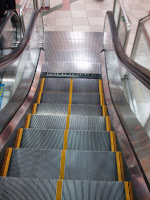 03
03 04
04 05
05
01: Probably the only old building in this area
02: China Keep Walking
03: An escalator (inside the Ito Yokado department store) with a yellow line in the middle separating the walking lane on the left and the standing lane on the right
04: An electric cooking gadget for Chinese people which saves the time for preparing broth from chicken bones etc. I've never seen something like this in Japan.
05: Ito Yokado, a Japanese department store chain
I stayed at Room 716 in Mt Emei International Hotel from 13 to 17 December, 2008.
The Good:
The internet access in bedrooms (with a LAN cable provided) for free of charge.
A kettle, rather than a coffee maker, in the bedroom (but only with Chinese tea bags; I forget bringing my favorite Twining English Breakfast teabags...)
All the written messages in the hotel are both in Chinese and in English (although the staff rarely speak English).
Near the hotel is an area with lots of small restaurants, bars, toy stores, and foot massage parlours, many of which are open until very late where you feel what must be the old Chinese town life before all the modernization took over.
Opposite the hotel across the large street is a big, Sichuan hot pot restaurant called 呉銘火鍋, where you can enjoy the local cuisine.
The Bad:
The bedroom faces a large, busy street. Even on the seventh floor, I hear the street noise.
On some floor below, loud music plays until 4 am, making the bedroom on the 7th floor noisy.
The restaurant serves breakfast of mediocre quality without few Western options, offering warm orange and lemon juice for some reason.
Even though the hotel has about 15 floors, there are only two lifts. It always takes a while to go down to, or up from, the ground floor.
Toothbrushes and toothpaste are provided, which is good, but the brush is not new, and the toothpaste tastes like bad medicine.
The toilet is easily blocked by flushing too much paper.
The glass door of a shower cubicle cannot be shut completely, allowing shower water to spill over to the bathroom floor.
The shower head is fixed to the wall.
Even though I put the sign "Don't disturb" all day, the front desk calls my room to ask me if I need cleaning. After telling them, "I'm fine," a room cleaner knocks on the door. Seems like the front desk didn't understand my English.
The Ugly:
Receptionists are horrible.
When I first arrived at the hotel, there were a few people standing in front of the front desk, talking to the receptionists. So I was waiting for them to finish. There were 3 receptionists, looking in their 20s, and 2 of them deal with these customers together, with another one doing something else. None of these 3 receptionists tried to make an eye contact with me. After 20 minutes, they seemed to finish dealing with the customers, but they never made an eye contact with me. Some other guests came to the reception without looking at me, talking to the receptionists. And they got served. Seems like there is no such a concept as queuing in this city. So I talked to one of the receptionists. It turned out she cannot speak English. Nor can the other receptionists. Maybe that's why they won't try to notice my presence. By handing out my passport, without speaking English, they figured out what I was asking for. But while she was dealing with me, a group of hotel guests came, asking her to return their luggage. And she did. There's no such a concept of queuing in this city.
When I was about to take a shower (so I was naked) in my bedroom after checking-in, a phone rang. It was from the front desk. A guy who did speak English told me I needed to pay a deposit of 200 yuan. I put on my clothes back, went down to the front desk, and gave my credit card. It didn't work. I paid a deposit in cash.
When a Chinese friend of mine asked where to have a drink near the hotel, the receptionist who dealt with my checking-in recommended the bar in the hotel. When my friend said we preferred a place outside, she just said, "Just go over there across the street."
At 11 pm on the day of arrival and in the last evening, the phone in the bedroom rings. It's an offer of massage. Very annoying if you go to bed early.
Verdict:
Unless you need to provide accommodation to international guests for a conference held in South Western University of Finance and Economics (which is located a 15-minute walk away from the hotel), you may want to avoid using this hotel. If you speak Chinese, the service may be much better, though.

Have dinner at 呉銘火鍋, a popular restaurant chain for Sichuan hot pot, with my former Japanese supervisor, his Chinese student, this student's female friend from Sichuan, and her former middle school classmate.
Broth in a pot (as shown in the above) is heated to boil, and a variety of meats, seafoods, and vegetables are poured into it. For some foods like thinly sliced beef, you pick up a piece with your chopsticks and dip and hold it into the broth until baked (about a minute). Cooked foods are then dipped in dipping sauce mixed with sesame oil, coriander, etc. before you put them into your mouth. It's very hot (the broth includes not only chili but also Sichuan pepper, which adds a distinct, tongue-paralyzing flavor to chili's hotness). But I cannot stop eating because it's very delicious. I'm also impressed by the variety of foods that Chinese people eat with this hotpot.
I end up eating a lot. For the following two days, my stomach feels uneasy. :) 
Restaurants in China typically offer the cover sheet for a coat or a jacket that customers hang over the back of a chair.
The conference dinner is held at Shun Xing Ancient Tea House (順興老茶館), a restaurant located on the third floor of the Chengdu International Exhibition and Convention Center. The Sichuan dinner is excellent. (Some dishes are too hot to eat, though.) When everyone is about to finish eating, the dinner show begins. Dance by good-looking girls in traditional costume, shadow play, three masked men fire-spitting and face-changing (click here for a YouTube video), comedy by a woman and a guy who puts a lit candle on top of the head, singing by an old guy with rudimentary instruments. Honestly speaking, it is shabby. I'm a bit offended as the show interrupted my conversation with other diners.
By searching through Japanese websites, I learn that this restaurant is one of the three major places in Chengdu where tourists can enjoy chuanju or Sichuan opera. And the consensus among Japanese tourists is that the quality of the opera at this restaurant is the worst among the three. No wonder.
But the quality of food is still excellent.
Photos that I took in the area to the north of South Western University of Finance and Economics (north-west Chengdu). Notice that many photos are foggy, and no one seems to know whether Chengdu is foggy all day because of natural fog or smog. (Chengdu is traditionally famous for foggy weather.) 01
01 02
02 03
03 04
04 05
05
01: A convenience store chain ubiquitous in Chengdu, where I keep buying Gogo no Kocha Milk Tea (produced by a Japanese beverage company Kirin), my favorite bottled milk tea back in my high school days.
02: The gate of a residential complex. There are quite a few residential complexes like this one in Chengdu where high-rise buildings surround a square that functions as a parking lot and as a playground for kids.
03: A typical apartment building in Chengdu with green-white stripe roofs (no balcony though).
04: A bank branch. All the bank branches in China seem to have a long electric signboard which advertises financial items in scrolling messages.
05: A pedestrian crossing that leads to a signboard. Pedestrians need to walk outside the crossing to reach the sidewalk.  06
06 07
07 08
08 09
09
06: A covered food market surrounded by high-rise residential buildings.
07: High-rise residential buildings in Chengdu usually come with shops on the ground floor.
08: A trendy hair salon sandwiched by uninspiring shops.
09: A square with several restaurants. 10
10 11
11 12
12
10: A chaotic traffic crossing
11: Residential buildings with a rather well-maintained bus.
12: The gate of a middle school 13
13 14
14 15
15 16
16
13: The sun in the thickly foggy (or smoggy) sky in the afternoon
14: South Western University of Finance and Economics
15: Pedestrians waiting for the green light. Motorcyclists and bikers completely ignore traffic signals in China. Pedestrians therefore wait between car lanes and bike lanes.
16: Toy stores open late in the evening.


